Trusting the ‘Five Eyes’ Only
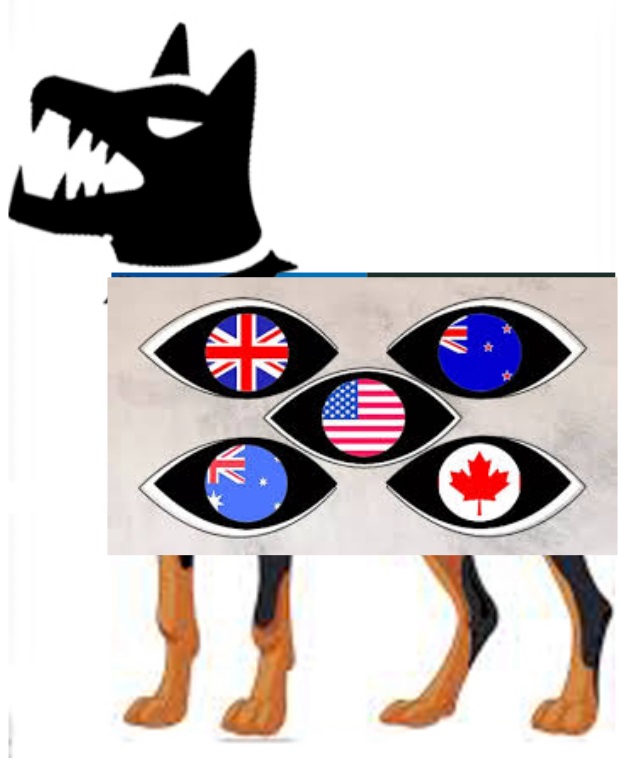
For Their Eyes Only
The “Five Eyes” (FVEY) is an elite club of five English-speaking countries — Australia, Canada, New Zealand, the United Kingdom, and the United States — that have agreed to cooperate in intelligence matters and share top-secret information. They all became parties to what was at first the bilateral UKUSA Agreement, a 1946 treaty for secret cooperation between the two countries in what’s called “signals intelligence” — data collected by electronic means, including by tapping phone lines or listening in on satellite communications. (The agreement was later amended to include the other three nations.) Almost all of the Five Eyes’ activities are conducted in secret, and its existence was not even disclosed until 2010. You might say that it constitutes the most secretive, powerful club of nations on the planet.
Anglo-Saxon solidarity supersedes all other relationships.
JULY 5, 2024 By Michael Klare / TomDispatch, https://scheerpost.com/2024/07/05/trusting-the-five-eyes-only/
Wherever he travels globally, President Biden has sought to project the United States as the rejuvenated leader of a broad coalition of democratic nations seeking to defend the “rules-based international order” against encroachments by hostile autocratic powers, especially China, Russia, and North Korea. “We established NATO, the greatest military alliance in the history of the world,” he told veterans of D-Day while at Normandy, France on June 6th. “Today… NATO is more united than ever and even more prepared to keep the peace, deter aggression, defend freedom all around the world.”
In other venues, Biden has repeatedly highlighted Washington’s efforts to incorporate the “Global South” — the developing nations of Africa, Asia, Latin America, and the Middle East — into just such a broad-based U.S.-led coalition. At the recent G7 summit of leading Western powers in southern Italy, for example, he backed measures supposedly designed to engage those countries “in a spirit of equitable and strategic partnership.”
But all of his soaring rhetoric on the subject scarcely conceals an inescapable reality: the United States is more isolated internationally than at any time since the Cold War ended in 1991. It has also increasingly come to rely on a tight-knit group of allies, all of whom are primarily English-speaking and are part of the Anglo-Saxon colonial diaspora. Rarely mentioned in the Western media, the Anglo-Saxonization of American foreign and military policy has become a distinctive — and provocative — feature of the Biden presidency.
America’s Growing Isolation
To get some appreciation for Washington’s isolation in international affairs, just consider the wider world’s reaction to the administration’s stance on the wars in Ukraine and Gaza.
Following Russia’s invasion of Ukraine, Joe Biden sought to portray the conflict there as a heroic struggle between the forces of democracy and the brutal fist of autocracy. But while he was generally successful in rallying the NATO powers behind Kyiv — persuading them to provide arms and training to the beleaguered Ukrainian forces, while reducing their economic links with Russia — he largely failed to win over the Global South or enlist its support in boycotting Russian oil and natural gas.
Despite what should have been a foreboding lesson, Biden returned to the same universalist rhetoric in 2023 (and this year as well) to rally global support for Israel in its drive to extinguish Hamas after that group’s devastating October 7th rampage. But for most non-European leaders, his attempt to portray support for Israel as a noble response proved wholly untenable once that country launched its full-scale invasion of Gaza and the slaughter of Palestinian civilians commenced. For many of them, Biden’s words seemed like sheer hypocrisy given Israel’s history of violating U.N. resolutions concerning the legal rights of Palestinians in the West Bank and its indiscriminate destruction of homes, hospitals, mosques, schools, and aid centers in Gaza. In response to Washington’s continued support for Israel, many leaders of the Global South have voted against the United States on Gaza-related measures at the U.N. or, in the case of South Africa, have brought suit against Israel at the World Court for perceived violations of the 1948 Genocide Convention.
In the face of such adversity, the White House has worked tirelessly to bolster its existing alliances, while trying to establish new ones wherever possible. Pity poor Secretary of State Antony Blinken, who has made seemingly endless trips to Asia, Africa, Europe, Latin America, and the Middle East trying to drum up support for Washington’s positions — with consistently meager results.
Here, then, is the reality of this anything but all-American moment: as a global power, the United States possesses a diminishing number of close, reliable allies – most of which are members of NATO, or countries that rely on the United States for nuclear protection (Japan and South Korea), or are primarily English-speaking (Australia and New Zealand). And when you come right down to it, the only countries the U.S. really trusts are the “Five Eyes.”
For Their Eyes Only
The “Five Eyes” (FVEY) is an elite club of five English-speaking countries — Australia, Canada, New Zealand, the United Kingdom, and the United States — that have agreed to cooperate in intelligence matters and share top-secret information. They all became parties to what was at first the bilateral UKUSA Agreement, a 1946 treaty for secret cooperation between the two countries in what’s called “signals intelligence” — data collected by electronic means, including by tapping phone lines or listening in on satellite communications. (The agreement was later amended to include the other three nations.) Almost all of the Five Eyes’ activities are conducted in secret, and its existence was not even disclosed until 2010. You might say that it constitutes the most secretive, powerful club of nations on the planet.
The origins of the Five Eyes can be traced back to World War II, when American and British codebreakers, including famed computer theorist Alan Turing, secretly convened at Bletchley Park, the British codebreaking establishment, to share intelligence gleaned from solving the German “Enigma” code and the Japanese “Purple” code. At first an informal arrangement, the secretive relationship was formalized in the British-US Communication Intelligence Agreement of 1943 and, after the war ended, in the UKUSA Agreement of 1946. That arrangement allowed for the exchange of signals intelligence between the National Security Agency (NSA) and its British equivalent, the Government Communications Headquarters (GCHQ) — an arrangement that persists to this day and undergirds what has come to be known as the “special relationship” between the two countries.
Then, in 1955, at the height of the Cold War, that intelligence-sharing agreement was expanded to include those other three English-speaking countries, Australia, Canada, and New Zealand. For secret information exchange, the classification “AUS/CAN/NZ/UK/US EYES ONLY” was then affixed to all the documents they shared, and from that came the “Five Eyes” label. France, Germany, Japan, and a few other countries have since sought entrance to that exclusive club, but without success.
Although largely a Cold War artifact, the Five Eyes intelligence network continued operating right into the era after the Soviet Union collapsed, spying on militant Islamic groups and government leaders in the Middle East, while eavesdropping on Chinese business, diplomatic, and military activities in Asia and elsewhere. According to former NSA contractor Edward Snowden, such efforts were conducted under specialized top-secret programs like Echelon, a system for collecting business and government data from satellite communications, and PRISM, an NSA program to collect data transmitted via the Internet.
As part of that Five Eyes endeavor, the U.S., the United Kingdom, and Australia jointly maintain a controversial, highly secret intelligence-gathering facility at Pine Gap, Australia, near the small city of Alice Springs. Known as the Joint Defence Facility Pine Gap (JDFPG), it’s largely run by the NSA, CIA, GCHQ, and the Australian Security Intelligence Organization. Its main purpose, according to Edward Snowden and other whistle-blowers, is to eavesdrop on radio, telephone, and internet communications in Asia and the Middle East and share that information with the intelligence and military arms of the Five Eyes. Since the Israeli invasion of Gaza was launched, it is also said to be gathering intelligence on Palestinian forces in Gaza and sharing that information with the Israeli Defense Forces. This, in turn, prompted a rare set of protests at the remote base when, in late 2023, dozens of pro-Palestinian activists sought to block the facility’s entry road.
Anglo-Saxon Solidarity in Asia
The Biden administration’s preference for relying on Anglophone countries in promoting its strategic objectives has been especially striking in the Asia-Pacific region. The White House has been clear that its primary goal in Asia is to construct a network of U.S.-friendly states committed to the containment of China’s rise. This was spelled out, for example, in the administration’s Indo-Pacific Strategy of the United States of 2022. Citing China’s muscle-flexing in Asia, it called for a common effort to resist that country’s “bullying of neighbors in the East and South China” and so protect the freedom of commerce. “A free and open Indo-Pacific can only be achieved if we build collective capacity for a new age,” the document stated. “We will pursue this through a latticework of strong and mutually reinforcing coalitions.”
That “latticework,” it indicated, would extend to all American allies and partners in the region, including Australia, Japan, New Zealand, the Philippines, and South Korea, as well as friendly European parties (especially Great Britain and France). Anyone willing to help contain China, the mantra seems to go, is welcome to join that U.S.-led coalition. But if you look closely, the renewed prominence of Anglo-Saxon solidarity becomes ever more evident.
Of all the military agreements signed by the Biden administration with America’s Pacific allies, none is considered more important in Washington than AUKUS, a strategic partnership agreement between Australia, the United Kingdom, and the United States. Announced by the three member states on Sept. 15, 2021, it contains two “pillars,” or areas of cooperation — the first focused on submarine technology and the second on AI, autonomous weapons, as well as other advanced technologies. As in the FVEY arrangement, both pillars involve high-level exchanges of classified data, but also include a striking degree of military and technological cooperation. And note the obvious: there is no equivalent U.S. agreement with any non-English-speaking country in Asia.
Consider, for instance, the Pillar I submarine arrangement. As the deal now stands, Australia will gradually retire its fleet of six diesel-powered submarines and purchase three to five top-of-the-line U.S.-made Los Angeles-class nuclear-powered submarines (SSNs), while it works with the United Kingdom to develop a whole new class of subs, the SSN-AUKUS, to be powered by an American-designed nuclear propulsion system. But — get this — to join, the Australians first had to scrap a $90 billion submarine deal with a French defense firm, causing a severe breach in the Franco-Australian relationship and demonstrating, once again, that Anglo-Saxon solidarity supersedes all other relationships.
Now, with the French out of the picture, the U.S. and Australia are proceeding with plans to build those Los Angeles-class SSNs — a multibillion-dollar venture that will require Australian naval officers to study nuclear propulsion in the United States. When the subs are finally launched (possibly in the early 2030s), American submariners will sail with the Australians to help them gain experience with such systems. Meanwhile, American military contractors will be working with Australia and the UK designing and constructing a next-generation sub, the SSN-AUKUS, that’s supposed to be ready in the 2040s. The three AUKUS partners will also establish a joint submarine base near Perth in Western Australia.
Pillar II of AUKUS has received far less media attention but is no less important. It calls for American, British, Australian scientific and technical cooperation in advanced technologies, including AI, robotics, and hypersonics, aimed at enhancing the future military capabilities of all three, including through the development of robot submarines that could be used to spy on or attack Chinese ships and subs.
Aside from the extraordinary degree of cooperation on sensitive military technologies — far greater than the U.S. has with any other countries — the three-way partnership also represents a significant threat to China. The substitution of nuclear-powered subs for diesel-powered ones in Australia’s fleet and the establishment of a joint submarine base at Perth will enable the three AUKUS partners to conduct significantly longer undersea patrols in the Pacific and, were a war to break out, attack Chinese ships, ports, and submarines across the region. I’m sure you won’t be surprised to learn that the Chinese have repeatedly denounced the arrangement, which represents a potentially mortal threat to them.
Unintended Consequences
It’s hardly a surprise that the Biden administration, facing growing hostility and isolation in the global arena, has chosen to bolster its ties further with other Anglophone countries rather than make the policy changes needed to improve relations with the rest of the world. The administration knows exactly what it would have to do to begin to achieve that objective: discontinue arms deliveries to Israel until the fighting stops in Gaza; help reduce the burdensome debt load of so many developing nations; and promote food, water security, and other life-enhancing measures in the Global South. Yet, despite promises to take just such steps, President Biden and his top foreign policy officials have focused on other priorities — the encirclement of China above all else — while the inclination to lean on Anglo-Saxon solidarity has only grown.
However, by reserving Washington’s warmest embraces for its anglophone allies, the administration has actually been creating fresh threats to U.S. security. Many countries in contested zones on the emerging geopolitical chessboard, especially in Africa, the Middle East, and Southeast Asia, were once under British colonial rule and so anything resembling a potential Washington-London neocolonial restoration is bound to prove infuriating to them. Add to that the inevitable propaganda from China, Iran, and Russia about a developing Anglo-Saxon imperial nexus and you have an obvious recipe for widespread global discontent.
It’s undoubtedly convenient to use the same language when sharing secrets with your closest allies, but that should hardly be the deciding factor in shaping this nation’s foreign policy. If the United States is to prosper in an increasingly diverse, multicultural world, it will have learn to think and act in a far more multicultural fashion — and that should include eliminating any vestiges of an exclusive Anglo-Saxon global power alliance.
Liberal National Party to debate nuclear despite ‘intriguing’ omission from Queensland state convention.

the omission of nuclear from the more than 170 resolutions has perplexed Queensland’s federal Coalition MPs, given the energy pitch has become a headline election policy for Opposition Leader Peter Dutton.
AFR, James Hall, Queensland correspondent, Jul 4, 2024 –
A senior federal Queensland MP has warned the party faithful will be “white-hot angry” if the Liberal-National Party’s state convention omits debating nuclear energy this weekend.
The alternative energy source has been left off the official running sheet for the three-day event in Brisbane, which the LNP hopes will serve as a celebratory launch for state leader David Crisafulli ahead of the October state election.
But the omission of nuclear from the more than 170 resolutions has perplexed Queensland’s federal Coalition MPs, given the energy pitch has become a headline election policy for Opposition Leader Peter Dutton.
They insist the energy source will be keenly discussed and debated despite efforts to minimise conflict between the federal and state branches following Mr Crisafulli’s refusal to support the policy.
There is an expectation among many that nuclear will be brought late to the convention floor as an urgent resolution, with Nationals MP Keith Pitt warning the base will react furiously to its possible exclusion.
He said members would be “white-hot angry” if a resolution on nuclear wasn’t considered, with the former minister insisting: “I’ve never been at a [LNP] conference when nuclear wasn’t discussed.”
“I’d be very surprised if there wasn’t a single branch, SEC [State Electorate Council], FDC [Federal Divisional Council] or others that hadn’t put forward a nuclear resolution,” Mr Pitt told The Australian Financial Review.
“There’s been one at every convention for as long as I can remember, so that would be a shock.”
Another MP told the Financial Review the omission “begs the question” whether a nuclear resolution had been put forward and rejected during the selection process by the agenda committee.
“It does seem a bit unusual that there wouldn’t be any,” they said.
“It’s intriguing for me because cost of living and energy are virtually one and the same at the moment, but energy is a very big issue for us federally.
“I know a lot of people are passionate about it [nuclear], so it not being on the agenda is intriguing.”
Mr Crisafulli’s repeated refusal to support the nuclear push has infuriated federal party figures, including Nationals leader David Littleproud and most vocally MP Colin Boyce, who previously said the state leader should “put his big girl pants on and face the energy issues”.
But state party figures are eager to hose down any suggestion of conflict.
They told the Financial Review the event would serve as a crucial opportunity for members to see “there’s no bad blood” between Mr Dutton and Mr Crisafulli at the LNP’s last convention before both the Queensland and federal elections………………………. more https://www.afr.com/companies/energy/lnp-to-debate-nuclear-despite-intriguing-omission-20240704-p5jr3s
If you don’t know, vote ‘No’ to Dutton’s nuclear plan
The CSIRO has investigated this carefully and has produced a detailed report saying that nuclear energy is not feasible. So, too, has Australia’s former chief scientist, Alan Finkel.
The L-NP has rejected both these reports and attacked the credibility of the scientists who prepared them, without offering any details themselves that counter the two reports.
By Craig Hill | 4 July 2024,
OPPOSITION LEADER Peter Dutton still refuses to release any details about how he will introduce nuclear energy into Australia. Therefore let’s look at some details of why it won’t work.
The first clue should be that there are no private investors who have expressed an interest in building a nuclear power plant.
All the energy companies in Australia have rejected nuclear energy as not being feasible and have invested billions of dollars in transitioning to renewables.
Secondly, all nuclear reactors take a long time to build. We wouldn’t be able to have one online until 2040 at the earliest.
You can’t just build them anywhere. Dutton’s plan to build them on the sites of existing coal-fired power plants is ill-informed and reckless.
Existing plants are built near coal mines with underground tunnels prone to subsidence. The soil is also contaminated which has caused changes in the silt layer, increasing the chance of subsidence. The last thing we want is nuclear power plants sinking into the ground.
Nuclear power plants also need to be built near large freshwater supplies. The water supplies that exist near coal-fired plants are not large enough and are also contaminated.
The ideal place to build nuclear plants would be near large existing dams that supply water for our major cities. I don’t think anybody would be agreeable to the possibility of a nuclear power plant contaminating the water supply.
Also, take into account that nuclear power plants were first built in the USA in 1955. Since then, 255 plants have been built and today, only 60 continue to operate commercially, with the last one going online in 2018. There are no new plants under construction in the USA.
Of the 60 that are operating commercially, only 30 are operating at a profit. After 70 years of nuclear power plant construction, nuclear energy only provides 18.6 per cent of America’s electricity supply.
Compare this to renewable energy which first came online in the USA in 2008. Today, renewable energy is responsible for 21.4 per cent of electricity production in the United States.
Nuclear is on the way out in America and renewables are replacing it. Even the Americans have realised that nuclear energy production is far more expensive than renewables.
The CSIRO has investigated this carefully and has produced a detailed report saying that nuclear energy is not feasible. So, too, has Australia’s former chief scientist, Alan Finkel.
The L-NP has rejected both these reports and attacked the credibility of the scientists who prepared them, without offering any details themselves that counter the two reports.
Best we Forget – Australia’s 70 year old nuclear contamination secrets about to be exposed

by Sue Rabbitt Roff | Jun 28, 2024 https://michaelwest.com.au/best-we-forget-australias-70-year-old-nuclear-contamination-secrets-about-to-be-exposed/?utm_source=newsletter&utm_medium=email&utm_term=2024-07-04&utm_campaign=Michael+West+Media+Weekly+Update
While Peter Dutton gets headlines for his nuclear fairytale and the Labor Government presses on with its AUKUS submarines, the fallout from nuclear bomb testing in the Pilbara in 1956 finally reaches court. Sue Roff reports from London.
In 1956, on the remote Montebello Islands off Western Australia, an atomic bomb was tested. It was supposed to be no more than 50 kilotons, but in fact measured 98 kilotons, or more than six times the strength of the bomb dropped over Hiroshima in 1945.
Ever since then, Australian and UK Governments have suppressed the facts and denied compensation to the victims. That may finally be about to change.
Three months ago, veterans of Britain’s Cold War radioactive weapons tests formally launched proceedings against the UK Ministry of Defence, alleging negligence in its duty of care to the men themselves and their families before, during and after the tests that began at the Montebellos in 1952.
MWM, “The opening phase seeks the full disclosure by the Ministry of Defence of all records of blood and urine testing conducted during the weapons trials, with compensation sought for MoD negligence and recklessness if they were lost or destroyed.”
At the same time, the veterans have made an offer to resolve their claim through the creation of a Special Tribunal with statutory powers to investigate and compensate if decades of cover-up are established.
A very big bomb
In October 1955, the Director of British atomic and thermonuclear tests in Australia, Professor William Penney, wrote to the Chair of the United Kingdom Atomic Energy Authority about the two detonations that were planned for the Montebello Islands in May and June 1956:
‘Yesterday I think I gave you the impression that the second shot at Montebello will be about 80 K.T. [kilotons]. This is the figure to which we are working as far as health and safety are concerned. We do not know exactly what the yield is going to be because the assembly is very different from anything we have tried before.
We expect that yield will be 40 or 50, but it might just go up to 80 which is the safe upper limit.
In fact, in recent years, it has been listed on the website of ARPANSA [the Australian Radiation Protection and Nuclear Safety Agency] as 98 kilotons.
The politics
A UK memo found in the UK National Archives that is undated but filed around August 1955, states:
“TESTS IN Montebello ISLANDS (CODE NAME ‘MOSAIC’) 25 7.
“We had agreed with the Australian Government that we would not test thermo-nuclear weapons in Australia, but [Australian Prime Minister] Mr. Menzies has nevertheless agreed to the firings taking place in the Montebello Islands (off the North-West coast of Western Australia), which have already been used before for atomic tests [emphasis added].”“As already explained, the Australians are very sensitive on the question of thermo-nuclear explosions, and although the true character of these tests is understood by the authorities immediately concerned, knowledge of the trials is restricted to a very small circle and no public statement has so far been made; when it is made, it will therefore require very careful handling.”
“Apparently it is still being very carefully handled by government agencies. 70 years after the British atomic and thermonuclear tests started in Australia scores of files held in the Australian National National Archives are marked ‘Not yet examined’. We urgently need to create an independent archive of Australia’s nuclear past.”
The falloutIn Roeboure, some 200km away from the blast, a witness – then seven-year-old John Weiland wrote later of “hearing and feeling the blast before going outside to see the cloud. My mother said she remembers material falling on her. I was in primary school at the time and we all stood out on the verandah to watch the cloud.”
Weiland later wrote to ARPANSA asking “if any testing was done or any follow up done particularly with the 30 or so children of the school. But I was told there was no radiation blown across from the islands.”
In December 1957, eighteen months after the second G2 Operation Mosaic blast at the Montebellos, the five scientific members of the Atomic Weapons Safety Committee (AWSC) appointed by the Australian government published a report titled ‘Radioactive Fallout in Australia from Operation ‘Mosaic’ in The Australian Journal of Science.
without approaching the mainland of Australia.’ However ‘a pronounced stable layer produced a marked bulge on the stem which trapped a small quantity of particulate material and this was spread to the south-east of the Montebello Islands …The more finely suspended material’ or ‘debris’ was dispersed in the first 48 hours …’ although there was light rain over Marble Bar.
Thirty years after this AWSC report, the Royal Commission into British Nuclear Tests in Australia issued its 1987 report after 18 months of hearings around Australia and in London. In relation to Mosaic G2 it reported:“7.4.25 The post-firing winds behaved similarly to those after Gl, i.e. they weakened and then began to blow to the south and east. An analysis of the trajectories of fallout particles showed that fallout at Port Hedland occurred 24 hours after the explosion and consisted of particles that originated from 20,000 feet in the region of the top of the stem and the bottom of the cloud….[RC 270, T24/57).”
“Clearly part of the main cloud did cross the mainland.”
The Royal Commission also concluded, “The Safety Committee communications with the Minister for Supply soon after the second explosion, when it reported that the cloud had not crossed the coast, with the implication that there was no fallout on the mainland, were misleading.”
Nearly forty years later, in January 2024, John Weiland submitted a query to the Talk to A Scientist portal of ARPANSA, asking for information. The unsigned response four days later referred him to Appendices B & C of a 32 year old document attached to the official response. A report, ‘Public Health Impact of Fallout from British Nuclear Tests in Australia, 1952-57, has a diagram annotated ‘Trajectories taken by radioactive clouds across Australia for the nuclear tests in the Mosaic and Antler Series. The main debris clouds from Mosaic Rounds 1 and 2 are not shown as they remained largely over the Indian Ocean, moving to the northeast parallel to the coast.’ (emphasis added).This diagram [ on original) doesn’t correlate with the maps in the Royal Commission Report north of Broome nor those of the AWTSC report in 1957 south of Port Hedland.
I have published extensive archival evidence about the score of coverups that have occurred over the past 70 years.The cover-up
They range from the agreement of Prime Minister Menzies to the progressive testing of hydrogen/thermonuclear devices in preparation for the full assembly in 1957 for the Grapple tests at Christmas Island, including testing less than two months before the start of the 1956 Olympic Games in downwind Melbourne, and Menzies’ hope of getting tactical nuclear weapons for Australia by his collusion.
They also include the submission of ‘sanitised’ health data on Australian test participants to the 1985 Royal Commission into British Nuclear Tests in Australia.I presented my concerns about the role of UK official histories of the tests in a seminar hosted by the Official Historian of the UK Foreign, Commonwealth and Development Office by invitation in February 2024.
Representing the victims, Oli Troen adds that “The Veterans previously sought redress through the English Courts, losing in the Supreme Court in 2012 when they could not prove they experienced dosages of radiation exposure. This meant they could not demonstrate their injuries resulted from that exposure.”
Blood tests taken at the time and in the years after presence at a test site are key to proving whether the legacy of rare illnesses, cancer and birth defects reported by the veterans is due to radiation from the nuclear tests and whether the government is culpable and can now be held accountable for their suffering.
A Freedom of Information tribunal has ordered the handing over of the blood tests of veteran and decorated hero Squadron Leader Terry Gledhill, who led ‘sniff planes’ into the mushroom clouds of thermonuclear weapons on sampling missions. This new case seeks to force the government to hand over such records for up to 22,000 UK veterans.
Dick Smith enters nuclear debate but CSIRO analysis shows his argument in meltdown
Graham Readfearn, https://www.theguardian.com/environment/article/2024/jul/03/dick-smith-enters-nuclear-debate-but-csiro-analysis-shows-his-argument-in-meltdown
The entrepreneur claims agency exaggerated the costs of the Coalition plan despite it using best-case scenario South Korea as the benchmark
High-profile entrepreneur Dick Smith entered the ongoing radioactive debate on nuclear energy this week, accusing government agencies of misleading ministers over the costs of reactors and the practicalities of renewables.
But Smith’s complaints about what the Australian Energy Market Operator’s plan for the future of the grid says, or how CSIRO calculated the costs of nuclear, are themselves misleading.
Smith placed an advert in the Australian and gave an interview to the newspaper, saying: “What you would have to do if you wanted to try and use wind and solar, you’d need the most incredible expenditure in batteries. “But if you have a wind drought or unusual cloud cover, the batteries go flat. You have no power.”
Except, Aemo’s plan for the future development of the electricity grid does not rely only on wind, solar and batteries, but also includes major pumped hydro storage projects, (think Snowy 2.0 or Queensland’s Borumba project) and an increase in the amount of electricity available from gas for times when solar and wind output is low.
This increase in the capacity of gas (up to 15GW in the future, compared with 11.5GW now, according to AEMO) does not actually mean more electricity being generated by gas.
Dr Dylan McConnell, an energy systems analyst at the University of NSW, says the future scenario that Aemo thinks is most likely sees the amount of gas generation electricity roughly at today’s levels by the late 2040s.
Aemo’s latest blueprint for the electricity system says: “This gas generation is a strategic reserve for power system reliability and security, so is not forecast to run frequently.”
Exaggerated costs?
Smith claimed CSIRO had exaggerated the costs of nuclear “by looking at the worst-case scenarios everywhere” – but did it?
CSIRO produces an annual report on the costs of different generation technologies, called GenCost, and for the first time this year included both large-scale nuclear reactors and small modular reactors, which are not yet commercially available.
For smaller reactors, CSIRO based its numbers on one of the only detailed set of costings available anywhere – a project in Utah that published detailed figures before it folded in November due to the high price of the electricity it would produce.
For larger reactors, GenCost benchmarked potential costs in Australia to one of the most successful and lowest cost nuclear builders anywhere – South Korea. This is, arguably, the opposite of choosing a “worst-case scenario”.
Tennant Reed, the climate and energy director at Ai Group and an energy systems expert, said the GenCost report was “very clearly not taking a worst case approach.”
Rather than look at South Korean nuclear costs, Reed said it would have been defensible for CSIRO to consider much higher nuclear costs in the US, UK, France or Finland – countries that had restarted nuclear building after a long pause, and therefore more similar to Australia’s situation.
He said: “A fair reading of GenCost makes clear that CSIRO have been pretty careful, if not generous, to avoid any overestimation of nuclear capital costs.”
1 This month

of the week – Australians for War Powers Reform (AWPR)
To see nuclear-related stories in greater depth and intensity
 Antinuclear