Amazon wins contract to store ‘top-secret’ Australian military intelligence

Please note – this article uses the word “cloud” – but this isa a lie
There is no cloud.
What they mean is -acres and acres of dirty great steel canisters, guzzling electricity and water
By defence correspondent Andrew Greene, Thu 4 Jul 2024 https://www.abc.net.au/news/2024-07-04/amazon-contract-top-secret-australian-military-intelligence/104057196
In short:
Three data centres will be built in secret locations to host Australia’s military secrets.
Amazon has won the $2 billion contract to store the classified intelligence.
What’s next?
The massive project will roll out over several years, and is expected to create more than 2,000 jobs
American technology giant Amazon will establish a “top-secret” data cloud to store classified Australian military and intelligence information under a $2 billion partnership with the federal government.
Three highly secure data centres will be built in secret locations across the country to support the purpose-built Top Secret (TS) Cloud which will be run by a local subsidiary of Amazon Web Services (AWS).
The massive new project is expected to harness cutting-edge artificial intelligence (AI) technology and scheduled to be in operation by 2027, with the government insisting Australia will have complete sovereignty over the cloud.
Similar data clouds have already been established in the US and UK allowing the sharing of “vast amounts of information”, with intelligence figures highlighting that potential adversaries were also investing heavily in similar technology.
Initially, the government will invest at least $2 billion into the project being run by the Australian Signals Directorate (ASD) and AWS, but it’s expected to cost billions more in operating costs over the coming years.
Details of the massive project were first revealed in a speech to an American audience last year by the director-general of national intelligence Andrew Shearer, who emphasised the benefits it presented for collaboration for partner nations.
Prime Minister Anthony Albanese says the project will create 2,000 jobs and “bolster our defence and national intelligence community to ensure they can deliver world-leading protection for our nation”.
“We face a range of complex and serious security challenges and I am incredibly proud of the work our national security agencies undertake on a daily basis to keep Australians safe,” Mr Albanese said
ASD director-general Rachel Noble said the project would provide a “state-of-the-art collaborative space for our intelligence and defence community to store and access top secret data”.
“For ASD, this capability is a vital part of our REDSPICE program which is lifting our intelligence and offensive and defensive cyber capabilities.”
AWS’ managing director in Australia, Iain Rouse, says his company is “uniquely positioned, as a trusted, long-term partner to the Australian government to deliver on this important partnership”.
“This critical national security initiative allows AWS to demonstrate our commitment to not just deliver a fixed set of requirements, but to continuously adapt, enhance and innovate together over the years to come.”
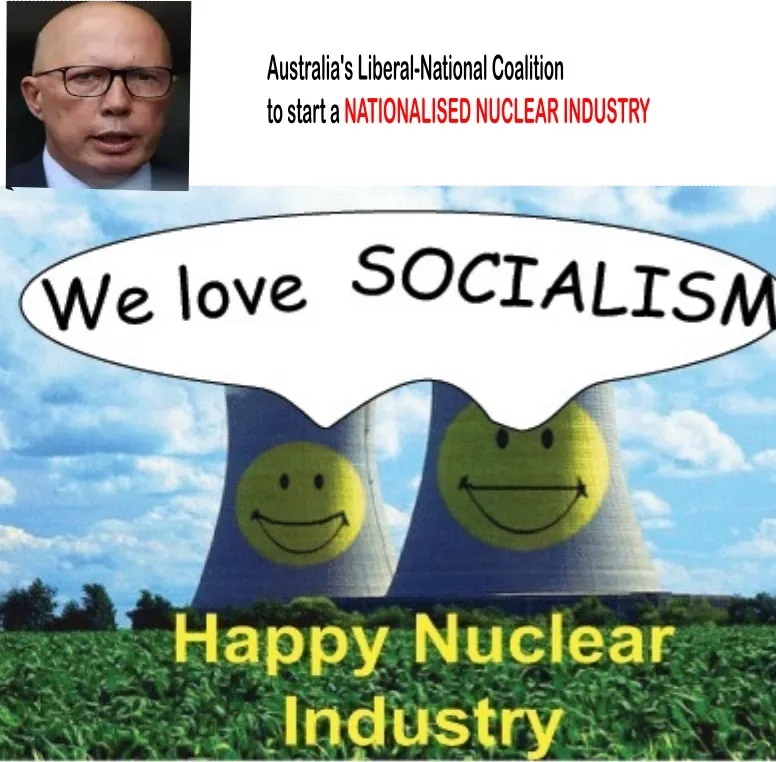
With its nuclear energy policy, Peter Dutton seems to have forgotten the Liberal Party’s core beliefs
Judith Brett, Emeritus Professor of Politics, La Trobe University,6 July 24, https://theconversation.com/with-its-nuclear-energy-policy-peter-dutton-seems-to-have-forgotten-the-liberal-partys-core-beliefs-233444
When Robert Menzies was out of office in 1943, in between prime ministerships, he was thinking about the future of non-Labor politics in wartime Australia. He read Edmund Burke’s book Thought on the Present Discontents. In it, Burke included the now-famous definition of a political party as:
a body of men united in promoting by their joint endeavour the national interest upon some particular principle on which they are all agreed.
For Burke, political parties were legitimate when they were based on shared principles and were committed neither to personal nor sectional interest, but to the interest of the nation as a whole.
Recently, Opposition Leader Peter Dutton announced the Coalition would not have an emissions reduction target for 2030. Instead, it would build seven nuclear power plants to reach zero emissions by 2050.
I have spent much of my research life thinking and writing about the Liberal Party and its predecessors, as well its three most successful leaders: Alfred Deakin, Robert Menzies and John Howard. So I have been running Dutton’s nuclear policies against my understanding of the Liberal party’s core principles.
It’s left me puzzled. Setting aside the many technical questions about the cost and feasibility of the plan, the proposal seems to breach some of those core principles.
Public ownership?
Political parties change and evolve over time, so it’s worth assessing the Liberal Party’s current web page for a contemporary statement of beliefs.
As expected, there are clear statements about the party’s commitment to maximising private sector initiatives. This includes statements like “government should only do those things the private sector cannot”, and “wherever possible government should not compete with an efficient private sector”.
So why is the Liberal Party proposing to build and own nuclear power plants on sites the government doesn’t even own, like Liddell in New South Wales? Or Loy Yang in Victoria where the owner, AGL, has plans already in train to develop low-emission industrial energy hubs?
How would a resort to compulsory acquisition of privately owned sites be justified by a party committed to private enterprise? And what would be the cost of these acquisitions?
Section 51 of the Constitution allows the Commonwealth to acquire property “on just terms from any State or person for any purpose in respect of which the Parliament has power to make laws.” Just terms – that means the property so acquired has to be paid for, by us, the tax payer, and this has to be added to the considerable cost of building the plants.
What about the states?
The state premiers of Queensland, NSW and Victoria oppose the plan, as do some Liberal opposition leaders such as Victoria’s John Pesutto.
Speaking to the Liberal Party Federal Council in June, Dutton said that the Commonwealth can override state laws, so the state premiers won’t be able to stop the plan.
Well it can, but it requires legislation that has to get through a Senate unlikely to be controlled by any future Coalition government. It would also cost a mountain of political capital.
But in terms of principles, how does this sit with the Liberal Party’s long-standing support for the rights of the states within the federation? One of the Liberal Party’s beliefs is that “responsibility should be divided according to federal principles, without the Commonwealth taking advantage of powers it has acquired other than by referendum.”
National interest or political interest?
It seems the policy as announced breaches two of the Liberal party’s core principles:
government should not do what is better left to private enterprise- the Commonwealth should respect state rights
But what of the national interest? The Liberal Party has always claimed it is not a sectional party and so is best able to represent the national interest. This, it says, is in contrast to Labor, with its ties to the unionised working class, and the Country Party turned Nationals which represents farmers, the regions, and increasingly, the miners.
What was most shocking about the Coalition’s plan is that it blithely flirts with sovereign risk and hence with Australia’s national interest. This is completely out of character for the Liberal Party.
Energy infrastructure is a long-term investment. Local and foreign investors are spooked by the collapse of bipartisan commitment to a clean energy transition and reconsidering their investment plans. And if the investment goes, so will the jobs it would have created. How is this in the national interest?
Shadow Minister for Energy Ted O’Brien tried to settle investors down by claiming the Coalition was still committed to renewables as well, but with little detail about the planned mix.
The only one of the Liberal Party’s traditional principles visible in this policy is the one that gives the leader, rather than the party, authority over policy.
But where does this leave the Liberals in federal parliament when their leader’s policy is so fundamentally at odds with their party’s core beliefs? Loyalty to the leader can only go so far. Perhaps Liberal MPs should consult their party’s website to remind themselves of the principles on which they stood for election. It seems in the pursuit of winning political points, political principles are all too easy to forget.
Australia’s ‘carbon budget’ may blow out by 40% under the Coalition’s nuclear energy plan – and that’s the best-case scenario
The Conversation, Sven Teske, Research Director, Institute for Sustainable Futures, University of Technology Sydney July 2, 2024
The Coalition’s pledge to build seven nuclear reactors, if elected, would represent a huge shift in energy policy for Australia. It also poses serious questions about whether this nation can meet its international climate obligations.
If Australia is to honour the Paris Agreement to limit global average temperature rise to 1.5˚C by mid-century, it can emit about 3 billion tonnes, or gigatonnes, of carbon dioxide (CO₂) over the next 25 years. This remaining allowance is what’s known as our “carbon budget”.
My colleagues and I recently outlined the technological options for Australia to remain within its carbon budget. We did this using a tool we developed over many years, the “One Earth Climate Model”. It’s a detailed study of pathways for various countries to meet the 1.5˚C goal.
So what happens if we feed the Coalition’s nuclear strategy into the model? As I outline below, even if the reactors are built, the negative impact on Australia’s carbon emissions would be huge. Over the next decade, the renewables transition would stall and coal and gas emissions would rise – possibly leading to a 40% blowout in Australia’s carbon budget.
Australia has a pathway to 1.5˚C
Earlier this year, my colleagues and I analysed the various ways Australia could reduce emissions in line with the 1.5˚ goal…………………………………………………………………………. more https://theconversation.com/australias-carbon-budget-may-blow-out-by-40-under-the-coalitions-nuclear-energy-plan-and-thats-the-best-case-scenario-233108
Queensland LNP excludes nuclear from agenda at conference ahead of state election

ReNeweconomy, Fraser Barton, Jul 5, 2024
There are 173 items on the discussion list for the annual Queensland LNP conference, but nuclear energy is not one of them.
The three-day event starting in Brisbane on Friday is not due to canvass the major policy which has sparked a divide between some federal and state Liberal and Nationals party members.
Queensland-based federal Opposition Leader Peter Dutton has unveiled plans to build seven nuclear power plants if the federal coalition wins government in 2025.
The policy was backed by Queensland based Nationals leader David Littleproud, who is due to join Mr Dutton at the LNP conference on Saturday, and by another Queensland-based LNP member, the federal energy spokesman Ted O’Brien.
Their approach to nuclear is not supported by Queensland’s Liberal National Party leader David Crisafulli.
Ahead of Queensland’s October election, Mr Crisafulli has confirmed nuclear is “not part of our plan” when asked about Mr Dutton’s policy.
The state convention’s list of resolutions is lengthy but makes no mention of nuclear energy, although Mr Dutton and Mr Littleproud might raise the issue during their addresses to the conference on Saturday.
Mr Crisafulli will address the event on Sunday.
“When you see hundreds of people coming to a venue to be able to debate the future of the state, the future of party, that’s really, really healthy,” Mr Crisafulli said ahead of the convention. ………………… https://reneweconomy.com.au/queensland-lnp-excludes-nuclear-from-agenda-at-conference-ahead-of-state-election/
Federal Coalition urged to retract claims linking medical technologies to nuclear power plans.
Margaret Beavis, Thursday, July 4, 2024,
Introduction by Croakey: Traditional owners of the Jabiluka uranium site in the Northern Territory are concerned the Federal Opposition’s plans for nuclear energy will increase demand for mining on their land, according to an ABC report.
As Croakey has previously reported, the Coalition’s nuclear plans have also been slammed by health, medical and scientific experts, with particular concerns for impacts upon First Nations peoples’ health and wellbeing.
In the article below, Dr Margaret Beavis OAM, Vice President of the Medical Association for Prevention of War (MAPW), calls on the Opposition to retract “patently false” claims made about a link between nuclear power and radiology, radiotherapy and nuclear medicine, which seek to “misrepresent nuclear medicine for political gain”. She also notes the likely derailing of climate action, and the problems of toxic waste and the potential for accidents and nuclear proliferation.
Meanwhile, Independent MP Dr Monique Ryan has urged Prime Minister Anthony Albanese to call an early election, warning that the Coalition has “recklessly jammed a stick into the spokes of the Australian economy by refusing to reveal a 2030 emissions reduction target and confusing the country with a threadbare nuclear energy announcement”.
Margaret Beavis writes:
The proposal for nuclear power in Australia needs more scrutiny from the public health perspective.
There are three aspects that are particularly problematic.
Firstly, investment in renewables will be damaged, making urgently needed decarbonisation much harder, worsening the very well documented health impacts of climate change.
No-one is pretending nuclear power can be implemented quickly. But for those who feel optimistic, looking at democracies similar to ours demonstrates the reality. The Hinkley Point plan in the United Kingdom, Flamanville in France, and Vogtle and VC Summer (abandoned after spending USD 9 billion) in the United States all have had both massive delays and major cost blowouts.
Slower roll out means even more coal and gas, and all the climate and health impacts that go with that. Compounding these delays will be the need in Australia for legislation at both state and federal level, and our lack of expertise and established workforce.
Secondly, the Coalition claims made about radiology, radiotherapy and nuclear medicine are patently false and deliberately misleading.
A letter sent by Coalition MPs to their constituents last month claimed that: “Nuclear energy already plays a major role in medicine and healthcare, diagnosing and treating thousands of Australians every day.”
We do not have, and have never had, nuclear power in Australia, and nuclear power has no connection to our world class nuclear medicine sector.
Australians will continue to benefit from diagnostic and therapeutic nuclear medicine irrespective of whether Australia’s future is powered by reactors or renewables. Nuclear power is not nuclear medicine, it is not X-Rays, and it is not radiotherapy.
X-Rays and radiotherapy do not use a nuclear reactor at all. Nuclear medicine in Australia – used to diagnose and treat some types of heart disease, thyroid conditions, infections, injuries, and cancers – involves radioactive elements (isotopes) that are made using a small research nuclear reactor at Lucas Heights in NSW.
Lucas Heights cannot and has not produced commercial power. But, like all nuclear reactors, it does produce radioactive waste that remains highly toxic for 10,000 years.
The Coalition also claims, on a website promoting the “need” for nuclear energy in Australia, that: “Research and advancements in radiation technology continue to evolve, providing new and improved methods for both diagnosing and treating diseases…”
False connections
Advancements to improve health outcomes and to reduce the size and risks of radiation exposures will occur whether or not Australia has nuclear power. With renewable energy, nuclear medicine will still exist and advance – our loved ones will still be treated and be cared for.
It’s disappointing that the Coalition has chosen to misrepresent nuclear medicine for political gain, and to make false connections between nuclear power and health.
Finally, it is important to consider the problems of waste and the risk of accidents, attacks and weapons proliferation.
Nuclear power poses significant risks to the health of people and the planet.
It is far from the zero emissions technology its acolytes claim it to be.
As noted, reactor waste is highly toxic for over 10,000 years. It remains globally an unsolved problem. The failure over decades to find a site for Australia’s existing limited amount of intermediate waste illustrates communities’ concerns.
First Nations communities have been repeatedly targeted. They have suffered enough from the impacts of British nuclear testing in the fifties and sixties.
Accidents can and do occur. There have been many near misses and at least 15 accidents risking uncontrolled radioactive release, involving fuel or core damage in Canada, Germany, Japan, Slovakia, the UK, Ukraine and the US.
Attacks on facilities could also cause extensive releases of radiation. A significant radiation release would require major long-term evacuation.
In addition, nuclear power is clearly linked with nuclear proliferation. Tilman Ruff, formerly at the Nossal Institute for Global Health in the School of Population and Global Health at University of Melbourne and co-founder of the International Campaign to Abolish Nuclear Weapons (ICAN), wrote in 2019:
South Africa, Pakistan and North Korea have primarily used the HEU (highly enriched uranium) route to build nuclear weapons, India and Israel primarily a plutonium route. All have used facilities and fuel that were ostensibly for peaceful purposes.”
Indeed, the possibility of acquiring nuclear weapons was part of former Australian Prime Minister John Gorton’s reasoning when considering a nuclear power plant at Jervis Bay.
In summary, building nuclear power in Australia will have significant long term adverse public health impacts. Extravagant claims that existing medical technologies and medical advances are somehow linked to plans for nuclear power are plainly wrong.
We urge the Coalition to retract these statements and remove inaccurate information from its marketing materials. We also urge they reconsider this policy, given its major health impacts both locally and globally.
Dr Margaret Beavis OAM is Vice President of the Medical Association for Prevention of War (MAPW) and a former GP who teaches medicine at Melbourne University. She has lectured on nuclear medicine and nuclear waste in Melbourne University’s MPH program.
Coalition parties asked to respond
Croakey has asked Federal Opposition Leader Peter Dutton and Leader of the Nationals Party David Littleproud for responses to the below questions raised in three articles Croakey has published on the Coalition’s nuclear energy plan.
- Health, medical and scientific experts have rejected your nuclear energy plans as dangerous and a way to delay climate action. What is your response?
- Aboriginal and Torres Strait Islander organisations and communities have raised concerns that nuclear energy would harm their health, wellbeing and connection to Country. What is your response?
- Additionally, health professionals have called for the Coalition to retract claims that medical technologies are linked to nuclear power plans. What is your response?
- Will you continue with your nuclear energy plan if local communities oppose reactors?
- How will you manage harms to health by delaying action on climate change and decarbonisation?
- Who will provide disaster insurance (Fukushima clean up estimated at $470-$660 billion)?
1 This month

of the week – Australians for War Powers Reform (AWPR)
To see nuclear-related stories in greater depth and intensity
 Antinuclear
