Australia’s dark, twisted nuclear fantasy

Can we assess the merits of nuclear energy in isolation from its possible contribution to a new nuclear arms race that could once again place humanity under imminent threat of civilisation-ending catastrophe? We could, but it would be delusional
Red Flag, 9 July 2024, James Plested
Australia’s political class is busy transforming the country into a base of operations for a possible US war with China. That, you might think, is bad enough. Now Peter Dutton wants—with his nuclear power plan—to throw a significant new bit of (radioactive) “spice” into the mix.
Just imagine. It’s 2040, and China has just launched an invasion of Taiwan. The US declares war, and begins the mobilisation of its and its allies forces across the Indo-Pacific region. Tens of thousands of US and Australian military personnel are massed, ready for action, on bases around Australia. British and US nuclear-powered submarines are dispatched from ports in Western Australia and Queensland (parking their submarines in Australian ports being the only part of the AUKUS deal that was actually delivered).
The Chinese military has meticulously prepared for this scenario over many years. It knows its only hope for a quick and relatively casualty-free victory lies in crippling, as much as possible, the other side’s ability to counterattack before it gets started. So at this point the first barrage of Chinese hypersonic missiles rains down. The targets aren’t just military facilities but also critical infrastructure—ports, major highways and bridges, data centres and (of course) power stations.
How would you feel about living next to one of Dutton’s seven planned major nuclear power stations in this situation? You might think an attack like this is unlikely. Surely, even in the event of a major war, the contending powers would stop short of targeting civilian infrastructure in such a destructive way. This belief is, unfortunately, a fantasy. You need only look at what the Israelis have done to Gaza—with the full support of their allies in countries like the US and Australia—to know that in a situation of all-out war, anything and everything would be deemed “fair game”.
Some of Australia’s foreign policy establishment believe that a scenario like this might be avoided if only we take the next step after establishing a nuclear power industry and create our very own nuclear weapons “deterrent”. It’s possible Dutton himself has an eye to taking this path. He’s no doubt aware that the kinds of resources, skills and technology that would be needed to establish a “peaceful” nuclear power industry are exactly the same resources, skills and technology needed to produce nuclear weapons (hence Western hysteria about Iran’s “peaceful” nuclear program).
Continue readingNo to nuclear in the Latrobe Valley
9 July 2024, Cormac Mills Ritchard, https://redflag.org.au/article/no-to-nuclear-in-the-latrobe-valley
“Don’t dump on us again”, says Wendy Farmer, president of the Latrobe Valley community group Voices of the Valley and a local community organiser for Friends of the Earth. The Latrobe Valley is one of Liberal Party leader Peter Dutton’s proposed sites for nuclear power reactors, which would replace the Loy Yang coal power station.
The region is already saddled with several toxic industries. As Farmer explains to Red Flag, “We have a waste-to-energy, we have a lead smelter, we have a magnesium smelter, we have the power stations … Just today I’ve gone outside and you should see the coal dust on my rubbish bins. It is just everywhere. People are like, ‘Why are we being the dumping ground again? Why are we just being told once again what’s good for us and what we need?’”
Wendy knows what it’s like for a community to be treated as expendable. She became an activist in 2014 during the Hazelwood coal mine fire, which lasted for 45 days. The fire blanketed the area with smoke, causing the deaths of at least 60 people according to extensive research carried out by Voices of the Valley. This was no accident, but a result of the owner ENGIE’s cost-cutting and negligence. “They knew the risks two days before the fire got into the mine and chose to ignore it. I think they put a couple of extra staff on over the weekend, when we were gonna have the hottest, windiest weekend. Any fool could have read that.”
The fire might also have been prevented through the mine’s watering system, a critical safety measure meant to keep the coal face wet and guard against bushfires, which the owners had previously dismantled.
“My husband at the time worked at Hazelwood”, Wendy says. “Hazelwood knew that things needed to be repaired. Hazelwood knew that they didn’t have the water where they needed it.” You can never completely trust a company, she says. “Industry has known about asbestos, yet they’ve used it. Industry has known about the stone [in kitchen bench-tops], yet they’ve used it. Industry has known about dangers before and covered them up.”
If companies like ENGIE axe safety measures and governments cover up their crimes, why should we expect nuclear to be any different? Wendy describes Dutton’s nuclear proposal as a fantasy: “No plan, no proposal, no detail”. But her objections run deeper than that. The risks of a nuclear failure weigh heavily on a community with such a recent history of disaster and injustice.
“If there’s a failure and the kids are at school or anywhere else”, Wendy says, “nuclear disaster would kill … That sort of radiation you don’t have much chance. If the kids are at school, it’s too late to go and get them. And if they’re not dead, the damage is done. You can’t reverse the damage”. Worse still, Wendy explains, the valley sits on an earthquake fault line. “We’ve had many earthquakes. It’s only a matter of time before we have a big one.”
Fortunately, through Hazelwood the community taught itself how to fight toxic industries. On the morning Dutton’s proposed sites were revealed, Wendy organised a snap protest outside local Nationals MP Darren Chester’s office. “The people who joined the anti-nuclear rally were pretty upset, pretty pissed off”, Wendy says. “‘How dare they? We don’t want nuclear reactors.’”
Not everyone is opposed to nuclear, however; the community’s views are mixed. According to a News Corp survey last month (which polled only 113 people), 59 percent of Latrobe Valley residents would be comfortable with a nuclear reactor being built in their state or region. “A lot of people who support nuclear are supporting it because there will be jobs. But in fact there won’t be jobs for 30 or 40 years”, says Wendy. Construction on the nuclear power plant cannot begin, Wendy explains, until after Loy Yang has been shut down and rehabilitated, which won’t be for at least a decade.
Affordable energy is the other argument opening people to nuclear. But nuclear-generated power is far more expensive than renewables, given the extensive capital costs. According to the GenCost 2023-24 report published by the CSIRO and the Australian Energy Market Operator (AEMO), while wind and solar PV combined are estimated to cost between $73 and $128/MWh, large-scale nuclear will cost between $141 and $233/MWh, or $230 to $382/MWh for small modular reactors.
“Hazelwood was a David and Goliath”, Wendy says. “I felt the community won. For sure the company weren’t punished enough, but the community won. We have to stand together and we can win this.”
Aboriginal supporter of right-wing racism, Warren Mundine’s interests in mining uranium -not doing too well.
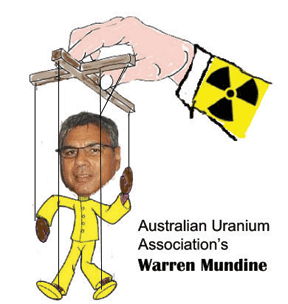
Mundine was one of the two main faces of the “No” campaign against last year’s Indigenous Voice to parliament referendum, campaigning against so-called “elites”.
The Voice “No” campaign was run by far-right lobby group Advance which ran a campaign of aggressively attacking so-called “elites” who it said were behind the Voice.
In fact, as previously reported, the No campaign was bankrolled by a handful of mega wealthy individuals, many with deep ties to the mining and fossil fuels sector.
The struggles facing Aura Energy coincide with a fierce political debate over the future of nuclear energy in Australia, with the federal Opposition calling for a nuclear rollout despite it being vastly more expensive than renewables.
Mundine uranium company shares collapse
ANTHONY KLAN, 9 July 24 https://theklaxon.com.au/mundine-uranium-company-shares-collapse/
A uranium exploration company overseen by businessman Warren Mundine has seen its share price crash after its auditor warned it was in danger of collapse.
Over $60 million has been wiped from the value of ASX-listed Aura Energy since its auditor waived the red flag — and a subsequent emergency capital raising has seen new investors left heavily in the red.
Company document show that on March 15 the auditor of Aura Energy — which states it has “major uranium projects” in “Africa and Europe” — warned there was a “material uncertainty” that it would be able to remain solvent.
Aura Energy had made losses of $9.79m in the 18 months to December 31 and had a remaining cash balance of just $5.86m.
Shares in the company — which is not covered by any analysts or stockbrokers — immediately crashed 33%, to 16.5c.
Aura Energy conducted a capital raising to help it stave off insolvency, but shares it sold under the offer only six weeks ago at 18c yesterday closed at just 13.5c.
Since January — while Australia has been engaged in a fierce debate over nuclear energy — the share price of Aura Energy has halved.
Mundine, who was appointed a director of Aura Energy in December 2021, is a major public advocate of nuclear energy was previously a director of Australian Uranium Association.
The woes facing Aura Energy follow the collapse of the planned $10m IPO of Mundine’s “minerals exploration” company Fuse Minerals in April.
That company, chaired by Mundine, was forced to scrap its plans to float on the ASX after failing to raise enough funds, despite it extending its capital raising period by more than eight-fold, from two weeks to more than four months.
Fuse Minerals had never earned a cent in revenue or conducted a single drill.
Mundine was one of the two main faces of the “No” campaign against last year’s Indigenous Voice to parliament referendum, campaigning against so-called “elites”.
He has repeatedly refused to comment when contacted by The Klaxon.
Company filings show Aura Energy entered a trading halt on March 15 and three days published its accounts for the six months to December 31.
In the six months it lost $2.99m, on the back of $6.80m in losses in the year to June 30, 2023.
In the half-year report, Aura Energy’s auditors Hall Chadwick state there is a “material uncertainty that may cast significant doubt” over the company’s “ability to continue as a going concern”.
In the report Aura Energy’s directors state the company is “dependent on further capital raises or external financing” to stay afloat.
“As the Group is in the exploration stage and does not generate operating cash inflows, the Group is dependent on further capital raises or external financing to maintain operations which results in a material uncertainty which may cast significant doubt on whether the Group can continue as a going concern,” the directors state.
On March 18 — the same day it published those half-year accounts — Aura Energy announced it had conducted a “successful placement” to raise $16.2m from “professional and sophisticated investors” by issuing 90.2m shares at 18c a share.
It would also raise $2m from the public, also at 18c a share, with those shares listed on the ASX on May 30.
Under both raisings, for every four shares bought there were also three “free” attached options, with an exercise price of 30c and a two year expiry. (Meaning they would have value if Aura Energy’s share price goes above 30c in the next two years).
In advertising the public raising, Fuse Minerals said the price of 18c a share was at an “18.2% discount” to the 22c a share they were trading at on the day the offer was announced.
Further, 18c a share was a “23.5% discount” to the average price the shares had been trading at over the five days before the offer was announced.
On the day the public offer shares were listed on the ASX, May 30, the company’s shared were trading at 16.5c.
Yesterday they closed at 13.5c.
At January 1 the company had 623m shares on issue and a share price of 26.5c, giving it a “market capitalisation” of $165.1m.
Yesterday its market capitalisation was $103m, down $62.1m.
The struggles facing Aura Energy coincide with a fierce political debate over the future of nuclear energy in Australia, with the federal Opposition calling for a nuclear rollout despite it being vastly more expensive than renewables.
Mundine and Senator Jacinta Price were the most prominent faces of the “No” campaign against the Indigenous Voice to parliament, which was voted down in October.
Two weeks later Mundine announced he was chair of Fuse Minerals — and that the company was seeking to raise up to $10m and list on the ASX.
The Klaxon subsequently revealed Fuse Minerals owned only one of the nine exploration licences listed in its prospectus — and that its own “independent expert” had warned it was in danger of collapse.
By January Fuse Minerals had raised just $1.86m, well short of the $6m-$10m sought and was legally required to refund money to investors seeking to exit.
On March 28 Fuse Minerals was forced to scrap the offer entirely.
The Voice “No” campaign was run by far-right lobby group Advance which ran a campaign of aggressively attacking so-called “elites” who it said were behind the Voice.
In fact, as previously reported, the No campaign was bankrolled by a handful of mega wealthy individuals, many with deep ties to the mining and fossil fuels sector.
No room for nuclear: AGL says flexibility is key as it plans to dump coal for renewables in a decade

ReNewEconomy Giles Parkinson, Jul 9, 2024
Australia’s biggest supplier of coal generation and baseload power, AGL Energy, has again underlined the fact there is no room for nuclear in Australia’s transition to renewables – neither on a grid dominated by wind and solar nor at its coal sites that it intends to transform into clean industrial hubs.
“I’d like to clarify – as I did in March – that nuclear energy is not part of our strategy and our position on this remains unchanged, AGL CEO Damien Nicks said in a presentation to a CEDA event in Sydney on Tuesday.
Nicks’ position is important because two of AGL’s coal generation sites have been identified by the federal Opposition for its nuclear power plans, which it says could see seven reactors, or more, start construction sometime in the 2030s or 2040s – should they be elected, be able to remove the bans, find the technology and finance, and the sites to host it.
AGL – and the owners of other mooted nuclear sites – have no intention of giving up their assets for nuclear power plants, despite the threats of compulsory acquisition, largely because they have their own plans.
Nicks says the site of the recently shuttered Liddell coal generator in the Hunter Valley is already accounted for, with plans for a giant battery, solar module manufacturing, panel recycling, a link to a planned 400 MW pumped hydro facility and multiple green industries including hydrogen, metals and other activities.
“The Hunter Hub is actively progressing opportunities across a variety of industries, including; solar thermal generation, solar PV manufacturing, battery and solar recycling, waste-ash-to-materials and hydrogen,” Nicks says.
“Our recent announcements with SunDrive and Elecsome are examples of the businesses we’re looking to work with.
“We’re committed to creating opportunities for our people and local communities, as well as partnering with like-minded industries to support economic diversification and jobs in the Upper Hunter.”
The point that Nicks made around the Hunter hub is that – because of its multi-billion dollar investment plans in new industries – there is no spare capacity for the sort of big nuclear projects that the Coalition wants to build. Or even small ones.
It points to the hot air behind the Opposition position on nuclear, and it’s complete of planning and consultation, something it plans to ignore by riding roughshod over opposition from state governments, asset owners, and local communities.
But the nuclear plan also makes little sense for Australia’s solar dominated grid, as so many energy experts have pointed out. Nicks once again highlighted this, saying the nature of a grid dominated by wind and solar needs flexibility rather than the “always-on” base-load design relied on by nuclear.
AGL intends to shutter the last of its coal generators by 2035, and is working to make them more flexible in the meantime so they can to respond to the generation patterns and “solar duck curves” created by rooftop PV, which will account for most of demand in daytime hours, and large scale wind and solar.
It’s critical we have the flexibility within our portfolio to firm capacity and help us manage some of the changing peaks and troughs in the renewable energy market,” he said
These include expanding its grid scale battery assets, boosting its capacity of hydro and gas peakers, and growing its portfolio of distributed energy assets to 1.6 GW by 2027, to support load shifting and orchestration of rooftop solar.
The slide provided above [on original] indicates a number of new wind, solar and battery projects, including the already announced Pottinger Energy Park in the Riverina, the proposed 500 MW, 2000 MWh Tomago battery, the newly approved Bowmans Creek wind project, and several other projects that have not yet been publicly named.
“We’ve undertaken significant upgrade works at our Bayswater plant in NSW and Loy Yang in Victoria that means these plants can now be flexed down approximately 60-70 per cent of their full operating capacity.
“This means we’re able to further ramp down during those daytime periods of peak solar generation which is commercially beneficial as it minimises production at negative pricing, using less coal and producing less emissions,” he said. …………………….. more https://reneweconomy.com.au/no-room-for-nuclear-agl-says-flexibility-is-key-as-it-switches-from-coal-to-renewables-in-a-decade/
Book – “Nuked” on Aukus ‘fiasco’ says decision to embrace pact will ‘haunt’ Labor for years

“undermines any argument that the new submarines – whether nuclear or not – would be used primarily to defend Australia or to protect the nation’s shipping lanes”.
“at least one new cabinet minister wondered if it was possible to stop Aukus, but the suggestion went no further”.
Fowler said he did not believe there had been adequate public debate in Australia about the merits of Aukus,
Andrew Fowler’s book reveals one of Australia’s most important requirements for its submarines was the ability to work alongside the US in South China Sea
Daniel Hurst , 7 July 24, https://www.theguardian.com/world/article/2024/jul/07/book-on-aukus-fiasco-says-decision-to-embrace-pact-will-haunt-labor-for-years
One of Australia’s most important requirements for its new submarines is the ability to work alongside the United States in the South China Sea, a new book discloses.
The book by Andrew Fowler, a former investigative journalist for the ABC’s Four Corners and Foreign Correspondent programs, also predicts that Labor’s rush to embrace the Aukus pact “will haunt them for years to come”.
Fowler examines the Morrison government’s cancellation of the French submarine contract and its pursuit of a nuclear-powered alternative in the book Nuked: The Submarine Fiasco that Sank Australia’s Sovereignty.
The book makes the case that Aukus is a “deeply flawed” scheme that, when combined with a parallel effort to deepen military integration with the US, effectively ties Australia’s future “to whoever is in the White House”.
It includes an interview with David Gould, a former UK undersecretary for defence, who was headhunted by the then Gillard Labor government in 2012 as a consultant on a replacement for Australia’s ageing Collins-class submarines.
“As we sat talking, Gould revealed for the first time what has long been suspected: one of the submarine’s most important requirements would be to work with the Americans in the South China Sea,” Fowler writes.
“He explained that the submarine would need ‘to get through the archipelago to the north of Australia and into the South China Sea and operate in the South China Sea for a reasonable period of time and then come back again, without docking, or refuelling or anything. That’s what it needs to do.’”
The book quotes Gould as saying that the submarine would work alongside the US and Japan in an “integrated system”, which had become “even more pertinent with China”.
Fowler writes that the statement “undermines any argument that the new submarines – whether nuclear or not – would be used primarily to defend Australia or to protect the nation’s shipping lanes”.
Fowler contends that the focus is “to contain China and threaten its trade routes and food and energy supplies in a crisis”.
The Australian government has repeatedly said that its strategic motivation for acquiring nuclear-powered submarines is to “contribute to the collective security of our region” and maintain the global rules-based order.
The Labor defence minister, Richard Marles, has argued that the defence of Australia “doesn’t mean that much unless we have the collective security of our region” and that the nuclear-powered submarines would put a “question mark in any adversary’s mind”.
Fowler contends that the focus is “to contain China and threaten its trade routes and food and energy supplies in a crisis”.
The Australian government has repeatedly said that its strategic motivation for acquiring nuclear-powered submarines is to “contribute to the collective security of our region” and maintain the global rules-based order.
The Labor defence minister, Richard Marles, has argued that the defence of Australia “doesn’t mean that much unless we have the collective security of our region” and that the nuclear-powered submarines would put a “question mark in any adversary’s mind”.
The book reveals that after Labor won the 2022 election, “at least one new cabinet minister wondered if it was possible to stop Aukus, but the suggestion went no further”.
In an interview with Guardian Australia, Fowler said he began researching the book after becoming fascinated with “the overuse of executive power of government in the Morrison government, particularly the exposure of his five secret ministries”.
“I thought that the arrival of a $368bn secret deal that was done and then sprung on the public and the opposition party at the last moment would require an investigation,” he said.
Fowler said he did not believe there had been adequate public debate in Australia about the merits of Aukus, the security partnership with the US and the UK that involves the nuclear-powered submarine project but also collaboration on other advanced defence technologies.
“I think we debate the dollar-and-dime arguments, as the Americans might say, but we don’t debate the really big issues,” Fowler said.
“I don’t give advice to government but I think the Australian people have a right to know what the submarines are being bought for. They’re being bought to run with the Americans and Japan to contain the rise of China.”
Fowler said the then Labor opposition was put “in a diabolical position” when forced by Scott Morrison to make a quick decision on whether to support Aukus in 2021.
“This was a calculated attempt to wedge Labor on this issue and Labor only had 24 hours to make a decision,” he said. “It was obscene and absurd, and yet they made the decision fearing that if they opposed it they would be accused of being anti-American and weak on national security.
“I do understand why they went with it, but I think they also had some time to do some backtracking.”
Fowler called for an inquiry focused on “a failure of due process” in the cancellation of the French contract and the decision to pursue the Aukus arrangement, which officials admitted during Senate estimates hearings had not gone through the normal two-gate process for defence acquisitions.
Instead, the Morrison government announced Australia, the US and the UK would carry out an 18-month joint study to work out how to deliver the project. That led to the Albanese government’s March 2023 announcement of more detailed plans.
The book argues the French submarines would have given Australia “greater independence”, noting the president, Emmanuel Macron, had described Australia, India and France as being at the heart of a “new Indo-Pacific alliance and axis”.
The book says this “more independent thinking” caused “consternation in Washington”.
Gas before nuclear ‘thought bubble’ as coal reign ends
Yahoo/Finance! Jack Gramenz, Tue 9 July 2024
Federal opposition plans to roll out nuclear energy have been dismissed as a thought bubble as the nation races to replace coal power.
Alternatives to the fossil fuel – which still powers much of the grid in NSW, Victoria and Queensland – are being rapidly rolled out with coal’s reign “swiftly ending,” according to electricity company bosses.
Proposals to increase natural gas supplies for the nation’s most populous state are being assessed and welcomed as renewable projects come online, NSW Energy Minister Penny Sharpe says.
“We don’t want to see price spikes and we don’t want to see uncertainty for industry,” she told a Committee for Economic Development of Australia event on Tuesday………………….
“More and more renewable energy is entering the system, but it’s always happening more slowly than we would like,” Ms Sharpe said.
The state Labor minister said she was “unimpressed” by a proposal from the federal coalition to roll out nuclear power stations.
The plan posed too many important but unanswered questions and threatened to smash a hole in the certainty provided by the state’s energy strategy, she said.
“NSW will not be risking our future economic prosperity for a policy thought bubble designed to play politics,” Ms Sharpe said……………………..
The chief executive of Australia’s largest energy generator and greenhouse-gas emitter reaffirmed nuclear power was not part of the company’s future.
AGL’s Damien Nicks told the same event the electricity supplier focused on renewable generation and storage.
“AGL’s generation portfolio will look completely different by 2035, when we’re no longer generating electricity from coal,” he said……………
The transmission network operator is building 2500km of new lines to carry an expected 17-gigawatt surge in renewable generation as more projects enter the grid.
Ms Sharpe on Tuesday announced the inaugural chair and seven commissioners for the state’s Net Zero Commission……. https://au.finance.yahoo.com/news/gas-nuclear-thought-bubble-net-044223314.html
1 This month
7 April – WEBINAR – Australia and the Doomsday Clock – Preventing nuclear war through NoFirstUse and other policies
Online | Tuesday April 7, 4:00-5:30pm, Australian Eastern Time / 8:00-9:30am Central Europe Time
– Access the registration link
15 April – Zoom –Nuclear Power is Not the Solution
Apr 15, 2026 01:00 AM in Canberra, Melbourne, Sydney

Join the International Physicians for the Prevention of Nuclear War (IPPNW) on Tuesday, April 14th for a timely webinar exploring the risks associated with nuclear power and challenging the myth that it offers a simple, safe, carbon-free solution to the climate crisis

21 April Webinar: No Nuclear Weapons in Australia
Start: 2026-04-21 18:00:00 UTC Canberra, Melbourne, Sydney (GMT+10:00)
End: 2026-04-21 19:30:00 UTC Canberra, Melbourne, Sydney (GMT+10:00)
Event Type: Virtual
A virtual link will be communicated before the event.
Host Contact Info: australia@icanw.org

of the week – Australians for War Powers Reform (AWPR)
To see nuclear-related stories in greater depth and intensity
 Antinuclear