Aboriginal supporter of right-wing racism, Warren Mundine’s interests in mining uranium -not doing too well.
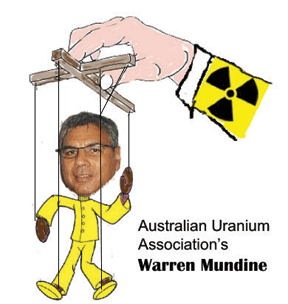
Mundine was one of the two main faces of the “No” campaign against last year’s Indigenous Voice to parliament referendum, campaigning against so-called “elites”.
The Voice “No” campaign was run by far-right lobby group Advance which ran a campaign of aggressively attacking so-called “elites” who it said were behind the Voice.
In fact, as previously reported, the No campaign was bankrolled by a handful of mega wealthy individuals, many with deep ties to the mining and fossil fuels sector.
The struggles facing Aura Energy coincide with a fierce political debate over the future of nuclear energy in Australia, with the federal Opposition calling for a nuclear rollout despite it being vastly more expensive than renewables.
Mundine uranium company shares collapse
ANTHONY KLAN, 9 July 24 https://theklaxon.com.au/mundine-uranium-company-shares-collapse/
A uranium exploration company overseen by businessman Warren Mundine has seen its share price crash after its auditor warned it was in danger of collapse.
Over $60 million has been wiped from the value of ASX-listed Aura Energy since its auditor waived the red flag — and a subsequent emergency capital raising has seen new investors left heavily in the red.
Company document show that on March 15 the auditor of Aura Energy — which states it has “major uranium projects” in “Africa and Europe” — warned there was a “material uncertainty” that it would be able to remain solvent.
Aura Energy had made losses of $9.79m in the 18 months to December 31 and had a remaining cash balance of just $5.86m.
Shares in the company — which is not covered by any analysts or stockbrokers — immediately crashed 33%, to 16.5c.
Aura Energy conducted a capital raising to help it stave off insolvency, but shares it sold under the offer only six weeks ago at 18c yesterday closed at just 13.5c.
Since January — while Australia has been engaged in a fierce debate over nuclear energy — the share price of Aura Energy has halved.
Mundine, who was appointed a director of Aura Energy in December 2021, is a major public advocate of nuclear energy was previously a director of Australian Uranium Association.
The woes facing Aura Energy follow the collapse of the planned $10m IPO of Mundine’s “minerals exploration” company Fuse Minerals in April.
That company, chaired by Mundine, was forced to scrap its plans to float on the ASX after failing to raise enough funds, despite it extending its capital raising period by more than eight-fold, from two weeks to more than four months.
Fuse Minerals had never earned a cent in revenue or conducted a single drill.
Mundine was one of the two main faces of the “No” campaign against last year’s Indigenous Voice to parliament referendum, campaigning against so-called “elites”.
He has repeatedly refused to comment when contacted by The Klaxon.
Company filings show Aura Energy entered a trading halt on March 15 and three days published its accounts for the six months to December 31.
In the six months it lost $2.99m, on the back of $6.80m in losses in the year to June 30, 2023.
In the half-year report, Aura Energy’s auditors Hall Chadwick state there is a “material uncertainty that may cast significant doubt” over the company’s “ability to continue as a going concern”.
In the report Aura Energy’s directors state the company is “dependent on further capital raises or external financing” to stay afloat.
“As the Group is in the exploration stage and does not generate operating cash inflows, the Group is dependent on further capital raises or external financing to maintain operations which results in a material uncertainty which may cast significant doubt on whether the Group can continue as a going concern,” the directors state.
On March 18 — the same day it published those half-year accounts — Aura Energy announced it had conducted a “successful placement” to raise $16.2m from “professional and sophisticated investors” by issuing 90.2m shares at 18c a share.
It would also raise $2m from the public, also at 18c a share, with those shares listed on the ASX on May 30.
Under both raisings, for every four shares bought there were also three “free” attached options, with an exercise price of 30c and a two year expiry. (Meaning they would have value if Aura Energy’s share price goes above 30c in the next two years).
In advertising the public raising, Fuse Minerals said the price of 18c a share was at an “18.2% discount” to the 22c a share they were trading at on the day the offer was announced.
Further, 18c a share was a “23.5% discount” to the average price the shares had been trading at over the five days before the offer was announced.
On the day the public offer shares were listed on the ASX, May 30, the company’s shared were trading at 16.5c.
Yesterday they closed at 13.5c.
At January 1 the company had 623m shares on issue and a share price of 26.5c, giving it a “market capitalisation” of $165.1m.
Yesterday its market capitalisation was $103m, down $62.1m.
The struggles facing Aura Energy coincide with a fierce political debate over the future of nuclear energy in Australia, with the federal Opposition calling for a nuclear rollout despite it being vastly more expensive than renewables.
Mundine and Senator Jacinta Price were the most prominent faces of the “No” campaign against the Indigenous Voice to parliament, which was voted down in October.
Two weeks later Mundine announced he was chair of Fuse Minerals — and that the company was seeking to raise up to $10m and list on the ASX.
The Klaxon subsequently revealed Fuse Minerals owned only one of the nine exploration licences listed in its prospectus — and that its own “independent expert” had warned it was in danger of collapse.
By January Fuse Minerals had raised just $1.86m, well short of the $6m-$10m sought and was legally required to refund money to investors seeking to exit.
On March 28 Fuse Minerals was forced to scrap the offer entirely.
The Voice “No” campaign was run by far-right lobby group Advance which ran a campaign of aggressively attacking so-called “elites” who it said were behind the Voice.
In fact, as previously reported, the No campaign was bankrolled by a handful of mega wealthy individuals, many with deep ties to the mining and fossil fuels sector.
No comments yet.
1 This month

of the week – Australians for War Powers Reform (AWPR)
To see nuclear-related stories in greater depth and intensity
 Antinuclear
Leave a comment