Greens up pressure against nuclear
newsroom, July 16, 2024 , https://www.2hd.com.au/2024/07/16/greens-up-pressure-against-nuclear/
Local government Greens candidates from Singleton, Maitland and Cessnock have met with Senator David Shoebridge, doubling-down on their opposition to the Coalition’s nuclear energy plans.
Last month the federal opposition unveiled its controversial energy policy, which would involve building nuclear reactors at seven locations across Australia.
Two of those are flagged for NSW, including at Muswellbrook’s former Liddell power station.
Singleton Greens local government candidate Louise Stokes says while some Upper Hunter residents are enjoying less air pollution with the closure of Liddell, what the Coalition is proposing will saddle them up with a more dangerous industry.
“Battering ram of bad faith actors:” Clean Energy Council says nuclear push causing confusion, delays and higher costs

Giles Parkinson, Jul 16, 2024, https://reneweconomy.com.au/battering-ram-of-bad-faith-actors-cec-says-nuclear-push-causing-confusion-delays-and-higher-costs/
The head of the Clean Energy Council, Kane Thornton, has launched a forceful attack on the pro-nuclear lobby, describing it as littered with bad faith actors, disinformation, and praying on a weakened mainstream media.
Thornton said Australia is poised to finally take advantage of its unique competitive advantage to produce low-cost, zero-emissions power that will transform the Australian economy, but the country’s ability to deliver reform and generational change is fragile and being undermined by vested interests.
“Bad faith actors are using a weakened media, praying on communities increasingly anxious about the uncertainty and tensions in the world around us to tear things down,” Thorntold said in an opening address to the Clean Energy Summit in Sydney on Tuesday.
“Vested interests are stepping up to tell their story and peppering it with mistruths and outright disinformation. They are undermining the very things that would build our nation’s future and resilience in an unstable world, to further their own short term political agenda.”
”The battering ram of bad faith actors today is nuclear power. We all know it’s several times more expensive than renewables and storage and is two decades away at best.”
Thornton noted that heavily promoted nuclear technologies such as small nuclear reactors still do not exist in commercial form, and coal power in Australia would be long gone before they could be delivered, if ever they could.”
Despite this reality, we are having a national debate about nuclear power. The Australian public are being confused and misled,” Thornton said.
”Investors know nuclear is not a commercially viable option for Australia and will never be realised here. But this debate is nevertheless deeply unhelpful for Australia’s international reputation as a safe place to invest, giving a perception that Australia’s energy policy remains deeply fractious and at risk of radical U-turns from one election to another.
”If we can’t have a sensible discussion about energy policy, then our problems as a nation go far beyond balancing our energy mix. We have suffered for over 15 years through the climate wars.
”These distractions and the inaction are why power prices are higher today and the energy transition is all the harder. It’s why we are playing catchup to reform our energy markets, fix and build out the grid, train the workforce, developing the standards and practices we should expect.”
Thornton said the rooftop solar market remained strong, and the battery storage market was also robust. “It’s the energy we need to charge these batteries that needs to happen much quicker,” he said.
Thornton said he hoped that the federal government’s Capacity Investment Scheme, which seeks 32 GW of new wind, solar and storage, will be one of the last “missing pieces” of the energy transition puzzle and help accelerate the rollout.
‘It needs to move quickly and deliver the investment confidence the market is seeking. If it works, we can expect a wave of large-scale renewable energy projects come forward,” he said.
But Thornton said that, given the disinformation around nuclear, the industry needed to work together to give confidence in the future of renewables.
“We need to recognise that change doesn’t always come easy. For some people it can create anxiety and uncertainty,” he said.
”They look for clarity, to people they trust. They want to understand lived experience and how new technology or projects in their community will impact their lives.”
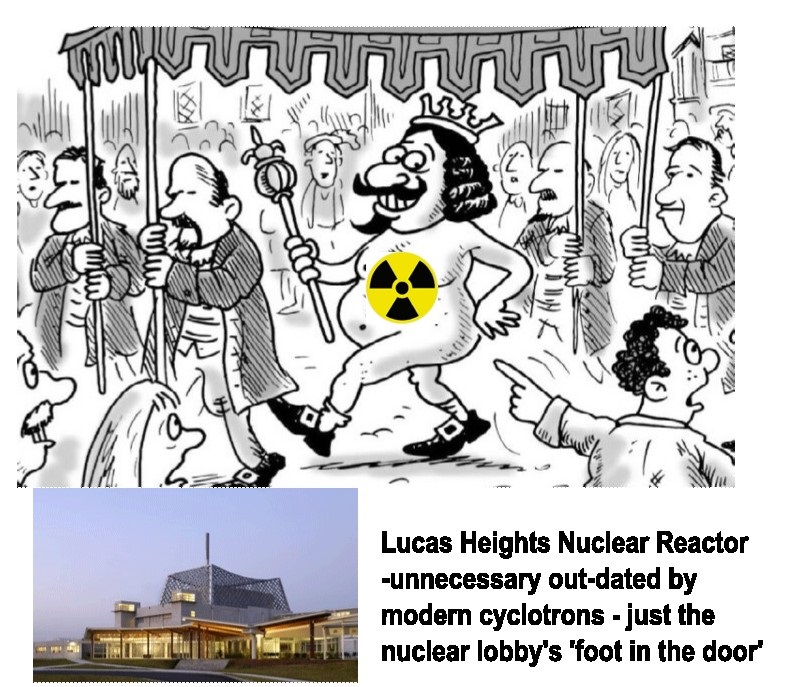
Sealed away in steel and concrete is Australia’s nuclear waste legacy at Lucas Heights in Sydney’s south
ABC News, By political reporter Matthew Doran, 15 July 24
Whenever there is a debate about nuclear power in Australia, one question regularly pops up: What do we do with the waste?
It can’t just be taken to the local dump along with garbage or rubble, and it has to be handled with immense care and stored in particular ways while it remains dangerous — sometimes for decades, and in the case of high level waste up to thousands of years.
Despite nuclear power generation still being a subject of political debate rather than reality, and nuclear-propelled submarines being decades away from being tied up at local docks, many Australians don’t know we are already producing, processing, and storing nuclear waste.
One of the largest repositories is Australia’s Nuclear Science and Technology Organisation (ANSTO) at the Lucas Heights nuclear facility, in Sydney’s south.
The ABC was invited inside……………………………………………………………………………………………………
The type of contaminated waste coming into the vast warehouse for assessment and processing is what’s classified as “low-level”.
Much of it includes items like rubber gloves, gowns, glassware, and old laboratory equipment from ANSTO’s nuclear medicine facility
It’s still contaminated and needs to be meticulously picked through, categorised, and stored away until it’s no longer dangerous, sealed away in the steel drums lining the shelves of multiple warehouses dotted across the Lucas Heights site.
Decades of legacy
Bags and bags of contaminated material sit in bins at the edge of the warehouse we’re standing in.
All the waste comes from ANSTO itself. While the organisation doesn’t store waste for others, it does assist with the material they produce………………. It’s brought into the warehouse, and scanned with high-tech machinery before ANSTO figures out the best way to store it – and for how long.
…. “A lot of the waste that we bring in is really very quickly able to be sent out to the normal tip, because working with nuclear medicine, which generates most of our waste, we have a lot of short-lived isotopes,” Paula Berghofer, head of waste management , says.
…………………………………………………………………………………………………………………… ANSTO’s Lucas Heights site is home to the only nuclear reactor in the country.
It’s a facility used to create radioactive isotopes for use in areas such as nuclear medicine. ……..
Lucas Heights’ OPAL reactor is currently undergoing maintenance.
It’s not used for power generation and doesn’t create waste anywhere near the level of radioactive material that would come from such a reactor.
However, that’s not to say there isn’t decades-old nuclear waste stored at the site.
Some drums and blocks of radioactive material, encased in concrete and steel tombs weighing many tons, have been here for decades.
Among them, are remnants of the original nuclear reactor at Lucas Heights – known as MOATA – which operated between 1961 and 1995, and was decommissioned 15 years ago.
“It will remain here, safely monitored and stored, until Australia has a disposal operation available for us to send it to,” Ms Berghofer says……………………………………………………………………………………………………………………
Offshore processing

There’s another warehouse, which looks a little different, on the Lucas Heights campus.
It’s newer. It’s taller. It’s wrapped in extra layers of security.
When you walk inside, it’s striking how empty it is. Apart from two huge cylinders, standing on their ends, at one side of the building
“While Australia has a very important role in the nuclear space, we are comparatively small, and we certainly don’t have the infrastructure or really the need or desire to install what is a very large price reprocessing facility here,” Ms Berghofer says.
“So it makes sense for us to have those international agreements, so that we can send this overseas to the experts, where they can reprocess it and send us back an equivalent.”
Again, these canisters are also intended for a national nuclear waste dump, once it is established. https://www.abc.net.au/news/2024-07-16/australias-nuclear-waste-legacy-lucas-heights-ansto/104091600
1 This month

of the week – Australians for War Powers Reform (AWPR)
To see nuclear-related stories in greater depth and intensity
 Antinuclear