Renewables caught in misinformation crossfire from Australia’s nuclear cheerleaders

Graham Readfearn, 18 July 24, https://www.theguardian.com/environment/article/2024/jul/18/renewables-caught-in-misinformation-crossfire-from-australias-nuclear-cheerleaders
Those pushing the nuclear option are making some questionable claims about the capacity of renewable energy.
Advocacy for the Coalition’s hopes to build nuclear power plants is increasingly coming with large side-orders of misinformation, not just on the speed or costs of nuclear but on renewables.
Dr Adi Paterson, the chair of the Nuclear for Australia advocacy group, has taken to attacking the credentials of CSIRO experts while going hyperbolic with his rhetoric.
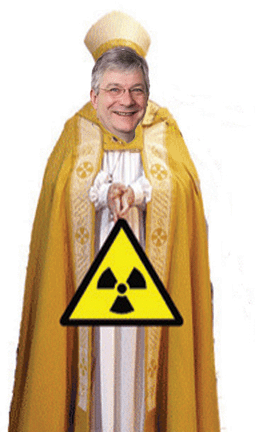
When Paterson told Sky News he thought the agency’s report on the costs of different electricity generation technologies was “a form of fascism” there was not a whisper of disapproval from the surrounding studio panel. Mussolini would be turning in his grave.
The definitely-not-fascist GenCost report has found electricity from nuclear would be far more expensive than solar and wind, taking into account the cost of extra transmission lines and technologies to connect, store and rerelease renewable power.
Paterson claimed on the Sky news show Outsiders that the GenCost report “looks at one reactor in Finland”. In fact, the report had based the cost of large-scale reactors in Australia on South Korea’s long-running nuclear program – one of the most successful in the world.
Entrepreneur Dick Smith, a patron of Nuclear for Australia, has also tried to claim CSIRO used a “worst-case scenario” for nuclear costs. One leading energy analyst has previously told Temperature Check the opposite was more likely the case.
Paterson, a former boss of the Australian Nuclear Science and Technology Organisation, said in any case, he wanted to see Australia consider 5MW micro-reactors (less than the size of a large wind turbine, suggesting Paterson would like to see Australia scattered with tiny nuclear reactors).
He then pointed to Bill Gates’ Terrapower company and its project in Wyoming (which has a much higher proposed generation capacity of 345 MW), saying it was currently licensed and “being built now”.
In fact, as Terrapower’s chief executive told CNBC a couple of months ago, the company has only just submitted its construction permit application to the US Nuclear Regulatory Commission and hopes to get approval in 2026. They are doing some construction at the site, but none of it relates to the nuclear aspects of the plant.
Two days out of five?
Paterson has claimed wind turbines only generate electricity “two days out of five” or “37% of the time”.
Dr Dylan McConnell, an energy systems analyst at UNSW, said this was a “misleading” characterisation of windfarm performance.
McConnell said the 37% figure referred to something called the capacity factor – that is, how much electricity is generated over a given period relative to a windfarm’s maximum capacity.
“It is equivalent to implying that windfarms run at 100% of capacity two days out of five, and zero capacity three days out of five. This is of course not at all how windfarms or renewable energy generation works,” he said.
“They infrequently run at 100% of capacity. The converse of this is that they are often running just at levels below their full rated output – which is even more true across the whole fleet.”
McConnell points to data showing over the past year windfarms contributed about 12% of the total generation across the national electricity market (everywhere except WA and the NT) and while he said there was “a lot of variability”, there were no days when windfarms failed to generate.
He said: “Saying they work ‘two days out of every five’ is misunderstanding or a misrepresentation of the contribution of wind to the power system.”
Free pass for renewables?
Conservative economist and contributor to the Australian and the Spectator, Judith Sloan, has penned several pieces in recent weeks favouring nuclear power while making questionable claims about renewables.
In the Spectator, Sloan wrote that state governments “have allowed renewable energy companies to avoid the normal approval processes, including environmental assessments”.
Firstly, renewables projects are subject to both state and federal environmental assessments.
The federal environment minister, Tanya Plibersek, has assessed and approved more than 50 renewables projects – often with conditions attached – under current environmental laws, and rejected one windfarm in north Queensland in May because of potential impacts on nature. (The previous environment minister, Sussan Ley, also rejected a windfarm in 2020.)
Marilyne Crestias, interim chief executive at the Clean Energy Investor Group, said it was “inaccurate” to say that projects avoided environmental assessments at state level.
“Each state and territory has its own set of laws governing environmental assessments for renewable energy projects.
For example, in New South Wales, large-scale renewable energy projects must undergo an environmental impact assessment (EIA) under the Environmental Planning and Assessment Act 1979. Similarly in Victoria, projects are assessed under the Planning and Environment Act 1987 for their environmental, social and economic impacts. And in Queensland, the Environmental Protection Act 1994 requires environmental impact statements (EIS) for significant projects, including renewable energy developments. These assessments ensure that renewable energy projects are developed responsibly and sustainably.”
Talking to Sky, Sloan has said: “One of the worst aspects of [the renewables rollout] is that these renewable investors have never entered into an undertaking that they will remediate the land.”
Crestias said this was a “misconception”, saying developers typically did have agreements that included remediating the land.
“These agreements often cover the entire lifecycle of the project, from development through decommissioning,” she said.
“For instance, planning permits for windfarms in Victoria require developers to submit a decommissioning and rehabilitation plan before construction begins.”
Dutton’s Quixotic Proposal: Nuclear Lunacy Down Under
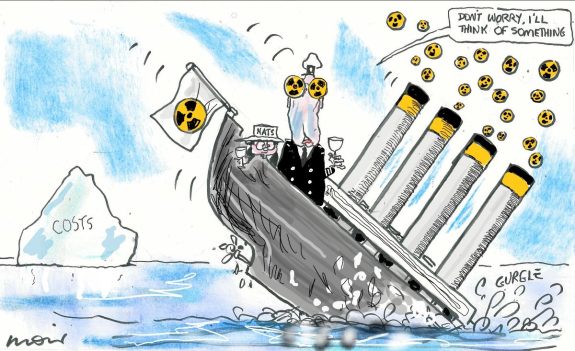
July 18, 2024, Dr Binoy Kampmark, https://theaimn.com/duttons-quixotic-proposal-nuclear-lunacy-down-under/
Politics and facts are not necessarily good dinner companions. Both often stray from the same table, taking up with other, more suitable company. The Australian opposition leader, Peter Dutton, has never been discomforted by facts, preferring the chimera-like qualities demagoguery offers. His vision for Australia is admirably simple and simplistic.
In foreign policy, he supports US interventions in any theatre of the globe without question. Ditto such allies as Israel. To the distant north, the evil Yellow Horde is abominated. Domestically, matters are similarly one dimensional. Irregular boat arrivals are to be repelled with necessary cruelty. And then there is a near pathological hatred of renewable energy.
Needing to find some electoral distraction to improve the Liberal-National coalition’s chances of returning to office, Dutton has literally identified a nuclear option. Certainly, it is mischievous, throwing those wishing to invest in the problematic Australian energy market into a state of confusion. The business of renewables, as with any investment, is bound to also be shaken.
Last month, Dutton finally released some details of his nuclear vision. Seven nuclear projects are envisaged, using sites with currently working or shuttered coal fired power stations. These will be plants up to 1.4 gigawatts (GW) to be located at Loy Yang in Victoria, Liddell in NSW’s Hunter Valley and Mt. Piper near Lithgow, Tarong and Callide in Queensland. Small modular (SMR) reactors are planned for Port Augusta in South Australia and Muja near Collie in Western Australia.
The SMR gambit is particularly quixotic, given that they have yet to come to viable fruition. Besides, the entire reactor venture already faces glaring legal impediments, as nuclear power is prohibited by Commonwealth and state laws. (The ban on nuclear energy was, with sweet irony, legislated by the Howard Coalition government a quarter of a century ago.)
Already, the handicaps on the proposal are thick and onerous. Ian Lowe of Griffith University witheringly describes the proposal as “legally impossible, technically improbable, economically irrational and environmentally irresponsible.”
The greatest of all handicaps is the fact that Australian governments, despite tentatively flirting with the prospect of a civilian nuclear sector at points, have never convinced the citizenry about the merits of such power. The continuous failure of the Commonwealth to even identify a long-standing site for low-level radioactive waste for the country’s modest nuclear industry is a point in fact.
Aspects of the proposed program also go distinctly against the supposedly free market individualism so treasured by those on Dutton’s side of politics. If nuclear power were to become the fundamental means to decarbonise the Australian economy by 2050, it would entail crushing levels of debt and heavy government stewardship.
The extent of government involvement and ownership of the proposed nuclear infrastructure made The Age and Sydney Morning Herald search for a precedent. It seemed to have an element of “Soviet economics” to it, directly at odds with the Liberal Party’s own professed philosophy of “lean government that minimises interference in our daily lives; and maximises individual and private sector initiative.”
It would also further add to the already monstrous AUKUS obligations Australia has signed up to with the United States and United Kingdom, a sovereignty shredding exercise involving the transfer and construction of nuclear-powered submarines to Canberra costing upwards and above A$368 billion. The Smart Energy Council has been good enough to offer its own estimate: the seven nuclear plants and reactors would cost somewhere in the order of A$600 billion, securing a mere 3.7% of Australia’s energy share by 2050.
While draining the treasury of funds, the nuclear-in-Duttonland experiment would do little to alleviate energy costs. The CSIRO, Australia’s national science agency, along with the Australian Energy Market Operator (AEMO), have concluded that nuclear power in Australia would not be prudent in terms of cost relative to other sources of power. The obstacles noted in their 2023-4 report are impressively forbidding.
Australia, for instance, lacks existing nuclear power projects. “Therefore, although it is true that all technologies have extensive pre-construction development times, nuclear is unique in that it has an empty development pipeline in Australia.” Throw in the layers of legal, safety and security steps, any pioneering nuclear plant in Australia would be “significantly delayed”, rendering nuclear power’s role in achieving net zero emissions by 2050 a nonsense.
The Dutton plan is scratched of all empirical shape. Estimates are absent. Numbers, absent. Capacity, absent. Figures, if supplied, will be done immediately prior to the next election, or while in government. Such moves teeter on the edge of herculean stupidity and foolhardiness, at least in Australian conditions. The exercise is also, quite rightly, being seen as an attempt to stealthily retain coal fired stations while starving continued investment to the renewable sector.
Dutton’s junior partner, the Nationals, have also shown much candour on where they stand on renewable energy projects. Party leader David Littleproud nailed his colours to the mast on that subject early last year. By August 2023, he was explicitly calling for a “pause” to the roll out of wind and solar and transmission links, calling the Albanese government’s pursuit of their 82% renewables target a “reckless” one. His implicit suggestion: wait for the release of the nuclear genie.
The Coalition opposition’s nuclear tease continues the tendency in Australia to soil climate policy with the sods of cultural conflict. On any matter, Dutton would be happy to become a flat earther were there any votes in it. The problem here is that his proposal might, on some level, be disruptively attractive – in so far as the voters are concerned. With Labor dithering in office with the smallest of majorities, any disruption may be one too many.
By its very nature, the Commonwealth would have to take the reins of this venture, given that private investors will have no bar of it. Tom Dusevic, writing in the otherwise pro-Dutton outlet The Australian, put it thus: “There is no other way because private capital won’t go anywhere near this risky energy play, with huge upfront costs, very long lead times and the madness that has pervaded our energy transition to meet international obligations.”
Tribes and Environmentalists Press Arizona and Federal Officials to Stop Uranium Mining Near the Grand Canyon

This story covers protests about the dangers to people and the
environment from uranium mining in Arizona near the Grand Canyon.
Most Australians probably don’t know about the dangers to people and the environment from Australian uranium, what countries import it from Australia, or that Australian uranium was (is still?) in use at Fukushima.
More information about the dangers of uranium, and the bind
Australia is in by exporting it as the price of uranium ore rises, needs to be known to Australians.

Activists hope to shut down an existing mine within a new national monument and to prevent the transportation of uranium on state and federal roads across Navajo Nation lands.
Inside Climate News, By Noel Lyn Smith, July 17, 2024
PHOENIX—Members of environmental groups stood together in the lobby of the Arizona State Capitol Executive Tower late last month to deliver a petition to Arizona Gov. Katie Hobbs, requesting that she stop uranium mining activities near the Grand Canyon National Park.
The Sierra Club, Center for Biological Diversity, National Parks Conservation Association, Wild Arizona, Chispa Arizona and Haul No!, a group formed to fight the mining and transport of uranium, delivered a petition with more than 17,500 signatures to the governor.
They are seeking closure of the Pinyon Plain Mine, located less than 10 miles from the Grand Canyon. It is inside the Baaj Nwaavjo I’tah Kukveni—Ancestral Footprints of the Grand Canyon National Monument, which President Joe Biden established in August 2023. The removal of uranium ore from the mine started in late December.
Although the designation prohibits new mining claims and development, it allows prior claims with valid existing rights like Pinyon Plain to continue their operations. Energy Fuels Resources owns the mine, which is approximately 17 acres, and operates it on land managed by the U.S. Forest Service.
“This mine threatens to pollute the groundwater that feeds the seeps and springs in Grand Canyon, supporting plants, animals and people,” the petition states.
People can develop respiratory disease and toxicity in the kidneys due to uranium exposure, according to the federal Agency for Toxic Substances and Disease Registry. There are more than 500 abandoned uranium mines on the Navajo Nation, and the tribe continues to confront the ramifications of mining activities on tribal members and the environment. This includes advocating for federal money to clean up abandoned mines and compensation for former mine workers.
No one from Hobbs’ office met the group or accepted the written requests in person. Instead, the activists left the petition, the groups’ latest action attempting to get the Democratic governor’s attention, with the executive receptionist on the first floor. In January, the groups sent a letter to Hobbs urging her to revisit permits issued for Pinyon Plain Mine and seeking her help closing it. They said she has not responded to the letter.
A spokesperson with the governor’s office confirmed on July 11 that the petition was received…………………………………………………………………………..
Vania Guevara is the advocacy and political director with Chispa Arizona, a program under the League of Conservation Voters that is dedicated to increasing Latinx voices in policies that address climate change and the environment. Guevara said it is urgent for Hobbs to address uranium mining because it threatens the health and safety of Indigenous communities.
A dozen tribes have ancestral, ceremonial and traditional connections to the region, including the Havasupai Tribe, Hopi Tribe, Hualapai Tribe, Kaibab Band of Paiute Indians, Las Vegas Paiute Tribe, Moapa Band of Paiutes, Paiute Indian Tribe of Utah, Navajo Nation, San Juan Southern Paiute Tribe, Yavapai-Apache Nation, Pueblo of Zuni and the Colorado River Indian Tribes…………………………………. https://insideclimatenews.org/news/17072024/arizona-activists-press-officials-to-stop-uranium-mining-near-grand-canyon/
Nuclear awakening ‘a decade or two late’, says AER
Angela Macdonald-Smith, AFR, 17 July 24
Australia’s debate over nuclear power is coming “a decade or two late”, as the earliest the technology could start contributing to the system is about 2050, according to the chairwoman of the Australian Energy Regulator.
In what is thought to be her first public words about nuclear power since the Coalition’s launch of its nuclear power policy last month, Clare Savage said it would take at least 25 years to get through the political and regulatory hurdles to develop the industry, and to get the first reactors built – much longer than the opposition is targeting……………..(Subscribers only) https://www.afr.com/companies/energy/nuclear-awakening-a-decade-or-two-late-says-aer-20240716-p5ju8q
1 This month

of the week – Australians for War Powers Reform (AWPR)
To see nuclear-related stories in greater depth and intensity
 Antinuclear