Massive IT outage spotlights major vulnerabilities in the global information ecosystem

the world may finally be realizing that modern information-based society is based on a very fragile foundation.
Richard Forno, Principal Lecturer in Computer Science and Electrical Engineering, University of Maryland, Baltimore County: July 20, 2024 https://theconversation.com/massive-it-outage-spotlights-major-vulnerabilities-in-the-global-information-ecosystem-235155
The global information technology outage on July 19, 2024, that paralyzed organizations ranging from airlines to hospitals and even the delivery of uniforms for the Olympic Games represents a growing concern for cybersecurity professionals, businesses and governments.
The outage is emblematic of the way organizational networks, cloud computing services and the internet are interdependent, and the vulnerabilities this creates. In this case, a faulty automatic update to the widely used Falcon cybersecurity software from CrowdStrike caused PCs running Microsoft’s Windows operating system to crash. Unfortunately, many servers and PCs need to be fixed manually, and many of the affected organizations have thousands of them spread around the world.
For Microsoft, the problem was made worse because the company released an update to its Azure cloud computing platform at roughly the same time as the CrowdStrike update. Microsoft, CrowdStrike and other companies like Amazon have issued technical work-arounds for customers willing to take matters into their own hands. But for the vast majority of global users, especially companies, this isn’t going to be a quick fix.
Modern technology incidents, whether cyberattacks or technical problems, continue to paralyze the world in new and interesting ways. Massive incidents like the CrowdStrike update fault not only create chaos in the business world but disrupt global society itself. The economic losses resulting from such incidents – lost productivity, recovery, disruption to business and individual activities – are likely to be extremely high.
As a former cybersecurity professional and current security researcher, I believe that the world may finally be realizing that modern information-based society is based on a very fragile foundation.
The bigger picture
Interestingly, on June 11, 2024, a post on CrowdStrike’s own blog seemed to predict this very situation – the global computing ecosystem compromised by one vendor’s faulty technology – though they probably didn’t expect that their product would be the cause.
Software supply chains have long been a serious cybersecurity concern and potential single point of failure. Companies like CrowdStrike, Microsoft, Apple and others have direct, trusted access into organizations’ and individuals’ computers. As a result, people have to trust that the companies are not only secure themselves, but that the products and updates they push out are well-tested and robust before they’re applied to customers’ systems. The SolarWinds incident of 2019, which involved hacking the software supply chain, may well be considered a preview of today’s CrowdStrike incident.
CrowdStrike CEO George Kurtz said “this is not a security incident or cyberattack” and that “the issue has been identified, isolated and a fix has been deployed.” While perhaps true from CrowdStrike’s perspective – they were not hacked – it doesn’t mean the effects of this incident won’t create security problems for customers. It’s quite possible that in the short term, organizations may disable some of their internet security devices to try and get ahead of the problem, but in doing so they may have opened themselves up to criminals penetrating their networks.
It’s also likely that people will be targeted by various scams preying on user panic or ignorance regarding the issue. Overwhelmed users might either take offers of faux assistance that lead to identity theft, or throw away money on bogus solutions to this problem.
What to do
Organizations and users will need to wait until a fix is available or try to recover on their own if they have the technical ability. After that, I believe there are several things to do and consider as the world recovers from this incident.
Companies will need to ensure that the products and services they use are trustworthy. This means doing due diligence on the vendors of such products for security and resilience. Large organizations typically test any product upgrades and updates before allowing them to be released to their internal users, but for some routine products like security tools, that may not happen.
Governments and companies alike will need to emphasize resilience in designing networks and systems. This means taking steps to avoid creating single points of failure in infrastructure, software and workflows that an adversary could target or a disaster could make worse. It also means knowing whether any of the products organizations depend on are themselves dependent on certain other products or infrastructures to function.
Organizations will need to renew their commitment to best practices in cybersecurity and general IT management. For example, having a robust backup system in place can make recovery from such incidents easier and minimize data loss. Ensuring appropriate policies, procedures, staffing and technical resources is essential.
Problems in the software supply chain like this make it difficult to follow the standard IT recommendation to always keep your systems patched and current. Unfortunately, the costs of not keeping systems regularly updated now have to be weighed against the risks of a situation like this happening again.
AUKUS – Australia-United Kingdom-United States nuclear pact endangers us all

Agreement is proliferation nightmare
By Jemila Rushton https://beyondnuclearinternational.org/2024/07/21/agreement-is-proliferation-nightmare/—
Australia arms up with UK and US help
The following is a statement to be delivered on July 23 at the 2024 Nuclear Non-Proliferation Treaty Preparatory Committee event in Geneva by Jemila Rushton, Acting Director, International Campaign to Abolish Nuclear Weapons, Australia. It was endorsed by a number of groups, including Beyond Nuclear. It has been adapted slightly for style as a written piece rather than oral delivery.
We gather in uncertain and dangerous times. All nine nuclear armed states are investing in modernizing their arsenals, none are winding back policies for their use. The number of available deployed nuclear weapons is increasing. We do not have the luxuries of time or inaction.
Against this background where the proliferation of nuclear weapons is an ongoing concern, Australia, the United Kingdom and the United States of America continue to further develop AUKUS, an expanded trilateral security partnership between these three governments.
AUKUS has two pillars. Pillar One was first announced in September 2021 and relates to information, training and technologies being shared by the US and UK to Australia to deliver eight nuclear powered submarines to Australia. Vessels which, if they eventuate, will utilize significant quantities of highly enriched uranium (HEU). It also allows Australia to purchase existing US nuclear submarines. Currently, Australia is committing billions of dollars to both US and UK submarine industry facilities as part of the AUKUS agreement, potentially enabling the further development of nuclear armed capability in these programs.
Two years ago, during the 2022 NPT Review Conference, many governments expressed concern that the AUKUS nuclear submarine deal would undermine the NPT, increase regional tensions, lead to proliferation, and threaten nuclear accidents in the ocean. There remains an urgent need to critique the nuclear proliferation risks posed by AUKUS.
The Australian decision to enter into agreements around nuclear powered submarines was made on the assumption that it would be permitted to divert nuclear material for a non-prescribed military purpose, by utilizing Paragraph 14 of the International Atomic Agency’s (IAEA) Comprehensive Safeguards Agreement (CSA). The ‘loophole’ of Paragraph 14 potentially allows non-nuclear armed states to acquire nuclear material, which would be removed from IAEA safeguards.
Australia’s proposed acquisition of large quantities of HEU outside of usual IAEA safeguards and scrutiny jeopardizes nonproliferation efforts and fissile material security. This conference has the mandate to prepare recommendations for the upcoming Review Conference to strengthen rather than weaken the global nonproliferation regime by moving to close the Paragraph 14 loophole. States represented here should negotiate the closure of the Paragraph 14 loophole in the NPT, as it permits Australia and other non-nuclear armed states to obtain nuclear-powered submarines and potentially weapons-grade HEU.
To eliminate the risk of non nuclear weapons states acquiring nuclear weapons grade HEU, all states, including AUKUS members, should refrain from sharing the technology and materials that will be transferred if Australia and others acquire nuclear-powered submarines. The paragraph 14 loophole undermines the NPT and needs to be closed.
Pillar Two of AUKUS plans to enhance the joint capabilities and interoperability between the partners, and may draw in other countries to AUKUS. This move is vastly out of step with a strong sense of Pacific regionalism and the long-standing commitment to a Nuclear Free Pacific. The South Pacific Nuclear Free Zone Treaty (Treaty of Rarotonga) is being put under strain in this agreement. It is of grave concern that currently Japan, Canada and Aotearoa/New Zealand are actively considering their engagement with AUKUS Pillar 2.
We are concerned that the AUKUS trilateral partnership, and any further expansions will exacerbate regional tensions, fuel an arms race and increase risks of war in the Asia-Pacific region, particularly involving China and the United States, and will increase the danger of nuclear escalation in any such conflict.
Within Australia, First Nations communities have expressed deep concern about the imposition of new military and radioactive waste facilities on their lands. First Nations and broader communities across Australia and throughout the Pacific have noted that AUKUS is part of a rapid militarization of the region, and raises the ever-present threat of nuclear conflict. Recognizing the disproportionate impacts of previous nuclear activities on First Nations or Indigenous Peoples, and the on-going legacies of nuclear weapons testing and activities in the region, there is deep concern for what AUKUS will mean for sovereignty of Small Island States and its impacts on Indigenous lands and Peoples.
The fuel for HEU naval propulsion reactors is weapons-grade, and the spent fuel is weapons-usable. HEU is the most suitable material for ready and rapid conversion into a nuclear bomb. While removing HEU from a submarine would not be an easy process, the possibility of diverting such material for weapons purposes cannot be ruled out. Meaningful safeguards are extremely limited when the material is on a stealth platform that can disappear for six months at a time.
With the entry into force of the UN Treaty on the Prohibition of Nuclear Weapons (TPNW), there is a mandate to strengthen existing non-proliferation mechanisms. By joining the TPNW, governments can legally confirm that they will not acquire or host nuclear weapons, nor assist with their use or threat of use. We affirm that AUKUS members should make firm their commitments to nuclear non-proliferation and disarmament by joining the TPNW as a matter of urgency.
Jemila Rushton is the Acting Director, International Campaign to Abolish Nuclear Weapons, Australia
Australia: Opposition’s nuclear power plans open the door for nuclear weapons
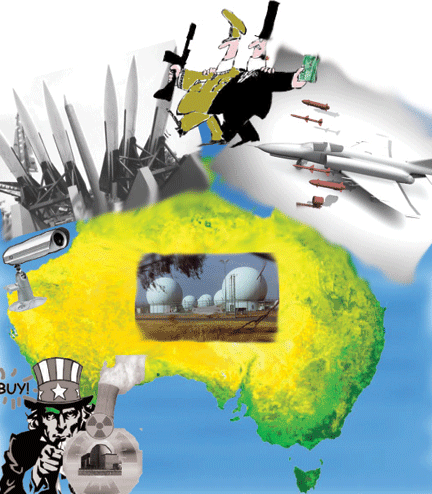
Barely mentioned is the potential of a nuclear power industry to provide a pathway for the development of nuclear weapons: first, by providing a large pool of nuclear scientists, engineers and technicians and, second, by creating the means to manufacture the fissionable material needed for a bomb. The latter would require further heavy investment in either a uranium enrichment plant or a plutonium reprocessing plant, or both.
Such a discussion has been underway largely behind closed doors in strategic and military circles for decades.
WSWS, Peter Symonds, 19 July 24
Federal opposition leader Peter Dutton’s announcement last month that the Liberal-National Coalition would build seven nuclear power plants seeks to overturn longstanding official opposition to nuclear energy, entrenched in state and federal law. Currently, Australia has just one nuclear reactor, operated by the Australian Nuclear Science and Technology Organisation (ANSTO) for research and the production of medical isotopes.
Dutton slammed Prime Minister Anthony Albanese’s Labor government for its reliance on renewables, claiming that nuclear power would provide cheap, reliable, environmentally-friendly energy for households and businesses. He dismissed problematic issues of nuclear waste and safety by pointing out that the Albanese government had already ditched Labor’s nuclear-free policy by embracing the acquisition of nuclear-powered attack submarines under the AUKUS pact with the UK and US.
In the ensuing wave of commentary on the nuclear power proposal, critics derided Dutton’s lack of detail, including costings, and pointed out that nuclear reactors would not be operational for at least a decade. Advocates of the profitable renewable industries touted solar and wind power as the cheap, clean, safe alternatives to nuclear power.
Barely mentioned is the potential of a nuclear power industry to provide a pathway for the development of nuclear weapons: first, by providing a large pool of nuclear scientists, engineers and technicians and, second, by creating the means to manufacture the fissionable material needed for a bomb. The latter would require further heavy investment in either a uranium enrichment plant or a plutonium reprocessing plant, or both.
Such a discussion has been underway largely behind closed doors in strategic and military circles for decades. Plans for an Australian atomic bomb were seriously considered in the 1950s and 1960s, with the 1968‒71 Coalition government of Prime Minister John Gorton taking the first steps in building a nuclear power reactor that provided a route to manufacturing a nuclear weapon.
In the midst of the Cold War, however, Washington was determined to maintain the effective monopoly of its massive nuclear arsenal and thus its use as a menacing threat or in war itself against the Soviet Union or any other potential rival. Under the guise of disarmament, the Nuclear Non-Proliferation Treaty (NPT) banned the manufacture of nuclear weapons except for the five countries with a known nuclear arsenal—the US, the Soviet Union, Britain, France and China—and effectively stymied the Australian project as well as most similar plans by other countries. Australia signed the NPT in 1971 and ratified it in 1973.
The global geopolitical landscape, however, has dramatically changed since the dissolution of the Soviet Union in 1991 and the end of the Cold War. Far from bringing global peace and prosperity, US imperialism has been waging war for the past three decades in a desperate attempt to maintain its global hegemony. Conflicts in the Middle East and Central Asia are now rapidly metastasizing into great power conflicts and world war involving nuclear-armed powers. The US and its NATO allies are already waging war against Russia in Ukraine and, in league with its Asian allies, including Australia, preparing for war against China.
In this context, as the danger of nuclear war looms larger, debate has reemerged in military circles over the building of an Australian atomic bomb. In his book How to Defend Australia, published in 2019, prominent strategic analyst Hugh White devoted an entire chapter to the question: “Does Australia need its own nuclear weapons to preserve its strategic independence in the decades ahead?”
The way White posed the question points to the central argument of the book as a whole—the necessity of Australian imperialism forging a foreign and military policy that does not rely on America’s waning power.
………………………………. In the Indo-Pacific, the US has been preparing for war with China, which Washington regards as the chief threat to its global domination. Far from leaving Australia isolated, the US is integrating the Australian military directly into its war plans against China—the AUKUS pact being the most obvious expression. This places the Australian population on the front lines of such a war.
White speaks for a minority in the ruling class that doubts the wisdom of being drawn into a catastrophic military conflict with Australia’s biggest trade partner. He and others argue for Australian imperialism to adopt a stance of heavily-armed neutrality. While not explicitly calling for an Australian nuclear weapon, White’s book certainly implied its necessity. Grossly inflating the threat posed by China, he argued that without the protection of the US, the only realistic means of countering such a threat is for Australia to have its own nuclear armaments.
……………………………………………………………………………………………………………………US imperialism is already, in reality, engaged in a war with nuclear-armed Russia in Ukraine and making advanced preparations for conflict with nuclear-armed China. The Australian military, including its bases, forms a vital component of the Pentagon’s strategy for fighting a nuclear war and, thus, a potential nuclear target. American nuclear submarines and nuclear-capable strategic bombers are being stationed in western and northern Australia. US spy and communications bases in Australia are indispensable to the US military’s global war plans. In other words, if US imperialism launches nuclear war, Australian imperialism is automatically involved……………………………………………………………………………………..more https://www.wsws.org/en/articles/2024/07/20/qxon-j20.html—
Agriculture ministers raise ‘serious’ concern over nuclear plans
Canberra Times, By Stephanie Gardiner, July 18 2024
Farmers deserve answers on how the federal coalition’s nuclear energy plan could impact food production, with Australia’s agriculture ministers joining forces to raise concern.
Ministers from every state and territory affected by the opposition’s nuclear proposal released a joint statement on Thursday, saying they had a duty to protect the future of the agriculture industry.
“We have serious concerns that this duty would be compromised by the federal opposition’s proposal for nuclear power in and around prime agricultural land,” it said.
Ministers from every state and territory affected by the opposition’s nuclear proposal released a joint statement on Thursday, saying they had a duty to protect the future of the agriculture industry.
“We have serious concerns that this duty would be compromised by the federal opposition’s proposal for nuclear power in and around prime agricultural land,” it said.
Opposition Leader Peter Dutton announced the nuclear strategy a month ago, flagging reactors at coal power station sites in NSW, Queensland, Victoria, South Australia and Western Australia.
More than 11,000 farms would be within an 80km radius of the seven earmarked sites, according to a analysis released by the federal government.
Under international standards, that radius is classified as an “ingestion exposure pathway” in which people may be left vulnerable to radiation through contaminated food, milk and water in the event of a nuclear accident.
US farmers in those zones are obliged to take on preventative measures during an emergency, such as providing livestock with separate feed and water, holding shipments and decontaminating produce.
Leaks have been detected in groundwater at 37 out of 54 nuclear sites in the US since 1979, though the radioactive material dissipates quickly and is rarely found outside reactor boundaries, according to a Nuclear Regulatory Commission report.
Australia’s agriculture ministers called on the coalition to explain to farmers how its nuclear vision would sit alongside the sector.
“”It’s about time the federal opposition provided some answers … about where the water will come from,” Agriculture Minister Murray Watt said ahead of a meeting of the group in Brisbane on Thursday.
“What would happen in the event of a nuclear accident? And what preparations (would) they be making to prepare for such an event?”
When Senator Watt made similar comments during an address to the Global Food Forum on Wednesday, Nationals leader David Littleproud accused Labor of scaremongering and hypocrisy………………….. more https://www.canberratimes.com.au/story/8699403/ag-ministers-raise-serious-concern-over-nuclear-plans/
1 This month
7 April – WEBINAR – Australia and the Doomsday Clock – Preventing nuclear war through NoFirstUse and other policies
Online | Tuesday April 7, 4:00-5:30pm, Australian Eastern Time / 8:00-9:30am Central Europe Time
– Access the registration link
15 April – Zoom –Nuclear Power is Not the Solution
Apr 15, 2026 01:00 AM in Canberra, Melbourne, Sydney

Join the International Physicians for the Prevention of Nuclear War (IPPNW) on Tuesday, April 14th for a timely webinar exploring the risks associated with nuclear power and challenging the myth that it offers a simple, safe, carbon-free solution to the climate crisis

21 April Webinar: No Nuclear Weapons in Australia
Start: 2026-04-21 18:00:00 UTC Canberra, Melbourne, Sydney (GMT+10:00)
End: 2026-04-21 19:30:00 UTC Canberra, Melbourne, Sydney (GMT+10:00)
Event Type: Virtual
A virtual link will be communicated before the event.
Host Contact Info: australia@icanw.org

of the week – Australians for War Powers Reform (AWPR)
To see nuclear-related stories in greater depth and intensity
 Antinuclear