Australia: Opposition’s nuclear power plans open the door for nuclear weapons
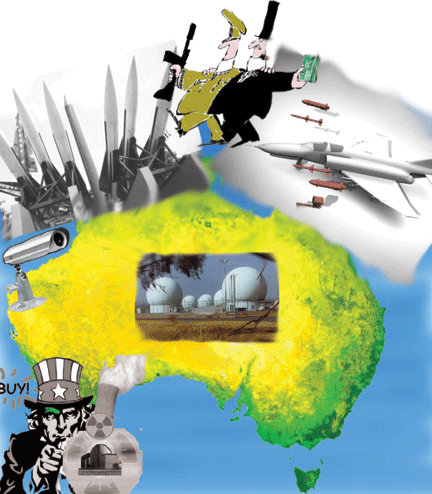
Barely mentioned is the potential of a nuclear power industry to provide a pathway for the development of nuclear weapons: first, by providing a large pool of nuclear scientists, engineers and technicians and, second, by creating the means to manufacture the fissionable material needed for a bomb. The latter would require further heavy investment in either a uranium enrichment plant or a plutonium reprocessing plant, or both.
Such a discussion has been underway largely behind closed doors in strategic and military circles for decades.
WSWS, Peter Symonds, 19 July 24
Federal opposition leader Peter Dutton’s announcement last month that the Liberal-National Coalition would build seven nuclear power plants seeks to overturn longstanding official opposition to nuclear energy, entrenched in state and federal law. Currently, Australia has just one nuclear reactor, operated by the Australian Nuclear Science and Technology Organisation (ANSTO) for research and the production of medical isotopes.
Dutton slammed Prime Minister Anthony Albanese’s Labor government for its reliance on renewables, claiming that nuclear power would provide cheap, reliable, environmentally-friendly energy for households and businesses. He dismissed problematic issues of nuclear waste and safety by pointing out that the Albanese government had already ditched Labor’s nuclear-free policy by embracing the acquisition of nuclear-powered attack submarines under the AUKUS pact with the UK and US.
In the ensuing wave of commentary on the nuclear power proposal, critics derided Dutton’s lack of detail, including costings, and pointed out that nuclear reactors would not be operational for at least a decade. Advocates of the profitable renewable industries touted solar and wind power as the cheap, clean, safe alternatives to nuclear power.
Barely mentioned is the potential of a nuclear power industry to provide a pathway for the development of nuclear weapons: first, by providing a large pool of nuclear scientists, engineers and technicians and, second, by creating the means to manufacture the fissionable material needed for a bomb. The latter would require further heavy investment in either a uranium enrichment plant or a plutonium reprocessing plant, or both.
Such a discussion has been underway largely behind closed doors in strategic and military circles for decades. Plans for an Australian atomic bomb were seriously considered in the 1950s and 1960s, with the 1968‒71 Coalition government of Prime Minister John Gorton taking the first steps in building a nuclear power reactor that provided a route to manufacturing a nuclear weapon.
In the midst of the Cold War, however, Washington was determined to maintain the effective monopoly of its massive nuclear arsenal and thus its use as a menacing threat or in war itself against the Soviet Union or any other potential rival. Under the guise of disarmament, the Nuclear Non-Proliferation Treaty (NPT) banned the manufacture of nuclear weapons except for the five countries with a known nuclear arsenal—the US, the Soviet Union, Britain, France and China—and effectively stymied the Australian project as well as most similar plans by other countries. Australia signed the NPT in 1971 and ratified it in 1973.
The global geopolitical landscape, however, has dramatically changed since the dissolution of the Soviet Union in 1991 and the end of the Cold War. Far from bringing global peace and prosperity, US imperialism has been waging war for the past three decades in a desperate attempt to maintain its global hegemony. Conflicts in the Middle East and Central Asia are now rapidly metastasizing into great power conflicts and world war involving nuclear-armed powers. The US and its NATO allies are already waging war against Russia in Ukraine and, in league with its Asian allies, including Australia, preparing for war against China.
In this context, as the danger of nuclear war looms larger, debate has reemerged in military circles over the building of an Australian atomic bomb. In his book How to Defend Australia, published in 2019, prominent strategic analyst Hugh White devoted an entire chapter to the question: “Does Australia need its own nuclear weapons to preserve its strategic independence in the decades ahead?”
The way White posed the question points to the central argument of the book as a whole—the necessity of Australian imperialism forging a foreign and military policy that does not rely on America’s waning power.
………………………………. In the Indo-Pacific, the US has been preparing for war with China, which Washington regards as the chief threat to its global domination. Far from leaving Australia isolated, the US is integrating the Australian military directly into its war plans against China—the AUKUS pact being the most obvious expression. This places the Australian population on the front lines of such a war.
White speaks for a minority in the ruling class that doubts the wisdom of being drawn into a catastrophic military conflict with Australia’s biggest trade partner. He and others argue for Australian imperialism to adopt a stance of heavily-armed neutrality. While not explicitly calling for an Australian nuclear weapon, White’s book certainly implied its necessity. Grossly inflating the threat posed by China, he argued that without the protection of the US, the only realistic means of countering such a threat is for Australia to have its own nuclear armaments.
……………………………………………………………………………………………………………………US imperialism is already, in reality, engaged in a war with nuclear-armed Russia in Ukraine and making advanced preparations for conflict with nuclear-armed China. The Australian military, including its bases, forms a vital component of the Pentagon’s strategy for fighting a nuclear war and, thus, a potential nuclear target. American nuclear submarines and nuclear-capable strategic bombers are being stationed in western and northern Australia. US spy and communications bases in Australia are indispensable to the US military’s global war plans. In other words, if US imperialism launches nuclear war, Australian imperialism is automatically involved……………………………………………………………………………………..more https://www.wsws.org/en/articles/2024/07/20/qxon-j20.html—
No comments yet.
1 This month
15 April – Zoom –Nuclear Power is Not the Solution
Apr 15, 2026 01:00 AM in Canberra, Melbourne, Sydney

Join the International Physicians for the Prevention of Nuclear War (IPPNW) on Tuesday, April 14th for a timely webinar exploring the risks associated with nuclear power and challenging the myth that it offers a simple, safe, carbon-free solution to the climate crisis

of the week – Australians for War Powers Reform (AWPR)
To see nuclear-related stories in greater depth and intensity
 Antinuclear
Leave a comment