TODAY. The digital system is a threat to the nuclear industry – it’ll get worse with AI

At last, somebody noticed! And the amazing thing is that this warning from think tank Chatham House came on July 12 – 10 days before the global digital outage.
I have wondered about the cybersecurity of nuclear facilities. There have been warnings – that terrorists or “bad actors” – might attack them digitally.
But now – the global collapse of information technology showed the awful truth- things can go wrong with just a teensy little stuffup of “normal” digital operations!
Bad enough if airline booking systems suddenly don’t work, and cash registers at supermarkets don’t work, and all sorts of economic systems grind to an expensive halt.
But what if digital things go wrong in nuclear facilities – reactors, cooling systems, waste management facilities , and hell – nuclear weapons!
But surely, I, a mere amateur, am exaggerating!
Well, the experts at Chatham House are on the same page as I am:
many nuclear plants rely on software that is “built on insecure foundations and requiring frequent patches or updates” or “has reached the end of its supported lifespan and can no longer be updated”.
with operators opting to run the facility by a central computer system without human presence. Increased reliance on cloud systems to run infrastructure is bound to enhance the cybersecurity risks.
Even Chatham House still uses that lying term “cloud” system, when we all know damn well – there is no benign “cloud” – only acres of steel canisters and conglomerations of metal and wires.
We now live in a strange global digital monoculture. A single software update gone wrong and Microsoft Windows computers around the world crash. There is something awfully wrong with our lives being dependent on one, or a very few, digital systems run by great corporations run by a few powerful squillionaires.
And of course, that includes the so-called “defense” systems – limbering up to attack China etc. It’s a sobering thought that Armageddon might come – not from a decision by some evil dictator – but just from a teensy computer glitch.
AI, now being incorporated in weapons systems, might now make digital technology more vulnerable to glitches?
The global IT outage has surely been a wake-up call – as businesses, governments and individuals cope with its expensive after-effects.
But it should be even more of a wake-up call for the public – to think about the danger we are all in, allowing the nuclear industry to proliferate.
Community alliance against Coalition’s nuclear policy

ABC Listen, 22 July 24
Political friction appears to be building in the seven regions set to host government-built nuclear reactors as part of the Coalition’s vision for the future of Australia’s energy mix.
Opposition leader Peter Dutton has visited the Callide coal-fired power station in Queensland, where he has talked up job creation and cheaper energy.
Meanwhile, community organisations in the areas selected in the Coalition’s nuclear policy have joined forces in an anti-nuclear campaign.
Featured:
Peter Dutton, Opposition leader
Wendy Farmer, Voices of the Valley president
James Khan, Collie traditional owner
Credits, Jon Daly, Reporter
Transcript
……………………………….Jon Daly: The Coalition’s earmarked seven sites across five states where it wants to co-locate nuclear reactors with retiring coal-fired power stations. Two will be in Queensland, two in New South Wales and one each for Victoria, South Australia and West Australia. The Opposition claims the sites would make good use of existing transmission lines and local workforces, though Mr Dutton is yet to reveal how much the nuclear builds would cost taxpayers.
Peter Dutton: We’ll have more to say about costings in due course and again as we know in somewhere like Ontario they’re paying a fraction for electricity compared to what we’re paying here. It’s a really important point that nuclear provides cheaper electricity. There’s a big up-front capital cost.
Jon Daly: The Coalition claims the first nuclear plant could be up and running by 2035. The Coalition has flagged two and a half years of local community consultation, but communities would not ultimately be given a chance to veto nuclear plans in their area. In Victoria’s coal heartland of the La Trobe Valley, Voices of the Valley President Wendy Farmer says that’s not consultation, that’s dictation.
Wendy Farmer: In other words, we are going into communities to tell them exactly what the Coalition wants to do and don’t argue with us because that’s what we’re going to do to your regions. That is not the way any community would expect to be treated.
Jon Daly: Voices of the Valley and other community organisations in the seven selected regions have launched an alliance opposing the current plan.
Wendy Farmer: So we thought that by the seven regions getting together, it just gives strength to all the regions and we can support each other. And we can actually do a much louder call for Australians to support the regions to say no to nuclear.
Jon Daly: What’s been the reaction from, say, your local community as the details of this proposal have unfolded?
Wendy Farmer: There’s a mixed reaction, Jon. You know, some do support having nuclear. They want the jobs. Then you’ve got the other people that are just saying we do not want nuclear reactors at all, ever, in our region.
Jon Daly: In West Australia, Collie’s coal-fired power station is closing by 2029 and the town is trying to find industries to replace those lost jobs. The Coalition has picked the town as a site for nuclear power. James Khan is a traditional owner of the area. He’s a Wilman man of the Bibbulmun Nation and he says he’s dead against nuclear energy being built there.
James Khan: Well, my thoughts on that there is negative. It’s a negative. It’s why are we going into something that we don’t know nothing about and it could affect everything, the vicinity of it. Nuclear reactors is too dangerous, too slow and it’s too expensive.
Samantha Donovan: Traditional owner James Khan speaking to our reporter Jon Daly. https://www.abc.net.au/listen/programs/pm/community-alliance-against-coalition-s-nuclear-policy/104128606
Czech nuclear deal shows CSIRO GenCost is too optimistic, and new nukes are hopelessly uneconomic
John Quiggin, Jul 21, 2024, https://reneweconomy.com.au/czech-nuclear-deal-shows-csiro-gencost-is-too-optimistic-and-new-nukes-are-hopelessly-uneconomic/
The big unanswered question about nuclear power in Australia is how much it would cost. The handful of plants completed recently in the US and Europe have run way over time and over budget, but perhaps such failures can be avoided. On the other hand, the relatively successful Barakah project in the United Arab Emirates was undertaken in conditions that aren’t comparable to a democratic high-wage country like Australia. Moreover, the cost of the project, wrapped up in a long-term contract for both construction and maintenance, remains opaque. Most other projects are being constructed by Chinese or Russian firms, not an option for Australia.
In these circumstances, CSIRO’s Gencost project relied mainly on evidence from Korea, one of the few developed countries to maintain a nuclear construction program. Adjusting for the costs of starting from scratch, CSIRO has come up with an estimated construction cost for a 1000 MW nuclear plant of at least $A8.6 billion, leading to an estimated Levelised Cost of Energy (LCOE) of between $163/MWh-$264/MWh, for large-scale nuclear. But, given the limited evidence base, critics like Dick Smith have been able to argue that CSIRO has overestimated the capital costs.
Thanks to a recent announcement from Czechia, we now have the basis for a more informed estimate. Ever since the commissioning its last nuclear plant in 2003, Czech governments have sought commercial agreements for the construction of more nuclear power plants, with little success until recently.
Finally, after a process beginning in 2020, the Czech government sought tenders from three firms to build at least two, and possibly four 1000 MW reactors. After Westinghouse was excluded for unspecified failures to meet tender conditions, two contenders remained: EDF and KNHP. On 17 July it was announced that KNHP had submitted the winning bid, which, coincidentally, set the cost per GW at $8.6 billion.
Sadly for nuclear advocates, that figure is in $US. Converted to $A, it’s 12.8 billion, around 50 per cent more than the CSIRO Gencost estimate. At that price, the LCOE, even on the most favorable assumptions, will exceed $225/MWh.
And unlike the case in Australia, Czechia is offering a brownfield site, at no additional cost. The new plants will replace existing Soviet-era reactors at Dukovany. By contrast, in Australia under Dutton’s proposals, the costs of a nuclear plant would need to include the compulsory acquisition of existing sites, from mostly unwilling vendors.
The bad news doesn’t stop there. The (inevitably optimistic) target date for electricity generation is 2038, about the time Australia’s last coal plants will be closing. But the Czechs have at least a five year head start on Australia, even assuming that a Dutton government could begin a tender process soon after taking office. In reality, it would be necessary to establish and staff both a publicly owned nuclear generation enterprise and a nuclear regulatory agency with an appropriate legislative framework.
And there’s one more wrinkle. Westinghouse, excluded from the Czech bid is engaged on long-running litigation with KNHP, claiming a breach of intellectual property. It’s been unsuccessful so far, but a final ruling is not expected until 2025. If Westinghouse succeeds, the Czech project will almost certainly be delayed.
Summing up, taking the Czech announcement as a baseline, building two to four 1000 MW nuclear plants in Australia would probably cost $50-$100 billion, and not be complete until well into the 2040s.
If nuclear power is so costly, why have the Czechs chosen to pursue this technology. The explanation is partly historical. The former Czechoslovakia was an early adopter of nuclear power and, despite the usual delays and cost overruns, enthusiasm for the technology seems to have persisted.
More significant, however, is the influence of one man, Vaclav Klaus, a dominant figure in Czech politics from the dissolution of the Soviet bloc to the 2010s. Apart from sharing the same first name, Klaus has little in common with the architect of Czech freedom, Vaclav Havel. Klaus was, and remains an extreme climate science denialist, whose views are reflected by the rightwing party he founded, the Civic Democratic Party (ODS). Although Klaus himself left office under a cloud in 2013, ODS remained a dominant force.
The current Czech Prime Minister, Petr Fiala (also ODS) has followed the same evolution as other ‘sceptics’, shifting from outright denial to what Chris Bowen has described as “all-too-hard-ism”. And with high carbon prices in Europe, persisting with coal is even less tenable than in Australia. In political terms, nuclear power is the ideal solution to the problem of replacing coal without embracing renewables. It’s just a pity about the economics.
With luck, Australia can learn from the Czech lesson. Even under the favorable conditions of a brownfield site and an established nuclear industry, new nuclear power is hopelessly uneconomic.
John Quiggin is a professor of economics at the University of Queensland.
Defence Industry Minister Pat Conroy downplays Rockingham residents’ concerns of AUKUS nuclear waste storage
advocacy group the Medical Association for Prevention of War [MAPW] said Mr Conroy was wrong to equate nuclear submarine waste with medical waste.
“The vast majority of nuclear waste from hospitals is very short-lived waste or very low level waste, both of which go to normal rubbish streams after a month or two,” MAPW vice-president Margaret Beavis said in a statement.
“The proposed submarine waste is low level waste (LLW), which needs isolation from the environment for 300 years.”
By Nicolas Perpitch, 23 July 24 https://www.abc.net.au/news/2024-07-23/pat-conroy-rockingham-garden-island-aukus-nuclear-waste-storage/104131462
In short:
The government has plans to temporarily store nuclear waste arising from its AUKUS contracts on Garden Island.
Residents in the nearby City of Rockingham have expressed concern about that, but the Defence Industry Minister says people shouldn’t worry.
What’s next?
The waste’s final storage place is unknown at this point, with the minister saying it will be on defence land.
The Albanese government has sought to dispel community concerns surrounding a planned radioactive waste management site off Perth’s coast for AUKUS nuclear submarines.
It comes as the chiefs of navy of the three AUKUS countries — the United States, the United Kingdom and Australia — met for the first time at the HMAS Stirling naval base on Garden Island, 50 kilometres south of the Perth CBD and about five kilometres off the coast of Rockingham, where the submarines will dock and be serviced.
The Australian Radiation Protection and Nuclear Safety Agency (ARPANSA), the nuclear safety watchdog, has issued a licence to the Australian Submarine Agency to prepare a site on HMAS Stirling for a low-level radiation waste management and maintenance site, to be known as the “Controlled Industrial Facility”.
It will be a workshop for servicing and repairing the nuclear submarines and will temporarily store the waste.
Some Rockingham residents have expressed alarm at the prospect of a radiation site just off the coast.
Among the submissions to ARPANSA on the facility, concerns were expressed about residents’ safety and the potential for radiation leaks.
But federal Defence Industry Minister Pat Conroy has sought to ease those fears, saying there was no risk to the community.
“This is akin to what occurs in 100 other sites around the country, anywhere that has a hospital that deals with medical imagery that involves radioactive isotopes has exactly the same level of waste,” Mr Conroy said.
Specifically, the radioactive waste would be material that Australian sailors and civilians use to maintain the nuclear submarines.
“Think things like gloves, and other things that naturally become slightly radioactive as they handle componentry. So this is not other people’s waste. This is Australian waste,” Mr Conroy said.
However, advocacy group the Medical Association for Prevention of War [MAPW] said Mr Conroy was wrong to equate nuclear submarine waste with medical waste.
“The vast majority of nuclear waste from hospitals is very short-lived waste or very low level waste, both of which go to normal rubbish streams after a month or two,” MAPW vice-president Margaret Beavis said in a statement.
“The proposed submarine waste is low level waste (LLW), which needs isolation from the environment for 300 years.”
Final storage site unknown
The radioactive waste will be temporarily stored at the HMAS Stirling site, before it is taken to a permanent repository elsewhere for AUKUS-nuclear submarine reactors and related radioactive waste.
But Mr Conroy did not say where that would be, only that it would be on defence land to be acquired by the defence forces.
Under the AUKUS security agreement with the United States and the United Kingdom announced in 2021, Australia will acquire nuclear technology to build and sustain its own nuclear submarines.
ARPANSA received 165 submissions about the waste and workshop facility proposal during a 30-day consultation period, but has not made them publicly available.
The facility will also need separate approvals for construction and operation.
Nuclear + Solar In Australia = A Huge Waste Of Energy
July 23, 2024 by Michael Bloch, https://www.solarquotes.com.au/blog/nuclear-renewables-australia-mb2969/
The operation of just one nuclear power station in Queensland would require cutting off renewable energy output equivalent to tens of thousands of home solar power systems every day says Queensland Conservation Council (QCC).
The Coalition wants to see nuclear plants at what are or will eventually be shuttered coal power sites around the country, including two in Queensland – one at Callide and the other at Tarong. The Coalition’s plan would mean increased burning of fossil fuels for many years while these power stations are being constructed. Australia’s existing ban aside, nuclear power plants are incredibly expensive and slow to build, and nuclear power doesn’t play well with renewable energy.
Nuclear power stations can’t be switched on and off as demand dictates. While output can be dialled down to a degree, there may still often be electricity surplus to demand during the “solar window” each day; and this could pose a threat to grid stability.
Nuclear-Powered Home Solar Shutdowns?
Something has to give during these times – either the expensive nuclear electricity or the cheap power from renewable energy. This could include home solar systems.
The tools needed for remote solar power system shutdowns are already in place in Queensland. Ergon Energy and Energex have the capability to remotely switch off some systems via a “dumb” device called a GSD, which is meant to be a tool of last-resort.
But “last resort” may become more common in a grid with nuclear power. And it’s simply not needed, as by the time the first nuclear plant could be built – around 2040 at the earliest – technologies such as batteries and pumped hydro should be providing the flexible storage needed to support renewables.
According to Queensland Conservation Council:
“Baseload generation is what our power system was built on, but it’s not what we need in the future. Saying that we need baseload generation is like saying that we need floppy disks to transfer files between computers.”
In its report titled Delayed Reaction: Why Queensland Will Never Need Nuclear Energy, the QCC estimates 3,700 GWh of cheap renewable energy would need to be wasted every year just to allow a single 1GW nuclear power station to run.
“This means the equivalent of an average of 45,000 Queensland household solar systems would need to be shut off every day.”
The organisation bases its estimates on the Australian Energy Market Operator’s “Step Change” scenario in the AEMO’s 2024 Integrated System Plan.
Queensland is not an island. Interconnectors between the state and New South Wales allow it to export power south. But if the Coalition’s plans reach fruition, there may not be anywhere to export it to. Whether it’s shutting down home solar or more curtailment of large-scale wind and PV, the “solution” is an awful waste of cheap-as-chips power.
Nuclear Spectre Scaring Investors
Even if the Coalition’s nuclear dream isn’t achieved, that it exists is starting to make some renewable energy investors nervous. Policy uncertainty has held back Australia’s renewable energy transition in years gone by. This rehashed nuclear debate has the potential do the same.
Raising this rotten old chestnut (yet again) seems to be an Opposition specialty. Whichever way it turns out, the distraction of nuclear power in Australia will be a huge waste of time, money – and energy.
Queensland has nearly doubled its renewable energy capacity in five years says QCC. While there are plenty of large-scale facilities operating or currently under construction, a significant part of the growth is associated with home solar power in QLD. This has fundamentally changed when the state needs energy to support the grid and QCC believes it’s where the Opposition should be directing its attention.
“We would like to see the Federal Opposition focus on a real plan for bringing down emissions and power prices and that would mean backing renewable energy and storage.”
Peter Dutton visits Queensland back country in nuclear energy push

Peter Dutton has hit the sticks to promote his controversial nuclear energy plan but remains mum on how much the “essential” project will cost.
news.com.au Nathan Schmidt, July 22, 2024
Opposition Leader Peter Dutton has for the first time spruiked the Coalition’s controversial nuclear energy plan in an electorate earmarked for a new “modular reactor”, promising the ambitious project will be more efficient than replacing wind turbines “every 25 years”.
The Liberal leader on Monday championed the contested energy project in Mount Murchison, a town of little more than 100 people in the Shire of Banana on Queensland’s central coast, following the unveiling earlier this year of the Coalition’s nuclear energy plan.
Mr Dutton flagged seven sites – two in Queensland and NSW and one each in South Australia, Victoria, and Western Australia – for potential new small-scale nuclear reactors under the plan that he promised to take to the next federal election in 2025.
Despite pushback from energy experts about the proposal’s feasibility, Mr Dutton said nuclear power would be “good for jobs” and “the underpinning of 24/7 reliable power into the future”, blaming Labor for warnings about future power shortages.
“The Coalition’s policy of renewables and gas and of nuclear (power) is absolutely essential to keeping the lights on, to having cheaper power and to making sure that we can reduce our emissions,” Mr Dutton said on Monday alongside Liberal Flynn MP Colin Boyce.
He claimed warnings by the energy regulator about brownouts were based on Labor policies. “The PM and Chris Bowen have us on this 100 per cent renewables-only path which is what’s driving up the price of your power bill. It’s what is making our system unreliable,” Mr Dutton said.
“If we want to have cheaper power, if we want greener power, and if we want reliable power, then nuclear is the way in which we’ll provide that 24/7 power into the future … let’s have an honest discussion because Australians are really struggling under this government.”…………………………………………………..
Under the plan, the Coalition proposed the government would fund the construction of the plants in partnership with experienced nuclear energy companies. The government would own the sites in a similar system set-up to the Snowy Hydro and NBN networks. https://www.news.com.au/technology/environment/sustainability/peter-dutton-visits-queensland-back-country-in-nuclear-energy-push/news-story/c4c311c83edf71a99738c76c484fc542
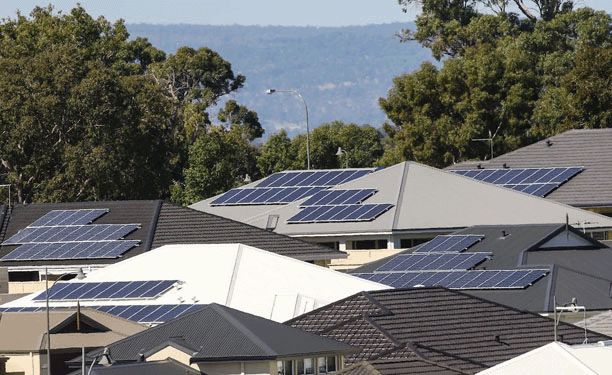
One nuclear plant could see 45,000 rooftop solar systems shut off each day
Sophie Vorrath, Jul 22, 2024, https://reneweconomy.com.au/one-nuclear-plant-could-see-45000-rooftop-solar-systems-shut-off-each-day/
The extent to which the federal Coalition’s nuclear power plans clash with Australia’s world-leading rooftop solar uptake has been highlighted by new analysis that estimates tens of thousands of residential PV systems would have to be shut off on a daily basis to allow just one nuclear plant to operate.
The Queensland Conservation Council report models the potential impact of nuclear power on the Sunshine State’s future grid by measuring it against the latest projections of the Australian Energy Market Operator’ in its’s 2024 Integrated System Plan.
The ISP sets out a detailed 20 year plan for how Australia will meet its energy needs while retiring all coal fired power stations by 2040, using mostly renewable energy and storage. Nuclear is not a part of this plan.
Using the most likely scenario of the ISP, the Step Change, the QCC finds that adding just one, 1GW nuclear plant to the equation in 2040 would displace more than 3,700 GWh of cheap renewables, due to the inflexible nature of “always on” nuclear power generation.
“A [1,000MW] nuclear power station, which can only run down to 500 MW …would usually be supplying more energy than the system needs (Figure 6),” the report says.
“This means the equivalent of an average of 45,000 Queensland household solar systems would need to be shut off every day. We would be shutting off cheap energy, like people’s rooftop solar, to allow expensive nuclear power to run.
“This report shows that, even if large-scale nuclear energy can be built in 15 years in Australia, we won’t need it.”
The new data supports what just about every other informed participant in Australia’s energy transition – from the market operator, to regulators, policy makers, utilities and the energy market itself – understand, and have been saying, about what will and won’t work in a grid that is changing dramatically.
And just last week, the University of Western Australia’s Bill Grace gave his own detailed analysis of why the sort of baseload power nuclear provides “is no longer necessary or commercially viable.”
QCC energy strategist Claire Silcock says this week’s report confirms that nuclear power has no place on Australia’s grid and isn’t what is needed to meet future energy demands at least cost.
“What we need is flexible generation and storage which can move energy from when we have lots of it, in the middle of the day, to when we need it overnight,” Silcock says. “That is not how nuclear power stations work.
“The earliest we could possibly build a nuclear power plant in Australia is 2040 – by then we will have abundant renewable energy and technology like batteries and pumped hydro will be providing the flexible storage we need to support that renewable energy.
“Nuclear is also much more expensive than renewable energy backed by storage,” she adds.
“It’s as clear as day that the federal Coalition’s nuclear plan is a fantasy to delay the closure of Australia’s polluting coal-fired power stations.
“We would like to see the federal opposition focus on a real plan for bringing down emissions and power prices and that would mean backing renewable energy and storage.”
Sophie Vorrath Sophie is editor of One Step Off The Grid and deputy editor of its sister site, Renew Economy. She is the co-host of the Solar Insiders Podcast. Sophie has been writing about clean energy for more than a decade.
1 This month
15 April – Zoom –Nuclear Power is Not the Solution
Apr 15, 2026 01:00 AM in Canberra, Melbourne, Sydney

Join the International Physicians for the Prevention of Nuclear War (IPPNW) on Tuesday, April 14th for a timely webinar exploring the risks associated with nuclear power and challenging the myth that it offers a simple, safe, carbon-free solution to the climate crisis

of the week – Australians for War Powers Reform (AWPR)
To see nuclear-related stories in greater depth and intensity
 Antinuclear