Jabiluka uranium mine lease not renewed in decision heralded as ‘huge win’

NT government opts not to grant 10-year lease after considering wishes of Indigenous people and federal government advice
Australian Associated Press, Fri 26 Jul 2024, https://www.theguardian.com/australia-news/article/2024/jul/26/jabiluka-uranium-mine-lease-not-renewed-in-decision-heralded-as-huge-win?CMP
The lease on the Northern Territory’s Jabiluka uranium mine will not be renewed, months after its remote surrounding area was granted new protections.
Energy Resources Australia (ERA) had applied for a 10-year lease renewal on the Jabiluka uranium mine, but was knocked back on Friday.
The NT mining minister, Mark Monaghan, said the decision to not renew was based partially on advice from the federal government.
“We have gone through a thorough process to ensure that all stakeholder views have been considered in this decision,” he said.
“The federal government advice, along with the wishes of the Mirarr people, were critical to this process and outcome.”
The Northern Territory government declared special reserve status over the Jabiluka area, which is in the surrounds of Kakadu national park, in May.
This prevents any future applications for the grant of a mineral title over the Jabiluka area once the current lease ceases on 11 August.
The Australian Conservation Foundation welcomed the decision, calling it a “huge win” for traditional owners.
“This decision allows a line to be drawn under the divisive era of uranium mining in Kakadu,” a statement read.
“This is a responsible decision that ends the threat that has hovered over this very special place for four decades.”
Mirarr people have long opposed any mining in the area, holding protests in the late 1990s and early 2000s when more than 5,000 people travelled to Kakadu to prevent uranium mining at Jabiluka.
Energy Resources of Australia, a subsidiary of the Rio Tinto Group, has been contacted for comment
A $36.8 billion lesson from Georgia, USA, – “The most expensive electricity in the world”
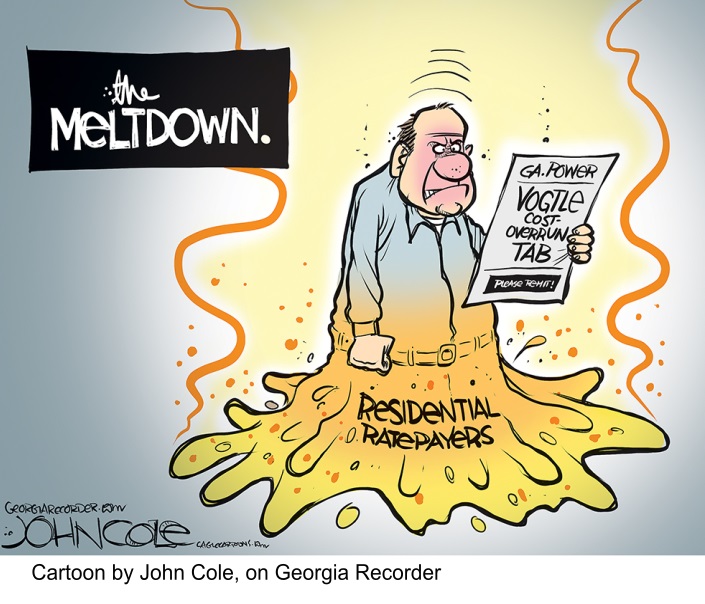
In May, the plaintiffs along with four other prominent Georgia consumer groups released a report, Plant Vogtle: The True Cost of Nuclear Power in the United States. The analysis detailed how the U.S. Department of Energy, Georgia Power, and the Georgia Public Service Commission (PSC), conspired to force Georgians into purchasing the most expensive electricity in the world, costing ratepayers $10,784 per kilowatt, compared to $900 to $1,500 per kilowatt (KW) for wind or solar. Recent Georgia Power electricity bills have shown the bill increase to be in the 30-40% range.
Again and again, the Georgia Public Service Commission (PSC) was warned about the astronomical cost of the Vogtle reactors and the financial toll it will bear on Georgians for decades to come.
Ratepayers beware. New nuclear power plants will gouge customers
From Georgia Conservation Voters Education Fund and Georgia WAND
Georgia consumer groups have filed a major lawsuit against the State of Georgia [AF1] in federal court, alleging Georgia lawmakers violated the state’s constitution by unilaterally postponing Georgia Public Service Commission (PSC) elections. According to the lawsuit, the PSC election’s unlawful postponement allowed the sitting commission members to rubberstamp the largest utility rate increases in Georgia history and grant utility companies the authority to charge Georgians for cost-overruns and mishaps. The groups argue that the charges may not have been passed onto consumers if elections were held as regularly scheduled.
House Bill 1312, which Georgia legislators passed in April, delays the election of new PSC members until at least 2025, giving multiple sitting PSC members an extra two years in office. Georgia’s constitution requires that PSC terms shall be six years, and therefore cannot be lengthened without a constitutional amendment. All PSC members have had their office terms extended to eight years, and one nine years as a result.
…………………………………….Brionté McCorkle, plaintiff and executive director of Georgia Conservation Voters Education Fund, said: “Georgians are fighting every month to stay ahead of rising costs for food, housing, and now energy. These aren’t optional costs. They’re things we need to survive. Public Service Commissioners like Tricia Pridemore, Fitz Johnson, and Tim Echols have allowed Georgia Power to take money out of the pockets of hard-working Georgians – and it has to end.”
In May, the plaintiffs along with four other prominent Georgia consumer groups released a report, Plant Vogtle: The True Cost of Nuclear Power in the United States. The analysis detailed how the U.S. Department of Energy, Georgia Power, and the Georgia Public Service Commission (PSC), conspired to force Georgians into purchasing the most expensive electricity in the world, costing ratepayers $10,784 per kilowatt, compared to $900 to $1,500 per kilowatt (KW) for wind or solar. Recent Georgia Power electricity bills have shown the bill increase to be in the 30-40% range.
Additional Key findings in the May Vogtle report included:
- Plant Vogtle allowed Georgia Power to expand its rate base, the assets on which they earn a guaranteed rate of return, by over $11 billion. Yet their share of Vogtle is 1,020 megawatts, making it the most expensive electricity in the world at $10,784/KW. Normal (wind, solar, natural gas) generation prices range from $900 to $1500/KW.
- Vogtle Units 3 & 4 took 15 years to build and cost $36.8 billion, well over twice the projected timeline and cost.
- Vogtle independent construction monitors documented that Georgia Power provided materially false cost estimates for at least ten years, falsehoods used to justify expanding Plant Vogtle. Similar false cost estimates sent South Carolina utility executives to jail for that state’s failed nuclear plant, which started construction at the same time as Plant Vogtle.
Patty Durand, consumer advocate, founder of Cool Planet Solutions and a recent candidate for the Georgia PSC, said:
“Again and again, the Georgia Public Service Commission (PSC) was warned about the astronomical cost of the Vogtle reactors and the financial toll it will bear on Georgians for decades to come. Commissioners repeatedly declined to protect ratepayers from cost overruns and ignored PSC staff recommendations to cancel the project. People went to prison for actions like this in South Carolina, yet we have had no accountability for the same, and worse, behavior here. Instead, the state legislature decided to shield current commissioners from facing voters by delaying PSC elections indefinitely. This is clearly unconstitutional. This is un-American.” https://beyondnuclearinternational.org/2024/07/28/a-36-8-billion-lesson-from-georgia/
Respect and responsibility: Jabiluka safe as uranium mining lease for Kakadu site not renewed.

The Australian Conservation Foundation has welcomed the decision of the federal and Northern Territory governments to not extend the uranium mining lease over Jabiluka, in Kakadu, which has been held by Energy Resources Australia (ERA) for more than 40 years.
“This is a responsible decision that ends the threat that has hovered over this very special place for four decades,” said ACF’s nuclear free campaigner Dave Sweeney.
“This is a huge win for the Mirarr Traditional Owners and for all who love Kakadu, Australia’s largest national park.
“It is a tribute to people’s concern and action over decades.
“It is a testament in particular to the sustained and unwavering efforts of the Mirarr, led by Yvonne Margarula, to defend their country and culture against the damage that inevitably accompanies uranium mining.
“This decision allows a line to be drawn under the divisive era of uranium mining in Kakadu.
“ERA’s full attention should now turn to cleaning up the mess left at the Ranger uranium mine, also on Mirarr country.
“ACF commends the federal government and looks forward to the government working with the Mirarr to advance the Ranger rehabilitation and the lasting protection of this magnificent region and the Kakadu World Heritage area.”
The Mirarr led a successful campaign 25 years ago to stop uranium mining at Jabiluka.
ACF has proudly walked alongside the Mirrar on this journey.
Solar doesn’t need a toxic “friendship” with nuclear power
Heidi Lee Douglas, Jul 26, 2024. https://reneweconomy.com.au/solar-doesnt-need-a-toxic-friendship-with-nuclear-power/
Federal Opposition Leader Peter Dutton has been in regional Queensland this week promoting hi nuclear plan, which claims nuclear and solar both have a future in Australia’s energy mix.
Yeah, nah.
A new report released this week by the Queensland Conservation Council has revealed building a 1,000 MW nuclear power station in Queensland in 2040 would knock out 3,700 GWh of cheap renewable energy from the grid.
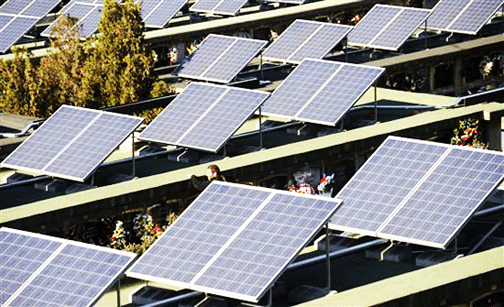
It is the equivalent of shutting an average of 45,000 Queensland household solar systems every day, according to the new analysis.
The report reinforces what other experts are saying – that rooftop solar and nuclear cannot co-exist – and reveals just how detrimental any proposal for nuclear would be for Queensland solar homeowners’ hip pockets.
To make nuclear power plants economically viable, nuclear must run at full capacity. That means a direct clash with rooftop solar whenever the sun is up, and to enable nuclear power production during the day they’ll have to stop rooftop solar panels from exporting to the grid.
The simple truth is adding nuclear power to the Australian energy mix will undermine the interest of rooftop solar owners.
Australia has an abundance of sunshine and renewable resources. Queensland already leads the world with uptake of household-scale solar, with the Sunshine State reaching a record 1 million rooftop solar installations earlier this year.
The second, third, fourth and fifth highest rates of rooftop solar output in Australia are in Bundaberg, Mackay, Toowoomba and Hervey Bay. These communities have the most to lose if their solar output is shut off during the day by nuclear.
With more Australian households nationwide having rooftop solar than swimming pools, it’s time for the Liberals and Nationals to start listening and stop ignoring people power, literally and politically.
Australians have already voted with their rooftops for cheaper, cleaner solar energy, with more than three million rooftop solar installations. Australians have a strong and abiding love of the cost saving, independence and security that comes from making their own solar power.
In fact we’ve invested $25 billion of our own money into rooftop solar, and are the envy of the eye worldwide for our home-grown renewable energy.
Everyday Australians are world leading energy producers – not just energy consumers. Every home solar rooftop should be treated with the respect of being a sustainable home solar energy “farmer”, bringing the cost of power down for all Australians, and simultaebously reducing our carbon emissions.
At Solar Citizens we work with community members from across the political spectrum who, time and again, have been vocal in support of solar because they are empowered by rooftop solar. We know how strong this movement of solar homeowners is. And it would be unwise for political leaders to forget it.
A smarter government investment would be to grow access to rooftop solar for households currently locked out of the benefits of clean energy including renters, people living in apartments or social housing and low-income households. And provide Australian households with assistance for a battery rebate, like the highly succcessful solar rebate.
Enabling more people to install home batteries will mean we can store cleaner, cheaper energy during the day and use it at night or when needed most. This would provide long term energy relief for households, improve our power network reliability and help cut network costs for all by avoiding transmission costs.
Rooftop solar coupled with home batteries delivers the win-win of cost-of-living relief with cheaper power and less climate pollution.
Put simply, solar and renewables would not happily co-exist in a toxic ‘frenemy” relationship’ with nuclear. Instead, we urgently need a great Aussie marriage of home solar with home batteries.
Heidi Lee Douglas is CEO of Solar Citizens, an independent, community-based organisation working to protect and grow solar and renewable energy and clean transport in Australia.
Forget nuclear: 5B says plunging price of PV means giga-scale solar farms the future for old coal plants
Sophie Vorrath, Jul 26, 2024, RenewEconomy,
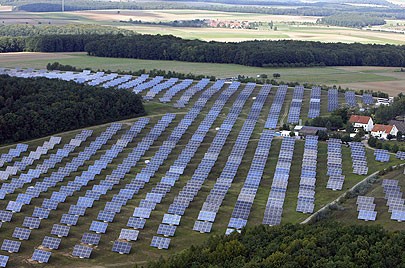
Australian solar innovator 5B says the plunging price of photovoltaic technology has made the company’s prefabricated Maverick arrays cost-competitive with single axis tracking solar plants – and in some cases cheaper, depending on the quality of the solar resource.
In a presentation to the Large-scale Renewable Generation & Storage Summit in Sydney on Thursday, 5B deputy CEO Nicole Kuepper-Russell said the company’s value proposition was “really singing” since module prices fell to just over 10 cents per watt in China in March.
The low cost of solar was a hot topic at the conference, as was the falling cost of storage.
In a presentation by former Clean Energy Finance Corporation chief Oliver Yates, the renewables investment guru argued cheaper batteries mean most existing government and industry plans should be “shredded and start again” to account for the “new solar/battery economic frontier.”
Representing Valent Energy – the energy storage focused joint venture between Gaw Capital and BW ESS – Yates said the cost of dispatchable renewables was now around $200/MWh – $65/MWh for solar production and $135/MWh for battery storage – and “anything producing power higher than that is ridiculous.”
For 5B – as Kuepper-Russell’s presentation illustrated, below [on original]– the levelised cost of energy for a solar project using its Maverick arrays hit price parity with the LCOE of single axis tracker solar towards the end of last year, and has steadily become cheaper as panel prices continue to fall……………………………………………………………………………………………………………………… more https://reneweconomy.com.au/forget-nuclear-5b-says-plunging-price-of-pv-means-giga-scale-solar-farms-the-future-for-old-coal-plants/
Coalition to fast-track nuclear power.

Pearls and Irritations, By Ian McAuley, Jul 27, 2024
The Coalition’s nuclear power idea is based on an obsolete model of electricity supply
Circulating in the media are three arguments against nuclear power in Australia. One is based on safety, an emotive issue, involving unresolved questions about future costs, and the dangers are probably overstated. The danger issue doesn’t need to be argued, however, because the main problems with the Coalition’s nuclear power plans have to do with cost and the long time before the first kWh would be generated.
Those impediments were confirmed in a speech earlier this month by AEMO CEO Daniel Westerman: Australia’s energy transition: What’s needed to keep the momentum going. He said:
Our ISP [Integrated System Plan] does not model nuclear power because it is not permitted by Australian law, and development of nuclear power generation is not a policy of any government. But we know from our work with the CSIRO on the GenCost report that nuclear is comparatively expensive, and has a long lead time. Even on the most optimistic outlook, nuclear power won’t be ready in time for the exit of Australia’s coal-fired power stations.
The Australian Academy of Technological Sciences and Engineering has just released an assessment of the viability of small modular nuclear reactors, which feature strongly in the Coalition’s proposals. These reactors are still at an early development stage: it will be many years before they become established. Although the study does not explicitly address costs, it does point out that early adopters are likely to face much higher costs than those who wait for SMRs s to become a mature product. As ATSE President Katherine Woodthorpe explains on ABC Breakfast, small modular reactors are unlikely to become a realistic energy source in Australia for decades, and our large coal-fired generators are closing in the next few years.
Writing in The Conversation Asma Aziz of Edith Cowan University reminds us of another cost component not covered in the Coalition’s plans: Without a massive grid upgrade, the Coalition’s nuclear plan faces a high-voltage hurdle. The Coalition’s idea is about replacing retiring coal-fired generators with nuclear plants, plugged into the existing transmission infrastructure. But as she points out, demand for electricity is growing rapidly, which means the cost of upgrading the transmission network should be included in the Coalition’s plans. (It is already included in the costings for renewable energy.) The other point she stresses is that all power plants, whatever their technologies, are subject to outages, planned and unplanned. A distributed set of comparatively small solar and wind plants therefore need less transmission redundancy than large centralized nuclear plants.
There is a fourth, and more basic problem with the Coalition’s nuclear proposal. It’s based on an old and inflexible “base load” model, which was determined by the technology of coal-fired generation. There has to be enough capacity in the system to cope with demand peaks, and that was achieved by keeping the boilers hot, keeping the generators spinning, and shovelling in heaps of coal as demand rose. Nuclear is a little different, in that shovels aren’t involved, but the principle is the same.
There are now more flexible and lower-cost ways to meet peaks……………………………………………………………
All the above is in the context of a debate about the comparative cost of nuclear energy and renewables. The Australian community is being distracted from that debate, because the Murdoch media and Coalition-aligned think tanks are spreading absurd misinformation and disinformation about the cost of renewable energy. ……
Even if nuclear power plants were cheaper than renewables (they’re certainly not), there is no way they could replace coal-fired stations as they come to the end of their lives. The lead time for nuclear power is just too long. As Michael West explains, there is a constellation of forces, including the Institute of Public Affairs, Putin’s mate Tucker Carlson, and the Murdoch media, pushing to keep oil and gas burning. That would have to involve new “base-load” coal-fired stations: there is no way to extend the life of our old stations for twenty or more years while nuclear power gets developed.
The other driver of the Coalition’s policy is an intention to cripple the renewable industry through creating uncertainty. That way they can confirm their claim that the government’s renewable plans are failing. It’s doubtful that any seriously cashed-up investor is convinced by the Coalition’s nuclear argument, but the belief that next year’s election could see the election of a government of Trumpian crazies is enough to make investors cautious. ………………more https://johnmenadue.com/coalition-to-fast-track-nuclear-power-north-korean-style-weekly-roundup/
1 This month

of the week – Australians for War Powers Reform (AWPR)
To see nuclear-related stories in greater depth and intensity
 Antinuclear