Nuclear plant trips due to fire, and battery storage steps in to stabilises the grid
What happens when a giant nuclear power station
suddenly goes off line? It’s a question that market operators have to ask
themselves all the time.
The biggest units on the grid are generally
nuclear, in those countries that have them, and a considerable amount of
planning and expense needs to make sure that the back-up is on hand,
despite the insistence by some of the whackier pro-nuclear spruikers in
Australia that no storage or gas is needed.
According to Grid Status, which
monitors grid operations in the US, the frequency excursion was arrested by
a rapid response from the state’s rapidly growing portfolio of big
battery projects. “Immediately, grid frequency declined,” Grid Status
noted in a post on LinkedIn and X. “An excursion below critical levels
required a fast response by ERCOT to ensure stability of the grid. In this
case, ERCOT swiftly deployed ancillary services, including a significant
amount of batteries providing ECRS, to boost the frequency back to
normal.” ERCOT is the Electricity reliability Council of Texas, which
manages the grid. ECRS refers to the contingency reserve service. The big
batteries were back in action a few days later when one of the state’s
coal fired power station units also tripped.
Texas is expected to more than
double its battery storage capacity in 2024, adding around 6.4 GW of
battery capacity (with varying levels of storage), to the 5.5 GW that
existed before.
Renew Economy 1st Aug 2024
Israel lobby ramps up scare campaigns in fear of truth
By Bilal Cleland | 1 August 2024, https://independentaustralia.net/politics/politics-display/israel-lobby-ramps-up-scare-campaigns-in-fear-of-truth,18826
Israel lobby groups have increased efforts to silence those accusing the nation of genocide in Gaza, writes Bilal Cleland.
SHAIMA FARWANEH, 16, in the coastal displacement camp in al-Mawasi, west of Khan Younis, was preparing to make breakfast for her family on 13 July when the Israeli bombs fell.
Ninety people, mainly women and children, were killed and over 300 injured.
Shaima told Mondoweiss:
There is no country in all the world that does this to children, women, and civilians. This isn’t how wars are.
A leg hit me and I saw dismembered bodies a few metres away. I saw a young child screaming. He lost his lower limbs and was crawling on his hands and screaming. The bombs didn’t stop and suddenly the boy disappeared. I saw how he vanished before me while we ran and lowered our eyes to the ground, unable to do anything but run.
Israel in trouble
Following 7 October, by the end of 2023, from over 4,000 immigrants a month only about 1,000 a month were arriving in Israel. A 70 per cent decline.
In that same couple of months, about 470,000 Israelis fled.
As reported in Anadolu Ajansi:
‘Therefore, there is a negative migration of about half a million people, and this does not include thousands of foreign workers, refugees and diplomats who left the country.’
Despite the support given to Israeli Prime Minister Benjamin Netanyahu by the ruling parties across North America, much of Europe and Australia, one in four Israeli Jews and four in ten Arab Israelis would like to leave Israel according to a new survey. This reflects ‘a steady distrust with Israel’s political and military leadership’.
International institutions closing in
Haaretz published the stunning International Court of Justice (ICJ) findings on the Israeli occupation of Palestinian territory:
- Israel must end its presence in the occupied territories as soon as possible.
- Israel should immediately cease settlement expansion and evacuate all settlers from the occupied areas.
- Israel is required to make reparations for the damage caused to the local and lawful population in the Palestinian territories.
- The international community and organisations have a duty not to recognise the Israeli presence in the territories as legal and to avoid supporting its maintenance.
- The UN should consider what actions are necessary to end the Israeli presence in the territories as soon as possible.
The International Criminal Court (ICC) in The Hague is expected to issue arrest warrants for Netanyahu and Defence Minister Yoav Gallant within a fortnight.
Conflating opposition to genocide with anti-Semitism
The United States makes much of the role of the Iranian Council of Guardians selecting acceptable candidates for political office but ignores the role of its own Council of Guardians, AIPAC, which decides on suitable candidates for office.
U.S. Congressman Jamaal Bowman, once a recipient of lobby largesse, after seeing reality in Palestine on a J Street-funded excursion, called Gaza a genocide and said boycotts were legitimate.
Israeli lobby groups spent $9.9 million in a Democrat primary to get rid of him in favour of a supporter of Israel.
The scare campaign around rising anti-Semitism, which conflates criticism of Israel’s mass atrocities with prejudice against Jews, is a feature of most of the old colonial countries.
Mary Kostakidis, one of Australia’s most respected journalists, who speaks truth to power, has written regarding the Israeli genocide in Gaza:
‘In an effort to silence me, the Zionist Federation have filed a complaint with the [Australian Human Rights Commission] for racial vilification, aided by a reporter who can’t do his own research.’
The lobby levelled another case of harassment and suspicious accusations against a Palestinian Australian engaged in anti-genocide activity.
Hash Tayeh, who had to present himself to the police over alleged anti-Semitic comments, was not charged and his matter has been referred to the Office of Public Prosecutions.
His Caulfield Burgertory outlet was set on fire, allegedly by two men, on 10 November, an attack he claimed was linked to his involvement in a pro-Palestine rally and thus a hate crime.
Then we witnessed the arrest of a Palestinian activist in the Prime Minister’s electoral office.
Sarah Shaweesh, who was asking about the delay in visas for her family in Gaza, was arrested.
The office refused to help her.
She is a key organiser of the 24/7 Gaza sit-in protest in front of the PM’s office.
Complicity in genocide
In early March, Sydney law firm Birchgrove Legal lodged a communiqué to the ICC prosecutor claiming that the Australian PM and a number of other high-level local politicians are complicit in the Gaza genocide.
On Tuesday this week, it announced that the Office of the Prosecutor of the ICC had added the document:
‘“…to the evidence gathered as part of the ICC’s investigation into the Situation in the State of Palestine,” as well as having been transmitted “to relevant staff members for further review”.’
Meanwhile, Muslim Votes Matter is mobilising the anti-genocide vote in preparation for the next federal election.
TODAY. “People of a generally nervous disposition” worry about mishaps with nuclear bombs.
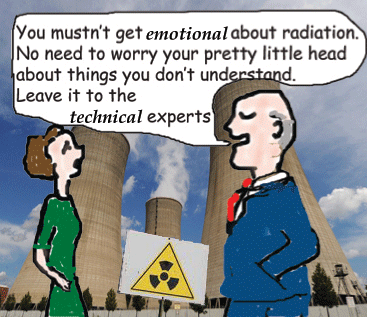
I just couldn’t resist that little quotation from an article today about an undetonated nuclear bomb lying at the bottom of a river. To be fair, I think that the writer might have been being sarcastic. He also mentions that “bomb-enthusiasts” worry, too.
Nevertheless, his statement is symptomatic of the comfortable attitude of the authorities to the whole subject of nuclear weapons – in this system, quaintly called deterrence. We’re all a bit worried that someone, like Putin, for example, might actually use one, some day.
But, in the “normal” course of events, nuclear weapons provide good, reliable jobs, and all sorts of government benefits to the community, and something to be proud of- “my strong country” etc. Don’t they?
So, it’s a bit annoying, when someone kicks up a fuss about the nuclear weapons that get accidentally dropped, and lost. They have all sorts of safety features, so they can’t easily explode. well, the land-based ones are supposed not to, anyway. The Atomic Archive lists for the USA 32 “Broken Arrow” nuclear accidents. Of course, that’s only the American ones. What about the others – French, British, Russian, North Korean, Chinese nuclear weapons? Russia was known to have 45.000 nuclear weapons up to 1986 – most of them on submarines – how many got lost undersea? Can they explode, undersea?
But that’s the thing. We are comforted by the reassurance from the experts, that explosion of a lost nuclear weapon is extremely unlikely. We are safe.
What they don’t talk about – is corrosion, leakage of radioactive materials. Over time, increased radioactivity in water and land will affect millions of people, – but don’t worry – of all those millions, only a few million will get cancer from this. So you see, a few million cancer deaths is nothing much really, to worry about. Or so the experts would have us think.
The nuclear lobby has achieved a wonderful global brainwashing. The only thing to worry about is a dramatic event, – an explosion with high levels of radiation released.
If you worry about those less dramatic millions of cancers, well, you must be “a person of a generally nervous disposition”. Hell – it’s your fault – you need psychiatric care, you poor thing.
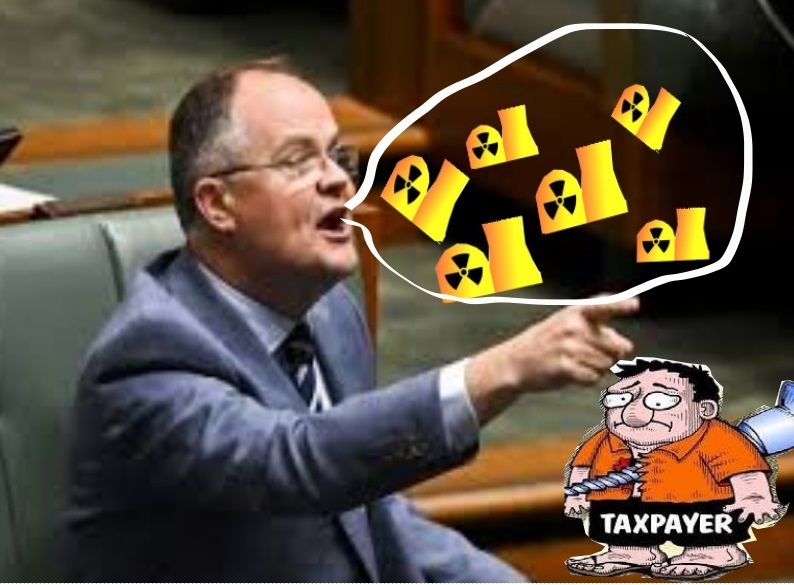
Ted O’Brien sets out long-term plan for uranium-enrichment industry
Joe Kelly, THE AUSTRALIAN, 31 July 24
Opposition energy spokesman Ted O’Brien will call for Australia to develop a sovereign capability at the front end of the nuclear fuel cycle – including the enrichment, conversion and fabrication of uranium – as new survey results show a dip in support for nuclear power.
In an address in Adelaide on Thursday night, Mr O’Brien will sketch out a long-term national endeavour to strengthen Australia’s energy security, building on the Coalition’s plans to replace retiring coal-fired power stations with up to seven nuclear power plants.
Mr O’Brien’s long-term nuclear plan for Australia now includes three key planks: the unlocking of the nation’s uranium reserves; the building of nuclear power plants; and a longer-term plan to develop expertise across the front end of the nuclear fuel cycle that would involve the development of a uranium-enrichment industry.
The three-pronged plan is aimed at ensuring Australia can eventually be self-sufficient, and not have to rely on global supply chains for the nuclear fuel rods that will be needed to power a future fleet of nuclear power plants…………………….
“Advancing Australia in this direction would set Australia up for the future, not just economically, but also strategically.”
Mr O’Brien will speak about his longer-term vision at an energy event on Thursday night being hosted by the Institute of Public Affairs, where he will also make a case for Australia to develop the capability to export nuclear fuel…………………….
The speech follows SEC Newgate’s release of its latest Mood of the Nation report on Thursday, which reveals only moderate support for nuclear power and a clear preference for renewables and new transmission infrastructure.
The latest tracking survey of 2021 Australians over the age of 18, taken between July 17 and 23, shows support for nuclear is slightly lower than in April at 37 per cent, while 39 per cent of respondents say they are against nuclear, and 23 per cent are neutral.
The results show a clear preference for building large-scale wind and solar farms with new transmission lines (50 per cent of respondents prefer this option), rather than nuclear power plants that use existing transmission infrastructure (26 per cent of people prefer this option).
Support for the Coalition’s policy to build seven new nuclear power plants is 39 per cent, while 35 per cent of respondents say it makes them less likely to vote with the Coalition, and 26 per cent say it makes them more likely to vote for the Opposition at the next election.
Of those who oppose the Coalition plan, most objections relate to safety concerns (41 per cent say it is too dangerous). However, 19 per cent of opponents to the Coalition plan believe renewables are superior.
Dutton praises Canada to sell nuclear plan. But does Ontario really have cheaper power?

Guardian, Graham Readfearn, 1 August 24
Opposition leader’s argument is puzzling given Canadian provinces dominated by renewables pay less for electricity.
There’s a community in Ontario called Dutton which, right now, seems appropriate given the number of times Peter Dutton has name-checked the Canadian province over the last 12 months.
In dozens of media interviews and speeches, Dutton (the opposition leader, not the township) has said Ontarians are getting cheap electricity because of their 20 nuclear reactors.
The Coalition has announced it wants to lift Australia’s ban on nuclear electricity and put at least one reactor at seven sites around the country.
Last week, Dutton again deployed his favourite Canadian talking point, telling reporters: “We could be like Ontario, where they’ve got 60 or 70% nuclear in the mix, and they’re paying about a quarter of the price for electricity that we are here in Australia.”
Really cheaper?
So ubiquitous has Dutton’s talking point been that it has made its way to Prof Mark Winfield, a sustainable energy expert at Ontario’s York University. And he is puzzled.
“I have heard about this,” he told Temperature Check. “I must admit I find the notion of holding Ontario up as a model for electricity and climate policy more than a little bizarre.”
Winfield says Ontario’s electricity rates are not low by Canadian standards, but added “the situation is distorted by the [$8bn a year] subsidy the province provides out of general revenues”.
Those billions, Winfield says, would otherwise be spent on things like schools and hospitals, instead of “artificially” lowering electricity rates.
“That accounts for the bulk of the province’s annual deficit,” he says.
So does nuclear mean cheap power for Ontario?
First, let’s start with Ontario’s electricity mix. The province has 20 of Canada’s 22 nuclear reactors, providing about 59% of Ontario’s electricity.
But comparisons of electricity prices across Canada and North America don’t show that Ontario’s nuclear-heavy generation delivers particularly cheap power.
According to two analyses (here and here), Quebec, the province next door where almost all electricity comes from hydropower, gives the cheapest rates. British Columbia and Manitoba are also cheaper, and they’re also dominated by hydro.
Dutton has said Ontarians “pay around about 14 cents kWh. There are parts in Australia that will be paying up to 56 cents a kilowatt hour from July 1 this year.”
But making a fair comparison between Australian electricity prices and Ontario is almost impossible because – before we’ve even got to the subsidy – the structures and governance systems around electricity are very different.
Almost half of Ontario’s power generation is publicly owned and the prices people pay are set by a government board.
Ontarians pay for their electricity in a more sophisticated way than Australians – people can choose one of three price plans, and the price people pay for each kWh can depend, for example, on how much power they have used that month or what time of day they are using it. The cost to the customer per kWh can be as low as 3c/kWh and as high as 32c/kWh.
But Winfield says the $8bn annual subsidy that helps keep those costs down is also masking the cost of refurbishing Ontario’s existing fleet of reactors that were built between the 1970s and 1990s.
“Those projects have consistently run billions over budget and years behind schedule, and in some cases ended in write-offs,” Winfield says.
The provincial government wants to refurbish 10 of its reactors. Winfield says the cost of those refurbs isn’t known, but his own estimates stand at about $44bn.
Ontario’s government has a chequered recent history when it comes to energy policy.
Critics have pointed to the province’s “horrifically expensive” nuclear reactors that helped the collapse of the publicly owned generator in the 1990s with $42bn of debt, and ratepayers were asked to repay some of that with a charge they continued to pay until 2018.
In 2018, the provincial government cancelled 758 renewable projects, reportedly costing Ontarians about $250m.
Winfield says Ontario’s decision to sideline renewables and back nuclear will see the province relying more on gas, which he says will push up greenhouse gas emissions.
“The fundamental underlying problem, along with all of the other downsides with nuclear – waste management, major upstream impacts in terms of uranium mining and milling, security, catastrophic accident and weapons proliferation risks that just don’t exist in relation to other energy technologies – is that it hasn’t benefited from the kinds of learning curves you have seen with renewables and storage, where costs have fallen and performance improved,” he says.
“Rather, nuclear costs just keep rising.”………………… https://www.theguardian.com/environment/article/2024/aug/01/peter-dutton-nuclear-power-plan-cost-price-canada-ontario
1 This month

of the week – Australians for War Powers Reform (AWPR)
To see nuclear-related stories in greater depth and intensity
 Antinuclear