Nuclear Power in Australia – it’s absurd

by Chris Simpson, https://www.democrats.org.au/nuclear-power-in-australia-its-absurd/—
The Coalition finally has a plan and it is to build nuclear power stations at existing coal fired power station sites in Tarong and Callide in Queensland, Mt Piper in NSW, Collie in WA, Loy Yang in Victoria and Northern Power in SA.
Nuclear power may seem attractive to voters as a way to easily meet the greenhouse gas reduction targets. However, having worked on coal fired and nuclear power plant construction myself, I can see where ‘the plan’ will run into practical problems.
About me: In late 2003 I was invited to Sydney to be mechanical works supervisor at Lucas Heights for the Replacement Research Reactor construction – INVAP. An Argentinian company was engaged for the Open Pool Australian Lightwater, state-of-the-art 20 megawatt multi-purpose reactor, predominantly built to replace the 50-year-old HIFAR reactor (1958–2007). I supervised the mechanical works for the reactor pool, service pool and neutron shutters and then the high-density concrete installation works to encase the mechanical components.
INVAP produces isotopes primarily for nuclear medicine, not power generation. The new INVAP opened in April 2007 by the then PM, John Howard, but serious leaks were found and it was shut down in July 2007 for two months. So, you may want to think again if someone tries to give you an iron-clad guarantee that modern nuclear power plants are 100% safe.
I am a proud Australian Democrat. Our party has a long history of fact-checking, and this is one way in which the party has been ‘Keeping the Bastards Honest’. This also applies to the nuclear power issue. For example, our party-leader, Lyn Allison (former Australian Democrats Senator and guest speaker at our upcoming Sandgate Town Hall meeting) was part of a Senate committee that reported in 2003 on regulating the uranium industry (mines). The executive summary speaks volumes in and of itself, and opens with:
“This inquiry was initiated in response to numerous leaks and spills at the four uranium mines in question and its terms of reference require the Committee to assess the adequacy and effectiveness of the current system of environmental regulation”.
The proposal by the Leader of the Opposition is naïve and reckless. As experts know, Tarong has a capacity of 1400 megawatts of coal fired power. Compare this with the 20 megawat output of INVAP and it becomes clear that small nuclear reactors are not the solution. SMTs are claimed to produce 300 megawatts as an optimum. At this rate, five reactors would be required at Tarong to produce the 1500+ megawatts required!
‘The plan’ may sound attractive, but we are guided by evidence and expert advice. Australia lacks the knowhow and maturity in the industry. Ramping up the skills and knowledge required for nuclear power is unrealistic – a policy in search of a political party to peddle it!
I welcome the opportunity to debate the Leader of the Opposition on this matter at our Sandgate Town Hall meeting on 30th August 2024. Lyn Allison will be able to offer valuable insights into nuclear issues as former Democrats spokesperson on nukes in the Senate.
Arundhati Roy: India Must Stop Arming Israel or ‘Forever Be Linked to Genocide’
“It is our responsibility to show that as people of India, we refuse to be complicit in that, even if our government wishes to continue with what it does.”
Brett Wilkins, Aug 02, 2024, https://www.commondreams.org/news/arundhati-roy-israel
Acclaimed Indian author and activist Arundhati Roy this week joined prominent jurists, diplomats, artists, and others in urging their government to stop selling weapons to Israel, which they called “abominable” and “a serious violation of India’s obligations under international law and our Constitution.”
Speaking Thursday at an event organized by the Press Club of India, Roy—winner of the 1997 Booker Prize for her debut novel The God of Small Things—said that Indians must “at least show that we do not support that murder in Gaza, we do not support our government’s support of that.”
Acclaimed Indian author and activist Arundhati Roy this week joined prominent jurists, diplomats, artists, and others in urging their government to stop selling weapons to Israel, which they called “abominable” and “a serious violation of India’s obligations under international law and our Constitution.”
Speaking Thursday at an event organized by the Press Club of India, Roy—winner of the 1997 Booker Prize for her debut novel The God of Small Things—said that Indians must “at least show that we do not support that murder in Gaza, we do not support our government’s support of that.”
“What is happening in Gaza, it is not just the murder… of tens of thousands of women and children,” she continued. “It is the bombing of hospitals, the destruction of universities… the attempt to erase the very memory people have of that place. It is a genocide like no other because it’s taking place on live TV.”
“India used to be a country that supported the people of Palestine in their struggle for freedom,” Roy noted. “Everywhere, even in the United States… people are standing up against their government’s support for [Israel]. But we are not standing up… and that is such a shame.”
“We must stand up. We must refuse,” she asserted. “We will not support the export of weapons of any kind.”
Roy is one of more than two dozen former Indian Supreme Court justices and other judges, foreign service officers, academics, artists, activists, and others who on Wednesday sent a letter to Indian Defense Minister Rajnath Singh urging him to halt the licensing of arms sales to Israel, whose military forces have killed or wounded more than 140,000 Palestinians while obliterating and starving Gaza.
“The International Court of Justice (ICJ) has clearly ruled that Israel is in violation of obligations under the Genocide Convention and further that Israel is in illegal occupation of the occupied Palestinian territory,” the letter states. “In light of these rulings, any supply of military material to Israel would amount to a violation of India’s obligations under international humanitarian law and the mandate of Article 21 read with Article 51(c) of the Constitution of India.”
Among the weapons India has sent to Israel are Hermes 900 unmanned aerial drones, which are co-manufactured with Israeli arms company Elbit Systems. The letter notes that the drones “have been extensively used in the Israeli Defense Forces’ military campaign in Gaza.”
“Several [United Nations] experts have warned that the transfer of weapons and ammunition to Israel may constitute serious violations of human rights and international humanitarian laws, and risk state complicity in international crimes, possibly including genocide, reiterating their demand to stop transfers immediately,” the letter’s signer wrote.
“In short, the grant of licenses and approvals for export of military material to Israel, coupled with reports of such exports by Indian companies, constitutes a serious violation of India’s obligations under international law and our own Constitution,” the letter stresses.
“International law aside, we consider such exports to be morally objectionable, indeed abominable,” the signatories added. “We demand, therefore, that India should immediately suspend its collaboration in the delivery of military material to Israel. Further, India must immediately make every effort to ensure that weapons already delivered to Israel are not used to contribute to acts of genocide or violations of international humanitarian law.”
The letter came ahead of planned nationwide protests by Indian leftists on Saturday calling for an end to arms sales and “all forms of complicity with Israel’s illegal occupation and genocide.”
India—which in 1971 invaded Bangladesh (then East Pakistan) in large part to end a U.S.-backed Pakistani genocide mostly targeting Bengalis—voted in favor of the December U.N. Security Council resolution calling for an immediate Gaza cease-fire.
However, the administration of Indian Prime Minister Narendra Modi and many lawmakers from his right-wing Bharatiya Janata Party have expressed steadfast support for Israel and its Gaza onslaught. Critics have noted that both Israel and India are occupying Muslims, the former in Palestine and the latter in Jammu and Kashmir.
In an interview with Middle East Eye published Friday, Roy—who faces prosecution in India over comments she allegedly made nearly 15 years ago regarding Kashmir—said that India could “forever be linked to genocide” if it does not change course.
“India needs to stop the export of weapons to Israel and ensure the return of Indian workers who have been sent to Israel to replace Palestinian workers,” she said.
“If it does not do so at once, it is in violation of the orders of the ICJ,” she added. “It will forever be complicit in aiding and abetting a genocide that is being telecast live for the world to watch.”
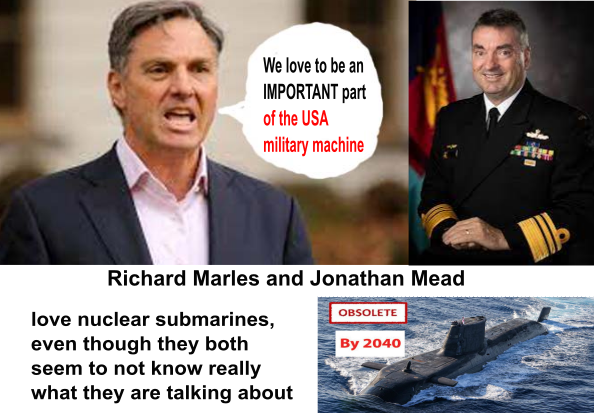
America’s war machine: Unless Australia acquires nuclear weapons, why acquire AUKUS subs?
By Percy Allan, 3 Aug 24, https://johnmenadue.com/americas-war-machine-unless-australia-acquires-nuclear-weapons-why-acquire-aukus-subs/
Nuclear-powered Virginia Class and AUKUS submarines are a useful deterrent only if they carry cruise missiles with nuclear warheads that can be launched from their unique vertical firing shaft.
Then if a distant enemy nuked Australia, we could launch an instant nuclear retaliation from such submarines lurking off their coast for months without needing refuelling.
That’s called MAD – mutually assured destruction – both sides know that neither side could nuke the other without risking oblivion.
Australia does not have nuclear weapons, nor does it plan to acquire them.
Australia’s quest to become part of America’s armed forces
Australia is fusing its navy, air force and army with America’s military forces. It’s called shifting from “interoperability” to “interchangeability”. One senior Australian defence officer has explained it as follows:
“…interoperability is two organisations able to work together, share information through technology and systems, and operate effectively as a joint or combined team. The higher standard of interchangeability includes all that plus the ability to seamlessly exchange individual people, equipment, doctrine, and/or systems between trusted nation groups.”
In essence under “interoperability” there are two separate national chains of command working jointly, whereas under “interchangeability” there is single chain of command. Under the latter it is doubtful the junior partner could break the chain of command and insist it call its own shots if the senior partner got into a skirmish not of Australia’s doing.
Without nuclear arms Australia should not be a party to confronting China
As such the Australian mainland could be the first casualty in an American war with China because we would be the weak link in America’s war machine without our own nuclear weapons.
Australian owned Virginia Class and AUKUS submarines carrying cruise missiles with conventional war heads would not provide a meaningful MAD deterrence.
And we have no guarantee from America that if a foreign power nuked Australia, America would nuke it in turn since that could cause a nuclear attack on America itself.
Worse still, unlike America we do not have an air defence system to intercept missile and drone attacks on our capital cities nor will we have such a protective shield in the foreseeable future.
Australia’s choice – get nuclear armed or stay conventionally armed?
In February 1970, Australia signed the Treaty on the Non-Proliferation of Nuclear Weapons (NPT), which commits us not to acquire nuclear weapons and to champion non-proliferation gobally. Since then, we have been one of the treaty’s strongest supporters.
Given that very long-range submarines like Virginia Class and AUKUS are best suited for nuclear armed powers (US, UK France, Russia, China, India, Pakistan, Israel, and North Korea), Australia needs to make a choice:
- Break the NPT and the join the club of nine nuclear armed nations and risk provoking our biggest neighbour Indonesia to do likewise, or
- Scrap nuclear-powered submarines for conventional ones better suited for defending our coastline than patrolling China’s foreshores
Canada recently decided to buy 12 modern electric-diesel powered submarines for an estimated US$44 billion (versus US$ 268-$368 billion for Australia’s 8 Virginia Class and AUKUS nuclear-powered submarines) since its focus is on patrolling its own vast coastline not that of distant nations.
Marles’ rationale for nuclear-powered subs does not stack up
Australia’s official rationale for obtaining submarines that can stay under water almost indefinitely is that they will defend our world shipping lanes and undersea communication cables. But that’s not credible.
Each year there are 26,000 ship port calls involving over 3,000 different ships at 70 Australian ports according to Shipping Australia.
China is Australia’s largest two-way trading partner in goods and services, accounting for one third of our trade with the world. It is not in China’s interests to disrupt it.
Marles should explain how three nuclear submarines by 2039 or eight by 2055 can defend each of these ships doing 26,000 round trips from being sunk by enemy submarines, destroyers, or bombers. Note that only one sub in three will be at sea at any time with the other two in port for maintenance or training purposes.
Marles probably thinks that our subs would be assisted by America’s 67 nuclear submarines (China has only 12 but is planning to have 21 by the early 2030s). But what assurance does he have that America would prioritise Australia’s trade routes and shipping movements over its own?
As for the nearly one million miles of telecommunication cables lying on the ocean floor, submarines can’t protect them. To safeguard these optical fibres, they are covered in silicone gel and wrapped in multiple layers of plastic, steel wires, copper sheathing, polyethylene insulator, and nylon yarn. In the deep sea, ocean inaccessibility largely protects cables, requiring only a thin polyethylene sheath. Hence the navy won’t have a role in patrolling their security.
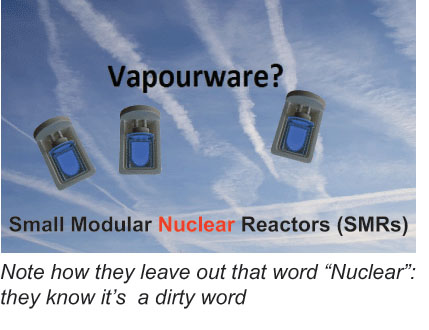
Australia should avoid small nuclear reactors until 2040s, engineers warn
https://www.thechemicalengineer.com/news/australia-should-avoid-small-nuclear-reactors-until-2040s-engineers-warn/, by Adam Duckett, 3 Aug 24
ENGINEERS have warned that if Australia is to reverse years of opposition to nuclear power and begin installing reactors in the country, the least risky option would be to wait until the 2040s once small modular reactor (SMR) technology has matured.
The report comes as the opposition Liberal Party argues the government’s energy strategy is overly reliant on renewables. If elected to power, the Liberal Party would overturn Australia’s longstanding moratorium on nuclear power and develop a nuclear fuels industry.
Party leader Peter Dutton has proposed seven sites where a coal-fired power plant has closed or is scheduled to close that could host nuclear reactors. The ambition is to build two SMRs or conventional large nuclear plants by 2037 at the latest.
However, this could be too ambitious according to a new study from the Australian Academy of Technological Sciences and Engineering (ATSE).
“SMR technology could provide low carbon energy compatible with Australia’s current electricity system, however as an emerging technology, there is considerable uncertainty around commercial viability and some of these potential benefits,” said ATSE president Katherine Woodthorpe.
“Overall, the associated timescales, expense, skills gap, legal and regulatory barriers, and social acceptance of nuclear power means the technology is high-risk when compared to existing energy options.”
If Australia was to pursue SMRs, the least risky option would be to procure them after several designs have been commercialised and successfully operated in other OECD countries, the report concludes. Companies including Rolls-Royce and NuScale are pushing ahead with the development of SMR technology but there are currently no SMR designs licensed for use in OECD countries. ATSE estimates that while prototype designs might be built by the mid-2030s a market for SMRs might not be fully formed until the late 2040s.
If an Australian government pushed for a prototype SMR earlier than the 2040s, the country would need to build a nuclear workforce, work directly with reactor developers, and reform legislation. In 1998, Australia passed a law preventing the construction or operation of nuclear power plants, fuel fabrication plants, enrichment plants or reprocessing facilities. The Liberal Party is undeterred, with shadow energy minister Ted O’Brien announcing earlier this week that the party wants Australia to go beyond being the fourth largest producer of uranium and develop an end-to-end nuclear fuels sector.
O’Brien said: “As Australia establishes its own civil nuclear program, we should aspire to build sovereign capability beyond the mining and milling of uranium to include conversion and enrichment through to fuel fabrication for civil nuclear power plants,” The Australian reports.
While state premiers have said they will resist a push from the federal government to go nuclear, analysis published by parliament suggests that it has the power to override regional bans.
Australia would also need to gain public support for nuclear though recent polls hint at growing support for the technology. A decade ago, six in ten Australians were opposed to nuclear power but a poll conducted this year shows this has flipped, with 61% now in support.
1 This month

of the week – Australians for War Powers Reform (AWPR)
To see nuclear-related stories in greater depth and intensity
 Antinuclear