The AUKUS operations are stalled because Australia cannot meet the nuclear waste disposal requirements of the non-proliferation treaty regime

13 Aug 24
Despite the somewhat difficult or convoluted language in the Agreement it gives the power and agreed authority to the International Atomic Energy Agency (IAEA) to demand a proper and safe means for the storage and disposal in accordance with the prescriptions of IAEA of all nuclear material including waste generated in or acquired by Australia by whatever means and for the continuing inspection and audit of that material by IAEA
This applies specifically to the nuclear waste generated by the rotational visits of the nuclear powered submarines of the United States and the United Kingdom with Australia being solely responsible for the management and disposal of that waste
Irrespective of the strength of AUKUS by the involvement of the United States and the United Kingdom the requirements of IAEA under the Agreement will be strongly demanded by the member states who are
signatories to the non-proliferation treaty regime
The international demands on this issue will be readily adopted since they go to the most basic principles of nuclear safety and both the United States and the United Kingdom are known to have serious problems with the management of their own nuclear waste
COMPREHENSIVE SAFEGUARDS AGREEMENT
From the latest available information the Comprehensive Safeguards
Agreement as described below has still not been varied which means
that the AUKUS arrangements cannot be fully implemented for the
purposes of the non-proliferation treaty regime
The reason is that Australia cannot meet all the safety requirements of
IAEA by not having the proper means for the management and disposal
of all the nuclear waste generated by the AUKUS activities in
accordance with its prescriptions as outlined in the publication by IAEA
as to Disposal of Radioactive Waste No. SSR-5 and other
prescriptions.
There is the problem of the disposal of all the
nuclear waste generated initially by the rotational visits of nuclear submarines of the United States and the United Kingdom to Stirling in Western Australia.
Australia by its foreign minister has advised IAEA that it is seeking
appropriate sites on Defence land for a facility for the AUKUS
generated nuclear waste but this has been insufficient for the variation
of the Comprehensive Safeguards Agreement and hence is delaying
the implementation of AUKUS
*********************************************
COMPREHENSIVE SAFEGUARDS AGREEMENT
The problem for Australia is that without a variation with the
International Atomic Energy Agency (IAEA) of the
Comprehensive Safeguards Agreement as it is commonly
called it will be difficult for Australia to implement the AUKUS
arrangements yet at the same time remain within the non –
proliferation treaty regime.
In order to achieve the variation Australia must show that it
has or is in the latter stages of planning a nuclear waste
facility for the permanent disposal of the nuclear waste to be
generated by the AUKUS operations.
COMPREHENSIVE SAFEGUARDS AGREEMENT
PROVISIONS
AGREEMENT BETWEEN AUSTRALIA AND THE INTERNATIONAL ATOMIC
ENERGY AGENCY FOR THE APPLICATION OF SAFEGUARDS IN
CONNECTION WITH THE TREATY ON THE NON-PROLIFERATION OF
NUCLEAR WEAPONS
Opened for signature at London, Moscow and Washington on 1 July 1968
and which entered into force on 5 March 1970
NON-APPLICATION OF SAFEGUARDS TO NUCLEAR MATERIAL TO BE
USED IN NON-PEACEFUL ACTIVITIES
Article 14
If Australia intends to exercise its discretion to use nuclear material which is
required to be safeguarded under this Agreement in a nuclear activity which
does not require the application of safeguards under this Agreement, the
following procedures shall apply:
(a) Australia shall inform the Agency of the activity, making it clear:
(i) That the use of the nuclear material in a non-proscribed military
activity will not be in conflict with an undertaking Australia may
have given and in respect of which Agency safeguards apply, that the nuclear material will be used only in a peaceful nuclear activity;
and
(ii) That during the period of non-application of safeguards the
nuclear material will not be used for the production of nuclear
weapons or other nuclear explosive devices;
(b) Australia and the Agency shall make an arrangement so that, only while
the nuclear material is in such an activity, the safeguards provided for in this
Agreement will not be applied. The arrangement shall identify, to the extent
possible, the period or circumstances during which safeguards will not be
applied. In any event, the safeguards provided for in this Agreement shall
apply again as soon as the nuclear material is reintroduced into a peaceful
nuclear activity. The Agency shall be kept informed of the total quantity and
composition of such unsafeguarded nuclear material in Australia and of any
export of such nuclear material; and
(c) Each arrangement shall be made in agreement with the Agency. Such
agreement shall be given as promptly as possible and shall relate only to
such matters as, inter alia, temporal and procedural provisions and reporting arrangements, and shall not involve any approval or classified knowledge of
the military activity or relate to the use of the nuclear material therein.
APPLICATION OF SAFEGUARDS
Article 2
The Agency shall have the right and the obligation to ensure that safeguards
will be applied, in accordance with the terms of this Agreement, on all source
or special fissionable material in all peaceful nuclear activities within the
territory of Australia, under its jurisdiction or carried out under its control
anywhere, for the exclusive purpose of verifying that such material is not
diverted to nuclear weapons or other nuclear explosive devices.
±±The relevant provision of INFCIRC/153 is paragraph 14
Paragraph 14 provides for the “non- application” of “the safeguards
provided for in the Agreement”, but only while the nuclear material is in
the non-proscribed military use. 15 Feb 2022
Australia indemnifies US and UK ‘against any liability’ from nuclear submarine risks

Guardian, Daniel Hurst Foreign affairs and defence correspondent, 12 Aug 24
New text reveals any party can terminate their collaboration on nuclear-powered boats with just one year’s notice
The United States, the United Kingdom or Australia could terminate their collaboration on nuclear-powered submarines with just one year’s notice, according to the terms of a new treaty designed to make the Aukus security pact a reality.
The Australian government published the text of the new agreement on Monday as it sought to dispel claims it was failing to tell the public about potentially significant political commitments to the US and the UK.
But opponents of the Aukus arrangement said the treaty contained “multiple get-out-of-jail-free cards for the US”, adding to pre-existing concerns a future president could back away from selling Virginia class submarines to Australia in the 2030s.
The concerns are based on US shipyard bottlenecks that are causing delays in the US meeting its own submarine production needs.
Under the Aukus plan announced in San Diego in 2023, Australia plans to buy at least three Virginia class submarines from the US in the 2030s.
Australia and the UK will then build a new class of nuclear-powered submarine to be known as SSN-Aukus.
The new agreement will allow for the transfer of nuclear material to Australia and it replaces a pre-existing treaty that allowed “for the exchange of naval nuclear propulsion information”.
……………………………………….. The document reveals Australia has agreed to take responsibility for any nuclear safety risks.
Australia will indemnify the US and the UK “against any liability, loss, costs, damage or injury” arising from nuclear risks “connected with the design, manufacture, assembly, transfer, or utilisation” of any of the material and equipment………………………………….
The Australian Greens’ spokesperson for defence, David Shoebridge, said he had “never seen such an irresponsible one-sided international agreement signed by an Australian government”.
“Every aspect of this agreement is a blow to Australian sovereignty,” Shoebridge said.
“This is the deal of the century for the US and UK who must be chuckling all the way to the bank having found the Albanese government and their billions in public dollars.”
Shoebridge and other critics of Aukus raised alarm last week when the US president, Joe Biden, revealed that the new treaty was accompanied by “a non-legally binding understanding” including “additional related political commitments”…………………..
The Australian defence minister, Richard Marles, said the treaty was “another significant Aukus milestone”………………….https://www.theguardian.com/world/article/2024/aug/12/aukus-deal-submarines-nuclear-termination-clause
Australia, US, UK sign nuclear transfer deal for AUKUS subs – AUSTRALIA RESPONSIBLE FOR THE SPENT FUEL WASTES
Australia would be responsible for the storage and disposal of spent nuclear fuel and radioactive waste from the nuclear power units that are transferred under the deal.
SYDNEY: Australia said on Monday (Aug 12) it had signed a deal to allow the exchange of nuclear secrets and material with the United States and Britain, a key step toward equipping its navy with nuclear-powered submarines.
It binds the three countries to security arrangements for the transfer of sensitive US and UK nuclear material and know-how as part of the tripartite 2021 AUKUS security accord.
AUKUS, which envisages building an Australian nuclear-powered submarine fleet and jointly developing advanced warfighting capabilities, is seen as a strategic answer to Chinese military ambitions in the Pacific region.
“This agreement is an important step towards Australia’s acquisition of conventionally armed nuclear-powered submarines for the Royal Australian Navy,” said Richard Marles, Australia’s defence minister and deputy prime minister.
Australia’s acquisition of a nuclear-powered submarine fleet would set the “highest non-proliferation standards”, he said, stressing that the country did not seek nuclear weapons.
The latest deal – signed in Washington last week and tabled in the Australian parliament on Monday – includes a provision for Australia to indemnify its partners against any liability for nuclear risks from material sent to the country.
Nuclear material for the future submarines’ propulsion would be transferred from the US or Britain in “complete, welded power units”, it says.
But Australia would be responsible for the storage and disposal of spent nuclear fuel and radioactive waste from the nuclear power units that are transferred under the deal.
“Submarines are an essential part of Australia’s naval capability, providing a strategic advantage in terms of surveillance and protection of our maritime approaches,” the transfer deal says.
China’s foreign minister Wang Yi warned in a visit to Australia in April that AUKUS raised “serious nuclear proliferation risks”, claiming it ran counter to a South Pacific treaty banning nuclear weapons in the region.
Nuked – The Submarine Fiasco that Sank Australia’s Sovereignty

The Submarine Fiasco that Sank Australia’s Sovereignty
The United States sank the French submarines deal and formed the AUKUS military pact, to smash a new Indo-Pacific strategic alliance of France, Australia and India that wanted friendship with China.
FRIENDS OR ALLIES DeClassified, by Andrew Fowler | 12 Aug, 2024
The United States’ push to cement itself as the dominant military power in the Indo-Pacific region, and the globe, saw it sabotage the French submarines deal with Australia, and establish the AUKUS military pact. It also sank the prospects for a Paris–Canberra–Delhi alliance that wanted a new Indo-Pacific geostrategic order developing harmonious relations with China.
These machinations are explained in this edited extract below from the new book, ‘Nuked: The Submarine Fiasco that Sank Australia’s Sovereignty’, by Andrew Fowler, published in July by Melbourne University Press.
As Prime Minister Malcom Turnbull and the new French president Emmanuel Macron discussed world affairs under the ornate chandeliers of the Élysée Palace in July 2017, they both understood the political and strategic significance of the submarine deal.
It just might shift the view of the other countries of the 27-member European Union that Australia would always have a closer relationship, both commercially and politically, with the United States than with Europe. Turnbull understood how important it was to prove to the French that they could have a strong ally in the South Pacific.
The following day, he headed off to Cherbourg to put the public seal on a project that had done so much to invigorate the relationship between the two countries. Cherbourg is home to Naval Group, one of the most successful submarine manufacturers in the world, with an order book bulging to €15 billion in 2019.
The Australian contract was just the latest in a series of wins for the company, but at the same time it produced a novel challenge for Naval Group. The French were going to take their Barracuda-class nuclear-powered submarine, remove the reactor that powered it, and insert a diesel-electric engine. ……………………
Thirteen days earlier Tony Abbott had been on Sydney radio station 2GB casting doubt on the entire project. He said that given the submarine acquisition process was long and involved, it was important that Australia had a ‘Plan B’. There was worse to come. The following day Abbott called for Australia to change course and consider buying submarines powered by nuclear reactors.
Prime Minister Turnbull had deliberately written into the French contract that Australia could switch back to nuclear submarines after two, three or four non-nuclear subs, without a penalty.
If Abbott’s comments had rankled Turnbull, this apparently didn’t show. Turnbull knew the non-nuclear subs could always be reverted to nuclear submarines if necessary. He’d deliberately written into the contract that Australia could switch after two, three or four non-nuclear subs, without a penalty. With a 500-strong highly educated and flexible workforce, the changes would not be that hard to achieve. There was another advantage: France was the only country in the world that made both nuclear and non-nuclear submarines………………………………………
The submarine deal was at the core of a new strategic partnership between Australia and France and, according to one French diplomat, ‘changed the view we had in France of Australia’. It shifted from that of a country not necessarily considered as a ‘priority connecting with us’, to a really essential partner. It was, he said, ‘a sea change’.
President Macron was persuaded that it was in the best interests of France for him to travel to Australia, not just because France had signed on to the biggest single defence project in its history, but because the Indo-Pacific was developing into a hugely important economic powerhouse and a potential flashpoint in the great rivalry between the United States and China. France had a large territorial stake in the region, and the more friends it had there, the better.
President Macron talked of the Indo-Pacific axis as a geostrategic new order — ‘the Paris–Canberra–Delhi axis’ — signalling a more independent group in the Indo-Pacific.………………………………………………………..
The emergence of this more independent thinking involving Australia, which until then had been a large purchaser of US military hardware, caused consternation in Washington, where then-president Donald Trump was busy launching a trade war against Beijing, accusing it of stealing American jobs.
Macron’s vision was a direct affront to American power in the Indo-Pacific. He told the politicians and military leadership who had gathered to hear him speak that France shared the strategic view of the Turnbull government about how to cope with the expanded power of China in the region.
……………………… multilateralism—not control dictated by any one nation—was a precondition of Chinese development in the region. China was fully aware of the difference between supremacy, stability and hegemony, he said.
Macron also confronted the China ‘hawks’ who oppose Beijing’s famed Belt and Road Initiative, a new ‘Silk Road’, building industrial and commercial links between Beijing, Europe, Africa and Asia. He gave veiled encouragement to Australia to be brave in the face of opposition from the United States.
For Macron, the question was not ‘to oppose this initiative, but, much more significatively, to build a dialogue with our allies’. In other words, France was not going to slavishly follow the United States in suppressing the rise of China as an economic power. This was not the kind of view that went down well in Washington, where China was to be not only contained but prevented from becoming a global power.
……………………………………………………………………….. Australia now had a significant counterweight to the United States in its foreign relations and defence strategy. Though France and the United States are members of the Group of Seven industrialised nations (G7) and permanent members of the UN Security Council, they do not always vote the same way on major issues of global importance. Australia would now be less beholden to the United States. The French connection would provide Canberra with a greater degree of sovereign choice in both defence and foreign policy.
he right of the Liberal Party reacted furiously. Under attack, Malcolm Turnbull appointed right-winger Peter Dutton to head up a new Home Affairs Department—a super-ministry controlling immigration, border protection and domestic security agencies, including the Australian Security Intelligence Organisation (ASIO) and the Federal Police. But giving the right more power only emboldened them—and their supporters.
Amid a number of leaks from the security services, the media reported in feverish detail that China was spying on Australian industries and targeting politicians.
The Trump administration was also whipping up a frenzy against China.
Andrew Shearer, a vehemently pro-American China hawk and former national security adviser to Howard and Abbott, had moved out when Abbott lost the prime minister job. He was now back with the Center for Strategic and International Studies (CSIS), a highly partisan right-wing think tank in Washington fixated on confronting China and warning a war was inevitable.
Shearer co-authored an article that mirrored the Americans’ anxieties and called for a ‘rotational presence’ of US warships at the HMAS Stirling naval base in Western Australia, and the possibility of ‘investing in the nuclear support infrastructure necessary for basing of attack submarines’.
It was the first sign of what was to come………………………………………………………………………
………….In August 2018, when Dutton unsuccessfully challenged Turnbull for the leadership, he opened the door for the ‘compromise candidate’, Scott Morrison, to be elected Liberal Party leader and then to become Australia’s thirtieth prime minister.
Within weeks Morrison moved Shearer from deputy head of the Office of National Intelligence (ONI) to an even more powerful position: Cabinet secretary.
…………..From the moment Shearer re-entered government, the tempo of the argument about which submarine to buy shifted from the best for defending Australia to the best for attacking China. In December 2018, the Morrison government announced that the first new submarine would be named HMAS Attack.
……………………………………….The Liberal–National coalition government could see no difference between what was best for Australia’s security, and what was best for the United States.
…………………..By March 2020, Morrison had appointed Peter Dutton, a blunt enforcer, as his defence minister—but Dutton’s job was to attack, not defend. Morrison had outsourced to a political headkicker the job of creating a Chinese ‘Red Scare’ and terrifying the population. He would need a compliant media to manufacture the level of consent that was required to carry out his grand plans, and all the help he could get from the right-wing think tanks now scattered across the nation.
In May 2020, Morrison had ordered a feasibility study to examine how Australia could acquire nuclear submarines without having an Australian nuclear industry to support them.
Morrison was secretly laying the groundwork for what the right wing in the Liberal Party had long wanted: the introduction of nuclear power into Australia and a closer relationship with the United States. The question of Australian sovereignty seemed to be of little or no account.
So the huge shift in Australia’s foreign policy alignment was hatched by a Christian fundamentalist former tourism marketing manager with no training in strategic or foreign affairs, but a great gift for secrecy and deception.
What came next:
What followed was months of media manipulation, political manouverings, and secret dealings to plot the dumping of Australia’s French submarine deal, for US-UK nuclear submarines. Along with these nuclear submarines, a broader AUKUS military pact to acquire hi-tech offensive weaponry, and to expand the US bases and military presence in Australia, was announced in October 2021.
All the details of these events, and more, are recorded in Andrew Fowler’s new book ‘Nuked: The Submarine Fiasco that Sank Australia’s Sovereignty‘ published in July by Melbourne University Press. https://declassifiedaus.org/2024/08/12/friends-or-allies
Peter Dutton’s nuclear lies.
Ian Lowe, The Saturday Paper, August 10–16, 2024, No. 512
https://www.thesaturdaypaper.com.au/2024/08/10/the-opposition-leaders-nuclear-lies#mtr
On June 19, Peter Dutton announced that a future Coalition government would introduce nuclear energy to Australia. A fact-check of the media release he sent out that day, and subsequent claims made by the leader of the opposition, reveals a whole series of factual errors, half-truths and barefaced lies. The media release urged an open discussion about nuclear power, but its tsunami of misinformation could have been designed to avoid serious evaluation of the proposal.
Before dealing with the explicit baseless claims, I remind you that the whole scheme is totally illegal. The Howard government legislated to prohibit nuclear power 25 years ago. Three states – New South Wales, Victoria and Queensland – have their own laws that would prevent building nuclear power stations. Since the initial media release, the Coalition found a lawyer who says the laws could be changed but didn’t admit that would require a majority in both houses of parliament.
There has been only one brief period in the past 30 years when the government had control of the Senate. Since the ban was actually proposed to the Howard government by the Greens, it beggars belief to think they would support its removal. The premiers of all the states proposed for nuclear power have come out against the scheme. Even Dutton’s Liberal National Party colleagues in Queensland, facing a state election in October, have hastened to distance themselves from the proposal. So there is a formidable legal barrier to the proposal to build nuclear power stations.
The media release claims “90 per cent of baseload electricity, predominantly coal fired power stations, is coming to the end of life over the next decade”. The clear implication is that the proposed nuclear power rollout would replace those plants. In fact, we now have about 21 gigawatts of coal-fired electricity. Three of the 15 power stations – Eraring and Vales Point B in New South Wales and Callide B in Queensland – are certainly scheduled to close by 2034 and take with them about five gigawatts of generating capacity. If a future Coalition government were to build its proposed seven nuclear power stations, that would roughly replace the three units that are certain to close. If 90 per cent of the capacity does actually retire, as the media release said, the proposed nuclear program would replace only about 30 per cent of the removed generation. What would then keep the lights on?
A second claim is that “zero-emissions nuclear energy … has proven to get electricity prices and emissions down all over the world”. This is one of nine places in the Coalition media release where the dishonest claim is made that nuclear energy is “zero-emissions”. Building a nuclear power station requires huge amounts of fossil fuel energy, about what would be produced by four years of nonstop operation. It has, like solar or wind, low emissions compared with burning coal or gas but nowhere near zero.
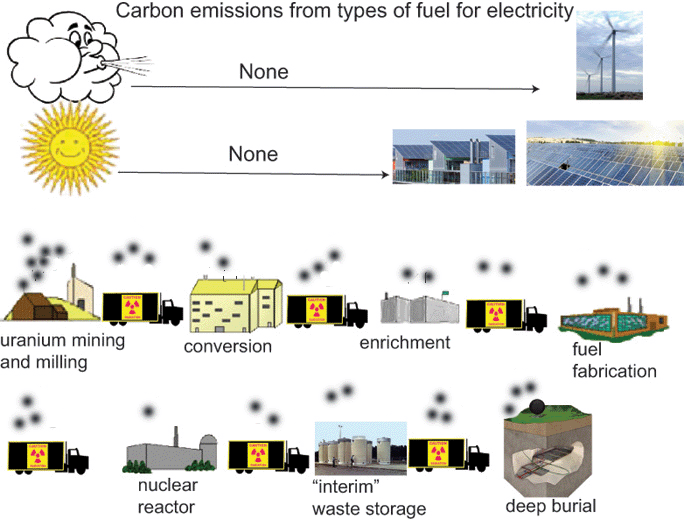
The dishonest claim of zero emissions implies we could use unlimited amounts and still meet our climate change obligations. In fact, building seven nuclear power stations would increase our greenhouse gas emissions and irresponsibly accelerate climate change.
Another falsehood is there in the very same sentence: nuclear energy is not used “all over the world”. Some 30 countries operate nuclear power stations, including four with just one reactor and six with two. About 160 countries don’t have any. Far from bringing prices down, the average price of nuclear power is much higher than solar, wind, hydro, gas or coal. Old power stations are being closed down because the costs of operation and maintenance mean they can’t compete with new solar farms and wind turbines. The world pattern of investment is telling. This year, about 500 gigawatts of new renewables will come on line. Hardly any nuclear power stations will start up. The electricity industry has voted with its chequebooks.
A third dishonest claim is that “Of the world’s 20 largest economies, Australia is the only one not using nuclear energy, or moving towards using it.” In fact, six of the 20 largest economies – Germany, Italy, Australia, Indonesia, Türkiye and Saudi Arabia – don’t operate nuclear power stations. Türkiye is the only one of those countries “moving towards using it”, with one nuclear power station being constructed.
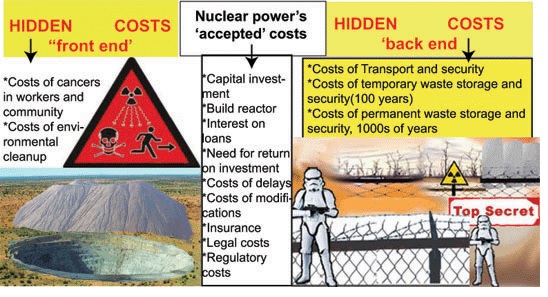
A fourth dishonest claim is that “A zero-emissions nuclear power plant will be a national asset delivering cheaper, cleaner and consistent energy for 80 years.” Again, the “zero-emissions” claim is false. Both current world average prices and regular CSIRO GenCost studies show nuclear power is far more expensive than renewables with storage. Historically, nuclear power stations have typically lasted 30 to 40 years, not 80. That is longer than the whole industry has existed.
The media release identifies “seven locations, located at a power station that has closed or is scheduled to close, where we propose to build zero-emissions nuclear power plants”. The list includes “Loy Yang Power Stations” and “Callide Power Station”. Loy Yang A is due to close in 2035, but Loy Yang B is scheduled to keep running until 2047. Callide B will close soon, but Callide C was commissioned in only 2001 and no closing date had been set. It is not true that all the power stations named will have closed within a decade.
Perhaps the most jaw-dropping of all the claims, however, is this one: “A Federal Coalition Government will initially develop two establishment projects using either small modular reactors or modern larger plants … They will start producing electricity by 2035 (with small modular reactors) or 2037 (if modern larger plants are found to be the best option)”. In fact, a report just released by the Australian Academy of Technological Sciences and Engineering shows it is unlikely we could buy small modular reactors before 2040. They do not yet exist anywhere in the OECD. Several different designs have been proposed, but they are all at the early stage of development. The idea they could be operating here by 2035 is pure fantasy.
The “modern larger plants” being built in Western Europe are years behind schedule, even though these are in countries with an established nuclear power industry, a working regulatory system and the skilled workforce needed to build these very complicated systems. The pro-nuclear Switkowski report, provided to the Howard government, concluded it would take at least 10 years and possibly 15 to build even one nuclear power station in Australia. It is just not credible to claim, even if the laws could be changed, that we could build seven by 2037, starting from scratch with no local experience and no regulatory system to assure the public of safety.
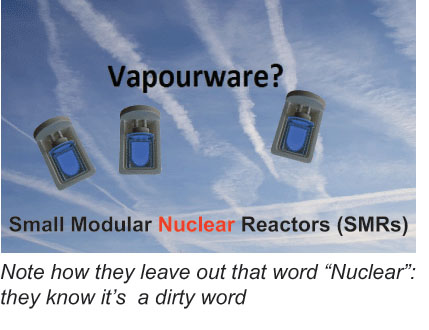
The label “small modular reactors” is misleading, too, giving the impression of a cute little device that would fit in your garage or a shipping container. The designs being proposed vary in size, but a typical so-called “small” reactor would require a site about the size of two football fields and would weigh several hundred tonnes. It would be “small” only when compared with most of the nuclear power stations that have been built. They have typically been much larger because there are economies of scale. For that reason, while there are no reliable figures at this stage, the CSIRO evaluation has consistently concluded that “small” reactors are likely to produce even more costly electricity than large ones.
A final piece of studied dishonesty is the statement that the current government’s approach of using renewables to provide our electricity would require 58 million solar panels and 3500 new wind turbines, giving a scary total investment figure. The clear implication is that seven nuclear reactors, for which no cost figures are given, wouldn’t cost as much. The recent track record for the building of nuclear power stations in Western Europe doesn’t provide much confidence. Hinkley Point C in the UK was meant to cost about $20 billion, but the total cost is likely to end up close to $100 billion. More seriously, the comparison is totally invalid. It compares an inflated estimate of the cost of providing enough renewables to meet all our needs with the unknown figure of the price of seven reactors. If they were ever to be built, they would provide about six gigawatts of generating capacity. Our installed capacity now is about nine times that much. A serious emissions reduction program will mean replacing petroleum transport fuels and gas heating with electricity. That will require doubling our capacity over the next decade. The Coalition is comparing apples with watermelons. They contrast the still-unrevealed cost of nuclear reactors to meet about 5 per cent of our needs with an inflated estimate of the cost of building enough renewables to supply our total demand.
The whole proposal is really a smokescreen. It is designed to hide the reality that a Coalition government would keep burning coal and gas for decades. There is also no plan to deal with the radioactive waste that nuclear reactors would produce, needing to be stored for geological time. The 2015 Nuclear Fuel Cycle Royal Commission, held in South Australia, estimated a storage facility would cost an eye-watering $41 billion. Peter Dutton’s nuclear plan is a farce. No part of it is real, plausible or sincere. As a proposal, it is probably the most dishonest ever put before the Australian electorate.
This article was first published in the print edition of The Saturday Paper on August 10, 2024 as “Dutton’s nuclear lies”.
Australian government would like the lucrative import of UK and USA nuclear waste ? But there’s a hitch.

Peter Remta. 12 August 24
From the information I have there is no question that Australia should like to import nuclear waste for permanent disposal principally from the United Kingdom but also from the United States if appropriate
The basic reason is that the payment for the disposal is considerable and will be some offset part of the substantial contributions – some would say astronomical – by Australia to the AUKUS arrangements
The United Kingdom has a reported legacy of 200,000 m³ of intermediate level waste with no means to dispose of it and has approached other countries for its disposal
The UK is hoping that Australia would take 40,000 m³ of this waste at obviously a negotiated fee but the applicable present cost internationally is $1.5 million a cubic metre of intermediate level waste
The British government had previously asked Australia to take this volume of waste for disposal but it could only be for long term storage at the proposed Kimba facility in South Australia which of course in timing and other reasons was not possible
An approach had also been made to Spain for disposal of that waste at the highly regarded El Cabril facility but the charges demanded by Spain were prohibitive despite being royal cousins
I understand it is affectively agreed that Australia will take 40,000 m³ of intermediate level waste as defined by the International Atomic Energy Agency from Britain as part of significantly assisting with the development and construction locally of the SSN AUKUS submarine fleet
However there can be no nuclear waste sent to Australia under the AUKUS arrangements until Australia achieves a variation of the Comprehensive Safeguards Agreement as explained in questions in the Senate, by Senator Jacqui Lambie .
1 This month

of the week – Australians for War Powers Reform (AWPR)
To see nuclear-related stories in greater depth and intensity
 Antinuclear