Peter Dutton’s nuclear lies.
Ian Lowe, The Saturday Paper, August 10–16, 2024, No. 512
https://www.thesaturdaypaper.com.au/2024/08/10/the-opposition-leaders-nuclear-lies#mtr
On June 19, Peter Dutton announced that a future Coalition government would introduce nuclear energy to Australia. A fact-check of the media release he sent out that day, and subsequent claims made by the leader of the opposition, reveals a whole series of factual errors, half-truths and barefaced lies. The media release urged an open discussion about nuclear power, but its tsunami of misinformation could have been designed to avoid serious evaluation of the proposal.
Before dealing with the explicit baseless claims, I remind you that the whole scheme is totally illegal. The Howard government legislated to prohibit nuclear power 25 years ago. Three states – New South Wales, Victoria and Queensland – have their own laws that would prevent building nuclear power stations. Since the initial media release, the Coalition found a lawyer who says the laws could be changed but didn’t admit that would require a majority in both houses of parliament.
There has been only one brief period in the past 30 years when the government had control of the Senate. Since the ban was actually proposed to the Howard government by the Greens, it beggars belief to think they would support its removal. The premiers of all the states proposed for nuclear power have come out against the scheme. Even Dutton’s Liberal National Party colleagues in Queensland, facing a state election in October, have hastened to distance themselves from the proposal. So there is a formidable legal barrier to the proposal to build nuclear power stations.
The media release claims “90 per cent of baseload electricity, predominantly coal fired power stations, is coming to the end of life over the next decade”. The clear implication is that the proposed nuclear power rollout would replace those plants. In fact, we now have about 21 gigawatts of coal-fired electricity. Three of the 15 power stations – Eraring and Vales Point B in New South Wales and Callide B in Queensland – are certainly scheduled to close by 2034 and take with them about five gigawatts of generating capacity. If a future Coalition government were to build its proposed seven nuclear power stations, that would roughly replace the three units that are certain to close. If 90 per cent of the capacity does actually retire, as the media release said, the proposed nuclear program would replace only about 30 per cent of the removed generation. What would then keep the lights on?
A second claim is that “zero-emissions nuclear energy … has proven to get electricity prices and emissions down all over the world”. This is one of nine places in the Coalition media release where the dishonest claim is made that nuclear energy is “zero-emissions”. Building a nuclear power station requires huge amounts of fossil fuel energy, about what would be produced by four years of nonstop operation. It has, like solar or wind, low emissions compared with burning coal or gas but nowhere near zero.
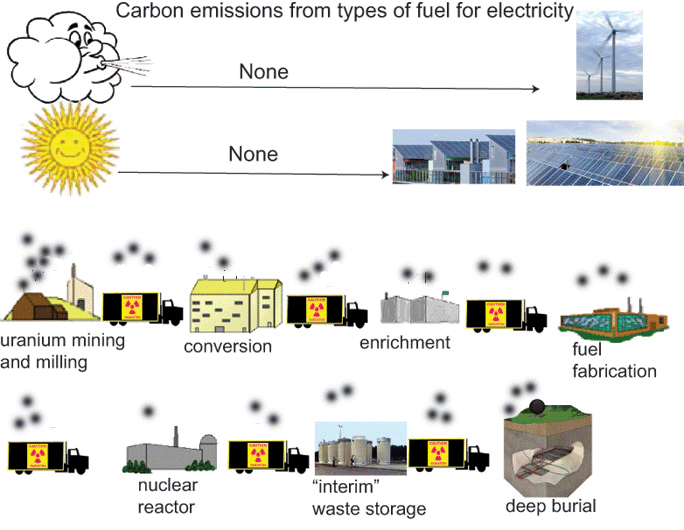
The dishonest claim of zero emissions implies we could use unlimited amounts and still meet our climate change obligations. In fact, building seven nuclear power stations would increase our greenhouse gas emissions and irresponsibly accelerate climate change.
Another falsehood is there in the very same sentence: nuclear energy is not used “all over the world”. Some 30 countries operate nuclear power stations, including four with just one reactor and six with two. About 160 countries don’t have any. Far from bringing prices down, the average price of nuclear power is much higher than solar, wind, hydro, gas or coal. Old power stations are being closed down because the costs of operation and maintenance mean they can’t compete with new solar farms and wind turbines. The world pattern of investment is telling. This year, about 500 gigawatts of new renewables will come on line. Hardly any nuclear power stations will start up. The electricity industry has voted with its chequebooks.
A third dishonest claim is that “Of the world’s 20 largest economies, Australia is the only one not using nuclear energy, or moving towards using it.” In fact, six of the 20 largest economies – Germany, Italy, Australia, Indonesia, Türkiye and Saudi Arabia – don’t operate nuclear power stations. Türkiye is the only one of those countries “moving towards using it”, with one nuclear power station being constructed.
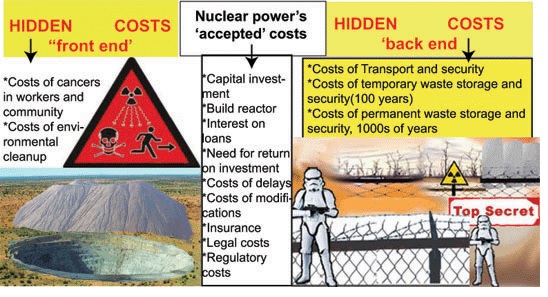
A fourth dishonest claim is that “A zero-emissions nuclear power plant will be a national asset delivering cheaper, cleaner and consistent energy for 80 years.” Again, the “zero-emissions” claim is false. Both current world average prices and regular CSIRO GenCost studies show nuclear power is far more expensive than renewables with storage. Historically, nuclear power stations have typically lasted 30 to 40 years, not 80. That is longer than the whole industry has existed.
The media release identifies “seven locations, located at a power station that has closed or is scheduled to close, where we propose to build zero-emissions nuclear power plants”. The list includes “Loy Yang Power Stations” and “Callide Power Station”. Loy Yang A is due to close in 2035, but Loy Yang B is scheduled to keep running until 2047. Callide B will close soon, but Callide C was commissioned in only 2001 and no closing date had been set. It is not true that all the power stations named will have closed within a decade.
Perhaps the most jaw-dropping of all the claims, however, is this one: “A Federal Coalition Government will initially develop two establishment projects using either small modular reactors or modern larger plants … They will start producing electricity by 2035 (with small modular reactors) or 2037 (if modern larger plants are found to be the best option)”. In fact, a report just released by the Australian Academy of Technological Sciences and Engineering shows it is unlikely we could buy small modular reactors before 2040. They do not yet exist anywhere in the OECD. Several different designs have been proposed, but they are all at the early stage of development. The idea they could be operating here by 2035 is pure fantasy.
The “modern larger plants” being built in Western Europe are years behind schedule, even though these are in countries with an established nuclear power industry, a working regulatory system and the skilled workforce needed to build these very complicated systems. The pro-nuclear Switkowski report, provided to the Howard government, concluded it would take at least 10 years and possibly 15 to build even one nuclear power station in Australia. It is just not credible to claim, even if the laws could be changed, that we could build seven by 2037, starting from scratch with no local experience and no regulatory system to assure the public of safety.
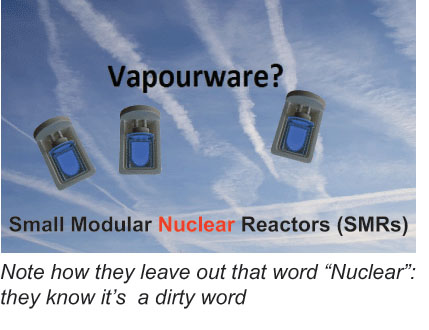
The label “small modular reactors” is misleading, too, giving the impression of a cute little device that would fit in your garage or a shipping container. The designs being proposed vary in size, but a typical so-called “small” reactor would require a site about the size of two football fields and would weigh several hundred tonnes. It would be “small” only when compared with most of the nuclear power stations that have been built. They have typically been much larger because there are economies of scale. For that reason, while there are no reliable figures at this stage, the CSIRO evaluation has consistently concluded that “small” reactors are likely to produce even more costly electricity than large ones.
A final piece of studied dishonesty is the statement that the current government’s approach of using renewables to provide our electricity would require 58 million solar panels and 3500 new wind turbines, giving a scary total investment figure. The clear implication is that seven nuclear reactors, for which no cost figures are given, wouldn’t cost as much. The recent track record for the building of nuclear power stations in Western Europe doesn’t provide much confidence. Hinkley Point C in the UK was meant to cost about $20 billion, but the total cost is likely to end up close to $100 billion. More seriously, the comparison is totally invalid. It compares an inflated estimate of the cost of providing enough renewables to meet all our needs with the unknown figure of the price of seven reactors. If they were ever to be built, they would provide about six gigawatts of generating capacity. Our installed capacity now is about nine times that much. A serious emissions reduction program will mean replacing petroleum transport fuels and gas heating with electricity. That will require doubling our capacity over the next decade. The Coalition is comparing apples with watermelons. They contrast the still-unrevealed cost of nuclear reactors to meet about 5 per cent of our needs with an inflated estimate of the cost of building enough renewables to supply our total demand.
The whole proposal is really a smokescreen. It is designed to hide the reality that a Coalition government would keep burning coal and gas for decades. There is also no plan to deal with the radioactive waste that nuclear reactors would produce, needing to be stored for geological time. The 2015 Nuclear Fuel Cycle Royal Commission, held in South Australia, estimated a storage facility would cost an eye-watering $41 billion. Peter Dutton’s nuclear plan is a farce. No part of it is real, plausible or sincere. As a proposal, it is probably the most dishonest ever put before the Australian electorate.
This article was first published in the print edition of The Saturday Paper on August 10, 2024 as “Dutton’s nuclear lies”.
No comments yet.
1 This month

of the week – Australians for War Powers Reform (AWPR)
To see nuclear-related stories in greater depth and intensity
 Antinuclear
Leave a comment