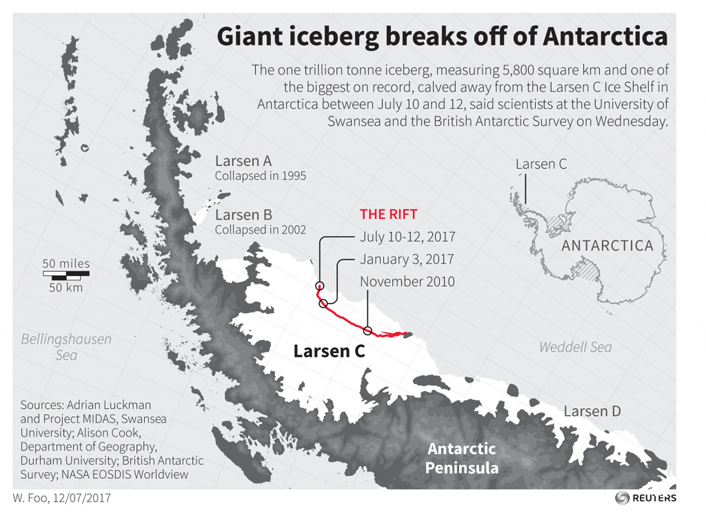
When glaciers calve: Huge underwater tsunamis found at edge of Antarctica, likely affecting ice melt.
Bulletin, By Michael Meredith | July 15, 2024
Antarctica is huge, it affects pretty much every place and every living thing on our planet, and it is changing. This should be a concern for all of us, and yet we know troublingly little about some key aspects of the great white continent.
Despite its position in the far distant south, Antarctica is a vital component in the functioning of the planet. It is central to global ocean circulation, thus exerting a profound influence on the world’s climate (Figure 1 on original). The vast Southern Ocean that surrounds Antarctica absorbs huge quantities of heat and carbon dioxide from the atmosphere and distributes them around the rest of the world, thereby slowing the rate of global warming elsewhere. This “climate favor” has comes at a cost, however—the Southern Ocean is overheating and acidifying, with marked impacts on the marine ecosystem. The extra heat in the ocean is also melting the fringes of the Antarctic Ice Sheet, destabilizing its glaciers, and increasingly pushing up sea levels worldwide. The sea ice around Antarctica—formed in the fall and winter of the Southern Hemisphere, when the ocean surface freezes—has now reached record low extents, affecting the Earth’s energy budget and acting to further accelerate climate change.
All the information we have from Antarctica comes from sparse networks of sensors and equipment deployed directly, augmented with satellite measurements of the ice and ocean surface and computer simulations. While we know more about Antarctica and the Southern Ocean than ever before, it is still one of the least-well measured places on our planet, with some areas still remaining “data deserts.” We need to know more, so that we can better understand the causes of the changes happening here, how they will continue to change in future, and hence what the global impacts are likely to be.
One feature of the Southern Ocean that is often overlooked is how (and how strongly) it is mixed. This is a key process that redistributes heat, carbon, nutrients, plankton, and all other things in the sea, with profound consequences.
………………………………………glacier calving event had caused a sudden massive burst in the mixing of the ocean, stretching many kilometers from the ice front.
How did it do this? The data revealed that the glacier calving had triggered an underwater tsunami event. In essence, large waves (the height of a two-story house) were generated and moved rapidly away from the glacier, riding the interface between layers in the ocean that were tens of meters down. When these internal tsunami waves finally broke—like surface waves on a beach—they caused massive churn and mixing…………………………………………………………………………
This process—of glacier calving generating internal tsunamis and bursts of ocean mixing—is entirely absent from the computer models that are used to simulate our climate and ecosystem, hampering our ability to reliably project future changes. We need to know more about how this process works, how it will change, and what its consequences will be. ……. https://thebulletin.org/premium/2024-07/when-glaciers-calve-huge-underwater-tsunamis-found-at-edge-of-antarctica-likely-affecting-ice-melt/?utm_source=Newsletter&utm_medium=Email&utm_campaign=ThursdayNewsletter08152024&utm_content=ClimateChange_HugeUnderwaterTsunamis_07152024&utm_source=Newsletter&utm_medium=Email&utm_campaign=ThursdayNewsletter08152024&utm_content=ClimateChange_HugeUnderwaterTsunamis_07152024
UK Nuclear Free Local Authorities send message of solidarity to Canadian First Nations opposed to nuke dump

14th August 2024
Following the United Nations’ International Day of the World’s Indigenous Peoples (9 August), the UK/Ireland Nuclear Free Local Authorities have joined the Cumbrian campaign group, Lakes against Nuclear Dump (LAND) in sending a message of solidarity and support to the Canadian First Nations who have publicly declared their opposition to the development of an underground nuclear waste dump at Ignace, Ontario.
On July 15, the Anishinaabeg of Kabapikotawangag Resource Council (the “AKRC”), representing five tribal groups, published their Declaration of Opposition in which the Council states declared that the Deep Geological Repository proposed near Ignace ‘poses and unprecedented threat to the integrity, safety, and sanctity of Kabapikotawangag and its surrounding environments. It has the potential to compromise the health, welfare, and cultural heritage of our Anishinaabeg people.
As stewards of the lands and waters in our territory, we have not provided our free, prior, and informed consent. We have a duty to protect and safeguard Kabapikotawangag (also known as Lake of the Woods). We cannot let this type of project move forward.’
The Nuclear Waste Management Organisation was established by the Canadian nuclear industry to lead the effort to find a location for an underground nuclear waste repository. Its attempt to foist a nuclear waste dump on First Nation land near Ignace, in collaboration with provincial and local authorities, appears to contravene the legal obligations made originally by the British Government to the First Nations under Treaty 3 and the commitments made by the Canadian Government in signing the UN Declaration on the Rights of Indigenous People.
………………………………………………………………………………………..This represents another example of ‘nuclear colonialism’, in which militaries, the nuclear industry, and their supporters in government disproportionately locate their activities in lands traditionally occupied by Indigenous People, impacting their environment, health, culture and future. At the first and last of the nuclear cycle, from the mining of uranium to the disposal of radioactive waste, the lands of Indigenous people are seen as fair game by big business, whilst their land has also been seen as ideal for nuclear weapons testing by the major powers.
The NFLAs have participated in several online meetings with campaign groups in the UK and Canada which are opposed to nuclear waste dumps in their locality. We are delighted now to be in contact with the Canadian First Nations. https://www.nuclearpolicy.info/news/nflas-send-message-of-solidarity-to-canadian-first-nations-opposed-to-nuke-dump/
Transition ‘well under way’ as AGL rejects nuclear push
Illawarra Mercury, By Marion Rae, August 14 2024 –
AGL Energy has staked millions more on the clean energy transition as higher power prices and fewer outages generate stellar profit growth and spare cash.
Australia’s biggest emitter announced on Wednesday the $250 million acquisition of Firm Power and Terrain Solar, adding solar power and battery storage across all states.
Their combined projects, at 8.1 gigawatts, will add to renewable sources of electricity as coal-fired power plants close from coast to coast.
However, recent polls show that many Australians don’t believe the transition is feasible or on track for the national target of 82 per cent renewable energy by 2030.
“We’re investing back into the transition … it’s well underway,” AGL managing director Damien Nicks told AAP.
He said big batteries would ultimately assist renewable generation by responding to market demand in milliseconds, along with pumped hydro and other firming assets including fast-start gas.
“It is the most complex transition this country has seen but you’re right, community engagement through this time is going to be critical … whether that’s on our sites or outside of our sites,” Mr Nicks said.
“We’re also trying to utilise the infrastructure and grid that’s available to us today, whilst the transmission gets built out around the rest of the country – that’s incredibly important.”
But he dismissed the option of nuclear reactors, which the coalition has promised to build if it wins power in 2025.
“Nuclear is not part of our plans, nor our strategy … we cannot sit around and wait for nuclear,” Mr Nicks said.
“The rationale for that is both cost and time to get there.
“We need to find 12 gigawatts of renewable and firming assets by 2035.”
AGL earlier posted an underlying net profit of $812 million for the year to June 30, up 189 per cent, while underlying earnings rose 63 per cent to $2.22 billion.
Shares in AGL rose in the wake of the results, delivering paper gains for AGL’s major shareholder billionaire Mike Cannon-Brookes…………………………………………………. more https://www.illawarramercury.com.au/story/8729378/transition-well-under-way-as-agl-rejects-nuclear-push/
China urges US, UK and Australia not to advance nuclear submarine cooperation
By Reuters, August 14, 2024, https://www.reuters.com/world/china-urges-us-uk-australia-not-advance-nuclear-submarine-cooperation-2024-08-14/
BEIJING, China’s foreign ministry said on Wednesday the United States, Britain and Australia should not advance their nuclear submarine cooperation until the international community has reached a consensus on safeguards and other issues.
Australia, Britain and the United States have agreed to work to transfer a fleet of eight nuclear powered and conventionally armed submarines to Australia by 2050 under their AUKUS programme.
The foreign ministry spokesperson Lin Jian said the programme undermined efforts to maintain regional peace and security.
1 This month

of the week – Australians for War Powers Reform (AWPR)
To see nuclear-related stories in greater depth and intensity
 Antinuclear