Nuclear waste dump debate heating up over AUKUS, Coalition plans
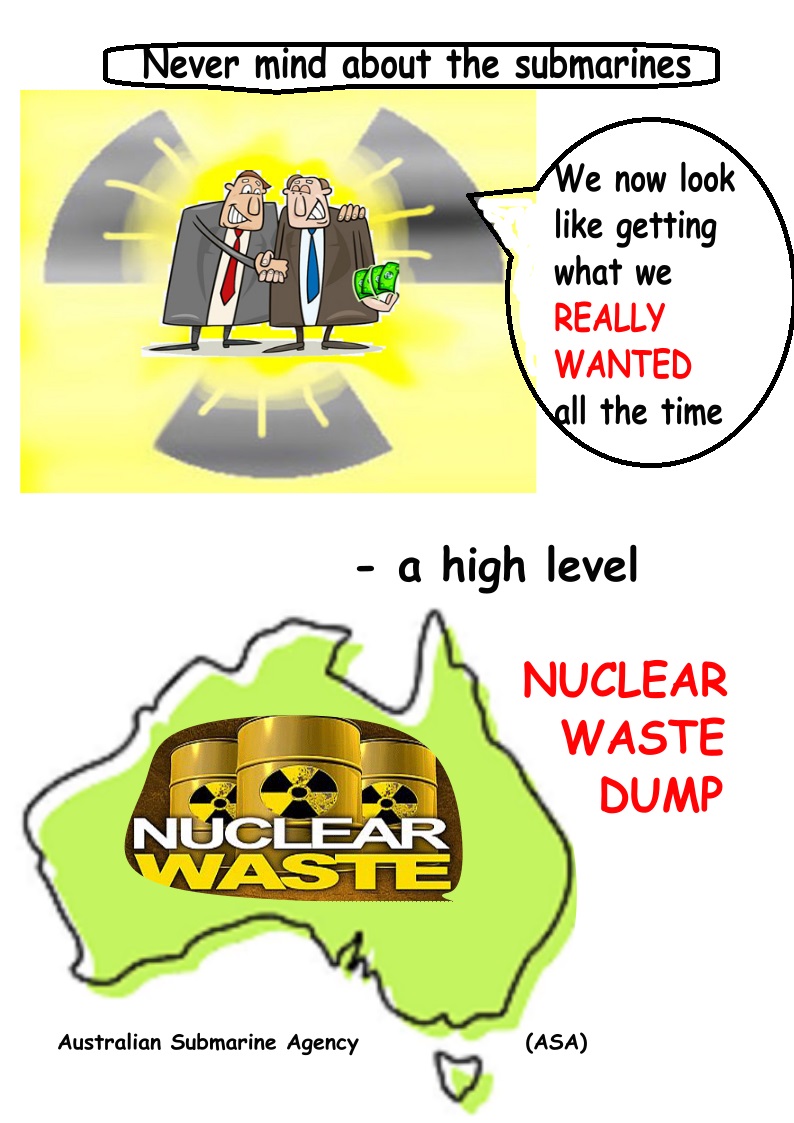
Australia’s AUKUS agreement with the US and Uk will pave the way for nuclear submarines – and nuclear waste. But some experts say the government has not learned the lessons of three past attempts to deal with that material.
protesters in the South Australian town of Port Augusta in 2018 were pushing back against a government proposal for a nuclear waste dump near the town of Kimba.
They took their fight all the way to the Federal Court, forcing Labor to ultimately abandon the plan.
But the issue of nuclear waste in Australia remains a controversial one.
Emeritus Professor Ian Lowe says that for now, much of Australia’s nuclear waste is stored near the nation’s only reactor at Lucas Heights in south-west Sydney, which is mostly used to make medicine, mining materials, and for research.
Low-level waste is also being stored in hundreds of cupboards, labs and hospitals nationally.
“Intermediate level waste is nastier. And it needs to be stored basically permanently for geological time, and it probably needs to be stored deep underground because the isotopes that are there can be harmful for thousands of years. At the moment, they’re in temporary storage at Lucas Heights near the research reactor. And the capacity there is okay for perhaps 10 years, but sooner or later we’re going to have to find a way of permanently disposing of the intermediate level waste. And that’s a more serious issue than the low level waste. It needs to be deep underground and it needs to be in a properly engineered storage site. And we’re talking big sums of money.”
That waste is safe and secure for now but the Australian Radioactive Waste Agency says this is not a sustainable solution long-term.
The government, opposition and Professor Lowe all agree.
“I mean, basically the temporary waste storage at Lucas Heights is just a very large shed with drums of radioactive waste.”
Australian Conservation Foundation campaigner Dave Sweeney says efforts to site a new nuclear dump have focused more on PR – and managing outrage.
“There has been 30 years of a divisive debate, of coercive attempts to impose radioactive waste, and there have been multiple fights at multiple sites, mainly in the Northern Territory and South Australia, where affected communities and particularly Aboriginal communities have been very very strident, strong and sustained in their opposition – and have defeated a proposal to put waste on their Country and the Canberra caravan has moved on.”
A spokesperson for Resources Minister Madeleine King has said the government is reflecting on lessons learned from past siting processes as it assesses options for safely disposing of nuclear waste.
But Dr Lowe says the government has not learned the lessons of history.
I think successive governments are just kicking the can down the road. If there is a plan, nobody knows about it.”
The debate is being revived because of the waste that will come from the on-board reactors of AUKUS subs.
This will be high-level waste – a more hazardous form Australia does not have right now.
The government plans to dispose of this weapons-grade waste on defence land – and Defence Minister Richard Marles says we have time to get it right.
“To be clear, we will not have to dispose of the first reactor from our nuclear-powered submarines until the 2050s. I want to assure the Parliament that there will be appropriate public consultation, particularly with First Nations communities to respect and protect cultural heritage. This will not be a matter of set and forget.”
In March last year Mr Marles told parliament the government would set out the process for selecting a site within 12 months, but 17 months on those details are yet to be announced.
Professor Lowe has criticised the bipartisan AUKUS agreement as being irresponsible without a waste management plan.
“I think if we’re being asked to approve nuclear power reactors or nuclear submarines, we’re entitled to see a clearly spelt out intellectually and morally and politically defensible solution for the problem that will inevitably be created. It’s just not responsible to create a problem saying, we hope future generations will figure out a way to deal with it.”
Campaigner Dave Sweeney opposes any high-level waste, but says we need to face up to the challenge of intermediate waste – although he doesn’t want to see the process rushed.
“I think we need to just every party take a breath, acknowledge that radioactive waste is in this country, acknowledge that it has been poorly managed to date, realise that we have because of hard efforts of contests from Aboriginal people and local communities, we have now won ourselves some breathing space with the interim storage of intermediate level waste securely at the ANSTO facility and use that time not to regroup in our trenches, but use that time to gather at the table and genuinely consider pathways forward.”
There appear to be some promising developments.
One company, called Tellus Holdings, has forged a new way forward for low-level waste, establishing a disposal site in West Australia – the first private firm ever licensed to do so.
CEO Nate Smith says the company has disposed of 6,000 cubic metres of radioactive material since its facility opened one-and-a-half-years ago – after ten years of consultation.
“With Kimba and others, I think government has announced the site, and then done engagement, and I think that puts people on the back foot. It all starts with trust. For us that was sitting down over cups of tea or going to the pub, it was sharing our vision of what we wanted to do and really understanding the community’s perspective but also their aspirations, and I think one of the biggest things we did that was in stark contrast to government is look we gave our Traditional Owners a veto right. For us, the whole concept from the start was, this is their land.”
Tellus Holdings will not accept intermediate or high-level waste, but Mr Smith says the company is eager to take on more low-level material, arguing this would free up space for interim storage at Lucas Heights.
“It would allow ANSTO and ARWA and others to focus on the real challenge right now, which is intermediate and high-level waste, because it’s coming with AUKUS and it’s already in existence from the Lucas Reactor.”
The Coalition’s plan for a nuclear power industry would also create more high-level waste if it goes ahead.
In a statement to SBS, the Opposition’s resources spokeswoman Susan McDonald said the Coalition anticipates that it would be stored on-site with the proposed nuclear power reactors and eventually disposed of permanently alongside the AUKUS material.
Professor Ian Lowe says the public deserves to know more.
“The one thing we know about nuclear reactors, they produce high level waste that has to be managed for geological time. And if we were to go ahead and build seven nuclear reactors by 2035, by 2036, we would be producing high level radioactive waste. So we really need to hear from the Coalition how they propose to resolve that problem.”
TODAY. Low dose ionising radiation as a cause of illness and death

It’s not fashionable to talk about low level radiation as causing illness. If it gets mentioned at all, well, we tentatively state low level radiation as linked with or associated with illness.
Nice and vague. We all know that you can’t respectably experiment on humans, to get absolute proof.
The nuclear lobby doesn’t mind admitting to the harmful effects of immediate high doses of ionising radiation. Those effects are so bad for the relatively few individuals that suffer them, – why it almost seems to prove that low doses are OK, (even good for you as the “hormesis” fans claim)! It’s easier to dwell on, and deplore the effects of high dose radiation on one person, which is, for some unknown reason, now the most popular topic on my nuclear-news website.

What is ignored, especially by the nuclear lobby, is the collective effect over time, of low level radiation. Nobody seems to have a figure for this. But there have been several thoroughly researched epidemiological studies, showing the harmful effects on exposed populations. The most recent was published in the British Medical Journal (BMJ Aug 16, 2023 accessible free of charge).
The thing is – people can get their head around the idea of one individual having a painful illness and death.
The less dramatic thought is – say for example – if 10 million people were exposed over time to low level radiation, and their risk of fatal cancer was increased from the normal risk of 5%, by another 8% (as the BMJ study showed) that would result in one million three hundred thousand fatal cancers.
When we pause to think about this less exciting information about slowly developing illness of great numbers of people – it’s pretty serious!
So this is the collective effect of low level radiation – that doesn’t get talked about.
One huge study recently has been based on dual research – i.e. on epidemiological research and experimentation on mice. This kind of study is similar to the work of Sir Richard Doll in the 1950s proving that cigarette-smoking causes cancer.
Now the corporate world prefers terms like “linked” and “associated with’ – terms that blur the reality of the scandals of environmental pollution and health. And there’s no bigger scandal than the pervasive lie that low level ionising radiation does not matter.
Chair of Nuclear for Australia denies that calling CO2 ‘plant food’ means he is a climate denier
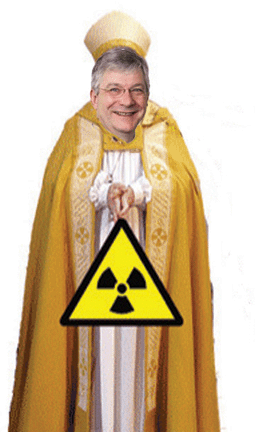
Dr Adi Paterson’s statements are apparently at odds with the group’s official position, which says nuclear is needed to tackle the climate crisis
Graham Readfearn, 17 Aug 24, https://www.theguardian.com/environment/article/2024/aug/17/dr-adi-paterson-nuclear-for-australia-climate-change
The chair of a leading Australian nuclear advocacy group has called concerns that carbon dioxide emissions are driving a climate crisis an “irrational fear of a trace gas which is plant food” and has rejected links between worsening extreme weather and global heating.
Several statements from Dr Adi Paterson, reviewed by the Guardian, appear at odds with statements from the group he chairs, Nuclear for Australia, which is hosting a petition saying nuclear is needed to tackle an “energy and climate crisis”.
Nuclear for Australia was founded by 18-year-old Queensland nuclear advocate Will Shackel, who has said repeatedly he believes reactors are needed to fight “the climate crisis”.
Two climate science experts told the Guardian that Paterson’s statements were misguided and typical of climate science denial.
Paterson defended his statements, telling the Guardian he was “not a climate denier”. He described himself as “a climate realist” and an “expert on climate science”.
In May, Paterson, who resigned in 2020 as the chief executive of the government’s Australian Nuclear Science and Technology Organisation, suggested on LinkedIn that concerns about climate change were “an irrational fear of a trace gas which is plant food”. He has been a regular guest on right-wing media outlets since the Coalition earlier this year said it wanted to lift the ban on nuclear and build reactors in seven locations.
On his Facebook page, Paterson has said that “cold is more dangerous than warm” and described a leading scientist as a “climate creep”.
On LinkedIn, he said US space agency Nasa was “deliberately confusing public understanding by publishing ground surface temperatures”, saying the agency’s climate work “should be given to a credible independent group. Defund NASA!”
In April, Paterson told an audience at the Centre for Independent Studies that “you can’t make a correlation between extreme events and climate” and said “no matter what you believe about carbon dioxide – it is plant food”.
“Increasing carbon a little bit is not going to dramatically change the climate. The plants will grow better,” he said, saying the planet was in a period of low CO2.
Prof David Karoly, a councillor at the Climate Council and a respected atmospheric scientist who has been studying the affects of CO2 on the climate since the late 1980s, said Paterson’s statements were typical of those from climate science deniers.
He said while CO2 levels were currently low in comparison to other times in Earth’s history, they were higher than at any time since the emergence of homo sapiens.
“He is misguided,” Karoly said. “CO2 has led to increases in temperature extremes, extreme rainfall, sea level rise and increases in bushfires and fire weather. CO2 has already dramatically changed the climate.”
Dr John Cook, an expert on climate change misinformation at the University of Melbourne, said Paterson was “regurgitating arguments” across a range of “thoroughly debunked talking points”.
He said: “It’s inconsistent to argue that CO2 is a trace gas which can’t possibly make any difference but at the same time claim that CO2 is going to green the planet.”
Shackel did not respond to questions. In an interview with the Guardian, Paterson argued the UN’s climate change panel “has made it very clear” that it was “not possible at this point” to link extreme events to changes in the climate.
But the panel’s latest report said it was “an established fact that human-induced greenhouse gas emissions have led to an increased frequency and/or intensity of some weather and climate extremes”, with evidence for rising temperature extremes, extreme rainfall, droughts, tropical cyclones and more dangerous fire weather.
Paterson said he did think rising levels of CO2 were a problem and that fossil fuels needed to be limited “as soon as we can”. “It is a very, very serious problem but it is not a climate crisis,” he said.
He said he had been concerned about climate change for many years but said unduly worrying children over the issue was “a form of child abuse”, and “the chance of significant catastrophic events” occurring in the next 30 years “related to an increase of CO2 in the atmosphere in the southern hemisphere” was “small”.
Paterson added he was more concerned about the “ecocide” from building wind and solar farms” than about climate change.
1 This month
Chernobyl: The Lost Tapes – A good documentary on Chernobyl on SBS available On Demand for the next 3 weeks– https://www.sbs.com.au/ondemand/tv-program/chernobyl-the-lost-tapes/2352741955560
15 April – Zoom –Nuclear Power is Not the Solution
Apr 15, 2026 01:00 AM in Canberra, Melbourne, Sydney

Join the International Physicians for the Prevention of Nuclear War (IPPNW) on Tuesday, April 14th for a timely webinar exploring the risks associated with nuclear power and challenging the myth that it offers a simple, safe, carbon-free solution to the climate crisis

21 April Webinar: No Nuclear Weapons in Australia
Start: 2026-04-21 18:00:00 UTC Canberra, Melbourne, Sydney (GMT+10:00)
End: 2026-04-21 19:30:00 UTC Canberra, Melbourne, Sydney (GMT+10:00)
Event Type: Virtual
A virtual link will be communicated before the event.
Host Contact Info: australia@icanw.org

of the week – Australians for War Powers Reform (AWPR)
To see nuclear-related stories in greater depth and intensity
 Antinuclear