That time when Canada cancelled its nuclear submarine order
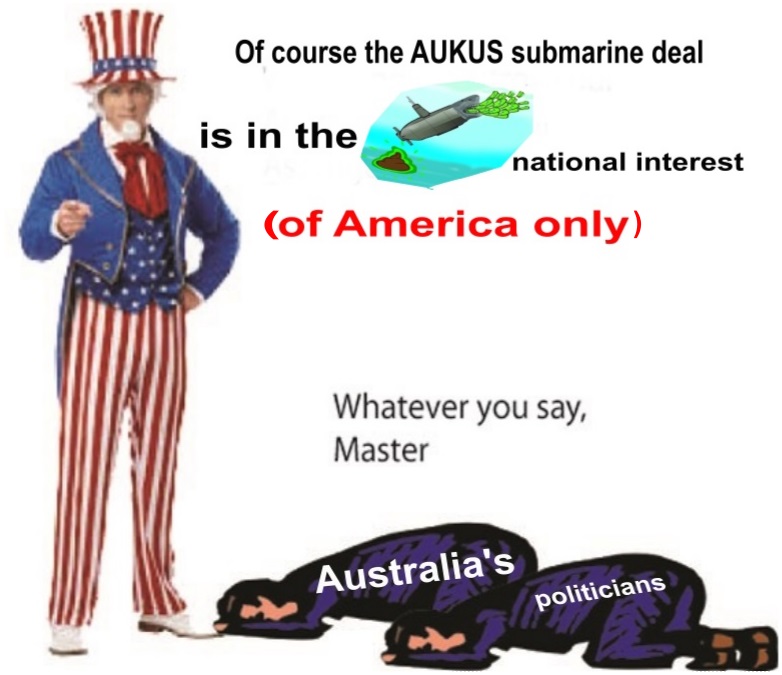
The decision to cut the Australian community out altogether — except where we will be called upon to service the US military as it builds its base in WA — puts us in the relationship of a vassal state, existing only to do the bidding of our powerful friend.
By Julie Macken and Michael Walker, Aug 30, 2024, https://johnmenadue.com/that-time-when-canada-cancelled-its-nuclear-submarine-order/
Back in 1987, when no one knew that the Cold War was just about to end, the Canadian Government signed up to build 10 nuclear-powered submarines. That submarine program lasted for all of two years before being cancelled in 1989. No nuclear Canadian sub ever even began construction, let alone getting put in the water.
There is a very real sense of déjà vu when we look at the Canadian experience and the current Australian experience of AUKUS. The good news is that it is not too late to learn the lessons the Canadians learnt for us.
One of the reasons for the Canadian cancellation was the $8 billion price tag, or about $19 billion in today’s money. Two billion dollars per submarine now sounds like a bargain compared to the astronomical $45 billion per submarine under AUKUS. Canada decided it had other priorities where that money could be put to better use.
But before the contract was cancelled in Canada, the ministries involved in its construction became embroiled in conflict, the Government itself was in a cost-of-living-crisis with immediate, real-world needs pressing and the hasty and secretive choice of vessel design came under withering criticism from the Treasury department for poor procurement with the cost expected to blow out to $30 billion ($70 billion today). And finally, media support eroded, with 71% of the population opposed to the project.
Déjà vu much?
On 12 June, the US Congressional Research Document service produced a research and advice document called the Navy Virginia-Class Submarine Program and AUKUS Submarine (Pillar 1) Project: Background and Issues for Congress.
The document points out the AUKUS deal was a three-step process. The first was to establish a US-UK rotational submarine force in Western Australia. The second was that the US would sell us three or five Virginia nuclear powered submarines and the third would be that the UK assists us in building our own AUKUS class nuclear submarines.
But the Congressional report outlines when comparing the “potential benefits, costs, and risks” of the three stage plan, it might just be better for the US to operate more of its own boats out of WA. That is, “procuring up to eight additional Virginia-class SSNs that would be retained in US Navy service and operated out of Australia along with the US and UK SSNs”.
That’s right, why bother with the whole step two and three when the US is best served by simply operating its nuclear-powered attack submarines out of WA?
This is an extraordinary development and one that demands more attention than has been given previously because a number of issues flow from this kind of thinking.
First, this potentially frees up $400 billion that could be put to far better use on a national housing construction program or high-speed rail network running the entire east coast of Australia or other large and much-needed nation-building projects. But not so fast.
The US Congressional Research Document suggests that “those funds (the $400 billion) could be invested in other military capabilities”, such as long-range missiles and bombers, “so as to create an Australian capacity for performing non-SSN military missions for both Australia and the United States”.
The decision to cut the Australian community out altogether — except where we will be called upon to service the US military as it builds its base in WA — puts us in the relationship of a vassal state, existing only to do the bidding of our powerful friend.
The fact that the document only referenced the “potential benefits, costs, and risks” from the US perspective, without any attempt to imagine how Australia may view becoming a life support for a US submarine base, makes the nature of our relationship pretty clear.
Australia’s Government may not consider it necessary to have done its due diligence on AUKUS but the Americans are happy to do that for us and, you guessed it, even though they quietly have doubts about the SSN project, they’ve already thought of plenty of other ways to spend our money on their own defence objectives. Spending it on the well-being and prosperity of our own people didn’t even rate a mention.
Recent Events Prove Western Nations Are Highly Vulnerable To Cyber Calamity
Alt-Market.US, August 27, 2024

COMMENT. The original of this article contains a conspiratorial view of Covid-19 and its causes.
I can’t really agree to that opinion on Covid.
BUT – the dangers of cyber calamity seem all too real to me, and this article sets it out well
As most people are aware, this month there was a sweeping internet outage across the US which led to a failure in roughly 8.5 million Microsoft Windows devices. Disruptions included banks, airline networks, emergency call centers, online retailers and numerous corporate networks. The outage is estimated to have caused at least $5.4 billion in profit losses and it only lasted about a day.
The alleged cause of the breakdown was Crowdstrike, a cyber-security company that uses large scale data updates to Microsoft Windows networks to counter cyber threats. Instead, the company uploaded bugged code and caused a cascading outage. Mac and Linux machines were not affected.
The scale of the shutdown was immense – Over 25% of Fortune 500 companies were frozen. Travel essentially stopped. Business transactions for many companies ceased. Some banks including Bank of America, Capital One, Chase, TD Bank and Wells Fargo could not function and customers could not access their accounts.
The event reminded me of the panic surrounding the Y2K scare 25 years ago. Of course, that was all nonsense; US systems were definitely not digitized to an extent great enough to cause a disaster should there be an internet crash or a software crash. But today things are very different. Nearly every sector of the American (and European) economy and many utilities are directly dependent on a functioning internet.
The fear that prevailed during Y2K was unrealistic in 1999. Now, it makes perfect sense.
………………First and foremost, there is the potential for random error like the Crowdstrike incident. Then there’s the potential for a foreign attack on US and European digital infrastructure. Then, there’s the potential for a false flag event BLAMED on random error or a foreign government in order to foment war or economic collapse.
……………………..In June of 2021 there was an internet outage that led to large swaths of the web going completely dark, including a number of mainstream news sites, Amazon, eBay, Twitch, Reddit, etc. A host of government websites also went down. All this happened when content delivery network (CDN) company Fastly experienced a “bug.” Although Amazon had its website back online within 20 minutes, the brief outage cost the company over $5.5 million in sales.
A content delivery network is a geographically distributed network of proxy servers and their data centers. They make up what is known as the “backbone” of the internet. Only a handful of these company’s support a vast majority of internet activity. All it would take is for a few to go down, and the internet goes down, taking our economy with it.
The recent Crowdstrike situation is perhaps the worst web disruption of all time, and that was just a bug in a software update. Imagine if someone wanted to deliberately damage internet functions for an extended period of time? The results would be catastrophic.
With supply chains completely dependent on “just-in-time” freight deliveries and those deliveries dependent on efficient digital communications and payments between retailers and manufacturers, a web-down scenario for more than a few days would cause an immediate loss of consumer goods. Stores would empty within hours should the public realize that new shipments might not arrive for a long time.
Keep in mind, I’m not even accounting for payment processing between customers and retailers. If that shuts down, then ALL sales shut down. Then, whatever food you have left in your pantry or in storage is what you will have to live on until the problem is fixed. If it is ever fixed…
Network attacks are difficult to independently trace, which means anyone can initiate them and anyone can be blamed afterwards. With the increasing tensions between western and eastern nations the chances of an attack are high. And corrupt government officials could also trigger an internet crisis and blame it on foreign enemies – Either to convince the public to go to war, or to convince the public to accept greater authoritarianism.
…………….Figuring out who triggered the breakdown would be nearly impossible. We could suspect, but proving who did it is another matter. In the meantime, western officials controlled by globalist interests could lock down internet traffic and eliminate alterna
What are the most practical solutions to this? As always we can store necessities to protect our families and friends. To protect data, I recommend shutting OFF Windows Updates to prevent something like a Crowdstrike error from affecting your devices. You can also set up a Linux-based device with all your important data storage secured.
You can purchase an exterior hard drive and clone your computer data, then throw it in a closet or a waterproof case. Then there is the option of building a completely offline device (a computer that has never and will never connect to the internet).tive media platforms they don’t like, giving the public access to corporate news sources only.
These options protect you and your valuable files, but there’s not much that can be done to prevent a national scale cyber attack and the damage that one could cause. Organizing for inevitable chaos and violence is all you can do.
With a cyber-event there is the distinct danger of communications disruptions – No cell phones, no email, no social media, nothing. So, having knowledge in ham radio and radio communications is a must. I’m a general class ham and I’m still finding there’s more to learn, but a basic knowledge of radios, frequency bands and repeaters will help you to at least listen in on chatter and get important information outside of controlled news networks.
The people who used to claim it’s “doom mongering” to examine the threat of cyber attacks have been proven utterly wrong this past month. We just witnessed one of the worst internet implosions of all time and more are on the way. Prepare accordingly and remember that technological dependency is a double-edged sword. Use your tech wisely and don’t let it run your life. https://alt-market.us/recent-events-prove-western-nations-are-highly-vulnerable-to-cyber-calamity/
The AUKUS submarine deal has been exposed as a monumental folly – is it time to abandon ship?
The good news, perhaps, is that it is difficult to imagine the nuclear-powered submarines will ever arrive. The bad news is we will still have to pay the Americans and the British to prop up their overburdened and underperforming shipyards in the meantime. With friends like these, who needs to make new enemies?
Mark Beeson, Adjunct professor, University of Technology Sydney, August 27, 2024 https://theconversation.com/the-aukus-submarine-deal-has-been-exposed-as-a-monumental-folly-is-it-time-to-abandon-ship-236873?utm_source=twitter&utm_medium=bylinetwitterbutton
Nautical metaphors are irresistible, I’m afraid, when talking about Australia’s seemingly endless submarine saga. But as investigative journalist Andrew Fowler makes clear in Nuked: The Submarine Fiasco that Sank Australia’s Sovereignty, his excellent and excoriating analysis of the genesis of the AUKUS pact, there isn’t much room for levity otherwise.
Anyone who doubts the accuracy of former Labor luminaries Paul Keating and Gareth Evans, who have argued that AUKUS is, as Keating put it, “the worst deal in all history”, really ought to read this book.
Review: Nuked: The Submarine Fiasco that Sank Australia’s Sovereignty – Andrew Fowler (Melbourne University Publishing)
The plan for Australia to acquire eight nuclear-powered submarines, built locally in partnership with the United Stated and the United Kingdom, is projected to cost up to A$368 billion. But it is not just the cost of the AUKUS project that is astounding.
While many people should hang their heads in shame, the principal architect of this monumental folly is Scott Morrison, whose reputation will be deservedly further diminished by the revelations contained in Fowler’s carefully researched volume. One question the book does not address in detail is the abysmal quality of political leadership in this country, especially, though not exclusively, on the conservative side of politics.
Whatever the reasons for this, the end result was that the huge shift in Australia’s foreign policy alignment was hatched by a Christian fundamentalist former tourism marketing manager with no training in strategic or foreign affairs but a great gift for secrecy and deception.
The shift in question was the decision to abandon an agreement to buy much cheaper, arguably far more suitable and deliverable submarines from France, with the aim of “welding Australia’s military to the United States”. In retrospect, it is hard to believe how badly the French were misled, or how shortsighted the rationale for the switch actually was.
In Fowler’s view, buying the French submarines would have been a “remarkable achievement”. It would have given Australia “greater independence and a more influential position in the world”.
Properly explaining Australian policymakers’ fear of strategic and foreign policy independence would take another book. But what clearly emerges from Fowler’s account is how irresponsible and self-serving Australia’s approach to national security became under Morrison. The fate of the Australian people, not to mention the endlessly invoked “national interest”, was of less concern than short-term political advantage.
“The fact that the increasing US military presence in the Indo-Pacific could draw Australia into a conflict,” writes Fowler, “seemed of little consequence in Morrison’s desire to wedge Labour on national security.”
Of course, being painted as “weak” on security, and the US alliance in particular, was the stuff of nightmares for the Australian Labor Party. It still is. Consequently, the ALP’s leadership has gone to extraordinary lengths to try and convince voters, and its own increasingly sceptical rank and file, that not only are they equally committed to national security, but that the AUKUS agreement is the best way of achieving it.
High costs, significant risks
Given AUKUS was the brainchild of a discredited conservative prime minster who, Fowler suggests, “believed he was on a divine mission”, one might have hoped the Albanese government could have at least conducted a perfunctory cost–benefit analysis. AUKUS is the largest single military acquisition the nation has ever undertaken, after all. Recent defence acquisitions have become known for massive cost blowouts and failures to operate or arrive in the advertised manner.
But the Labor Party has not only walked into Morrison’s trap; it has willingly, even enthusiastically, “embraced a decision taken after a deeply flawed process”. Even more consequentially, as Fowler points out, “with the major parties in lockstep on AUKUS, the most complex and expensive spend in Australian military history would never be publicly investigated”.
At the very least, this is an astounding failure of good governance and accountability. Perhaps even more remarkably, it also demonstrates a singular lack of political judgement, driven by short-term political concerns rather than long-term strategic interests.
“Labor lost the one chance it had to identify itself as independent and courageous and put the interests of the country ahead of its understandable desire to win government,” argues Fowler. “The consequences of the fear that drove the ALP leadership to embrace AUKUS with barely a second thought will haunt them for years to come.”
Serves them right. When there is little discernible difference between the major political parties on issues of profound national importance, voters – especially the younger variety – may understandably despair about their futures.
Even if we put aside the fragile, unpredictable and polarised nature of US politics, it is not too controversial to suggest that the US alliance has some potential frailties and significant costs. Not the least of these is fighting in wars that have no obvious strategic relevance to Australia.
AUKUS will further complicate Australia’s relationship with China, our major trading partner. But it carries other significant risks. This not just because, as Opposition Leader Peter Dutton says, it is “inconceivable” that we would not fight alongside the US in any conflict with China over Taiwan.
If the naval base at Garden Island, just down the road from me off the coast of Fremantle, is not already a nuclear target, it assuredly will be once US and UK nuclear-powered submarines routinely operate from there. Whether my neighbours realise they risk being vaporised as part of our commitment to the alliance and a “great nation building project” is a mystery that has not been explored.
Local politicians, universities and defence representatives certainly recognise the short-term benefits that may flow from new investment. But this means there is likely to be next to no informed debate about, much less opposition to, the AUKUS pact, no matter what the ultimate costs may be for a nation that can’t even provide adequate housing for its own people. Indeed, the lack of debate, not to say outrage, about the sheer cost of the AUKUS project is perhaps the most remarkable feature of the sorry submarine saga.
And that is before we get to the growing doubts about the reliability, deliverability or strategic relevance of nuclear-powered submarines. Perhaps people find technical discussions stupefyingly dull or incomprehensible. Perhaps they don’t realise that if we spend all that money on submarines, not only will our sovereignty and capacity to act independently be significantly eroded, as Keating and Malcolm Turnbull have claimed, but we won’t be able to spend the money on more immediate and tangible threats – repairing our rapidly degrading natural environment, for example.
I am not convinced Australia needs to buy any submarines. This will no doubt strike those in Canberra’s strategic bubble as heretical, ill-informed and irresponsible. But it is noteworthy that our overall security did not seem to suffer while the ageing Collins class submarines were unavailable for four years.
Even those with widely respected expertise in such matters, such as Hugh White, have cast doubt on the feasibility of AUKUS. White has written that “long delays and cost overruns are certain. Outright failure is a real possibility.”
Drunken sailors
Fowler has produced quite the page-turner for a book on strategic policy. His account provokes occasional gasps of disbelief, especially about the conduct of the Morrison government and its coterie of carefully chosen, like-minded advisors, many of them from defence companies likely to benefit from government spending.
Many former Morrison ministers – as well as Morrison himself – have exited through the revolving door between government and business to take up lucrative positions in the defence industry. Who would have thought?
Nuked is worth a close reading to see how Fowler arrives at his damning conclusion:
the level of incompetence in the government of Australia was breathtaking, as were the repercussions. The United States would be calling all the shots on what kind of submarines would be sold to Australia, how old they would be, how many there would be, when they would be delivered, and even if they would be sold at all.
It was to be expected that Washington would act in its own best interests. What is extraordinary is the possibility that Morrison truly believed that what was best for the United States was best for Australia. Just as extraordinary is the fact that the Labor Party, perhaps fearful of history embraced the deal that made Australia so vulnerable, undermining its independence and sovereignty.
Another nautical metaphor about spending like drunken sailors comes to mind. It wouldn’t be quite so galling if the nation’s political leaders weren’t using our money or were motivated by something other than short-term political advantage or the fear of being wedged.
The good news, perhaps, is that it is difficult to imagine the nuclear-powered submarines will ever arrive. The bad news is we will still have to pay the Americans and the British to prop up their overburdened and underperforming shipyards in the meantime. With friends like these, who needs to make new enemies?
It beggars belief that a country with unparalleled geographical advantages and no obvious enemies thinks it is a good idea to spend $368 billion on offensive military capabilities, which may or may not work or be delivered. Nuked explains how this situation came about. But we may need to ask psychologists why our political leaders have turned us into what the diplomat Alan Renouf famously called a “frightened country” and allowed such follies to flourish.
Defence Minister Richard Marles opened $600k second office in Geelong, a short walk from his existing space

COMMENT. Defence Minister Richard Marles grows more grandiose by the day.
ABC News, by political reporter Courtney Gould 29 Aug 24
In short:
Defence Minister Richard Marles requested permission to establish a second office in his hometown of Geelong.
He is the only minister within the Albanese government to have a standalone ministerial office, besides his electorate office. It came at a cost to the taxpayer of more than $600,000.
What’s next?
A spokesperson said the spend was within the rules and guidelines set by the Finance Department.
A brand new headquarters for Defence Minister Richard Marles was established just 240 metres from his existing office at a cost to the taxpayer of over $600,000.
The costly office build, located on Geelong’s waterfront, was revealed in a freedom of information request by the ABC.
The offices are within walking distance of each other in the Geelong city centre.
Mr Marles made his request for the additional office space 13 days after Labor won the federal election in 2022. He is the sole minister to have had a standalone ministerial office approved.
“As the newly elected deputy prime minister, I am advised that I am entitled to additional office space,” he wrote in a letter dated June 3, 2022.
The original plan was to establish a new standalone office for his duties as the deputy prime minister and keep his existing Geelong headquarters open to constituents……………………………
The Department of Finance shelled out $658,053 to fit out and furnish the new office and paid $6,297 for repairs, removing and installing new signage, and new office furniture for the refurbished building.
An additional cost to fit out his now ministerial office to meet “security requirements” was paid by the Department of Defence. Defence Media did not respond to requests for comment about the cost of the upgrades
Marles the only minister to have standalone office
Under current arrangements, a minister can be provided with an additional office space to go about their ministerial responsibilities.
It is “usually” located within the Commonwealth Parliament Office (CPO), an option 19 ministers have elected to take………………….https://www.abc.net.au/news/2024-08-29/richard-marles-second-office-geelong/104280748
Advocates for nuclear power should heed the lessons from Kursk
By Richard Broinowski, Aug 29, 2024, https://johnmenadue.com/advocates-for-nuclear-power-should-heed-the-lessons-from-kursk/
On 22 August, Rafael Grossi, director-general of the International Atomic Energy Agency, warned of the deadly effect a military attack on Russia’s nuclear power complex at Kursk would have on civilian communities in Russia, Ukraine and potentially across Europe. He had previously warned of the consequences of such attacks on Ukraine’s nuclear reactors at Zaporizhzhia.
The Kursk nuclear complex is approximately 30 kilometres from a fluid military situation between invading Ukrainian forces and Russian defenders. The complex has six Russian designed RBMK reactors, the same type as at Chernobyl. Two are shut down, two are in construction mode, and two are hot. None have protective domes. The easiest and most effective military action would be destruction of the complex’s power supply, which as with flooded generators at Fukushima, would halt cooling pumps, overheat the reactors, cause a melt-down of fuel rods, and the uncontrolled venting of radioactive materials into the atmosphere.
People have short memories, and tend to forget the dimensions of previous nuclear disasters and near disasters, particularly at Windscale, Three Mile Island, Chernobyl and Fukushima. Chernobyl was arguably the worst, followed closely by Fukushima. At Chernobyl, reactor number four exploded, not due to military action, but an experiment by Russian engineers to see how long turbines would spin and supply power to cooling pumps if the reactor’s main electric supply failed. In the reactor, the collision of incandescent nuclear fuel with cooling water created an explosion which blew apart the reactor vessel and spread radioactive dust including xenon gas, short-lived Iodine 131 (eight days) and Caesium 137 (30 years) across much of Ukraine and Belarus, as well as parts of Russia, and Scandinavia. The nearest town of Pripyat was evacuated and a no-go zone of 30 kilometre radius, later expanded to 4,300 square kilometres, was declared.
Subsequent reports by the UN Scientific Committee on the Effects of Atomic Radiation found that immediate deaths caused by radiation from Chernobyl could be calculated, most certainly deaths from thyroid cancer, but not of long-term stochastic deaths. The precise number is unknown and there are wildly different estimates, including among the medical profession. Because of fears about radiation damage to foetuses, over one million abortions were performed across Europe in the year following the disaster.
And now, two warring countries dice with death over Zaporizhzhya, Europe’s largest nuclear power complex and one of the 10 largest in the world. Most recent attacks occurred between 2022 and 2024. Fighting in 2022 led up to Russia wresting management of the complex. While it was going on, a large calibre bullet pierced the outer wall of reactor number four and an artillery shell hit a transformer in reactor number six.
In April 2024, the IAEA reported the plant was attacked by a swarm of drones, three of them torching surveillance and communication equipment. There were three direct hits on containment structures. On 11 August, fire broke out in one of two cooling towers. Zelensky blames Putin for the attacks, Putin blames Zelensky. Putin is probably right. Why would Russia attack the complex it now managed? Both tend to downplay the disastrous consequences an attack on the reactors or their electricity and cooling systems would have on civilian populations across Europe. They would be similar if not worse than the results of the Chernobyl fiasco.
Although badgered by journalists following his 22 August address, Grossi refused to attribute blame for the attacks at Zaporizhzhia and who might initiate them at Kursk. He said the IAEA was not a political organisation, and blame would be up to the UN Security Council. He would not get into speculation. When pressed, however, he said if his investigations led to clear evidence of the perpetrators, he would call them out. Meanwhile, he was about to go to Kursk and examine the situation in conjunction with the managers and engineers of the nuclear complex there. He then planned to separately see both Putin and Zelensky.
What the whole situation should bring home to Australian politicians and their backers in the nuclear industry, who so blithely recommend the construction of a dozen-odd nuclear reactor complexes here, is the widespread lethal damage a kinetic attack on any one of them would cause in this country. We already see that US military and surveillance installations would become natural targets for China if ever war breaks out over Taiwan. Nuclear reactors would pose a much wider damage to the civilian population.
1 This month
15 April – Zoom –Nuclear Power is Not the Solution
Apr 15, 2026 01:00 AM in Canberra, Melbourne, Sydney

Join the International Physicians for the Prevention of Nuclear War (IPPNW) on Tuesday, April 14th for a timely webinar exploring the risks associated with nuclear power and challenging the myth that it offers a simple, safe, carbon-free solution to the climate crisis

of the week – Australians for War Powers Reform (AWPR)
To see nuclear-related stories in greater depth and intensity
 Antinuclear