Climate review backs solar, wind, hydrogen, not nuclear

Marion Rae, Sep 05, 2024, https://www.thenewdaily.com.au/news/national/2024/09/05/climate-review-backs-solar-not-nuclear
An independent review of Australia’s climate response has found no need, or time, for nuclear to be added to the energy mix to reduce emissions.
The Climate Change Authority on Thursday released its review of the ways big-emitting industries must change for the country to reach net zero emissions by 2050.
“We need to seize this once in a generation opportunity to ensure Australia’s rapid and orderly transition as the world transforms to avert the worst impacts of climate change,” chair of the authority Matt Kean said.
But developers of renewable energy projects need to engage with regional communities about the energy transition, and better explain the benefits that can be shared, he said.
As well as solar and wind for electricity generation and batteries for energy storage, the rapid development of emerging technologies such as hydrogen will play a part, the review finds.
The authority steers clear of nuclear power, citing federal and state bans, other available technologies, the long lead time and the premium it would cost for a first-of-a-kind reactor deployed in Australia.
Energy Minister Chris Bowen said the independent advice confirms nuclear could not replace aging coal capacity fast enough to support Australia’s 2050 target.
“Any delay risks not just our energy reliability and security but our ability to act on emissions reduction and secure the future for the next generation,” he said.
But Kean warned the nation must overhaul supply chains, production systems, public and private finance, and workforces.
The advice comes as the federal government faces a deadline on declaring an emissions reduction target for 2035, with Australia within striking range of its legislated target of 43 per cent of emissions cut by 2030.
The Australian Conservation Council welcomed the analysis showing the country can meet and beat its 2030 ambitions and accelerate towards a 75 per cent by 2035 target.
The modelled scenarios make it clear the extraction of fossil fuels will need to be reduced and ultimately phased out, spokesman Paul Sinclair said.
“A high ambition 2035 target is critical to set a clear goal for the government’s Future Made in Australia strategy,” Sinclair said.
The Pathways Review was commissioned by parliament to provide independent and technical advice on decarbonising the economy.
Sectors covered include energy and electricity, transport, industry and waste, agriculture and land, resources, and the built environment.
The Greens said Australia could hit net-zero by 2035 but Labor was “crab-walking away from strong climate targets” while approving coal and gas projects that will run through to 2080.
“Labor are climate frauds. Small targets won’t stop the climate crisis,” leader Adam Bandt said.
How much water does nuclear really need?
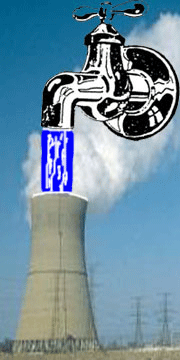
The Coalition’s plan for atomic energy has raised concerns about the amount of water that reactors will use in a hotter and drier Australia.
AFR, Christopher Niesch, 5 Sept 24 .
Opposition Leader Peter Dutton’s proposal to build seven nuclear reactors in five states has put nuclear energy in the spotlight. While Dutton claims nuclear power is a zero emissions solution to the energy transition, Anthony Albanese’s Labor government says it will take too long to build, be too costly, and will use too much water.
Under the Coalition plan, there would be five large-scale power plants and two small modular reactors, with the first to be operational by either 2035 or 2037.
Based on the scant detail so far available, the CSIRO has estimated a total build cost of about $60 billion in today’s dollars for these facilities. Other estimates, based on actual build costs abroad, are much higher.
But Labor has raised concerns about the amount of water that the reactors would consume, especially in a hotter and drier climate more prone to drought in the 2030s and 2040s…………………………………………………………………………………………………………………..
In an interview with Sky News in July, then agriculture minister Murray Watt said nuclear power uses “substantially more” water than coal does.
“There’s a real question about where that water is going to come from, whether some of that water is going to need to be taken off farmers, and what farmers are going to have to pay for their water if there’s a competing use for that water,” he said.
Watt also said that based on international practice, farmers would need to take expensive steps during a nuclear leak and would need to inform their customers that they operate within the fallout zone.
Queensland Premier Steven Miles has also said nuclear power could risk the state’s water security, with water consumption at the proposed stations depleting water reserves during droughts.
As coal stations were decommissioned they would have given up their water rights, but nuclear power stations would have to use that water for their 80-year lifetime, Miles says.
…………………………………………………………………………Where will water for the reactors come from?
The water would be from the same sources that existing coal-fired plants use.
Dutton says that if elected to government the Coalition would build nuclear reactors at locations where there are closed or scheduled-to-close coal-fired power stations.
“Each of these locations offer important technical attributes needed for a zero-emissions nuclear plant, including cooling water capacity and transmission infrastructure,” he says. “That is, we can use the existing poles and wires, along with a local community which has a skilled workforce.”
None are now owned by the commonwealth, which Dutton suggests could be overcome by compulsorily acquiring the sites.
Five full-scale reactors would be built in NSW, Victoria and Queensland, with small modular reactors in Western Australia and South Australia.
How much water does green power use?
Johanna Bowyer, an analyst at the Institute for Energy Economics and Financial Analysis, notes that solar and wind energy don’t rely on water and so the water currently used by coal-fired power stations could be used for agriculture instead.
And wind and solar energy could keep running at full capacity during times of drought, unlike coal or nuclear power.
Bowyer notes that there have been instances where coal-fired power stations have had to reduce their output during drought.
In 2007, the Tarong Power Station in Queensland cut its generation by 25 per cent in January and followed up with another 45 per cent cut in March to save water during the drought.
That water was also being used for drinking, so they prioritised that usage over the power station usage,” she says.
“Who knows what the future holds, but there’s some historical basis there for potential challenges, particularly during droughts. But it all depends on … the water cooling design for the nuclear power plant and it depends on how exactly they satisfy their water cooling requirements.
“That’s all really yet to be detailed in the Coalition’s plan.”
Where does all this leave the Coalition’s plan?
Dutton hasn’t released much more detail about his plans, so we can’t know exactly how much water they will use.
Nor is it clear how much water the small modular reactors (SMR) the Coalition is planning will use. more https://www.afr.com/companies/energy/how-much-water-does-nuclear-really-need-20240826-p5k5b6
TODAY. The Anglophone nations ganging up to dominate the rest of the world, mindlessly obeying the USA

What is it with this sychophantic obedience and grovelling to the USA? Does it come from memories of World War 2, or more likely, memories of how Hollywood portrayed World War 2? Many a Hollywood film, over the decades, told the glorious story of how America won the war, and saved the rest of us. In reality, that just was not true at all, for Britain, but partially true for Australia.
Then there was The Bomb – hastily dropped on Japanese civilians – despite Japan about to surrender anyway. But that wasn’t to save us, to end the war. It was done to intimidate the Russians.
Anyway, 79 years later, the danger is not the evil foreigners who don’t speak English. The danger is above all, the existence of nuclear weaponry itself. And this danger is now being landed especially on the Anglophone nations.

In the UK , only 3 weeks after Keir Starmer and the Labour Party took over, Labour amended the Eisenhower-era 1958 Mutual Defence Agreement (MDA) that is crucial to Britain’s Trident nuclear missile system. Officials deleted a long-standing sunset clause that required it be renewed every ten years. All references to an “expiry date” have been removed “to make the entirety of the MDA enduring, securing continuing cooperation with the US”
This change, quietly made, with no discussion in Parliament, let alone any public information, ensures that Britain will continue to host American nuclear weapons technology , and as always, slavishly follow the USA into its next military adventure, whatever that may be.
The UK’s most dangerous sites would include Lakenheath , the UK’s largest American air force base , and the Clyde Trident nuclear base. What enticing targets for America’s enemies in time of war!
If the USA is using Britain (and Europe) to position these dangerous nuclear targets, its moves into the whole continent Australia are even more breath-takingly bold. There’s always been the secret 5 Eye base at Pine Gap – but now – increasing military bases in Northern and Western Australia, and the nuclear submarine sage unfolds -with its potential to turn Australia into a USA/UK nuclear military waste dump.

What these Anglophone peoples don’t seem to “get” – is that nuclear military technology – if it ever was for “defence” has now become the biggest threat to our safety.
Australian nuclear news headlines Sept 5 – 9

Headlines as they come in
- Submission- G.H. Toll -re new agreement on Naval Nuclear Propulsion- Australia should pursue an independent non aligned foreign policy.
- Submission- Joseph Philippa-re new agreement on Naval Nuclear Propulsion- Much to lose and nothing to gain.
- South Australia is aiming for 100% renewable energy by 2027. It’s already internationally ‘remarkable’
- For Australia to meet emissions reduction targets, we don’t need nuclear energy.
- Basing US Nuclear Subs at Stirling on Garden Island makes Western Australia a nuclear target, while risking “catastrophic conditions” in a N-Sub reactor accident.
- Yah would’nt know it was happening. USA military might and toxic nuclear waste quietly infiltrating Australia?
- (CURRENTLY UNAVAILABLE – The Public Interest and Indigenous Rights in South Australia must not be compromised by an untenable Defence imposition of AUKUS military High-Level nuclear waste & nuclear weapons usable fissile material on the Woomera Area.)
- Mining bash to dish up nuclear as PM pushes future plan
- Submission- Amelia King -re new agreement on Naval Nuclear Propulsion- a shoddy deal for submarines that might not even exist
- Submission- Andrew Gaines -re new agreement on Naval Nuclear Propulsion- could take us to war against China
- Submission- Susan Benham-re new agreement on Naval Nuclear Propulsion- financial and security concerns.
- Another Hunter Valley earthquake sounds alarms on Coalition’s nuclear scheme
- Ted O’Brien’s not so excellent nuclear adventure
- The massive new projects propelling South Australia towards 100 per cent net renewables.
- Give Me Missiles: Gina Rinehart and the Pathologies of Mining
- From the archives: Racist statements by mining magnate Lang Hancock, and claims that he had Aboriginal children
- Submission- Friends of the Earth -re new agreement on Naval Nuclear Propulsion.
- Cash splash for nuclear towns under Coalition plan. Climate review backs solar, wind, hydrogen, not nuclear
- How much water does nuclear really need?
- Steve Thomas admits Collie residents unlikely to have “veto” in Coalition’s nuclear plans.
Submission- Friends of the Earth -re new agreement on Naval Nuclear Propulsion
underlying premises are false or misleading
most importantly, a wasteful expenditure of public money that will make Australia less safe
It is a logical contortion to suggest that nuclear powered naval submarines are “a peaceful activity”.
Besides spent nuclear fuel from Australian AUKUS submarines, there is a danger that Australia could be pressured into storing and disposing of spent nuclear fuel from UK and US submarines.
a giant millstone bequeathed to the people of Australia.
Submission to the Joint Standing Committee on Treaties re “Agreement … for Cooperation
related to Naval Nuclear Propulsion” Submission no. 5 https://www.aph.gov.au/Parliamentary_Business/Committees/Joint/Treaties/NuclearPropulsion/Submissions
Philip White, For Friends of the Earth Adelaide 4 Sept 24 [Original contains many nots, references, sources)
This Agreement should be rejected for reasons including those outlined below.
- Because the underlying premises are false or misleading.
(a) Australia’s defence and security
The premises stated in the preamble include:
Recognizing that their common defense and security will be advanced by the exchange
of information, including Naval Nuclear Propulsion Information, and the transfer of
Material and Equipment for conventionally armed, nuclear-powered submarines, in
accordance with this Agreement; and
Believing that such exchanges and transfers can be undertaken without unreasonable
risk to each Party’s common defense and security.
These premises are false. In fact, Australia’s security will not be advanced and there is an
unreasonable risk to Australia’s defence and security, as can be seen from the quotes below from
eminent military analysts.
Hugh White (emeritus professor of strategic studies at the Australian National University, former
deputy-secretary of the Department of Defence) states as follows:
The new plan – to buy a nuclear-powered submarine instead – is worse [than the old
plan]. It will make the replacement of the Royal Australian Navy’s fleet of Collins-class
boats riskier, costlier and slower. It means an even bigger slump in our submarine
capability over the next few dangerous decades. And it deepens our commitment to the
United States’ military confrontation of China, which has little chance of success and
carries terrifying risks.1
He concludes that it “tied Australia to a deal that undermines our sovereign capabilities,
overspends on hardware we can barely be confident of operating, and drags us closer to the front
line of a war we may have no interest in fighting.”2
Major General Michael G Smith (retired) says:
In my view this decision to procure nuclear-powered submarines will prove to be as
useless, but even more costly, than was our flawed Singapore strategy before World War
II.3
Sam Roggeveen (director of the Lowy Institute’s International Security Program) is quoted as
saying:
It (AUKUS) is a project of vaulting ambition that is out of step with Australian tradition
as a middle military power, wildly at odds with our international status and, most
importantly, a wasteful expenditure of public money that will make Australia less safe.4
(b) Nuclear non-proliferation
The preamble also includes the following premises:
Reaffirming their respective obligations under the Treaty on the Non-Proliferation of
Nuclear Weapons, done at London, Moscow, and Washington 1 July 1968, and entered
into force 5 March 1970; …
Further recognizing that Australia has announced its intention to negotiate and conclude
an Article 14 arrangement with the International Atomic Energy Agency (“IAEA”)
pursuant to the Australia-IAEA Comprehensive Safeguards Agreement, related to
cooperation under this Agreement.
The premises thus stated fail to acknowledge that the ‘Article 14’ arrangement in question is a
self-contradictory attempt to close a dangerous loophole in the Treaty on the Non-Proliferation of
Nuclear Weapons (NPT). The NPT only requires the application of safeguards to ‘peaceful’
nuclear activities. That leaves unstated the question of what to do about ‘non-peaceful’ nuclear
activities, other than nuclear weapons which are banned for non-nuclear-weapon states
‘Article 14’ of the Australia- IAEA comprehensive safeguards agreement (INFCIRC/217, 13
December 1974) states:
Australia shall inform the Agency of the activity, making it clear:
That the use of the nuclear material in a non-proscribed military activity will not be in
conflict with an undertaking Australia may have given and in respect of which Agency
safeguards apply, that the nuclear material will be used only in a peaceful nuclear activity.
It is a logical contortion to suggest that nuclear powered naval submarines are “a peaceful
activity”.
In a 6 October 2021 letter to President Biden, seven leading US non-proliferation experts explain
the problem as follows:
The IAEA is charged by the Treaty on the Nonproliferation of Nuclear Weapons with
verifying that nuclear material in non-weapon states is not diverted to nuclear weapons.
The IAEA is constrained, however, by Section 14 of its standard safeguard agreement,
“Non-Application of Safeguards to Nuclear Material to be Used in [Non-Explosive]
Non-Peaceful Activities,” which would allow a country to exempt HEU fuel from
normal inspections for decades. This well-known loophole has not yet been tested.5
These nuclear non-proliferation experts go on to articulate the following concern:
We … are concerned that the AUKUS deal to supply Australia with nuclear-powered
attack submarines fueled with weapon-grade uranium could have serious negative
impacts on the global nuclear nonproliferation regime and thereby on US national
security.6
They are concerned that countries including Iran, Brazil and South Korea could use the agreement
between Australia, the UK and the US as a precedent to support their own interest in acquiring
nuclear submarines. The experts express their concern for US national security, but the negative
impacts also apply to the national security of Australia.
- Radioactive waste
If Australia goes ahead with its plan to acquire nuclear powered submarines, the resulting spent
nuclear fuel and other radioactive waste will continue to be dangerous for tens of thousands of
years. It will have to be managed, stored and disposed of, but the countries from which we would
purchase these submarines inspire no confidence that this can be safely achieved. In over 60 years
of operating nuclear submarines, the US and UK have been unable to dispose of their own spent
nuclear fuel.
Besides spent nuclear fuel from Australian AUKUS submarines, there is a danger that Australia
could be pressured into storing and disposing of spent nuclear fuel from UK and US submarines.
Under the Agreement, the status of spent fuel from second hand Virginia class submarines to be
purchased from the US is vague, but it is likely that Australia would be expected to accept US
spent fuel: i.e. to dispose of both the spent fuel produced while the submarines were owned and
operated by the US, as well as that produced while they were owned and operated by Australia.
The situation regarding other UK and US submarines is also unclear.
Minister for Defence RichardMarles has stated that Australia would not accept radioactive waste from overseas, but this has not been explicitly ruled out in the Australian Naval Nuclear Power Safety Bill 2023 currently before Parliament. The words of an under-pressure defence minister in 2024 are unlikely to count for much decades hence if Australian legislation and the Agreement between Australia, the UK and
the US do not prohibit the acceptance of foreign spent nuclear fuel.
It is important to acknowledge Australia’s poor history regarding radioactive waste disposal
facilities. As former Senator Rex Patrick points out, “Australia has been searching for a site for a
National Radioactive Waste Management Facility (NRWMF) site since the 1970s; and after 50
years, it still hasn’t found a spot on which to safely establish such a repository.”8 Several attempts
have been made, but they have been opposed by the Traditional Custodians, as well as the wider
public. The United Nations Declaration on the Rights of Indigenous Peoples states:
States shall take effective measures to ensure that no storage or disposal of hazardous
materials shall take place in the lands or territories of indigenous peoples without their
free, prior and informed consent.9
This principle has not been followed in the search for a National Radioactive Waste Management
Facility. Now the Commonwealth Government is seeking to commit Australia to storing and
disposing of highly radioactive long-lived spent nuclear fuel from nuclear submarines. In the event
that Australia does acquire nuclear submarines, any future disposal site selection process should
adhere to this principle. However, it should not be taken for granted that Australia will be able to
find willing communities to host a site, especially considering that several State and Territory
governments have laws or policies opposing the disposal of nuclear waste in their jurisdictions. The Commonwealth should respect such prohibitions. It should not take the view that it can jus tride roughshod over them.
- Health and Safety
Much as the United States Navy claims that its nuclear-powered submarines are safe,11 the fact is
that the longer they operate the more highly radioactive material accumulates in their reactors.
Unlike civilian nuclear power plants, which have some of their spent fuel removed during regular
outages, US and UK designed submarines, which use highly enriched uranium and do not require
refuelling, keep accumulating radioactive material for the life of the submarine. Therefore, even
though submarine reactors have a lower power output than standard civilian reactors, after they
have been operating for a while they accumulate a substantial inventory of spent fuel.
It is not possible to guarantee that some of that radioactive material will not be released into the
environment, but, under the terms of the Agreement, liability is foisted onto Australia. Article IV.E
states as follows:
Australia shall indemnify, subject to paragraph F of this Article, the United States and
the United Kingdom against any liability, loss, costs, damage or injury (including
third-party claims) arising out of, related to, or resulting from Nuclear Risks connected
with the design, manufacture, assembly, transfer, or utilization of any Material or
Equipment, including Naval Nuclear Propulsion Plants and component parts and spare
parts thereof, transferred or to be transferred pursuant to this Article.
So even if the fault lies with the US or the UK, the liability, which could be huge, lies with
Australia. No government should accept such a risk.
Emergency planning is necessary to respond to potential accidents. In the case of port visits by
foreign nuclear vessels, organisations including the Australian Radiation Protection and Nuclear
Safety Agency (ARPANSA), the Department of Defence, and State and Territory authorities each
play a role in planning and responding to accidents involving the release of radioactive material. According to the Department of Defence,
1.4 The Australian Government requires contingency arrangements to be in place at all
Australian ports visited by NPWs and also requires that there be the capability to
undertake radiation monitoring of the port environment. These arrangements are
formulated to cover two potential release mechanisms, which are failure or malfunction
of radioactive waste control systems within the vessel and an accident involving the
reactor plant.13
One scenario that is not considered is the case of a nuclear vessel being attacked by a hostile
foreign power. As we witness the attacks on the Zaporizhzhia Nuclear Power Plant in Ukraine, we are forced to realise that attacks on nuclear facilities are not confined to the realm of fantasy.
Inevitably a hostile power (be it China, or Russia, or some other country in future) would perceive
Australian nuclear powered submarines operated in alliance with the United States and the United
Kingdom as a threat. We cannot rule out the possibility that such a hostile power might one day
decide to attack an Australian nuclear powered submarine, or a US or UK nuclear vessel while it is
in an Australian port or in waters near the Australian coast.
Even if the probability of a nuclear accident is low, the potential consequences could be
catastrophic. The fact that there are grave risks is essentially acknowledged in the high
“permissible radiation dose[s]” envisaged under the existing emergency response plans.
14,15 There are already risks involved in accepting visits by foreign nuclear ships. However, there have been no nuclear vessel visits to Adelaide, where Friends of the Earth Adelaide is based, so there has
been no need to develop emergency plans for this contingency. We would like to keep it that way.
For that reason, we do not want Osborne to be declared a “designated zone” for nuclear submarine
construction. The claimed benefits (which are mostly illusory) are not worth the risk.
- Waste of money and human resources
The projected cost of AUKUS is extraordinary.
The costs of the submarine component of AUKUS are estimated at $368bn through to
the 2040s; and the total cost also includes $3bn to be transferred to the USA to help with
its current domestic submarine production difficulties (Creighton 2023).16
We live in a time of multiple crises: for example, a failing health system, lack of housing, energy
system transformation, and degradation of the environment. All of these crises are security issues.
The security of ordinary Australians is compromised when they can’t get a hospital bed, or find a
home to live in, or pay their electricity bill, or enjoy the fruits of a sustainable environment. All
these security crises could be greatly ameliorated by the wise use of $368 billion. On the other
hand, nuclear-powered submarines won’t even make us safer from attack (refer discussion above),
let alone solve any of the real security issues faced by Australians on a daily basis.
Politicians like to claim that the submarine project will create jobs.
A government press release in March 2023 claimed that the jobs in South Australia
arising from the AUKUS deal would be fairly evenly divided between 4,000 workers employed to design and build the infrastructure at Osborne (Port Adelaide) and a further
4,000 to 5,500 to build the actual submarines. The AMWU sees around 5,000 workers
being needed to build, maintain and repair the submarines when the build is scheduled to
start in the 2040s. Spread over more than a quarter of a century, this is not hugely
impressive.
Furthermore, as John Quiggin (2023) pointed out, at current estimates, this works out at
roughly $18 million per job.17
Spending this money on health, housing, renewable energy and the environment would create
many more jobs at the same time as addressing the real sources of insecurity for Australians now
and in the foreseeable future. Furthermore, it is not just a matter of the money, but also the
diversion of skills that unwise spending leads to.
For Port Adelaide/Osborne, the lesson is that it would be wise to treat all claims
regarding job growth and related local economic development with a large pinch of salt.
South Australia, like the rest of the country, is facing a massive skills shortage. A 2023
report from Jobs and Skills Australia (JSA 2023) argued that Australia would need more
than two million workers in the building and engineering trades by 2050 and more than
32,000 more electricians by 2030. A development focussed entirely on producing
nuclear submarines to reinforce a growing Cold War is going to suck skilled workers
from other vital sectors.18
- Conclusion
The proposal for Australia to acquire nuclear powered submarines from the US and the UK, was
conceived in secret and presented as a fait accompli to the Australian public by then Prime
Minister Morrison. After taking a few hours to collect its thoughts, judging that so close to an
election it couldn’t afford to be seen to be weak on Defence, as a matter of political expediency the
then Albanese Opposition accepted the deal, even though it made no sense from a security
perspective and represented a massive opportunity cost for every Australian for decades. If
Australia proceeds with the deal, it will be Scott Morrison’s greatest legacy: a giant millstone
bequeathed to the people of Australia.
Despite the fact that the deal has received criticism from both the right and the left, there is no sign
that either Labor or the Liberal/National Coalition are interested in winding it back. But maybe
these submarines have an escape hatch written into the clauses of the Memorandum of
Understanding and the Agreement itself. Clause 6 of the Memorandum of Understanding states:
The Governments affirm that cooperation under the Agreement is to be carried out in
such a manner as to not adversely affect the ability of the United States and the United
Kingdom to meet their respective military requirements and to not degrade their
respective naval nuclear propulsion programs.
The grounds for making this judgement are not specified, but based on the current rate of
submarine construction in the US and the UK, it would not be difficult for those countries to make
the case that delivery of submarines to Australia would “degrade their respective naval nuclear
propulsion programs”.19 Article XIII of the Agreement gives them the right to terminate the
Agreement with one year’s written notice, so there is their escape hatch.
We strongly believe that the Agreement should not be entered into in the first place. The proposal
for Australia to acquire nuclear powered submarines should be rejected on security, safety, nuclear
non-proliferation, environmental and economic grounds. Given that both sides of politics have
committed themselves to these submarines, it would take some political courage to reverse course.
If the government does not have enough political courage to make the right decision now, then it
should encourage the US and UK governments to do the arithmetic and quickly come to the
conclusion that they can’t build submarines fast enough to supply Australia without degrading
their own nuclear propulsion programs. The quicker everyone acknowledges this and exercises
their right to terminate the Agreement, the less money will be wasted.
Cash splash for nuclear towns under Coalition plan

Don’t believe the hype!
The Age, By Paul Sakkal and Mike Foley, September 5, 2024 —
Regional communities will be showered with gifts for hosting nuclear reactors under Opposition Leader Peter Dutton’s energy policy, as the Coalition pledges a government-backed managed investment fund propped up by profits from its proposed power plants.
Opposition energy spokesman Ted O’Brien detailed the plans in a speech planned for this week’s Gippsland New Energy Conference, announcing the Coalition’s Community Partnership funds that invest dividends earned by the nuclear plants into the local economy.
Climate and Energy Minister Chris Bowen was invited to speak at the conference while O’Brien’s office claimed he was blocked from speaking despite the Coalition proposing a nuclear facility in the region, displaying what O’Brien called Australia’s “immature” energy debate that excludes nuclear energy advocates. Conference organisers were contacted for comment.
The Coalition’s signature energy policy would build seven taxpayer-funded, government-owned nuclear plants on the sites of existing coal generators. The proposed sites are in Lithgow and the Hunter Valley in NSW, Loy Yang in Victoria’s Latrobe Valley, Tarong and Callide in Queensland, Collie in Western Australia and Port Augusta in South Australia.
In his draft speech given to this masthead, O’Brien claimed the plants would supply the “cheapest electricity in the nation” for firms in industrial zones, which would attract a wave of investment to build facilities, grow the workforce and drive regional population growth.
“We want to ensure that communities like Latrobe can power Australian manufacturing for the remainder of this century and beyond,” O’Brien said in the speech.
“The key here is workers can move over in their same occupations, continuing to apply their skills, doing what they’ve always done. It means their social networks remain, their kids can still go to the same school.”
The Coalition has pledged to build the first two nuclear plants by 2037, with all seven completed by 2050. The sites have been selected to tap into existing transmission line infrastructure once the existing coal plants reach the end of their life.
However, experts have rejected claims that nuclear energy would be cheap, arguing renewables already produce less expensive electricity than fossil fuels and that CSIRO findings show it would cost more than $16 billion to build a single nuclear reactor.
The CSIRO said electricity will come from a grid drawing 90 per cent of its power from renewables, it would cost between $89 and $128 per megawatt hour by 2030. A large scale nuclear reactor would supply power for $136 to $226 per megawatt hour by 2040, according to the CSIRO.
The Coalition disputes the findings, saying the CSIRO did not consider the long life of nuclear plants, but has not released its own costings. This document will be key to understanding how the Coalition intends to return a profit on taxpayers’ investment in nuclear plants.
Bowen told the Gippsland conference on Wednesday the Coalition’s nuclear plan would cripple investment in renewable energy currently flowing to regional communities.
“They want to stop investment, stop jobs, and stop benefits in favour of waiting for a nuclear fantasy that may never come true,” he said.
The Coalition’s claims of a regional industrial boom under the nuclear plan resembles the goals of its previous regional investment policies…………………….more https://www.theage.com.au/politics/federal/cash-splash-for-nuclear-towns-under-coalition-plan-20240902-p5k72h.html
1 This month

of the week – Australians for War Powers Reform (AWPR)
To see nuclear-related stories in greater depth and intensity
 Antinuclear