Yah wouldn’t know it was happening. USA military might and toxic nuclear waste quietly infiltrating Australia?

I think that you’ve got to give credit to the corporate media, especially the Australian media.
I dunno about the rest of you, but I am pretty much numbed by the blanketing of all news for weeks on end, with coverage of the Olympics. Former Liberal Prime Minister Malcolm Fraser wished that politics should be relegated to page 3,with sport at the front page. He would be delighted with today’s situation where sport occupies about the first 37 pages of the news.
In Melbourne, we are about to come up for air after being submerged in Olympics news, only to face the next inundation, which is of course Australian Rules Football.
But the media here will dutifully make an exception for news about an enormous weapons industry fest now being held in Melbourne. No doubt there’ll be condemnation of those evil protestors who want to stop this wonderful industry – that brings in the dollars in weapons sales to places like Israel and Ukraine – so good for the Australian economy!
There are bits of news that just do not surface at all.
There’s a government Review going on – that just about nobody has heard about – https://www.defence.gov.au/about/reviews-inquiries/review-woomera-prohibited-area-coexistence-framework .
It’s all about how the government uses a large stretch of land in South Australia – almost certainly a quiet introduction to the idea of dumping USA’s AUKUS nuclear waste there. They very quietly called for Submissions by September 6th.

So pretty much nobody knew anything about that. (One investigative nuisance – David Noonan actually managed to get a Submission in)
Australians are pretty much conditioned now, to know that the only important news is sport, preferably with Australia winning, – (because it’s the only thing we’re good at, isn’t it?). Some Aborigines might be anxious to learn that South Australian land, already polluted by British nuclear bomb tests in the 1950s, is going to get another burst of nuclear weapons pollution from our “friends” the UK and USA.
But last year, the Australian media managed to kill off any plan for the Aborigines to have a Voice to Parliament. This year, media silence on the AUKUS nuclear waste plan will probably be even more effective in removing any Aboriginal objection from the process.
New images raise concerns over state of UK nuclear submarines
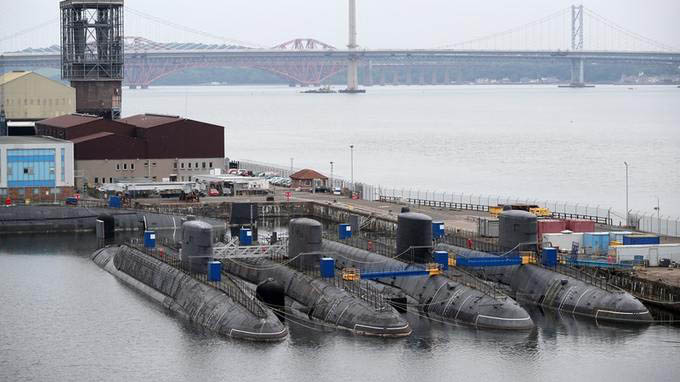
The National By Xander Elliards 8th September 24
CONCERNS have been raised that the deteriorating state of the UK’s nuclear submarines is “potentially putting the vessel and her crew at risk”.
Alarm bells were rung after the Ministry of Defence (MoD) announced last week that Defence Secretary John Healey had joined one of the UK’s four Vanguard-class submarines as it returned to dock at Faslane.
An image shared by the MoD showed Healey looking at the submarine, which appeared covered in algae, slime and rust along its entire length.
Further photos taken by locals living near the HM Naval Base Clyde showed the submarine was missing numerous patches of anechoic tiles – which line the exterior to help hide the submarine from sonar.
The submarine is thought to have been on patrol since mid-March, meaning it had spent around 160 days underwater.
In March, HMS Vengeance returned to Faslane after 201 days underwater – reported to be the second-longest patrol ever – directly following a mission which lasted 195 days. Patrols on the previous Polaris generation of nuclear submarines averaged 60-70 days, according to the Campaign for Nuclear Disarmament (CND)
HMS Vengeance is one of four Vanguard-class submarines, which were each built with a 25-year lifespan – a limit imposed by the lifespan of major components – and either commenced sea trials or saw their reactor go critical in 1992, 1994, 1996, and 1999. The UK Government noted in 2007 that it “should be possible” to extend these lifespans by five years to a total of 30.
At least one submarine is meant to be patrolling the oceans at any time in order to deliver a nuclear strike if the UK Government orders it. However, the ageing fleet meant that essential works had to be carried out to keep the submarines seaworthy, placing higher pressure on the remaining boats.
In January, alarm bells had been rung after Dominic Cummings, a key adviser during Boris Johnson’s time in Downing Street, said there was a hidden “scandal of nuclear weapons infrastructure” which he called a “dangerous disaster and a budget nightmare of hard-to-believe and highly classified proportions”.
Issues with ageing equipment nearly led to a major disaster in 2022 after a broken depth gauge meant one nuclear submarine was continuing to descend despite unknowingly approaching “crush depth”.
On Saturday, the Daily Mail reported that none of the UK’s attack submarines are currently at sea, and the majority (16 out of 25) of the country’s warships are broken down, being modified, or undergoing trials. Retired rear admiral Chris Parry called the situation “utterly dire”.
In May 2023, HMS Vanguard finally completed a seven-and-a-half-year refit, and in March 2024, work on HMS Victorious was also completed. The final boat in the fleet is called HMS Vigilant, but it is not clear which of the four were greeted by Defence Secretary Healey at Faslane last week.
Responding to the nuclear-armed submarine returning to Faslane, Chris McEleny, Alba Party’s general secretary and a former MoD employee, said: “The latest sight of a Vanguard-class submarine returning to base caked in algae is very concerning. And, yet again we see anechoic tiles are missing, potentially putting the vessel and her crew at risk.
“The lengthy patrols should also spark concerns as to whether or not subs are going out on patrol with increased payloads due to concern over the half-life.
“The MoD have, as usual, failed to provide basic guarantees in regards to the safety-critical implications of these prolonged patrols.”…………………………..
Lynn Jamieson, the chair of the Scottish CND, claimed that the “UK’s nuclear weapons system is a shambles but that does not capture the absurdity and seriousness of its dangers”.
“The longer at sea, the more mental and physical stress on the crew and the more chance of accidents,” she went on. “The older the submarine the more the risks of unplanned radioactive leaks and other such incidents.
“The cost of keeping the ageing nuclear weapon system going and simultaneously building a replacement grows while public services are drastically cut. In 2023 alone, it cost £6.5 billion [according to a report from the independent Nuclear Information Service] and it will be even more this year.”……….
Jamieson said the UK Government should show “true leadership [and] scrap the old system and its replacement rather than continuing to valorise a capacity for genocide that puts the world in peril, a target on our backs and risks in our backyard”.
SNP MSP Bill Kidd, the co-president of Parliamentarians for Nuclear Non-Proliferation and Disarmament (PNND), said Scotland was the “dumping ground for nuclear leaks and discharges into our waters and coasts and we are the target for any potential nukes an enemy would fire at”.
“Nothing is planned to change in all this as far as Westminster is concerned – and that means Labour every single bit as much as Tories”, he said……………………………….. https://www.thenational.scot/news/24568990.new-images-raise-concerns-state-uk-nuclear-submarines/
Submission- Tom Warwick -re new agreement on Naval Nuclear Propulsion- not in the public interest, designed to provoke China
The other partners in the deal take no risk and Australia agrees to accept all the risks and nuclear waste. The government who agreed to this deal is not acting in the interest of the people and is either naive or traitorous
China does not want war with Australia, China has not fired a shot in 40 years, China is trying to prove that their model of prosperity without war is superior and they are successful in doing so.
Submission no 11 https://www.aph.gov.au/Parliamentary_Business/Committees/Joint/Treaties/NuclearPropulsion/Submissions
Dear senate committee, I am a member of the Australian public, and a voter in the electorate of
Durack. I represent myself and the ordinary people of Australia.
The AUKUS deal is not in the interest of the Australian people.
The opportunities forgone by spending an exorbitant $368B on nuclear submarines is enormous, we
have great need in this country for public spending on social programmes, social and commercial
infrastructure.
Not only does the AUKUS spending not produce social good it is harmful and causes risks to
Australian society.
The other partners in the deal take no risk and Australia agrees to accept all the risks and nuclear
waste. The government who agreed to this deal is not acting in the interest of the people and is
either naive or traitorous. If naïve the government should be removed, if traitorous the government
must be prosecuted and severely punished.
The submarines are not defensive in nature, the reason why nuclear has been chosen is that they
can operate far off shore and not in Australian territorial waters to provoke and possibly attack an
adversary far away, and though it has not been explicitly stated China is the object of this
antagonism, our largest trading partner and the nation upon who most of our prosperity depends.
China does not want war with Australia, China has not fired a shot in 40 years, China is trying to
prove that their model of prosperity without war is superior and they are successful in doing so.
AUKUS is not in the public interest
AUKUS has never been demanded by the Australian people
AUKUS places an excessive financial burden in the public purse, funds that could be much
better spent on public infrastructure.
There are no guarantees that Australia will receive anything from AUKUS except public debt,
nuclear waste from Britain and USA and risk.
AUKUS is provocative to our most valuable trading partner
Please cancel AUKUS now.
Submission- Dr Marty Branagan -re new agreement on Naval Nuclear Propulsion- it’s the worst foreign policy mistake
It will contribute to a regional arms race which could have disastrous consequences.
China and Australia have a mutually-beneficial trade relationship which this deal will harm.
a growing national movement which wants an end to AUKUS
Submission no. 10 https://www.aph.gov.au/Parliamentary_Business/Committees/Joint/Treaties/NuclearPropulsion/Submissions
The acquisition of a fleet of nuclear-powered submarines (some of them second-hand) costing up to
A$368 billion is the largest defence project since World War Two and the worst foreign policy
mistake since a failed bid to introduce conscription during World War One, according to former
prime minister Paul Keating. Occurring with little public consultation, it was supported by a ‘Red
Alert’ series of fearmongering front-page articles in Australia’s ‘Nine’ newspapers in consultation
with the Australian Strategic Policy Institute, which has close ties to arms dealers, and which argued
for greater defence capabilities to resist a supposedly imminent war with China. Yet China and
Australia have a mutually-beneficial trade relationship which this deal will harm. It will contribute to
a regional arms race which could have disastrous consequences. It is already shifting valuable
resources away from the more pressing threat of global warming facing both countries. The cost is
massive at a time of desperate need for social housing and cost-of-living relief; for that money, far
more people could be employed in education, health, housing, agricultural, environmental and social
service
The project can be cancelled with a year’s notice according to a revamped AUKUS agreement tabled
in federal parliament, and there’s no guarantee whether an almost $5 billion payment to the USA
will be refunded if no nuclear-powered boats are delivered. Australia has also agreed to indemnify
the US and UK against any loss or injury connected to nuclear materials transferred here. Resistance
has been fierce, with a series of protests against plans for a new submarine base in Port Kembla,
some drawing 5,000 protesters. The South Coast Labor Council, consisting of unions representing
50,000 workers, fear the base could choke a nascent clean energy sector by taking up scarce land
and ushering in security curbs, while the permanent presence of U.S. warships would be a nuclear
target. Environmentalists are concerned about the fact that ‘Australia shall be responsible for the
management, disposition, storage, and disposal of any spent nuclear fuel and radioactive waste
resulting from the operation of Naval Nuclear Propulsion Plants’. The ‘Marrickville Declaration’ by 30
community groups such as the Anti-AUKUS Coalition is part of a growing national movement which
wants an end to AUKUS, claiming that its cost and the open-ended commitment to foreign military
priorities are to the detriment of priorities for a resilient, safe and peaceful Australian society. It also
violates Australian sovereignty and our commitment to a nuclear-free Pacific under the Treaty of
Rarotonga (the South Pacific Nuclear Free Zone Treaty).
Australia’s primary threat is global warming and extreme weather events such as the catastrophic
Lismore floods and 2019-20 bushfires. We would be better served by new fire-fighting planes and
conversion from military operations to disaster response and emergency relief services. Increased
spending on foreign aid, cultural ties, diplomacy, refugee resettlement and nonviolent defence
would strengthen regional peace more cheaply and with a lower environmental footprint.
Dr Marty Branagan
Senior Lecturer in Peace Studies
University of New England
15 August 2024
Submission- Women’s International League for Peace and Freedom, Australia -re new agreement on Naval Nuclear Propulsion.
Submission no. 6 https://www.aph.gov.au/Parliamentary_Business/Committees/Joint/Treaties/NuclearPropulsion/Submissions
In contributing to this inquiry, the WILPF Australia Board will:
- Introduce WILPF Australia.
- Note that the National Interest Analysis is negligent in that it makes no serious attempt to assess
the public interest of the proposed Agreement - Highlight the significant national interest arguments against acceding to the terms of the
agreement which need to be given proper consideration - Recommend a complete rejection of the Agreement as it would serve to implement decisions
previously made without proper consideration of the national interest.
Women’s International League for Peace and Freedom (WILPF)
WILPF Australia is a feminist peace-building organisation of volunteer activists which is anti-war, antiviolence, non-profit, and non-aligned, bringing civil society together to bring about a sustainable peace.
WILPF staff, sections and members have been active and vocal supporters of the international treaty to
ban nuclear weapons for over a decade, following consistent antinuclear organising and advocacy since the dawn of the nuclear age.
The National Interest Analysis is negligent
The National Interest Analysis is predominantly a summary of what appears in the draft Agreement. There
are only two direct references to the National Interest:
- at item 6, referring to allowing access to information and material necessary to implement a
nuclear-powered submarine program - at item 10, referring to the need to achieve the “Optimal Pathway”
Other issues directly relating to the draft Agreement which would appear to be contrary to the National Interest are not considered, including:- Article IV (C) – the agreement commits Australia to paying whatever price the US or the UK wish to
charge for the “Special Nuclear Material contained in complete, welded Power Units, and other
Material as needed for such Naval Nuclear Propulsion Plants”. The statement that the prices with
be “based on the fair market price of comparable enriched uranium” at IV(B) neglects to consider
that there will be no market price for the goods under consideration. Committing Australia to
paying whatever the UK and the US wish to charge is not in the national interest - Article XI – Intellectual Property – commits Australia to handing over any intellectual property and
patents developed by Australians to the US and/or the UK where it derives from “information,
Material, or Equipment” that they have provided. This applies to both Classified and non-Classified
information. Such a sweeping commitment will ensure that Australia does not benefit from any
innovations developed here for fifty years (to 2075). It is clearly not in the National Interest
The cursory nature of the National Interest Analysis does not inspire confidence that the national interest
is foremost in the minds of the government.
More importantly, however, is the fact that the National Interest Statement takes the commitment to
embark on a nuclear-powered submarine program and the so-called “Optimal Pathway” to implement this commitment, as given. Neither of these have been subjected to National Interest assessment. The
legitimacy of all these agreements and arrangements hinges on the legitimacy of that original decision. In
the following section we set out some of the National Interest arguments that WILPF suggests should be
considered.
National Interest arguments that should have been considered
Firstly, for years, WILPF has debunked the myth that militarisation creates a safer world, showing that
more weapons and arms invariably lead to more violence, instability, and gender inequality. The
masculinist, militarist nuclear deal proposed by the US and UK is not in the National Interest because it will not make Australia safer. On the contrary, changing Australia’s defence policy to be more assertive
towards our major trading partner in the region threatens our economic well-being, our regional alliances
and exposes us to additional threats.
Secondly, the National Interest arguments concerning the nuclear waste that will result from
implementing the draft Agreement have not been considered. Disposal of high-level nuclear waste is
globally unprecedented. Our AUKUS ‘partners’, the US and UK, have proven unable to dispose of the waste\ in the 60+ years since first putting nuclear submarines to sea. It seems that the ALP’s National Platform commitment to “remain strongly opposed to the importation and storage of nuclear waste that is sourced from overseas in Australia” is yet to be considered.
Further, storage and disposal of nuclear wastes already compromises the safety and welfare of the people
in South and Western Australia. The fact that nuclear waste storage is prohibited in South Australia by the
SA Nuclear Waste Storage (Prohibition) Act 2000 can potentially be overridden by Federal law. This is
shameful, and could be an abuse of power that undermines Australians’ basic human rights
Thirdly nuclear weaponry and wastes have gendered impacts …………………………….
Fourthly Australia has a long land ongoing legacy of colonialism………………………….
WILPF Australia recommends that the agreement be rejected……………………………..
Submission- Bevan Ramsden -re new agreement on Naval Nuclear Propulsion- leads to war against China
a significant threat to the health of the Australian People who live or work within the nuclear zone
ties Australia and indeed commits Australia, to use them in a war with the US, for example against China.
requires Australia to be responsible for the management,
disposition, storage, and disposal of any spent nuclear fuel and radioactive waste resulting from the operation of Naval Nuclear Propulsion Plants
No public consultation has been undertaken,
Submission no. 4 https://www.aph.gov.au/Parliamentary_Business/Committees/Joint/Treaties/NuclearPropulsion/Submissions
This submission urges that the Joint Standing Committee on Treaties recommends against
the Australian Government signing this Agreement as it in not in the best interests of the
Australian people on a number of grounds.
These grounds include:
a) The nuclear weapons grade fuel and nuclear reactors pose a significant threat to the
health of the Australian People who live or work within the nuclear zones associated
with the storage of the imported nuclear fuel, the construction of nuclear
submarines and the designated facilities for disposal of nuclear waste produced by
these activities plus nuclear zones associated with the porting of foreign nuclear
submarines. For this reason, the Agreement should not be signed by the Australian
Government. Annex A provides supporting material explaining the danger and risks
to health of workers and residents in defined nuclear zones as per the Australian
Naval Nuclear Power Safety Bill, 2023 and the Australian Radiation Protection and
the Nuclear Safety Authority (ARPANSA).
(b) This Agreement is one step and a necessary one for Australia to construct hunterkiller nuclear submarines. It is the contention of this submission that such a project is
not in the best interests of the Australian people as the acquisition of hunter-killer
nuclear propelled submarines through this Agreement process ties Australia and
indeed commits Australia, to use them in a war with the US, for example against
China. Such a war which would be devastating for the Australian economy and way
of life, could bring a missile attack upon us and is unnecessary as there in no military
threat posed to Australia by China or any other enemy of the United States. For this
reason, the Agreement should not be signed by the Australian Government.
(c) This Agreement requires Australia to be responsible for the management,
disposition, storage, and disposal of any spent nuclear fuel and radioactive waste
resulting from the operation of Naval Nuclear Propulsion Plants transferred pursuant
to this Article, including radioactive waste generated through submarine operations,
maintenance, decommissioning, and disposal.”
Australia has no such facility and indeed there appears to be no example world-wide
of such a facility that can guarantee such disposition, storage and disposal of spent
fuel and radioactive waste in a manner that is safe for our population for thousands
of years. Having this requirement dumped on Australia will put the Australian
people’s health at risk for many, many years. For this reason, the Agreement should
not be signed by the Australian Government
(d) In any case the Agreement is one sided as it does not guarantee the cooperation of
the UK or US in fulfilling the objectives of the Agreement if in doing so that would
“constitute an unreasonable risk to its (own)defence and security (Article I).”
This means Australia is paying both the US shipyards and UK shipyards billions
without any iron-clad guarantee of getting the nuclear fuel, nuclear reactors or being
able to construct, therefore nuclear-propelled submarines. This is a further reason
for recommending against the signing of the Agreement in its present form.
(e) Further the Agreement is also one-sided in responsibility as (para 22) says “ The
Agreement requires Australia to indemnify the UK and the US against any liability,
loss, costs, damage, or injury (including third party claims) arising out of, related to,
or resulting from nuclear risks (risks attributable to the radioactive, toxic, explosive
or other hazardous properties of materials) connected with the design, manufacture,
assembly, transfer, or utilisation of any material or equipment, including naval
nuclear propulsion plants, parts thereof, or spare parts transferred or to be
transferred pursuant to the Agreement (Article IV(E)).” Yet another reason for
recommending that the Australian Government does not sign this Agreement in its
present form.
(f) The final reason for recommending that the Australian Government not sign this
Agreement is that there has been no public consultation on the implications of the
Agreement for the Australian people and especially those living and working in
nuclear zones as defined in the Australian Naval Nuclear Power Safety Bill 2023. The
fact that there has not been any public consultation is acknowledged in the
Agreement:
“ATTACHMENT ON CONSULTATION
Public Consultation 55. No public consultation has been undertaken, given the
classified scope of consultations between the Parties on the Agreement, including
matters relating to national security and operational capability.”
(The italics are mine)
Ted O’Brien’s not so excellent nuclear adventure
September 5, 2024 , https://www.theage.com.au/national/victoria/ted-o-brien-s-not-so-excellent-nuclear-adventure-20240905-p5k88l.html
NUCLEAR ENERGY
Can we please stop referring to the Coalition’s nuclear fantasy as a policy or even a plan? (“Coalition has cash plan for nuclear towns”, 5/9)? Nuclear power is prohibited in this country. This, combined with other hurdles such as considerable expense, decade-long build times, high water use and waste disposal risks, highlights just how ridiculously improbable it is that nuclear power will ever eventuate in Australia. We must call out opposition spokesman Ted O’Brien’s preposterous, piecemeal energy suggestions for what they are: a divisive, distraction that will prolong the use of coal and gas, worsening the climate crisis.
Amy Hiller, Kew
Coalition appears all at sea with nuclear idea
At first, the Coalition said it would consult with communities before any decisions were made about nuclear reactors. Then in June, David Littleproud said the Coalition was prepared to make “tough decisions” about building nuclear reactors where local communities opposed them.
Now, those communities will be “showered with gifts” (“Cash splash for nuclear towns under Coalition plan”, 5/9), in the form of dividends from nuclear power.
The Coalition appears all at sea with their nuclear idea, while continuing their denigration of our transition to renewables. They falsely promise dividends on the basis of a taxpayer-funded, hugely costly and theoretically unavailable-until-2040s technology. And for it to be viable, renewables would have to be switched off.
Fiona Colin, Malvern East
Coalition still not producing evidence for its case
Once again the Coalition is claiming that nuclear power plants – the first operating by 2037 – would supply the “cheapest electricity in the nation”. And again they are doing so without providing the supporting financial modelling.
Perhaps the experience with the UK’s first nuclear plant project in well over 20 years provides the explanation as to why they are being so coy. First, when initially proposed, the two unit 3200 MW Hinkley Point C in Somerset was expected to supply power by 2017 but is now not expected to do so until around 2030. Second, its owner EDF has indicated recently that the cost could increase to £46 billion ($92 billion), approximately double the initial estimate made in 2015. And this with a plant designed by an experienced French company which currently operates 46 nuclear units, being built in a country with a well-established nuclear power industry.
Kevin Bailey, Croydon
There is a ″mature″ debate about nuclear in regions
It was interesting to see Ted O’Brien, the man who would be energy minister if the Coalition wins the next election, claiming Australia is having an ″immature″ energy debate which excludes nuclear advocates (″Coalition has cash plan for nuclear towns″, 5/9).
I was at the Gippsland New Energy Conference this week acting as a facilitator in a session titled ″Beyond Coal: Navigating the Future of Energy″. Across the conference, we heard speakers from all kinds of new energy: solar, offshore wind, battery storage and indeed, nuclear.
Serious questions were asked about nuclear, including who will handle an emergency if there is one, who will have to give up water to power the thirsty nuclear reactor, who would be responsible for the multi-billion dollar rehabilitation of the open cut mine if the coal-fired power station is compulsorily acquired by the federal government against the wishes of the owner, where the toxic waste would be stored for 100,000 years, which roads would we use to transport it there, and how a government-owned nuclear reactor could make any profit given the energy is so expensive.
There were some 800 people at the new energy conference this year: Rarely, have I seen a community approach a tough issue with such goodwill.
Tony Wolfe, Warragul
The massive new projects propelling South Australia towards 100 per cent net renewables
The season of renewable records has begun early in Australia, sending
average coal power down below 50 per cent for the first time, establishing
new records for wind output, and sending grid demand to new lows across the
main grid.
The state at the forefront of the country’s energy transition
is, without a shadow of a doubt, South Australia. It kicked out coal in
2016, and is steadily reducing its dependence on gas. When a new
transmission link to NSW is completed in the next two years, the state
expects to run at 100 per cent net renewables – reducing gas to a support
role and becoming the first multi-gigawatt scale grid in the world to reach
such a milestone through wind and solar, rather than more conventional
renewable sources.
Big industry is lining up to build new factories and
production facilities to take advantage of cleaner power and lower
wholesale prices, and BHP is talking of doubling its mining production at
the giant Olympic Dam – and its smelting and refining capacity. The
latest data shows that wind and solar provided enough power to meet more
than 70 per cent of the state’s electricity demand in the last 12 months
– although the government says it is 75 per cent.
Over the past 30 days
it has been 86.4 per cent, and over the past week it has been more than 105
per cent. Rooftop solar now supplies the equivalent of all state demand on
occasions, presenting a complication for the market operator which prefers
to run the grid with assets it can control. It’s working on that solution
with new inverter standards and grid protocols, including solar
switch-offs. South Australia also led the country, and the world, in the
installation of the first big battery, the original “Tesla Big Battery”
now properly known as the Hornsdale Power Reserve.
Renew Economy 6th Sept 2024
1 This month
15 April – Zoom –Nuclear Power is Not the Solution
Apr 15, 2026 01:00 AM in Canberra, Melbourne, Sydney

Join the International Physicians for the Prevention of Nuclear War (IPPNW) on Tuesday, April 14th for a timely webinar exploring the risks associated with nuclear power and challenging the myth that it offers a simple, safe, carbon-free solution to the climate crisis

of the week – Australians for War Powers Reform (AWPR)
To see nuclear-related stories in greater depth and intensity
 Antinuclear