Submission- Jennifer Lyons -re new agreement on Naval Nuclear Propulsion- reject AUKUS and its dangerous war games
Enough of the fat cat white men making decisions, that are more about a bunch of boys playing war games than the health and future of our country.
Submission no. 17
Why would Australia spend so much money (our money, the people’s money) on something that
would put us in a volatile position with China?
America and Britain are both crumbling sick societies with useless political leaders, and here we
are following their lead.
Wake up Australia before it is too late. You are killing us, our land and my grandchildren’s future
with stupidity.
Enough of the fat cat white men making decisions, that are more about a bunch of boys playing
war games than the health and future of our country.
I am a concerned citizen and I am begging you to change.
Jennifer Lyons
Submission- Robert Coney -re new agreement on Naval Nuclear Propulsion- this must not stand – its only purpose being to attack China
The AUKUS submarines will not be here to defend Australia, but only to attack China in a subordinate role with the American forces.
Do we buy guns in support of an American led war of aggression? Or commit that funding to the wellbeing of our people?
Submission no.16
AUKUS. This is a horror for which I now fear for the lives of my children and their children.
This is now changing the direction of Australia for the next forty or fifty years.
We have never seen anything like this in peacetime Australia. At any stage.
This must not stand.
The horrors of AUKUS
Firstly, the automatic involvement in war.
We have already been tied to the United States by the bases – by Pine Gap, by North West
Cape, by the Space Surveillance Telescope that take us into space warfare, by the many
other Australian bases to which the US has access.
We are already tied in, hard-wired in many cases, to the American war machine.
And the ADF is barely an autonomous force today.
But AUKUS takes us very much further down that road.
We already know what the submarines are there for.
This is a politically-driven, call-from-Washington-inspired scheme for long-range, long endurance nuclear-powered submarines whose only rational use is to attack China.
The AUKUS submarines will not be here to defend Australia, but only to attack China in a
subordinate role with the American forces.
What could $368 billion in funding – $12 billion per annum for the next 30 years – fund for
Australia and Australians?
That is the question Australians must ask.
With Australia facing the most severe housing crisis in our history, rising cost of living,
increasing inequality, the pressing need to reform our schools, health, disability and aged
care systems, and the critical need to transform our energy systems and reduce our carbon
emissions to net zero, we face a choice.
Do we buy guns in support of an American led war of aggression? Or commit that funding to
the wellbeing of our people?
What, could $368 billion dollars achieve in developing relations with our close neighbour,
Indonesia, and the Association of South East Asian Nations?
Do we forget that any possible aggression – and there is absolutely no sign of it – from China,
would be first experienced by our ASEAN neighbours?
I believe AUKUS must not stand.
South Australia is aiming for 100% renewable energy by 2027. It’s already internationally ‘remarkable’
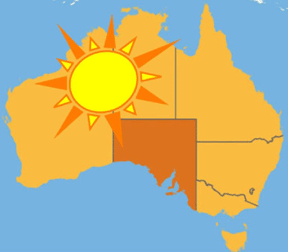
Experts say the state’s approach could provide a template for what can be achieved elsewhere.
Eight years ago, South Australia’s renewable energy future was in doubt as an extraordinary statewide blackout saw recriminations flow.
On 28 September 2016, a catastrophic weather event sent the entire state into system black. Around 4pm, some 850,000 homes and businesses lost power as supercell thunderstorms and destructive winds – some travelling up to 260km/h – crumpled transmission towers, causing three major power lines to trip.
Almost immediately, and despite advice to the contrary, members of the federal government sought to blame the blackout on wind and solar, with the then prime minister, Malcolm Turnbull, saying several state governments had set “extremely aggressive, extremely unrealistic” renewable energy targets.
Instead of relenting,SA chose to persevere. It now leads the world in the integration of variable, or weather-dependent, renewables.
Wind and solar power in South Australia grew to 75% in 2023, with few other systems reaching comparable levels. For instance, frontrunner Denmark achieved 67% in the same year.
The International Energy Agency says demonstrating the ability to power a large grid with wind and solar is crucial in the context of climate change, and South Australia’s share is “remarkable”.
The state government is now attempting to legislate a target of 100% renewable energy by 2027. Experts say the state’s approach could provide a template for what can be achieved elsewhere.
Energy specialist Dr Gabrielle Kuiper says powering a jurisdiction of almost 2 million people with majority wind and solar is a globally significant achievement.
“One of the most impressive things about that feat, from a technical point of view, is there have also been periods, starting in September last year, where the entire state was powered by rooftop solar alone,” Kuiper says.
On New Year’s Eve 2023, rooftop solar met 101.7% of South Australia’s energy needs for 30 minutes. Australia’s energy operator says that’s a world record for a grid of that size. Its engineering roadmap seeks to enable similar milestones throughout the national grid.
Daniel Westerman, chief executive of the Australian Energy Market Operator, says the “world-leading” rooftop solar contribution is made possible by power system equipment providing security, smarter connections between rooftop solar and the grid, and policies which protect consumers from unwanted disruptions.
Dr Susan Close, South Australia’s deputy premier and climate change minister, was a government minister during the 2016 statewide blackout. She believes the then federal government’s reaction at the time, blaming the state’s renewable energy, was “unfair and unsubstantiated”.
But if anything, she says the unhelpful response from Canberra hardened the state’s resolve. “In South Australia, the vast majority of people were proud of what we were doing, and simply wanted us to make sure that it was as secure and stable as possible,” Close says.
Close says the state’s energy shift hasn’t happened by chance. World-leading climate laws, consistent policy and a supportive planning system attracted investment and helped the state gain an early advantage under federal renewable energy targets. High retail power prices combined with a generous feed-in tariff scheme (now finished) to drive early uptake in rooftop solar. Now every second home in the state has solar installed.
Johanna Bowyer, lead analyst at the Institute for Energy Economics and Financial Analysis, said while South Australia does have fantastic wind and solar resources, “that’s the case for a lot of Australia”. Crucially, coal power stations were allowed to close under market conditions, she said. “They didn’t subsidise it to stay open for longer, like what is happening in New South Wales with Eraring.”
As coal generation was phased out, renewable energy grew to fill the gap.
Proposed changes to South Australia’s Climate Change Act include a 100% net renewable energy target, formalising statements by the energy minister earlier in the year.
The “net” terminology recognises that interstate transmission lines – connecting South Australia to Victoria and eventually NSW – will continue to share electricity across state borders.
The amendments also include a 60% emissions reduction target by 2030 – compared to 43% federally, and 50% in Queensland, NSW and Victoria – and a framework for timely updates along the pathway to net zero by 2050.
Kirsty Bevan, chief executive of the Conservation Council of SA, says the state’s “trailblazing renewable energy transition” puts it in a unique position to adopt much stronger emissions targets than other state governments. The council supports the renewable energy and 2030 emissions targets, but is keen to see the net zero target date brought forward.
“We should be proud of our past renewable energy accomplishments, but also build upon and capitalise on those accomplishments – to the benefit of all South Australians, our nature, and our shared planet,” Bevan said.
The state government’s focus is on stability, flexibility and reliability, with more large-scale battery storage following in the footsteps of the Hornsdale battery (the world’s biggest when it was activated), and hydrogen part of the plan to soak up excess wind and sun.
Kuiper says the secure and reliable system is made possible thanks to investment in storage, smarter management and grid flexibility. But the key to SA’s success isn’t merely technical, she says, it’s also political.
“The bipartisan support for renewable energy in South Australia has been really significant. It’s given investors a sense of certainty,” Kuiper said.
“I think there are lessons at a federal level, particularly for the federal opposition, about what can be achieved if you provide consistent support to this vitally important industry – that’s important for the domestic economy and for Australia’s development of export industries into the future.”
The aim of 100% net renewables was initially set under the Marshall Liberal government, with the Malinauskas Labor government bringing the date forward.
Close acknowledges the opposition’s part in supporting the state’s decarbonisation, adding that the current bill protects to a degree from “a sudden shift in temperament from the other side of politics.”
She says there’s no reason the energy and cultural transition in South Australia couldn’t be replicated in other parts of the country.
“The sooner you start, the easier it is,” she said. “The real cost is in being the last ones to make the change. And so we wish our interstate colleagues well in making that shift.”
Submission- Jim Hazzard -re new agreement on Naval Nuclear Propulsion- let’s dump AUKUS, and not be at war with China
Submission no. 15
Australians were never asked their opinion on AUKUS but thankfully we now have. Morrison gave Opposition leader Albanese one day to agree to the proposal on which the USA wanted bi-partisan unity.
Lets take Auatralia off the hook for $368 billion to be paid to US and UK weapons
manufacturers so we can fight our biggest trading partner China. China does not want a
war against Australia.
US and UK are under zero obligation to deliver the submarines and if they don’t Australia
won’t get it’s money back.
We have an obligation to build infrastructure for Australia: The bradfield scheme,
Hospitals, Schools, Housing instead of a US war with China. So let us dump AUKUS and
be a sovereign nation at peace with China and the world, Yours faithfully, James
Hazzard
Mining bash to dish up nuclear as PM pushes future plan
FBC News, By Marion Rae (AAP) in Canberra, September 9, 2024
Mines are being mothballed even as Anthony Albanese calls for a future made in Australia with battery minerals and clean energy – not nuclear – at its heart.
As the world goes for net zero, the resources industry is “front and centre” in the government’s plan for Australia to make the most it, the prime minister will tell a Minerals Week dinner on Monday.
“The global imperative to cut emissions is Australia’s opportunity to grow our economy – and diversify it. That’s what I mean when I talk about a future made in Australia,” he says, according to a copy of his speech.
Making government “a catalyst for new investment in critical minerals at every stage”, the nation will build new industrial centres powered by clean energy.
But sector leaders say red and green tape must be cut and, with energy demand expected to double by 2050, all technologies – including nuclear – will be required to meet future energy needs…………………………………….. https://www.fbcnews.com.fj/world/mining-bash-to-dish-up-nuclear-as-pm-pushes-future-plan/
1 This month

of the week – Australians for War Powers Reform (AWPR)
To see nuclear-related stories in greater depth and intensity
 Antinuclear