Submission -James Lechte – re new agreement on Naval Nuclear Propulsion it’s not too late to walk back this AUKUS commitment
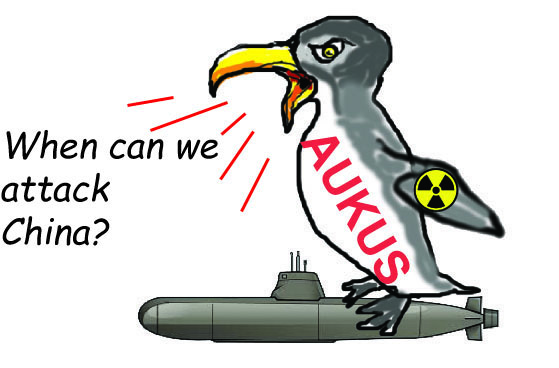
China has never in its long history shown a track record of external aggressiveness.
its highly likely that
rather than China, the US in fact may become more unstable and less trustworthy in the coming
decades, even sooner perhaps.
Submission no 19
This is formal feedback on the proposed AUKUS legislation/policy and related $ 370 billion budget
spend forecast by the current administration for the nuclear submarine acquisition from the US.
As a concerned Aussie citizen, and having had the privilege of living in Switzerland for a number of
years whilst working overseas, it brings new light on recent commentary about the AUKUS deal and
Australia’s position, held by both Labour and the Liberal National party coalition.
My feedback relates to If and how.
IF
The key question Australians deserve further dialogue over is whether or not its in our best interests
to develop a first of a kind, pro US, assertive (some would consider aggressive) defense posture in
the region. Australia is a peaceful country, with a diverse and increasingly multi-cultural pan Asian
background. History tells us that wars are difficult, do not end well nor are in any parties interests.
Whatsmore, history also tells us that deterrence based on increased defence capability is not based
in fact. Rather, strategic ambiguity – where by any threat does not understand which side we would
take in a conflict, may be a better deterrent, as it gives parties options and does not actively signal a
threat.
AUKUS removes this opportunity.
likelihood of getting into conflict. Switzerland is an excellent example here – across their history from
the late 1200s, they have managed to achieve this ambiguity, which has provided them with options
in alliances and support, in different scenarios across history.
China has never in its long history shown a track record of external aggressiveness. On the contrary,
despite them being very assertive in their economic position, often crossing the line, the latest
example from 2020/21 economic stoush with Australia highlights to us that this can be managed and
resolved, by using soft power – diplomacy, patience and dialogue. In any conflict, showdown or
threat, we have already engaged by virtue of the posture that is in question built into AUKUS. We
have no option but to engage, regardless of the rhetoric of Minister Marles suggesting that this is
within our discretion. We effectively have a target on our back.
As Ray Dalio highlights in his essays regarding world power being reshaped, its highly likely that
rather than China, the US in fact may become more unstable and less trustworthy in the coming
decades, even sooner perhaps. If this happens, where does this leave Australias options around
independence, freedom of defence action and strategic ambiguity? If this world power shift continues and China continues its ascendency, why is it in Australias interest to maintain an
aggressive posture with the new world power? This makes no sense.
How
If one is to assume that based on a long history of alliance, collaboration and defence information
and knowledge sharing, Australia should join an AUKUS alliance, then the question is how this can be
achieved whilst maintaining a) as much of the above ambiguity as possible as its in our long term
interests, and b) a commercial strategy that sees Australia have an equitable commercial
relationship, grow its economy, not primarily its debt. It is in Australias interest to have a resilient
and multi faceted defence capability, whilst also managing a careful cost benefit of investing in these
assets. This means that we need to be extremely commercial, shrewd and strategic in the use of
multiple options to fend off potential threats and get the best long term value for money. This
classically is now termed ‘Asymmetric’ capabilities. Aside from the issue of how Australian Defence
experts and the Government choose to renew this capability, one thing is for certain, we need to
develop much better commercial capabilities in this space given the quantum were talking about,
this role would be similar in scale to a Deputy capability group within the ATO or home affairs for
example, dealing with the size of the spend. We should be extremely commercially aggressive on
clawing back spend where budgets have been over run, ultimately meaning that shared success is
the primary objective for all parties.
The deal that has been presented to Australians, with scant detail, suggests that none of the above
has been achieved. On the contrary, it seems like we have entered into an agreement MAXIMISING
our partners interests and not ours. The context that this deal is/has taken shape under is that for
the health and prosperity of the region, it is in many parties (US, Japan, Indo Pacific nations etc)
interests for Australia and other nations to have strategic defence capabilities. It is also important to
note, that in doing so, we are buttressing the US’s defence posture in the region and as such,
deserve special economic consideration, just like the defence consideration (being given access to
these tools). We are also an extension of the US defence capability, given the tools being selected. It
somehow flies in the face of economic reality and pragmatism, that Australia is the sole payer at
what appears a significant premium, where the bulk of the jobs, companies and profits will go
offshore.
This is an enormous let down to Australians. A let down for the significant work and taxpayer dollars
that taxpayers are burdened by. There is no question that a) we have enormous spending
commitments over the coming decades with an ageing population and at best c class infrastructure
across the country and b) declining tax revenues combined with c) an inability to reform the tax
system so that the wealthy, mining and other multinationals pay way too little tax. It is more that
arguable that Australia simply cannot afford this luxury capability, especially until one or many of
these aforementioned planks of our economic condition are improved measurably.
Ultimately, if we have no choice but to contribute to the AUKUS pact, we should do so judiciously,
economically, and carefully. However – its not too late to maintain some form of independence by
walking back commitments to acquire nuclear submarines, which will undoubtedly be well over
budget, technologically inferior and pin us down to be a multi decade minion of the US, as one
recently put it – ‘the 51 state of the United States’. Developing a more conservative stance within
these treaties is in all Australians interests. https://www.aph.gov.au/Parliamentary_Business/Committees/Joint/Treaties/NuclearPropulsion/Submissions
No comments yet.
1 This month

of the week – Australians for War Powers Reform (AWPR)
To see nuclear-related stories in greater depth and intensity
 Antinuclear
Leave a comment