Why Aged Care Funding Scrutinised, but Military Spending Not
Double Standards in Public Discourse
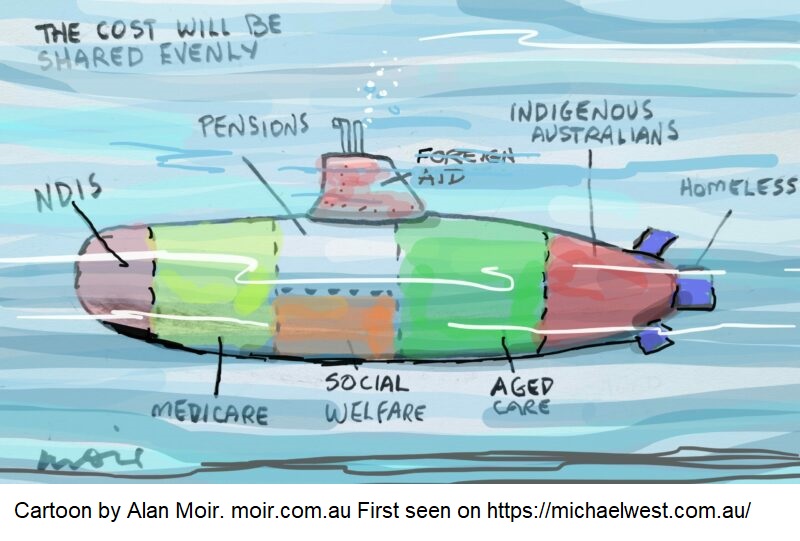
The double standard in how we view social versus military spending is stark. While aged care is framed as a financial burden that requires higher contributions from individuals, military spending is accepted without the same level of scrutiny. Why is it that investments in the well-being of citizens are questioned while investments in military equipment go ahead without question?
Australia’s government has the financial ability to distribute more resources toward aged care without compromising national defence. By reallocating just, a fraction of the $368 billion earmarked for submarines, the aged care system could receive the necessary funding to address worker shortages, improve infrastructure, and ensure that no senior is left without quality care.
September 13, 2024 by By Denis Hay, The AIM Network
Introduction
Australia is grappling with rising demands for aged care services as its population grows older, leading to a $5.6 billion reform package to improve the sector. Yet, every dollar given to aged care is met with scrutiny, with questions about sustainability and affordability. In stark contrast, military spending – including the $368 billion given for the AUKUS submarine deal – goes ahead with far less financial scrutiny.
Why do we ask, “At what cost?” for aged care, yet overlook the same question for military projects? This article explores these double standards and how Australia’s currency sovereignty means the government has the financial capacity to fund both without compromising one for the other.
Disparities in Spending Scrutiny
I. Aged Care Reforms: Why “At What Cost” is Constantly Asked
A. Key Changes in Aged Care
The Australian government’s $5.6 billion aged care reform package aims to improve services for more than 1.4 million older Australians, helping them stay at home longer before entering institutional care. However, the reforms include higher means-tested contributions from seniors, raising concerns about affordability for lower-income individuals.
B. Challenges in Aged Care Funding
Australia’s aged care sector is facing significant challenges, even with the new reforms:
1. Workforce shortages – More than 300,000 workers are needed to meet the demand for aged care services, but underfunding is making recruitment and retention difficult.
2. Underfunding – The sector is still underfunded despite the reforms, with many care facilities still struggling to provide adequate services.
3. Increased demand – With Australia’s aging population expected to double by 2050, more funds will be needed to provide quality care.
Despite these growing challenges, aged care funding is constantly questioned. The $5.6 billion reform package was seen as necessary, but it came with a public narrative focused on budget concerns and intergenerational equity, suggesting the government is walking a financial tightrope when funding such social services.
C. Public and Political Scrutiny
Aged care spending is consistently subjected to public and political debate, with media coverage often emphasising the “cost to the taxpayer“ and generational fairness. Yet this intense scrutiny stands in stark contrast to how military spending is viewed, where multibillion-dollar defence projects move forward with little financial questioning.
II. Military Spending: An Unquestioned Cost
A. Overview of Military Expenditures
In 2023, Australia committed $368 billion over the next 30 years to the AUKUS submarine program, making it one of the largest military spending commitments in the country’s history. The overall defence budget for 2023-2024 alone reached $50 billion, marking a significant increase compared to previous years.
B. Justifications for Military Spending
Proponents of military spending often argue that defence investments are critical for national security, particularly with the growing military presence of China in the Indo-Pacific region. The AUKUS deal, which promises to deliver nuclear-powered submarines to Australia, has been framed as necessary for safeguarding Australia’s interests in the future.
However, this narrative ignores the question of cost. While $368 billion has been committed for submarines over the next three decades, far less attention is given to the financial opportunity costs – what else could be funded with such vast sums?
C. Limited Scrutiny on Defence Budgets
In contrast to aged care, military expenditures are rarely subject to serious financial scrutiny. Public debate around defence spending typically focuses on national security threats rather than the financial burden of these projects. Even when media coverage addresses military budgets, it rarely compares them to the costs of social services, leaving aged care and defence spending to occupy entirely different public conversations.
Australia’s Currency Sovereignty and the Real Limits…………………………………………………………………………..
Double Standards in Public Discourse
The double standard in how we view social versus military spending is stark. While aged care is framed as a financial burden that requires higher contributions from individuals, military spending is accepted without the same level of scrutiny. Why is it that investments in the well-being of citizens are questioned while investments in military equipment go ahead without question?
…………………………………………………………… Rebalancing Australia’s Budget Priorities
…………………..Australia’s government has the financial ability to distribute more resources toward aged care without compromising national defence. By reallocating just, a fraction of the $368 billion earmarked for submarines, the aged care system could receive the necessary funding to address worker shortages, improve infrastructure, and ensure that no senior is left without quality care. ……………..more https://theaimn.com/why-aged-care-funding-scrutinised-but-military-spending-not/
The tangled nuclear web of lies and half-truths – can we believe that Australia will refuse to take USA toxic wastes?
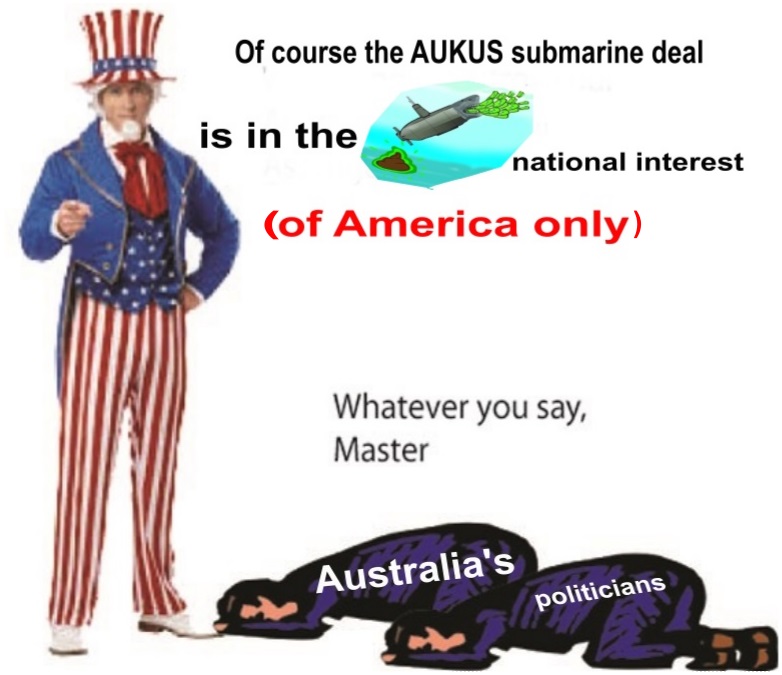
How is the Australian government going to twist their way around THIS ONE!
I’d really like to believe Prime Minister Anthony Albanese, who once was a noble opponent of the military-industrial-nuclear complex.
But – now – I fear that he is as gutless as most Australian politicians when it comes to sucking up to the USA.
https://theaimn.com/can-we-believe-that-the-australian-government-will-really-refuse-to-take-usa-uk-nuclear-submarine-waste/ 12 Sept 24, Today comes one of those amazing bits of news that a national government, in this case, it seems, Australia, has actually listened and responded to the many voices of peace and environment activists who are shocked at the proposed Naval Nuclear Propulsion Treaty which benefits the USA, but not Australia, and which makes Australia responsible for high level nuclear wastes from U.S/UK nuclear submarines.
If we can believe the Labor government – they are going to stand up to the USA and the UK, and refuse to accept high level toxic radioactive trash from USA – ‘Relief’ Australia won’t take high-level nuclear waste under AUKUS.
The latest information on Australia getting nuclear submarines is that as early as 2027, the United States will begin rotational presence in the Western Australia facility. Ultimately, there will be up to four U.S. Virginia-class submarines and one United Kingdom Astute-class submarine at HMAS Stirling. https://www.defenseone.com/business/2024/01/race-prepare-australia-nuclear-subs/393601/
So these nuclear submarines will be stationed in Australia , but owned by the USA and UK, not by Australia.
Well- here are a couple of clauses from this jargon-filled proposed Treaty:
ARTICLE IV – D
Australia shall be responsible for the management, disposition, storage, and disposal of any
spent nuclear fuel and radioactive waste resulting from the operation of Naval Nuclear
Propulsion Plants transferred pursuant to this Article, including radioactive waste generated
through submarine operations, maintenance, decommissioning, and disposal.
ANNEX B: SECTION I – SPECIAL NUCLEAR MATERIAL
Such Power Units shall contain highly enriched uranium and, only with respect to irradiated fuel, may contain plutonium.
Friends of the Earth are among the many who have sounded the warning:
Minister for Defence Richard Marles has stated that Australia would not accept radioactive waste from overseas, but this has not been explicitly ruled out in the Australian Naval Nuclear Power Safety Bill 2023 currently before Parliament. The words of an under-pressure defence minister in 2024 are unlikely to count for much decades hence if Australian legislation and the Agreement between Australia, the UK and
the US do not prohibit the acceptance of foreign spent nuclear fuel.
It is important to acknowledge Australia’s poor history regarding radioactive waste disposal
facilities.
How is the Australian government going to twist their way around THIS ONE!
I’d really like to believe Prime Minister Anthony Albanese, who once was a noble opponent of the military-industrial-nuclear complex.
PM Albanese has been adroit at making himself a “small target” for both the Opposition nuclear enthusiasts, and for his own Labor Party members who deplore the AUKUS nuclear deal. No doubt he will rely on the mealy-mouthed USA-sycophant defence Minister Richard Marles to spin the story on this.
Submission -Terry Barridge – re new agreement on Naval Nuclear Propulsion – it’s dangerous, the public should vote on it.

Given the significant implications of such a security pact, it is only democratic that the Australian population has a direct say in this matter. I strongly advocate for this issue to be put to a vote, allowing the voices of Australian citizens to be heard and respected in a decision that will impact our nation’s future.
I am writing to express my concerns and opposition to the recent enhancement of the AUKUS agreement,
commonly referred to as AUKUS 2.0, between Australia, the United States, and the United Kingdom. As an
Australian citizen deeply invested in the long-term security and prosperity of our nation, I feel compelled to voice my apprehensions regarding the implications of this agreement
Firstly, I am troubled by the increased proximity of Australian military and security policies to those of the
United States. The United States, in its current geopolitical stance, appears to many as a waning power, facing significant domestic challenges and shifting international allegiances. By binding our security interests so closely with those of the United States through agreements like AUKUS 2.0, Australia risks inheriting the animosities and conflicts that are directed towards America. This alignment not only draws us into the sphere of influence of a nation facing considerable global scrutiny and criticism but also potentially makes Australia a target for those who view the United States unfavorably.
Secondly, the financial burden of AUKUS 2.0 on Australian taxpayers is a major concern. The investment
required to uphold the commitments within this agreement is substantial, and the returns – both in terms of security enhancements and economic benefits – are uncertain. In an era where economic stability is precarious, it is crucial that government expenditures are made with a clear and guaranteed return on investment. The lack of transparency regarding the financial implications and benefits of AUKUS 2.0 is worrying. Australian taxpayers deserve clarity on how their funds are being used and assurances that these expenditures will not only safeguard but also enhance our national interests.
Furthermore, in light of the current “cost of living” crisis, the financial commitment required for this deal
appears especially irresponsible. Many Australians are already struggling to manage everyday expenses, from utility bills to housing costs. Allocating substantial public funds to an uncertain and contentious military agreement further burdens the average citizen without offering immediate or transparent benefits.
Moreover, the United States has a long and contentious history of treating warfare as a business opportunity, enriching a select few at the expense of many. This perspective on military engagement should not be what we aspire to promote in our region. America’s track record in wars across the globe has often led to long-standing conflicts without clear successes, posing significant concerns about the wisdom of aligning our defense policies so closely with their strategies.
Given the significant implications of such a security pact, it is only democratic that the Australian population has a direct say in this matter. I strongly advocate for this issue to be put to a vote, allowing the voices of Australian citizens to be heard and respected in a decision that will impact our nation’s future.
I appreciate your attention to this matter and look forward to your response, outlining how you and your office will address these concerns. https://www.aph.gov.au/Parliamentary_Business/Committees/Joint/Treaties/NuclearPropulsion/Submissions
1 This month

of the week – Australians for War Powers Reform (AWPR)
To see nuclear-related stories in greater depth and intensity
 Antinuclear