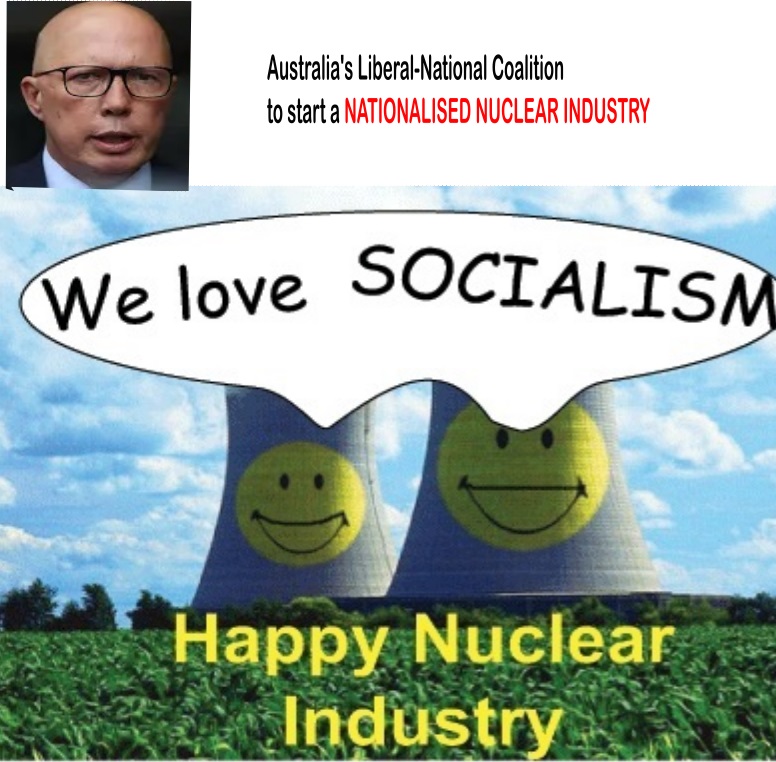
TODAY. The West embraces SOCIALISM – first of the nuclear kind, -and then?
Proud defenders of individual liberty, private enterprise , and of the free market solving everything, the West has run into a spot of bother over the nuclear industry.
Good old dictatorships don’t have this problem. Russia , North Korea and China can develop government-run nuclear power programmes faster and cheaper, (though sadly, China is falling behind, due to the success of its renewable energy industry). Saudi Arabia has its Saudi National Atomic Energy Project (SNAEP). The Saudi one should do very well, as they don’t have pesky women in power, raising objections.
But never fear – things are looking up for nuclear power in the “free” West.
For one thing, everybody’s now realising that the “peaceful” nuclear industry is absolutely essential for the weapons nuclear industry. And as defence, (and attack) are a government responsibility, well, then, the tax-payer must cough up to help the “commercial” unclear industry.
And if we’re going to do the job properly, let’s take up the faster ?cheaper methods of Russia, North Korea, – maybe not China as they’re too much into renewable energy. Saudi Arabia’s system sounds promising – we don’t want silly emotional women bleating about cost and safety.
France has always recognised that the government should run all things nuclear – right from the days of its toxic nuclear bomb tests in the Pacific, and even today, despite a bit of trouble with costs, and the impacts of climate change causing rivers to overheat.
The USA government has always found devious ways to prop up its supposedly private nuclear industry.
Britain has come up with its system of “Regulated Asset Base” . This means that electricity customers are charged a fee from day one of the construction of the nuclear project, and cop the burden of cost overruns (as happened in the USA with the Vogtle nuclear fiasco). The UK government, rather than the developer, underwrites the risk of construction cost overrun “above a remote threshold” – referred to as the “Funding Cap”. – (more https://www.fieldfisher.com/en/insights/rab-and-go-getting-new-nuclear-underway).
The previous Tory UK government set up “Great British Nuclear” – with the tax-payer supporting the nuclear industry. Keir Starmer’s Labour government continued this , with – a new, publicly owned, energy company, “Great British Energy “.
In Australia, the Liberal-National Coalition Party, led by Peter Dutton, stands for private enterprise, individual freedom, and total opposition to socialism
In 2023 this Party had an amazing success, in turning Australian public opinion around towards an anti-indigenous stance in a referendum intended to give indigenous people a Voice to Parliament. This very right-wing party was helped by the Murdoch media, and also by a powerful social media campaign, and by the Atlas Network – to gain quite a degree of control over public opinion.
Again with the help of the Murdoch media, and the Atlas Network, the global nuclear lobby could have a resounding tax-payer funded success.
So – ironically – it will be a party dedicated to private enterprise and individual liberty that could bring in completely government-run nuclear industry to a whole Western democratic continent.
The UK’s nuclear waste problem
“more nuclear power means more nuclear waste”
By Chas Newkey-Burden, The Week UK, 16 Sept 24 https://theweek.com/environment/the-uks-nuclear-waste-problem
Safety concerns as ‘highly radioactive’ material could be buried in the English countryside
“Not in my backyard” is a term normally used in conversations about proposed new housing or rail lines, but a version of it could soon be heard about one of the most dangerous materials on the planet.
Nuclear power stations are filling up with radioactive waste, so “swathes” of the highly dangerous material are set to be “buried in the English countryside”, said The Telegraph. For local communities, it isn’t so much “not in my backyard” as “not under my backyard”, said the Financial Times.
‘100,000 years of hazard’
Sellafield, in Cumbria, is the “temporary home to the vast majority of the UK’s radioactive nuclear waste”, said the BBC, “as well as the world’s largest stockpile of plutonium”. It’s stuck there because no long-term, high-level waste facilities have been created to deal with it.
The “highly radioactive material” releases energy that can infiltrate and damage the cells in our bodies, Claire Corkhill, professor of radioactive waste management at the University of Bristol, told the broadcaster, and “it remains hazardous for 100,000 years”.
The permanent plan to handle the waste currently at Sellafield is to first build a designated 650ft-deep pit to store it. Although the contentious matter of its location has yet to be agreed, the facility will hold some of the 5 million tonnes of waste generated by nuclear power stations over the past seven decades. Then, in the second half of the century, a much deeper geological disposal site will be dug, which will hold the UK’s “most dangerous waste”, such as plutonium, said The Telegraph.
The problem is only going to get bigger because nuclear power is a central part of the government’s mission for “clean power by 2030” and “more nuclear power means more nuclear waste”, said the BBC.
With at least three new nuclear power stations planned, said The Telegraph, the country will quickly be “at odds with” the 1976 review of nuclear waste policy by the Royal Commission on Environmental Pollution, which warned the UK was amassing nuclear waste so fast that it should stop building reactors until it had a solution.
‘Poison portal’
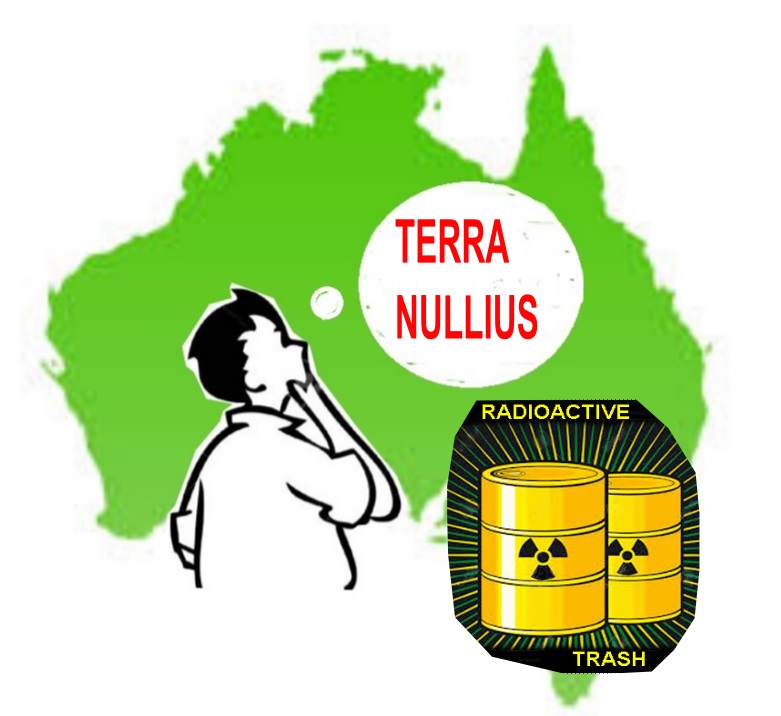
Some believe part of that solution will be found overseas. Earlier this year, there were warnings that Australia could become a “poison portal” for the UK and US as a result of a new three-nation defence pact called Aukus. The original wording of the agreement would allow for facilities to be created to dispose of waste from “Aukus submarines”, which could have included UK and US vessels.
Dave Sweeney, the Australian Conservation Foundation’s nuclear free campaigner, warned at the time that Aukus partners could see Australia as “a little bit of a radioactive terra nullius”.
After pushback, the Australian government added a loophole to the legislation to “ensure Australia will not become a dumping ground for nuclear waste”, said The Guardian.
But the Australian Greens’ defence spokesperson, David Shoebridge, said the changes did not go far enough. The amendment only addresses high-level radioactive waste, he said, and “still allows the US and UK to dump intermediate-level waste, and Australian high-level waste, anywhere in Australia”.
1 This month

of the week – Australians for War Powers Reform (AWPR)
To see nuclear-related stories in greater depth and intensity
 Antinuclear