Jewish Council disappointed at Australia’s UN abstention, calls for strong international action to prevent Israeli war crimes

By Jewish Council of Australia, September, 19, 2024
The Jewish Council of Australia says it is deeply disappointed at Australia’s abstention from a critical United Nations General Assembly resolution calling on Israel to end its occupation of the Palestinian territories within 12 months. The resolution passed with 124 votes in favour, highlighting global frustration with Israel’s actions.
In a statement, the JCA said Australia’s abstention did not align with its commitments to international law and peace-building. While the Australian Government had indicated support for many aspects of the resolution, its failure to vote in favour was s a missed opportunity to show stronger, principled leadership, the Jewish group said.
“This vote comes at the same time as further apparent Israeli attacks on Lebanon, a day after the pager attacks,” a statement from the JCA said.
“The Jewish Council of Australia condemns these attacks. Their indiscriminate nature, killing dozens and injuring thousands of civilians, is an apparent war crime which underscores the urgent need for a collective international response to prevent Israel further breaching international law.
“We call on the government to join with other countries in condemning the killing of innocent civilians, and reiterate our calls for Australia to take material action by imposing sanctions and throwing its weight behind a global arms embargo.
JCA executive officer Sarah Schwartz said:
“We condemn the loss of any innocent life. Australia and the international community must take material steps to prevent, and ensure accountability for, the commission of war crimes. These indiscriminate attacks, which have killed innocent bystanders, are the behaviour of a rogue state and should be treated as such.”
JCA executive officer Dr Max Kaiser added:
“We urge the Australian government to join the vast majority of countries in the international community that are taking a firm stance. Australia can and should be doing more to hold Israel accountable for its unlawful presence in Palestinian territories. The time for decisive action is now.”
Nuclear in Australia would increase household power bills
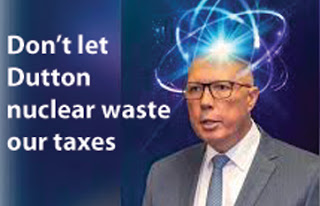
Report Nuclear Electric Grid Energy Policy Australia
September 20, 2024, Johanna Bowyer and Tristan Edis, https://ieefa.org/resources/nuclear-australia-would-increase-household-power-bills
Key Findings
Typical Australian households could see electricity bills rise by AUD665/year on average under the opposition Coalition’s plans to introduce nuclear to the country’s energy mix.
IEEFA analysed six scenarios based on relevant international examples of nuclear power construction projects; in every scenario, bills increased by hundreds of dollars.
For households that use more electricity, bills could rise more – for a four-person household, the bill rise was found to be AUD972/year on average across nuclear scenarios and regions.
The cost of electricity generated from nuclear plants would likely be 1.5 to 3.8 times the current cost of electricity generation in eastern Australia.
Australia’s main federal opposition, the Liberal-National Coalition, has proposed building seven nuclear power plants across the country, including both large-scale reactors and small modular reactors (SMRs). This report seeks to detail the likely impact on household consumers’ electricity bills from such a plan, based on recent real-world experience from construction costs for nuclear power plants around the world.
Rather than use theoretical projected costs, we have calculated the potential electricity bill impact for a range of nuclear cost recovery scenarios, based on the following real-world examples:
Finland: Olkiluoto Unit 3. France: Flamanville Unit 3. UK: Hinkley Point C. US: Vogtle Units 3 and 4.US SMR: NuScale SMR. Czech Republic: Dukovany proposed plant expansion.
The first four scenarios are based on actual, recent nuclear power plant construction costs and timeframes for countries in liberal democracies where costs are transparent. Commenting on nuclear construction cost estimates, electricity market economist Professor Paul Joskow states: “The best estimates are drawn from actual experience rather than engineering cost models.”
In the case of SMRs, no plants have been successfully completed in a democratic country, so we instead used the one example of a binding contract offer to build such a plant in the US, the now-cancelled NuScale project. We also used this approach for assessing the costs for a proposal to build South Korean APR technology (a design that the Coalition has cited for potential implementation in Australia) in a separate democratic country with laws protecting labour rights, outside of its country of origin – the Czech Republic.
Household electricity bills impact
We found that electricity bills would need to rise in order for nuclear costs to be recovered. The chart below illustrates the resulting increase in typical household power bills if nuclear power plants with similar costs and characteristics to the international examples were built in Australia. The average bill increase was AUD665/year across states and nuclear scenarios for households with a median level of electricity consumption. The lowest impact is equivalent to bill increases of AUD260-AUD353 per year, linked to estimated costs for the pre-construction project Dukovany, which is highly likely to underestimate final costs. The lowest impact from a nuclear plant successfully completed (Vogtle) is AUD383-AUD461 per year for an average household. Meanwhile, the UK experience with Hinkley Point C indicates electricity bill rises of more than AUD1,000 per year are possible.
Figure 1 [on original]: Increase in typical household electricity bill to recover cost of nuclear plants based on different countries’ experience (AUD/year)
The range of costs is wide due to the significant cost differentials for large-scale nuclear in different countries, and the significant cost uncertainty for SMR technology, which is still under development. The impact in each state can vary due to differing typical electricity consumption levels in each state, and different electricity bill cost structures.
For households using more electricity than the median level, the bill increases from nuclear would be higher. For example, for a four-person household the bill impact would be AUD972/year on average across nuclear scenarios and states, and for a five-person household AUD1,182/year.
How nuclear costs are reflected on electricity bills
These results might come as surprising to some, because large-scale nuclear is a mature technology currently in use across a wide range of countries. In addition, misinterpreted data on retail electricity prices (which also include the costs of powerlines and taxes, not just generators and so is misleading) can show some cases of nations that use nuclear who have lower retail prices than Australia.
However, in almost all cases around the world, the cost of nuclear power plant construction and financing is not fully reflected in market prices for power. This is because either nuclear power plants are very old and their costs are largely depreciated, or governments have acted to recover the costs either through taxpayers, or via levies which are independent of electricity markets – for example in France, the UK and Ontario, Canada. In other jurisdictions, such as a number of US states including Georgia where the Vogtle power plant is located, there isn’t actually an electricity market in operation, with consumers instead served by a regulated monopoly without any competitive choice.
The Coalition has outlined something different, ruling out taxpayer subsidies and stating that any government investments in nuclear plants would receive a commercial return. This implies that the Coalition expect that wholesale electricity market prices will be sufficient for nuclear power plants in each state to recover their construction costs plus a commercial level of return. The Coalition has also outlined that these nuclear power plants would operate at full capacity almost all of the time. Therefore, power prices would need to average out at the level a nuclear plant needs to be commercially viable – to recover their costs – almost all of the time.
High costs of recent nuclear projects
The reason bills increased in this study is because recent large-scale nuclear projects across Europe and North America involved very high costs. The European Pressured Reactor (EPR) program had promised to deliver more efficient, safer nuclear power. However, the three recent projects (Olkiluoto 3, Flamanville 3 and Hinkley Point C), which have either just been completed or are under construction, have all faced construction challenges, delays and cost-blowouts. If plants with similar costs and characteristics were built in Australia, they would require a levelised cost of electricity (LCOE) between AUD250 per megawatt-hour (MWh) and AUD346/MWh to recover their costs.
A few other types of reactors are being built or considered internationally of a similar design to what the Coalition indicates might be built in Australia: the South Korean APR1000 design proposed at Dukovany in the Czech Republic; and a Westinghouse AP1000 design recently completed at Vogtle in the US. The Vogtle plant experienced seven years of delays and actual capital costs (excluding financing costs) 1.7 times the original estimates. Those plants present LCOEs of between AUD197 and AUD220 per MWh in an Australian context – noting the Dukovany costs are only initial pre-construction estimates and could rise.
Based on NuScale, we estimate that the LCOE of nuclear SMR in an Australian context would be AUD289/MWh – but could be far higher if construction extends beyond the 3.25 years used in this study – as financing costs increase as construction timelines extend.
Capital costs (excluding financing costs) of recent nuclear power builds have tended to blow out by a factor of between 1.7 and 3.4, leading to financial difficulties for companies involved. All conventional nuclear projects built in recent years in the US and Europe – Vogtle, Olkiluoto 3, Hinkley Point C and Flamanville 3 – have contributed to financial difficulties for companies involved. Westinghouse, which was the technology provider for Vogtle, filed for bankruptcy protection in 2017. France’s AREVA, who was the original technology provider for Olkiluoto 3, Flamanville 3 and Hinkley Point C, came close to bankruptcy over 2015, which required a French Government-sponsored bail-out.
The chart below [on original] details the wholesale market prices required for each of the recently constructed or quoted nuclear plants to be commercially viable, relative to the current wholesale electricity costs being passed through in household electricity bills in the regions of Victoria, NSW, South East Queensland (SEQ) and South Australia (SA).
[Figure 2: Current wholesale energy cost (WEC) component of current household bills compared to commercial price to recover nuclear plant costs in Australian context (AUD/MWh)]
Australia would likely face even higher large-scale nuclear costs than these recent international examples, due to the country’s limited nuclear capability and the small size of any potential Australian nuclear build-out program. With seven nuclear power stations proposed (two of them SMR-only), all at separate sites, there will be limited scope to achieve learning-based cost reductions like those seen in a large continuous build program, for example the build program in South Korea on which CSIRO’s GenCost costings are based. South Korea has built 26 reactors since the 1970s. Further, the assumptions in this report have provided an optimistic levelised cost of electricity for nuclear, for example using a 60-year economic lifetime, 93% capacity factor, and a low discount rate.
Our analysis suggests household power bills would need to rise significantly for nuclear power plants to become a commercially viable investment in the absence of substantial, taxpayer-funded government subsidies. In IEEFA’s opinion, any plan to introduce nuclear energy in Australia – such as that proposed by the Coalition – should be examined thoroughly, with particular focus on the potential impact on electricity system costs and household bills, and with detailed analysis of alternative technologies such as renewables and firming.
Peter Dutton is about to talk nuclear at CEDA. Will he be fact checked by Chris Uhlmann?

Dutton and his team have not come close to explaining how it will dance around rooftop solar, or how rooftop solar will be forced to dance around nuclear. Will Dutton tell solar households that their PV will be switched off in the middle of the day to accommodate his energy ideology?
Giles Parkinson, Sep 19, 2024
Federal energy minister Chris Bowen calls it the great distraction. Virtually everyone in the electricity market calls it a nonsense, but Opposition leader Peter Dutton’s efforts to put the nuclear debate on centre stage appears to be gaining traction.
On Monday, Dutton takes his nuclear campaign, complete with obvious untruths and exaggerations, to the august environment of the Committee For Economic Development of Australia. The event, on Monday, is titled “A nuclear powered Australia – could it work?
CEDA was established in 1960 to “better understand and interrogate public policy” and says it remains independent and not restricted by vested interests or political persuasion. It should, in that case, be the perfect place for Dutton’s nuclear claims to be fact-checked.
Dutton has so far revealed little about his nuclear policy, apart from a vague plan to build reactors, both large-scale and the yet-to-be-commercialised small modular reactors (SMRs) at seven sites across the country where coal fired power stations have or still do operate.
The premise, according to the Coalition, is simple. Just build them and plug them in where there is an existing grid connection, and Australians will be protected from the lights going out and the economy being sent back to the dark ages, something it insists will be the result of Labor’s renewable energy roadmap.
It’s not clear how much more Dutton will tell CEDA about the details of the nuclear plan. He has insisted that the first reactors could be up and running and producing power by 2035 – a fanciful idea according to the regulators and other experts who point out that the late 2040s might be closer to the mark.
Dutton insists that nuclear is essential for the net zero target. It might be for other countries, particularly those with inferior solar resources and a well-established nuclear industry, but for Australia that claim is a nonsense.
The clear intention of the Coalition to slow, even stop, the rollout of new wind, solar and battery storage projects, extend the life of ageing coal generators and invest heavily in new gas – all of which will blow Australia’s emissions budget over the coming decades. It is difficult to think of a worse idea if climate change is the motivation.
Dutton has been regularly fact-checked on a number of other claims both here, and on the Guardian – less so, if not at all, in the rest of mainstream media and on radio and TV, where the claims are often broadcast. It hasn’t deterred him.
It includes the claim that Labor is looking to build 28,000 km of transmission lines to support its green energy transition. Not true. it has only targeted little more than 5,000kms.
The 28,000 km is a target under the most optimistic green energy scenario – it was developed by the Australian Energy Market Operator in its modelling under the previous Coalition government, and has changed little since then.
Dutton claims that nuclear is cheaper than wind, solar and storage. Again, not true and not by a long shot, according to recognised and respected Australian and international experts – all of whom have come under fierce attack by the Coalition and its attack dogs on social media.
It includes the claim that nuclear leads to lower power bills for consumers. But that only happens when the nuclear power is heavily subsidised, as it is in France, and when consumers are protected from market forces.
Ontario is often cited by the Coalition as having cheaper electricity prices than Australia, but they forget to tell you Ontario’s electricity prices are significantly higher than other Canadian provinces, thanks to nuclear.
Australia’s bills are weighed down by the cost of networks, servicing a population nearly twice the size of Ontario in a land are more than seven times bigger.
Dutton’s claim that nuclear can be plugged in to existing power grids without the need for upgrades is also nonsense. Most of those sites already have replacement capacity – Port Augusta and Collie in particular, and the site owners at Liddell, Mt Piper and Loy Yang have their own plans that definitely do not include nuclear.
The Coalition and their choristers also insist that nuclear somehow requires no additional back-up. That would be a miracle. All forms of generation require back up to ensure the lights stay on in case of an unexpected outage, or planned and long term maintenance.
Nuclear is no exception – it was the cause of massive amounts of pumped hydro being built around the world, in France, the Americas and China – and the size of its units at large scale mean additional measures are needed should the units go offline, even if the cause is as mundane as a tree falling across power lines.
Dutton insists that nuclear is attractive because it is “baseload” and “always on.” But modern grids demand flexibility, and none more so than Australia where – because of its excellent solar resources, the falling cost of PV and the high retail prices – more rooftop solar has been installed per capita than anywhere else in the world.
That rooftop PV is already causing problems for the existing “baseload” generators – coal and gas: It destroys their business models, and is technically challenging. The economics of nuclear relies more than any other on being “always on”.
Dutton and his team have not come close to explaining how it will dance around rooftop solar, or how rooftop solar will be forced to dance around nuclear. Will Dutton tell solar households that their PV will be switched off in the middle of the day to accommodate his energy ideology?
Dutton’s event will be compered by Chris Uhlmann, the former ABC political editor who became an instant “expert” in grids and renewables when he seized on the South Australia state-blackout and blamed it all on wind energy, even though multiple reports from regulators and energy experts have shown that not to be the case.
Will Uhlmann fact-check Dutton in the way that CEDA might expect? Uhlmann has spent much of his time since joining Sky News and The Australian earlier this year attacking the same targets as the Coalition – the IPCC, climate science itself, emissions targets, and the transition away from fossil fuels.
One of his more egregious pieces was an attack last month on a research report “Fossil Fuels are a Health Hazard” that was put together by the Doctors for the Environment Australia. Uhlmann’s piece in the Weekend Australian was titled “Fossil fuel bans are hazardous to our health”.
It included claims by Uhlmann that products such as panadol and soap depend on fossil fuels. Nonsense, the doctors wrote in response: These products might source fossil fuels now, but they don’t need to. No, we can’t stop using fossil fuels overnight, but we can phase them out very quickly.
The promotion of nuclear and fossil fuels, and attacks and the downplaying of climate science often go hand in hand. Will that be the case at CEDA next week?
As Nicholas Talley and Kate Wylie wrote in the excellent Croakey:
“Journalists have an opportunity to raise public awareness of climate change, using their power to encourage transformative action on what is termed the defining story of our time. They have a responsibility to ensure their coverage is evidence based and reports on the very real scientific and health warnings.”
Monday’s event should be very interesting.
1 This month

of the week – Australians for War Powers Reform (AWPR)
To see nuclear-related stories in greater depth and intensity
 Antinuclear