Peter Dutton and the pursuit of fame.
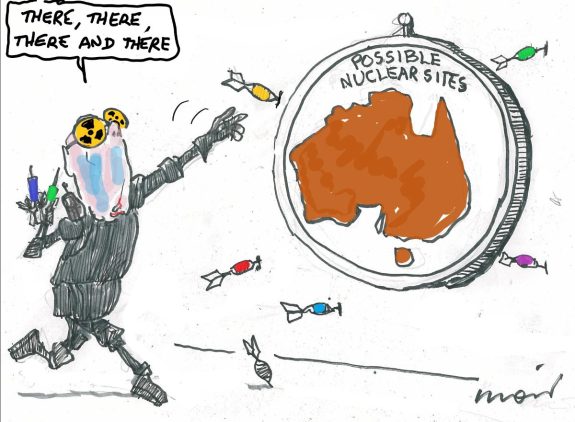
21 September 24 https://theaimn.com/peter-dutton-and-the-pursuit-of-fame/
Peter Dutton is the leader of Australia’s opposition party – the Liberal-National Coalition.
Which is pretty noteworthy and important, anyway. But of course, he would be more important if he is elected as Prime Minister in 2025. But is that enough fame for him?
Dutton aspires to a greater, global, significance. He would be the first world leader to introduce the commercial, peaceful, advanced nuclear industry to not just a country, but to an entire continent. And not to some “third-world” “undeveloped” country “in need of charity” – but to a prosperous, privileged, purportedly well-educated, and still mainly white population.
For the global nuclear industry – that would be a first! And not just any old first, but an extremely timely one. Just released this week, The World Nuclear Industry Status Report 2024 describes an industry on life support. Even back in 2016 Former World Nuclear Association executive Steve Kidd spoke to this problem, noting that “the industry is essentially running to stand still.”
For Australia to adopt a government-run nuclear industry involving both large and small nuclear reactors across a continent – what a wonderful shot in the arm for the global nuclear lobby. And Dutton – what a hero!
Dutton would be famous not just in Australia, but world-wide
Is this why Peter Dutton is promoting his nuclear policy?
I can’t think of any other reason.
Australia, especially in the State of South Australia, is becoming a world leader in renewable energy use – particularly in decentralised household rooftop solar, but also in large solar and wind programmes. Of course, Australia’s mining magnates are pretty happy with Dutton’s plan, as it will mean more mining, not just of uranium, but of coal and gas in the decades before nuclear power actually comes into use.
So – look – it’s a winner for Dutton’s fame.
And if that doesn’t work, there’s fame in another way
The last Liberal Prime Minister, Scott Morrison, is a great contender for the worst Prime Minister in Australian history. Just a few of his achievements to merit this award were:
- By 2022, Australia’s gross national debt was 42.5 per cent of GDP (Peak Whitlam government was 24.5. Peak Hawke-Keating was 24. Peak Rudd-Gillard Government debt was 20.)
- Notorious for taking a holiday during Australia’s 2019–20 bushfire season.
- Signed Australia up to the costly AUKUS nuclear submarine deal
- Secretly appointed himself to five ministerial positions without the knowledge of the public or his own government.
Economically, the nuclear power programme, added to the continuing AUKUS nuclear deal, could pretty well bankrupt Australia. Although Dutton claims that nuclear power will be cheap, he’s given no costings, and the over-riding opinion of energy and economics experts is that nuclear power would be the most expensive form of energy for Australia.
Environmentally, Dutton’s plan includes advanced nuclear reactors, which will require plutonium or enriched uranium – so this brings virtually eternal radioactive pollution into Australia (something that has been nearly avoided up until now). It also brings the hazards of nuclear weapons proliferation, and terrorism targets.
So – it’s a bold venture for Peter Dutton, to centre his election campaign on promoting the nuclear industry. He is to be commended for bravery in taking such a big risk.
If Dutton carries this through, as Prime Minister, he will rapidly gain world fame.
But also, as far as Australia is concerned, he could beat Scott Morrison into history as the nation’s worst Prime Minister.
Dutton’s big risk is that he might not get elected in 2025, and vanish very quickly from history.
Coalition’s nuclear plan will lead to ‘massive’ electricity shortages and risk blackouts, new analysis warns

Energy minister Chris Bowen says Peter Dutton must explain what happens to national grid over next decade if opposition stops building renewables
Guardian, Adam Morton Climate and environment editor, 20 Sept,24
The Coalition’s proposal to cap large-scale renewable energy and eventually build nuclear power plants would lead to “massive” electricity supply shortages risking blackouts, according to analysis released by the federal government.
The climate change and energy minister, Chris Bowen, released the findings of an energy department analysis that suggested electricity supply could be at least 18% less than what will be needed in 2035 under a scenario that reflects the few details of the Coalition plan that have been released.
Those details include the country building fewer solar and wind farms, the cancellation of the “rewiring the nation” policy to build transmission lines, extending the life of ageing coal plants and building nuclear plants at seven sites.
The Coalition’s proposal to cap large-scale renewable energy and eventually build nuclear power plants would lead to “massive” electricity supply shortages risking blackouts, according to analysis released by the federal government.
Under a scenario in which about 90% of remaining coal generation closes by 2035 – consistent with what the Australian Energy Market Operator (Aemo) projects – the gap between demand and supply could be 49%, according to the analysis.
Bowen said it showed Peter Dutton would “take to our finely tuned electricity system planning with a sledgehammer” and cause “massive supply shortages over the next decade”.
“The question that Mr Dutton has to answer is: where would the electricity come from if we stop building renewables now and nuclear takes so long?” Bowen said at a media conference. “He wanders around making outrageous accusations about blackouts under this government when in fact it’s his own scheme [that] is the biggest risk to reliability in Australia.”
The analysis, released via an opinion piece in The Australian, is timed to precede a speech by Dutton on Monday on whether nuclear power could work in Australia.
Dutton and the opposition treasury spokesman, Angus Taylor, rejected Bowen’s analysis in TV interviews on Friday, but declined to release details of their proposal. Speaking on Sky News Australia, Taylor said Bowen was “full of nonsense” and Labor’s policies would “always cost Australians more than our alternative policies”.
The Coalition has said if elected it would use public money to build nuclear plants at seven sites. It has suggested it would also cap investment in large-scale renewable energy and back more gas, a fossil fuel responsible for 21% of Australia’s climate pollution.
It has not released the expected cost of the plants, explained how the Coalition would lift legislated bans on nuclear power, or said why he believed the first two plants could be operating by 2035 or 2037 – a much faster timeframe than experts say would be possible.
Government agencies and independent analysts have found nuclear and more gas would be more expensive for households and businesses than Labor’s plan of running on variable renewable energy backed by “firming” from batteries, pumped hydro, more transmission lines and some gas.
Aemo last month suggested the country’s main power grid, covering the five eastern states, would remain reliable as it shifted from running on mostly coal to mostly renewables if planned investments in new generation were delivered “on time and in full”. Bowen said this would not be possible under the Coalition’s plan……………………………………….. more https://www.theguardian.com/australia-news/2024/sep/20/coalitions-nuclear-plan-will-lead-to-massive-electricity-shortages-and-risk-blackouts-new-analysis-warns?fbclid=IwY2xjawFZ80RleHRuA2FlbQIxMQABHRjcdt-9ZgyIv3BFzTaDCzbuWnZHwb4j4tAAT811vpZzm5UGVBP0h9xHpA_aem_LiV8Y3dC8T95lCzPdJNBHQ
Affordable nuclear? Dutton’s plan would add nearly $1,000 a year to the power bill of a family of four

Sophie Vorrath, Sep 20, 2024, https://reneweconomy.com.au/affordable-nuclear-duttons-plan-would-add-nearly-1000-a-year-to-the-power-bill-of-a-family-of-four/—
A family of four in living on the east coast of Australia would pay nearly $1000 more a year for electricity under the federal Coalition’s nuclear power plan, a new report has found, while the average Australian household would see bills rise by $665 a year.
In a major new report, the Institute for Energy Economics and Financial Analysis, IEEFA, has undertaken to calculate the cost to consumers of Peter Dutton’s plan to build seven nuclear power plants across Australia, including both large-scale reactors and small modular reactors (SMRs).
This has already been done, to a fashion, by Australia’s main scientific body, the CSIRO, whose GenCost report in May of this year found large-scale nuclear to be at least double the cost of integrated renewables, and impossible to deliver before 2040.
IEEFA has taken a different tack, seeking to measure the cost of nuclear to “mums and dads,” by calculating the electricity bill impact of a range of scenarios, based on the actual costs of six recent projects in countries comparable to Australia.
For large-scale reactors the first four scenarios are based on actual, recent nuclear power plant construction costs and timeframes for countries in liberal democracies where costs are transparent, IEEFA says.
This includes the real-life projects – Finland’s Olkiluoto Unit 3, France’s Flamanville Unit 3, the US’s Vogtle Units 3 and 4 and the UK’s Hinkley Point C.
For SMRs – where, as IEEFA notes, “no plants have been successfully completed in a democratic country” – costs are based on the one example of a binding contract offer to build such a plant in the US, the now-cancelled NuScale project.
It also used this approach to assess the costs to build South Korean APR technology (a design that the Coalition has cited for potential implementation in Australia) in a democratic country with laws protecting labour rights: the Czech Republic’s Dukovany proposed plant.
“In the international examples examined, the capital cost of nuclear power plants was very high – up to $90 billion,” says Johanna Bowyer, report coauthor and lead analyst for Australian electricity at IEEFA.
“Recent international large-scale nuclear projects have experienced construction challenges, delays and cost-blowouts. Capital costs, excluding financing costs, of recent nuclear power station builds we analysed had blown out by a factor of 1.7 to 3.4 times.”
When extrapolated to the Australian market, results vary – the more than 50-page report provides precise details on the differences in bill increases depending upon which nuclear power project cost experience you consider, which state (South Australia, Victoria, New South Wales or south-east Queensland) and the size of the household.
But the bottom line is that, in every scenario, bills increase by hundreds of dollars and in some cases by more than $1000.
At the bottom end, the bill increase for households consuming a median amount of electricity was as low as $260 a year based on the anticipated cost of a new nuclear plant in the Czech Republic – although given that is a pre-construction project IEEFA says it is highly likely to have underestimate final costs.
The lowest impact from a nuclear plant successfully completed (Vogtle) is $383-$461 per year for an average household. Meanwhile, the UK experience with the still under construction Hinkley Point C indicates electricity bill rises of up to $1,259 are possible.
Across all nuclear scenarios and regions, the report finds that for a four-person household the bill impact would average out at $972/year, and for a five-person household – like Peter Dutton’s – that figure would rise to an eye-watering $1,182/year.
Ultimately, it’s a finding that rather answers the question posed by next week’s CEDA luncheon discussion: “A nuclear powered Australia – could it work?”
“For nuclear power plants to be commercially viable without government subsidies and generating 24/7 – as the Coalition proposes – electricity prices would need to rise to these higher levels to allow the nuclear power plants to recover their costs,” says Bowyer.
“This would result in a large increase in wholesale market prices which would then flow through to household bills,” Bowyer says. “In a cost-of-living crisis, bill increases like this are a big deal.”
But what about those countries that use nuclear and have lower retail electricity prices than Australia? Aren’t they proof positive that nuclear power is affordable?
Nice try, but no, says IEEFA. “In almost all cases around the world, the cost of nuclear power plant construction and financing is not fully reflected in market prices for power,” the report says.
“This is because either nuclear power plants are very old and their costs are largely depreciated, or governments have acted to recover the costs either through taxpayers, or via levies which are independent of electricity markets – for example in France, the UK and Ontario, Canada.
“The Coalition has outlined something different, ruling out taxpayer subsidies and stating that any government investments in nuclear plants would receive a commercial return.”
Tristan Edis – a director at energy advisory firm Green Energy Markets and a contributor to the IEEFA report – says the mistaken perception that nuclear is a cost-effective technology is often based on the fact that it is in use across the globe.
But he says most of the plants built in the western world were committed based on projected costs and timeframes that turned out to be “horrible underestimates” that have cost governments dearly.
“They almost make Snowy 2.0 look good by comparison,” Edis says, referring to the federal government-owned 2.2GW pumped hydro project whose original price tag of $2 billion has ballooned to a massive $12 billion and is running seven years behind schedule.
“The end result has often been bankruptcy and taxpayer-funded bail-outs for many of the firms involved,” Edis adds, citing the examples of Ontario’s publicly owned utility, for Westinghouse with its AP1000 design, and for France’s AREVA and EDF.
“These cost blow-outs are sometimes not apparent in the electricity prices seen in other countries, but that’s just because it is the taxpayer picking up the tab instead,” he says.
In the case of Australia, the Coalition has repeatedly ruled out taxpayer subsidies for its nuclear plans, and repeatedly claimed that any government investments in nuclear plants would receive a commercial return.
Take shadow treasurer Angus Taylor’s comments to the National Press Club in May:
“The key for me as someone who really believes that we should make sure that we have affordable, reliable power, and I don’t want to commit subsidies that aren’t necessary, is to make sure that it’s [nuclear power] commercially viable, and we think it can be. … If it’s commercially viable, it’s not going to be
subsidies. It’s as simple as that.”
As the report notes, this line of logic implies that the Coalition expects wholesale electricity market prices will be sufficient for nuclear power plants in each state to recover their construction costs plus a commercial level of return.
Further, these nuclear power plants would be “always on,” which means power prices would need to average out at the level a nuclear plant needs to be commercially viable – to recover their costs – almost all of the time.
And the only way this can be achieved without substantial, taxpayer-funded government subsidies is for household power bills to rise significantly, says Bowyer.
“Our analysis indicates that the Coalition’s plan is unlikely to represent a realistic cost-effective energy solution for Australia,” she says.
“Any plan to introduce nuclear energy in Australia … should be examined thoroughly, with particular focus on the potential impact on electricity system costs and household bills, and with detailed analysis of alternative technologies such as renewables and firming.”
Australian nuclear news headlines 16 -23 September

Headlines as they come in:
- Peter Dutton refuses to divulge costs of going nuclear at anticipated ‘could it work’ speech
- Why is Peter Dutton so frightened of nuclear detail?
- Peter Dutton’s weird obsession with uncosted nuclear risks energy security, the economy and our kids’ future.
- Peter Dutton’s nuclear plan still has no costings, and no grid connection: It’s a political hoax
- Australian film-maker refused entry into India.
- We don’t need nuclear power – the path to cheaper electricity is renewables.
- AUKUS boss insists project remains on track despite frustrations and staff upheaval within submarine agency
- South Australia joins Denmark in elite club of two, “pushing the boundaries” of renewable energy integration
- Nuclear debate stalls as detail goes missing in action
- Coalition should show us its sums on nuclear
- Peter Dutton and the pursuit of fame .
- Affordable nuclear? Dutton’s plan would add nearly $1,000 a year to the power bill of a family of four
- Global status report highlights parlous state of nuclear power sector
- “Catastrophic:” Coalition plan to stop renewables and push nuclear will result in massive supply gaps
- The UK’s nuclear waste problem .
- Nuclear in Australia would increase household power bills
1 This month
15 April – Zoom –Nuclear Power is Not the Solution
Apr 15, 2026 01:00 AM in Canberra, Melbourne, Sydney

Join the International Physicians for the Prevention of Nuclear War (IPPNW) on Tuesday, April 14th for a timely webinar exploring the risks associated with nuclear power and challenging the myth that it offers a simple, safe, carbon-free solution to the climate crisis

of the week – Australians for War Powers Reform (AWPR)
To see nuclear-related stories in greater depth and intensity
 Antinuclear