AUKUS boss insists project remains on track despite frustrations and staff upheaval within submarine agency

In an interview coinciding with the third anniversary of the AUKUS agreement, Admiral Mead rejected criticism within defence that the multi-billion-dollar push to acquire nuclear-powered submarines was cannibalising the budget for other military projects
ABC News, by defence correspondent Andrew Greene, 20 Sept 4
In short:
The head of Australia’s submarine agency has acknowledged staff turnover but insists the $368 billion AUKUS project is on track.
Privately, Australian Submarine Agency insiders and other officials have expressed frustrations with the progress of Australia’s nuclear submarine endeavour.
Staff upheaval and frustrations with leadership are emerging inside the new government agency that is overseeing Australia’s $368 billion AUKUS project, as concerns mount about the ambitious push to acquire nuclear-powered submarines.
Australian Submarine Agency (ASA) boss Vice Admiral Jonathan Mead has rejected claims his organisation is “top heavy” but acknowledged some recent departures of senior figures, while also insisting “AUKUS is real and it’s happening”.
Defence figures, foreign officials and industry representatives have privately spoken to the ABC about their disquiet with the ASA’s progress on preparing for AUKUS, contradicting recent optimistic statements about the trilateral venture.
AUKUS was first unveiled in 2021 by former prime minister Scott Morrison and aims to deliver a nuclear submarine capability for Australia through a security partnership struck with the United States and United Kingdom.
In July last year, the ASA was established to “safely and securely acquire, construct, deliver, technically govern, sustain and dispose of Australia’s conventionally armed nuclear-powered submarine capability” under the AUKUS partnership.
Several weeks ago, ASA staff say they were stunned to learn one of the organisation’s most senior technical directors was leaving after playing a significant role that he had taken on following years of distinguished service in defence and the private sector.
“There’s a lot of disquiet here and we are really struggling to keep staff,” one ASA insider told the ABC, speaking under the condition of anonymity through fear of retribution by defence.
Another source connected to the agency claimed “several” relatively senior and experienced people left the organisation in recent months because of “concerns with the ASA’s top leadership”…………………………………………………………………………………….
Mead defends AUKUS project
Since its establishment under Admiral Mead, the ASA has grown to almost 700 full-time staff, including a dozen military officers holding a 1-star rank or higher, and an annual budget of $330 million, which is mainly comprised of salary costs.
In an interview coinciding with the third anniversary of the AUKUS agreement, Admiral Mead rejected criticism within defence that the multi-billion-dollar push to acquire nuclear-powered submarines was cannibalising the budget for other military projects…………………..
Under stage one of AUKUS, British and American nuclear submarines will rotate out of Perth from 2027. Then in the 2030s, Australia will receive second-hand Virginia boats from the United States, before constructing a new SSN-AUKUS fleet in Adelaide.
Privately, US officials have also expressed alarm at the slow progress in preparing for the stationing of nuclear-powered submarines out of Western Australia, under Submarine Rotational Force-West, and the transfer of second-hand boats in the 2030s.
We keep hearing announcements of new workforce recruitment initiatives, but they need to be far greater and much faster — the sense of urgency just isn’t there,” an American official who is not authorised to speak publicly told the ABC.
Admiral Mead insists “the US is very happy” with Australia’s progress but also declined to say what would happen if American shipyards do not deliver 2.33 Virginia submarines a year by 2028, the target required before boats can be transferred here…………………….
Frustration over slow progress
Frustration with the ASA’s direction is also privately shared by local defence industry representatives who have expressed disquiet with the slow progress in striking a joint venture to build the future SSN-AUKUS fleet in Adelaide.
In March, the government announced the Commonwealth-owned ASC would partner with British-owned company BAE Systems Australia to construct the nuclear-powered boats in Adelaide, but the joint venture is yet to be finalised.
One figure involved in the process claims targets are already being missed, highlighting the competing tensions and agendas between defence and ASC, which is run by the finance department……………………… more https://www.abc.net.au/news/2024-09-20/aukus-boss-defends-project-amid-frustrations-staff-turnover/104372920?utm_source=abc_news_app&utm_medium=content_shared&utm_campaign=abc_news_app&utm_content=mail
Is the new UK government prepared to rise to the challenge of investing in energy efficiency measures and reducing the country’s energy use?

Internationally, more recent UN assessments are placing much greater emphasis on changing demand for fuel, broadly supporting the CREDS’ analysis of the scale of the potential. The International Energy Agency consistently refers to energy efficiency as ‘the first fuel’, and the European Commission actively promotes ‘Energy Efficiency First’.
Is the new government prepared to rise to the challenge of investing in energy efficiency measures and reducing the country’s energy use? asks Andrew Warren.
The UK has a new government. It arrives determined to deliver the potential that greater investment in energy efficiency offers, and these are acknowledged to be ‘wins all round’ in economic, social and environmental terms. Every plausible scenario for delivering climate targets depends critically on delivering these improvements.
The key question remains – how best to deliver this potential? Fortunately, for the past six years, there has been a major project, funded by UK Research & Innovation, that has been exploring precisely these answers.
The Centre for Research into Energy Demand Solutions (CREDS) has been run by an Oxford University professor, Nick Eyre – a man with a very practical background in the subject. Prior to becoming an academic, he worked at a senior level for the Energy Saving Trust. An active County Councillor, he was a key figure seconded to the Cabinet Office, helping create the first energy White Paper for 30 years, launched by Tony Blair in 2003, which elucidated the entire case for an energy efficiency/renewables-based future.
And way back in 1989, he helped prepare the energy efficiency case for Margaret Thatcher’s government on the ‘greenhouse effect’. This included the identification of potential emission reductions of 477 Mt CO₂ within 30 years. These were deemed grossly over ambitious by the energy establishment at the time, but they have nonetheless been achieved. Practically half these savings have come from improvements in energy efficiency, which have been spread across the three major categories of energy use: electricity (32%, 123 Mt CO₂) heating (34%, 68 Mt CO₂) and transport (17%, 33 Mt CO₂).
Energy demand matters
A full analysis of what has actually been achieved to date can be found on the Centre’s website (www.creds.ac.uk/creds-research-findings/). In addition, there are approaching 500 other publications drawn from academics based throughout the UK involved in this initiative, the vast majority of these fully peer-reviewed. On the website, these have been grouped under nine different ‘themes’. The overall findings of the six-year project can be found in 15 one-page topic summaries, each of which provides links to the underlying evidence base.
The CREDS consortium has a wide range of perspectives. For a collection of academics this is inevitable, and healthy. But there are some insights that are commonly shared.
The first is that energy demand management matters. Use of energy is fundamental to a modern society, but it is currently the main cause of greenhouse gas emissions. The analysis confirms it has to be reduced, made more flexible and switched to decarbonised fuels. Reducing the amount of energy that needs to be decarbonised reduces the cost of the transition.
The work reasserts the importance of energy efficiency improvements, and importantly identifies the huge boost to its potential offered by electrification. But also established is that some of the broader benefits of demand reduction (e.g. for health, energy security and green employment) also require more fundamental change in the systems that drive energy use, in particular shifts to a circular economy.
Reducing consumption
Going forward, CREDS’ analyses show clearly that current UK energy consumption can be halved by 2050 – and, critically, the policy measures that need to be introduced, and enforced, to achieve this. The research has consistently found that fairness matters – not just because it is normatively important, but also because perceptions of fairness, or otherwise, affect public support for change.
All this means that managing demand for energy is central to the shift to sustainable energy within a zero emissions concept. Conceptualising changing energy demand purely in terms of ‘individual responsibility’, ‘greener choices’ or ‘behaviour change’ simply misses the point.
Just like changing energy supply, changing demand requires changes in infrastructure, technology and business models.
For many people, this may well be CREDS’ most surprising insight. It certainly also means that existing institutions and policies will not be adequate. Previous UK governments have failed to address this key conclusion. All significant change takes time and effort. Particularly in democracies, a ‘long march through the institutions’ is needed. And there are positive signs that these insights are beginning to have traction.
Efficiency first
Internationally, more recent UN assessments are placing much greater emphasis on changing demand for fuel, broadly supporting the CREDS’ analysis of the scale of the potential. The International Energy Agency consistently refers to energy efficiency as ‘the first fuel’, and the European Commission actively promotes ‘Energy Efficiency First’.
In the UK, some similar shifts can be seen in reports from the Climate Change Committee, the National Infrastructure Commission and the Government Office of Science. And there are positive signs in the Scottish and Welsh governments and many local authorities, as well as forward-thinking businesses and civil society organisations.
For research funders, the CREDS initiative has a clear message – inter-disciplinary approaches are still needed. They can be hard work, but the challenges of changing demand require multiple perspectives. As importantly, ‘changing energy demand’ is not a single topic; the challenges are diverse and require in-depth knowledge of specific sectors, technologies and energy services. Expertise matters and should be supported.
One of the biggest long term benefit of CREDS will be from the skills and commitment of the people its existence has brought together. They are part of the generation that will help government map the pathways through to complete decarbonisation.
As his professorship becomes ‘emeritus’, wise leaders in the new UK administration should be expressing considerable gratitude to Nick Eyre, for the very remarkable groundwork his foresight in creating the insightful CREDS initiative has provided for them.
South Australia joins Denmark in elite club of two, “pushing the boundaries” of renewable energy integration
Sophie Vorrath, Sep 20, 2024, https://reneweconomy.com.au/south-australia-joins-denmark-in-elite-club-of-two-pushing-the-boundaries-of-renewable-energy-integration/
[excellent tables and graphs]
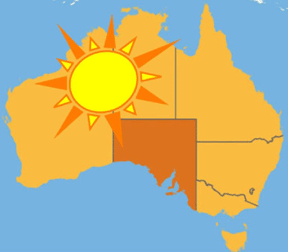
South Australia has joined an elite global club, after being listed alongside Denmark as the only other energy system in the world to be successfully managing significant volumes of surplus variable renewable energy across the year – albeit with a lot of hard work ahead.
In its latest global stocktake of variable renewable energy (VRE) integration across 50 power systems, the International Energy Agency says South Australia has joined the ranks of grids with the highest share of solar and wind in the world.
On the IEA’s scale, this puts South Australia in Phase 5 of the integration of renewables (Phase 6 is the top ranking), managing a share of solar and wind that averages out to be higher than fossil fuels over most of the year and at times surpasses 100% of local demand.
And while this is an achievement to be extremely proud of – of the 50 systems analysed by the IEA, 25 are in Phases 1 or 2, representing around 60% of global electricity generation – it also puts South Australia at the pointy end of renewable energy integration, where big changes need to happen fast, to keep the transition on track.
“A growing number of power systems are pushing the boundaries of VRE integration, successfully managing very high shares of variable renewables,” the report says.
But these “frontrunner systems” face complex challenges related to stability and flexibility, which the IEA says call for a transformation of how power systems are operated, planned and financed.
Certainly, South Australia is facing numerous challenges to get its grid from where it is now, to net 100 per cent renewables. And, as the report notes, some of these challenges are uniquely complex.
“In contrast to the case of Denmark, South Australia has limited interconnections with its neighbours, and the impact of solar PV on the net load is more visible,” it says.
“High VRE periods resulting in surplus generation are managed by a combination of measures including energy exports via interconnection to the
neighbouring state, storage with battery energy storage systems (BESS), demand response and curtailment.
“High ramps at sunrise and sunset hours resulting from solar PV generation are managed predominantly by fast-acting gas turbines and the BESS, as well as accessible resources in the rest of the NEM through the interconnector.”
To this end, Project EnergyConnect – a “nation critical” new transmission project that will join up key renewable energy zones in South Australia,
New South Wales and Victoria – is expected to help.
Meanwhile, other parts of Australia are not far behind – the IEA says Australia, as a nation, should be well into Phase 4 by 2030, where it will face “key operational challenges” to the way the power system responds to maintain stability immediately following disruptions in supply or demand.
Just this week in New South Wales, the state’s “potential output” of renewables – that is, the amount available for use or storage in ideal circumstances – was clocked at 99.8 per cent of native demand just before 11am on Sunday, with a combination of sunny weather and strong winds across most of the state.
But, as Renew Economy editor Giles Parkinson notes here, that level of variable renewables currently can’t be accommodated on the NSW system, for a combination of technical and economic reasons. And it is precisely this problem that the IEA report is hoping to address.
“By 2028 the main case of our renewables forecast shows that a range of countries …reach unprecedented annual shares of generation originating from wind and solar power plants – some above 65%,” the report says.
“This development calls for a better understanding of how this could affect electricity systems even further, and what measures can be taken on several fronts to ensure that those higher levels of VRE are integrated in an affordable and secure manner.”
And it warns that a failure to solve these challenges could derail the global climate effort.
“Should integration measures fail to be implemented in line with a scenario aligned with national climate targets, up to 2,000 terawatt-hours (TWh) of global VRE generation would be at risk by 2030, endangering achieving national energy and climate pledges,” the report says.
“This potential loss – equivalent to the combined VRE output of China and the United States in 2023 – stems from possible increases in technical and economic curtailment, as well as potential project connection delays.
“Consequently, the share of solar PV and wind in the global electricity mix in 2030 would reach 30%, lower than the 35% in the case where integration measures are implemented on time. If this decrease is compensated by increased reliance on fossil fuels, it could lead to up to a 20% smaller reduction of carbon dioxide (CO 2) emissions in the power sector.”
It is comforting to note, however, that Australia is not alone in the challenges it faces – even if it is at the leading edge of some of them.
The IEA says successfully integrating higher levels of solar and wind energy into the grid will increasingly rely on measures taken to meet two “critical
requirements:” electricity grids, and procuring flexibility from a broad range of assets.
Grid congestion is a worldwide issue, the IEA notes, considering that global investment in renewables almost doubled between 2010 and 2023, while from 2015 grid investment has stagnated at $US300 billion a year until 2024, when it rose to $US400 billion.
“As a result of insufficient grid investment, at least 1,500 GW of solar and wind projects at an advanced stage were waiting for grid connection as
of mid-2023,” the report says.
“Further, many countries are facing grid congestion issues, which are expensive to address due to the high cost of dispatching power plants to overcome
immediate issues and because of the large amount of investment necessary to overcome congestion in the future.
“It is crucial for countries to accelerate grid expansion and upgrades, as it enables benefits beyond solely integrating VRE, such as improved electricity access and supporting overall demand growth.”
But, as Australia is experiencing, grid development takes a long time to materialise, the report adds, which means any and all complementary solutions with shorter lead times must be tapped to improve the integration of solar and wind.
On power system flexibility, the IEA says most of these needs will be met by solutions that are already in use, such as batteries, demand response and, to a smaller extent, curtailment.
Flexibility also extends beyond conventional generators, the report adds, encompassing storage, new electricity-based end uses, and grid infrastructure, all of which vary regionally.
“This report calls for strategic government action, enhanced infrastructure, and regulatory reforms to ensure the successful large-scale integration of solar PV and wind in order to meet global energy transition targets,” the IEA says.
“Robust data, stakeholder collaboration and government prioritisation of integration measures are essential for overcoming these challenges and achieving a sustainable energy future.”
Sophie Vorrath Sophie is editor of One Step Off The Grid and deputy editor of its sister site, Renew Economy. She is the co-host of the Solar Insiders Podcast. Sophie has been writing about clean energy for more than a decade.
Global status report highlights parlous state of nuclear power sector

“the industry is essentially running to stand still.”
Jim Green, 20 Sept 2024, https://reneweconomy.com.au/global-status-report-highlights-parlous-state-of-nuclear-power-sector/
Two new reports have undermined the Dutton Coalition’s claims about nuclear power.
A report by the Institute for Energy Economics and Financial Analysis (IEEFA) undermines claims that nuclear power would reduce power bills, and the latest edition of the World Nuclear Industry Status Report undermines claims that nuclear power is on a growth trajectory and Australia risks being left behind.
The IEEFA report’s key findings are as follows:
– Under the Coalition’s nuclear plans, electricity bills could rise by $665 per year on average across jurisdictions and scenarios, for households using a median amount of electricity.
– The bill impact would be more acute for larger households, given their higher electricity consumption. For example, for 4-person households the average annual bill increase across regions and nuclear scenarios would be $972 and for 5+ person households it would be $1,182.
– The cost of electricity generated from nuclear plants would likely be 1.5 to 3.8 times the current cost of electricity generation in eastern Australia.
– Overnight capital costs (excluding financing costs) of recent nuclear power station builds analysed by IEEFA have blown out by a factor of between 1.7 and 3.4, creating significant financial difficulties for the companies involved.
World Nuclear Industry Status Report 2024
The World Nuclear Industry Status Report 2024 (WNISR-2024) was released yesterday. Since 1992, these reports have provided a wealth of factual information about the status and trajectory of nuclear power worldwide.
WNISR-2024 notes that as of 1 July 2024, a total of 408 nuclear power reactors were operating in 32 countries, 30 below the 2002 peak of 438 reactors.
At the end of 2023, nuclear capacity stood at 365 gigawatts (GW). As of mid-2024, operating capacity reached 367.3 GW, 0.2 GW more than the previous 2006 end-of-year record of 367.1 GW.
That’s something for the nuclear boosters to cheer about: record nuclear capacity. But some context is needed. Nuclear power has been stagnant for the past 30 years and a fleet of mostly young reactors is now a fleet of old reactors.
In 1990, the mean age of the global power reactor fleet was just 11.3 years. WNISR-2024 notes that the average age of the world’s operating reactor fleet has been increasing since 1984 and stands at 32 years as of mid-2024, up from 31.4 years in mid-2023.

As the rate of closure of ageing reactors increases, it will become increasingly difficult for the industry to maintain its 30-year pattern of stagnation by matching closures with start-ups, let alone achieving any growth.
Former World Nuclear Association executive Steve Kidd spoke to this problem in 2016, noting that “the industry is essentially running to stand still.”
In 2023, WNISR-2024 notes, there were five reactor start-ups (5 GW) and five permanent closures (6 GW) with a net decline of 1 GW in capacity. (This year has also been underwhelming: a net gain of 2 GW of nuclear capacity compared to several hundred GW of new renewable capacity.)
Nuclear’s share of global electricity generation declined from 9.2 percent to 9.1 percent in 2023, little more than half of its peak of 17.5 percent in 1996.
In the 20 years from 2004 to 2023, there were 102 startups and 104 reactor closures worldwide. Of these, 49 startups were in China with no closures. Outside China, there has been a net decline of 51 reactors over the same period, and net capacity declined by 26.4 GW.
As of mid-2024, 59 reactors were under construction worldwide, 10 fewer than in 2013. China had the most reactors under construction (27) but none abroad. Russia dominates the international market with 26 units under construction as of mid-2024, six of them in Russia and 20 in seven other countries.
WNISR-2024 states: “It remains uncertain to what extent these projects have been or will be impacted by sanctions imposed on Russia and other consequential geopolitical developments following Russia’s invasion of Ukraine.”
Construction started on six reactors in 2023 — down from 10 in 2022 — including five in China.
Chinese and Russian government-controlled companies launched all 35 reactor constructions in the world from December 2019 to mid-2024. Besides Russia’s Rosatom, only France’s EDF is currently building nuclear power plants abroad (two reactors in the UK) as lead-contractor.
Potential nuclear ‘newcomer’ countries
Peter Dutton claims that “50 countries are exploring or investing in next-generation nuclear technology for the first time.” That’s nonsense. WNISR-2024 notes that the number of countries building reactors fell by three from mid-2023 to mid-2024.
Reactors are under construction in 13 countries, down from 16 countries the previous year as the UAE and the US completed their last construction projects and Brazil suspended its only reactor construction project. Only three countries — China, India, and Russia — are building reactors at more than one site.
Just three potential nuclear newcomer countries had reactors under construction as of mid-2024: Egypt, Bangladesh and Turkiye.
WNISR-2024 notes that of 18 African countries analysed, only four would have grid systems large enough to meet minimum capacity criteria to host a large nuclear reactor (based on the rule of thumb that the largest unit in a grid system should not exceed 10 percent of total system capacity).
Small modular reactors might find a niche — but they don’t exist.
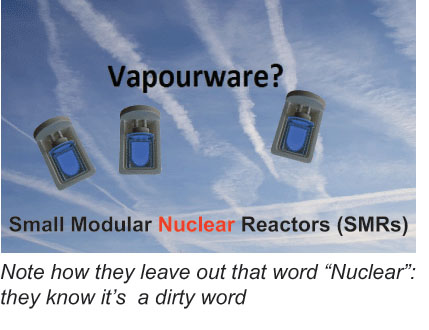
Small modular reactors
WNISR-2024 states: “The gap between hype about Small Modular Reactors (SMRs) and industrial reality continues to grow. The nuclear industry and multiple governments are doubling down on their investments into SMRs, both in monetary and political terms. So far, reality on the ground does not reflect those efforts.
“SMR projects continue to be delayed or canceled. Costs for nuclear projects in general and SMRs in particular are surging. The few available cost estimates for SMRs, especially when weighted by their electrical power generation capacities, show how expensive these are.”


Two developments over the past year have punctured the hype around SMRs. The first was NuScale’s decision to abandon its flagship project in Idaho after cost estimates rose to an absurd A$30,000 per kilowatt (A$14 billion for a 462 megawatt plant).
Then, French utility EDF announced that it had suspended the development of its Nuward SMR and reoriented the project “to a design based on proven technological building blocks.”
The two operating SMRs — a twin-reactor plant in China and a twin-reactor floating plant in Russia — weren’t built using serial factory construction methods so can’t be called SMRs. Nor are there plans to mass-produce these reactors types using serial factory construction methods, so the so-called SMRs in China and Russia can’t even be called prototype SMRs.
Dutton wants taxpayers to fund the construction of large reactors in the eastern states and SMRs in SA and WA. SA aims to reach 100 percent net renewable electricity generation as soon as 2027. Presumably Dutton wants to replace some of that renewable power generation with SMRs, for some unfathomable reason.
Nuclear vs renewables

Total investment in non-hydro renewable electricity capacity in 2023 was estimated by Bloomberg New Energy Finance (BNEF) at $US623 billion, up 8 per cent compared to the previous year. According to a WNISR estimate, this represents 27 times the reported global investment decisions for the construction of nuclear power plants of about $US23 billion for 6.7GW.
BNEF estimated investments in stationary storage capacity at around US$36 billion in 2023, which, for the first time, exceeded investments into new nuclear. Globally, utility-scale storage additions jumped from just over 10 GW added in 2022 to more than 25 GW in 2023.
In 2023, annual additions of solar and wind power grew by 73 per cent and 51 per cent, respectively, resulting in nearly 460 GW of combined new capacity, according to the International Renewable Energy Agency.
The solar PV market saw China alone adding around 217 GW — a 150-percent increase over 2022-additions — and the rest of the world 129 GW for a total of 346 GW or about 1 GW per day.
The Global Wind Energy Council reported a record of 117 GW of new wind installations, a 50 per cent year-on-year increase, with China accounting for 65 percent of total added onshore capacity and 58 per cent of total added offshore capacity. These numbers compare with a net addition of 1 GW nuclear capacity in China and a global decline of 1 GW in 2023.
WNISR 2024 states: “In 2021, the combined output of solar and wind plants surpassed nuclear power generation for the first time. In 2023, wind and solar facilities generated 50 percent more electricity than nuclear plants.
“Wind power alone generated 2,300 terawatt-hours (TWh) and is getting close to nuclear’s 2,600 TWh. Since 2013, non-hydro renewables added 3,500 TWh to the world’s power generation, 14 times more than nuclear’s roughly 250 TWh, and generated 80 percent more power than nuclear in 2023.”
In 2023, the European Union achieved its largest renewable capacity additions ever and the renewable share in total electricity generation reached a record 44 percent. Solar and wind plants together produced 721 TWh compared to nuclear’s 588 TWh.
For the first time ever, non-hydro renewables generated more power than all fossil fuels combined in 2023. Fossil fuel power generation dropped by a record 19 percent, reaching its lowest level ever and accounting for less than one-third of the EU’s electricity generation.
In China, solar PV produced a total of 578 TWh of electricity in 2023, 40 percent more than nuclear’s 413 TWh. Wind power generation first exceeded nuclear in 2012: in 2023, wind produced 877 TWh, more than doubling nuclear generation. Adding other non-hydro renewables like biomass to solar and wind, the net total generation of 1,643 TWh in 2023 was four times the nuclear output.
Keep in mind that China is the only country in the world with a significant nuclear power expansion program. It might be a stretch for WNISR-2024 to state that “nuclear power remains irrelevant in the international market for electricity generating technologies”, but it is heading in that direction.
Dr Jim Green is the national nuclear campaigner with Friends of the Earth Australia and a member of the Nuclear Consulting Group.
Nuclear debate stalls as detail goes missing in action

Angela Macdonald-Smith, https://www.afr.com/companies/energy/nuclear-debate-stalls-as-detail-goes-missing-in-action-20240920-p5kc56 21 Sept 24
Australia’s debate over nuclear power is going nowhere. Politicians are happy to roll out any argument that suits them, but the credible and comprehensive analysis and modelling needed is completely missing.
The upshot is that the energy industry – the people who need to make the transition happen – are disengaged, and consumers who will have to vote on these “policies” are confused.
The vacuum of information includes both the costings and details behind the Coalition’s seven-site nuclear power vision, but also a realistic assessment from the Albanese government about the difficulties in reaching its 2030 climate targets.
Federal Energy and Climate Change Minister Chris Bowen on Friday released energy department findings on the huge reliability gaps that the Coalition’s nuclear plan would cause.
Two scenarios were studied: one that assumed coal plant owners close their plants as projected by the Australian Energy Market Operator between now and 2035, and the Coalition caps investment in large-scale renewables and does not support new transmission builds; a second assumed all coal power stations set to close before 2035 are extended beyond 2040 to try to tide the power system over until nuclear reactors could come online.
According to the results released by Bowen’s office, the first would lead to a huge 49 per cent gap between the demand for energy of about 316 terawatt-hours and available supply – of about 160 TWh – by 2035. The second, an 18 per cent gap of “unmet energy”.
The minister’s office compared those numbers with AEMO’s current tolerance gap for an effectively operating electricity system of just 0.002 per cent of “unmet energy”.
Bowen says the analysis shows how the Coalition’s plan “will result in massive supply shortages over the next decade”. However, the full work carried out by the department was not made available.
Analysis released on Friday by the Institute for Energy Economics and Financial Analysis, which advocates a faster shift to clean energy, also played into Labor’s hands. The analysis sought to estimate the potential impact on household electricity bills using six scenarios that were based on international examples of nuclear power construction projects.
The results suggested that the median household bill would rise, on average, by about $665 a year. The work was based on six recent real-world examples of new nuclear plant builds, ranging from the cheapest location in the Czech Republic through to the most expensive, the Hinkley Point C reactor under construction in the UK at a cost that may top £46 billion ($90 billion).
“The cost of electricity generated from nuclear plants would likely be 1.5 to 3.8 times the current cost of electricity generation in eastern Australia,” IEEFA found.
The analysis was dismissed as “complete nonsense” by shadow treasurer Angus Taylor, while Opposition Leader Peter Dutton also questioned its credibility. He cited Labor’s failed pre-election promise to deliver $275 bill reductions by 2025 as evidence it can’t be trusted.
But the Coalition’s own arguments are just as flimsy, weakened by the continuing absence of the full costings and details of its energy plan.
Dutton is scheduled to speak on nuclear power at the Committee for Economic Development of Australia on Monday. It will not, however, include the much anticipated business case for nuclear. Coalition sources say that will have to wait until some time before the election, due by May next year.
A Coalition source said Monday’s speech would instead be “values”-based. That means a reaffirmation of the seven potential nuclear sites, and more words about why nuclear is better than Labor’s “renewables-only” approach.
The energy industry, meanwhile, is disengaged as the politics play out. While not writing the nuclear option off as impossible, the starting point for real action is much too far off for it to register.
Continuing delays in the build-out of the energy grid – caused by slow project approvals and rising costs, among many other issues – mean these companies have much more immediate challenges to worry about.
Coalition should show us its sums on nuclear
September 20, 2024, https://www.smh.com.au/national/nsw/coalition-should-show-us-its-sums-on-nuclear-20240920-p5kc2k.html
How many more studies are needed to show what is glaringly obvious to everyone? That nuclear power is not cheap and that it is potentially very expensive (“Extra cost of nuclear power revealed”, September 20)?
Despite this, the Coalition keeps sticking to its guns. They can’t be wrong and any study that says otherwise is “shallow and flawed”. They claim the latest study cherry-picks the worst cases, ignoring that any selection is needed to make the study more realistic. Australia won’t have access to cheap labour, so those cases should rightly be ignored. Also, nuclear energy is not where you want to cut corners to keep costs down. And yet, the Coalition has decided to go down the nuclear path.
How can you make a decision without the supporting numbers? If they have the numbers they should release them. David Rush, Lawson
Nuclear is not a viable option for Australia. It will be too expensive and it will take far too long to be of any use and by the Coalition’s own numbers, it will produce almost no electricity even if they are built. Every report from the CSIRO down that exposes Peter Dutton’s nuclear brain explosion has been belittled by the Coalition. The Coalition says it will release its costings eventually. Presumably, they don’t know what the cost will be yet, but given their wildly inaccurate estimates on Snowy 2.0 and inland rail, we have little cause for hope of an accurate figure. Ross Hudson, Mount Martha (Vic)
Coalition energy spokesman Ted O’Brien calls the first analysis of the Coalition’s nuclear plan shallow and flawed – in other words fake news. Having cherry-picked the lowest numbers in their discussions of this policy, and choosing their examples, the Coalition will now have to present their documentation as to how low electricity prices will be under their leadership. As a taxpayer, I’m concerned about the level of accountability if there are cost blowouts or hugely extended construction times. So even if the proposed nuclear plants can deliver cheaper electricity, what happens in the meantime? The Coalition’s switch to government ownership of this infrastructure and the cash splash to those communities who accept a nuclear plant is using taxpayer money to subsidise lower electricity prices to win this argument. We are not just building a few buildings – we are creating a whole new industry from scratch. Meanwhile, another decade or so will pass and more opportunities will be wasted for a better environment. Robert Mulas, Corlette
Ted O’Brien says the US non-profit think tank the Institute for Energy Economics and Financial Analysis has cherry-picked the costs for the opposition’s nuclear “plan”. Why it would do this is unclear but far from choosing selected examples, it has based its analysis on average bills for construction of large-scale nuclear plants by countries with comparable economies to Australia. As for who will put up the money, O’Brien says they will be built by a government entity while Angus Taylor says they will not be publicly subsidised. Peter Nash, Fairlight
More than a third of Australian households have solar power and they won’t like analysis from the Smart Energy Council that shows Dutton’s seven nuclear reactors will shut down solar panels for between 1.8 and 2.9 million homes. The council says that as nuclear power can’t be switched off, it will continue pushing power into the grid, “regardless of whether it’s the most expensive form of energy, or even needed”. Is this really the best energy policy Dutton can come up with, or is it simply an expensive smokescreen to extend the life of fossil fuels? Alison Stewart, Riverview
We are now told our power bills may rise by $665 a year to pay for nuclear energy infrastructure costs. Is this why Dutton is so reluctant to release his costings? Peng Ee, Castle Cove
“Catastrophic:” Coalition plan to stop renewables and push nuclear will result in massive supply gaps

Giles Parkinson, Sep 20, 2024, https://reneweconomy.com.au/catastrophic-coalition-plan-to-stop-renewables-and-push-nuclear-will-result-in-massive-supply-gaps/
Federal energy minister Chris Bowen has launched a new attack against the federal Coalition’s nuclear power policy, saying its plan to stop renewables and potentially “sweat” the remaining coal assets could lead to “catastrophic” supply gaps in the electricity market.
The federal government released new modelling on Friday, the same day as another independent report pointed to a $1,000 a year bill hike to consumers from a nuclear power policy, and just days before Coalition leader Peter Dutton is expected to outline more details at a Sydney event.
The Coalition has been vague about its nuclear power plans to date, identifying only seven potential sites for large scale nuclear or small modular reactors, but has said it intends to stop new wind, solar and battery projects, cease the rollout of new transmission lines, and boost coal and gas output.
In response, the federal department of energy has modelled several different scenarios, and both point to massive supply gaps in the future if the Coalition holds firm on its promise to stop renewable, and even “tear up” as some contracts, as National leader David Littleproud has threatened.
The department estimates that the Coalition’s energy plan will leave a “gaping black hole” of between 18 per cent to 49 per cent of unserved energy, ie the gap between supply and demand.
The biggest gap is created on the assumption that private coal operators do close their ageing coal fired generators between now and 2035, and that the Coalition does not build any new utility scale renewables beyond what’s currently committed, and does not support new transmission builds.
On that scenario, the department modelling estimates a shortfall of around 156 terawatt hours (TWh) between demand for energy (around 316 TWh) and available supply (arround 160 TWh).
The second scenario assumes that all coal plants are extended beyond 2040, to allow time for the Coalition to begin construction of its promised nuclear power plant, but that still results in a shortfall of 18 per cent if the Coalition delivers on its promise to stop the rollout of large scale renewables.
“These scenarios are so catastrophic for the economy, for ordinary Australians, and for Australia’s place as an advanced country they seem implausible,” the department report says.
“But that will be the result of the Coalition’s nuclear scheme.”
It’s ironic because the Coalition is pitching its nuclear scheme on three assumptions: That it is lower cost, that it is more reliable, and that it is compatible on a net zero strategy.
But analysis shows that it would fail on all three counts. Multiple reports have highlighted the higher cost of nuclear, and although the Coalition insists there higher costs affect only investors and not consumers (without ever explaining why), the new analysis from IEEFA points to a blow out in retail bills.
The Coalition insists that a reliance on wind and solar will lead to the destruction of industry, but that is proved a nonsense by South Australia, already at more than 70 per cent wind and solar and aiming for net 100 per cent by 2027, and its inability to explain what will be meeting growing demand needs.
“The fact of the matter is that Mr Dutton and Mr Littleproud and Mr O’Brien wander around the country saying that they will pause renewable energy investments,” Bowen told journalists on Friday.
“Even under their own scheme, they admit that we would not have any nuclear power in Australia until 2035 at the earliest, and that is wildly optimistic.
“Now the question that Mr Dutton has to answer is, where will the electricity come from? If we stop building renewables now and nuclear takes so long, as Australia’s electricity needs are increasing every day, where will he get the power from?
“He wanders around making outrageous accusations about black‑outs under this government, when in fact it’s his own scheme which is the biggest risk to reliability in Australia.”
The department report is just one of three released this week that undermines the Coalition’s case for nuclear in Australia. One is the IEEFA report on the impact on bills, and the World Nuclear Industry Status Report on nuclear that shows an industry that is barely advancing, despite the Dutton rhetoric.
And the problem around reliability is further highlighted by issues at Vogtle, the first nuclear power plant to be built in the US for more than three decades. (And despite Coalition claims of a nuclear renaissance, no other nuclear power projects are being built or committed).
One of the two units at Plant Vogtle, a plant that ran way over budget and time in the country with the biggest nuclear fleet of any, was shut down in July, and again in September, due to various valve issues in what critics note is the most expensive power plant on the planet.
The Coalition has been selling nuclear as reliable and “always on”, but like any generation source it can face hiccups, and the bigger the generation unit – the Westinghouse AP1000s at Vogtle (cited as a potential technology choice by the Coalition) have a capacity of 1,117 MW – the more back-up that is required.
And it is these unexpected interruptions, as opposed to the entirely predictable setting of the sun each day, that creates the biggest problems for the market operator.
“I’ve never said the shift to a clean, cheap, renewable energy system would be easy. But it is achievable, and our plan is working,” Bowen wrote in an op-ed in The Australian.
“Supporting new investment in generation and batteries, bringing on offshore wind projects, and underwriting crucial transmission lines through Rewiring the Nation are real policy solutions underway now.
“Last month AEMO confirmed on time delivery of federal, state and territory programs as planned and legislated, will be sufficient to meet demand out to 2035, within the stringent reliability standard.
“Contrast that with the Coalition’s ideological pursuit of its anti-renewable nuclear scheme that leave almost half Australia’s energy needs unserved in the same period.”
The challenge for Labor, however, is not to convince the Australian or even international energy industry of this. The industry understands just how unsuitable the nuclear option is.
But the Coalition, with the often uncritical and sometime active support of mainstream media and most conservative “think tanks”, is seeking only to win a public debate on this, and the public care little about the details.
“They are treating the Australian people like mugs, arrogantly holding the details of their costings, of the modelling, of the impact of their policies on Australians from the Australian people,” Bowen said.
1 This month

of the week – Australians for War Powers Reform (AWPR)
To see nuclear-related stories in greater depth and intensity
 Antinuclear