Dutton’s baseload nuclear plan shows he does not understand energy systems, Bowen says.

Giles Parkinson, 24 Sept 24 https://reneweconomy.com.au/duttons-baseload-nuclear-plan-shows-he-does-not-understand-energy-systems-bowen-says/
Federal energy minister Chris Bowen has accused Coalition leader Peter Dutton and his fellow nuclear spruikers of failing to understand the changing dynamics of the Australian energy system.
Bowen’s remarks follow reports warning of potential blackouts and price spikes should the Coalition pursue its plan for extending the life of Australia’s ageing coal fleet while waiting for nuclear to be built, and comes a day after Dutton refused to reveal his nuclear costings in what was supposed to be a keynote speech in Sydney.
Instead, Dutton continued his attack on Labor’s reliance on wind and solar, saying it would result in the lights going out, soaring prices, and a stalled economy.
The focus of the debate seems to revolve around the construct of baseload power, which the Australian Energy Market Operator said this week, and big utilities agree, is being made redundant by the emerging dominance of wind and solar, and rooftop PV in particular, backed up by storage and other flexible generation.
Most in the energy industry argue that nuclear, which relies on being “always on” and has limited ability to ramp up and down, simply doesn’t fit into a grid with a majority wind and solar. The nuclear industry itself admits as much.
Dutton on Monday said renewables and nuclear could co-exist, but the four grids he cited – Arizona, France, Finland and Ontario – have no more than 18 per cent renewable share. Australia is at 40 per cent, going on 50 per cent with already committed projects, and is aiming for 82 per cent by 2030.
“The thing about Peter Dutton’s plan is again he doesn’t understand that what we need for a system which is net zero and predominantly renewable with peaking and firming,” Bowen said in an interview on Radio National breakfast.
“Coal is not suitable for peaking and firming, because once you turn a coal‑fired power station on, you’re not turning it off, and guess what, same as nuclear.
“Whereas gas can be turned on and off to support the energy system when we do need more energy, it can be turned on or off at two minutes’ notice, so when a gas‑fired power station is not turned on, it is zero emissions.
“Coal and nuclear can’t be turned on and off, and when coal is on it is emitting even if we don’t need the energy. It’s a fundamental misunderstanding of the energy system.”
Dutton and conservative voices have said that Bowen’s 82 per cent renewables target is impossible to meet, and will destroy industry. They argue that no grid can survive on such a high level of renewables, despite South Australia already doing so, and the market operator also convinced it can and will be done.
“Getting to 82 per cent renewables is no small thing, it’s a big change for the country,” Bowen said.
“But it’s also got to be supported by a well‑detailed plan to back it by new storage, batteries primarily, but also pumped hydro. That’s happening, and we have policies in place to do that, and that is rolling out; we’re seeing a big increase in storage.”
The Clean Energy Regulator on Tuesday released a report which showed that 7 GW of new wind and solar, including 4 GW of large scale renewables, should be committed this year, an improvement on previous years although still short of the level required.
Former NSW Coalition energy minister and now chair of the Climate Change Authority Matt Kean was also critical of Dutton’s assertions that nuclear makes a good bedfellow for renewables.
“I think the advice from the CSIRO and the Australian Energy Market Operator is very different,” he told ABC TV’s 7.30 program.
“We know that nuclear technology is not flexible to work with renewables, so therefore it isn’t the best technology to support renewables.
“We also know that it will take a long time to build nuclear capacity. Australia doesn’t have a nuclear industry. We don’t have the workforce that’s ever done this before, and the best example to look to is what’s happening in the UK, another democracy that’s currently building a nuclear power plant.”
He pointed to the Hinckley C reactor that has been delayed more than a decade, and where costs have blown out to more than $A86 billion as an example.
“AEMO and the CSIRO have said clearly that the cheapest way to replace our existing capacity is renewables that are backed up by firming technologies,” Kean said.
“We’ll take the advice of the experts. We’re not going to get into ideology. This should be about evidence, science, engineering and economics.”
Dutton’s truth-sounding nuclear power arguments are for generating impressions, not information.

He didn’t mention having to keep coal in the mix for a lot longer. But that’s certainly what his Coalition partners, the Nationals, have been saying with a nudge and a wink, whenever they are in receptive company.
Karen Middleton, 24 Sept 24, https://www.theguardian.com/global/2024/sep/24/peter-dutton-ceda-speech-coalition-nuclear-power-plan-costs
The opposition leader keeps bypassing questions over the cost of his energy plan – while leaning on little more than fuzzy assurances.
It was nothing if not audacious.
In a speech that avoided answering one of the biggest questions hanging over his policy to build nuclear reactors at seven sites around Australia, Peter Dutton posed a very similar one about his opponents and their plans to phase out fossil fuels.
“Who will bear the costs of this transition?” Dutton asked in an address to the Committee for Economic Development of Australia on Monday, before answering it himself. “Australian households will – in their power bills.”
Dutton’s speech to a lunchtime event titled “A nuclear-powered Australia – could it work?” contained no new information about his nuclear plan and was instead an exercise in relativism via admission. To paraphrase: my energy policy might cost a lot, but theirs will cost more and mine is more reliable.
“Yes, our nuclear plan does have significant upfront cost,” Dutton said. “… But a whole new and vast transmission network and infrastructure won’t be needed.”
He has still provided no evidence to support this statement, nor any further detail beyond naming seven sites and indicating he favours small modular reactors.
This speech was not about providing that detail. It was about making truthy-sounding arguments designed to generate an impression, not information.
He had a few messages that clearly came straight from the focus groups, starting and ending on a plea for “pragmatism, not politics”, rebuking the Albanese government for being “juvenile” and “childish” and accusing it of avoiding “a sensible discussion” about nuclear power.
What is evident from Dutton’s speech is that he knows, as the government does, that it won’t be arguments about three-eyed fish or even earthquake fault lines that will swing voters for or against nuclear power as they think about which way to vote. It’s what it will cost and whether nuclear can actually address Australia’s energy challenges.
Dutton was cosying up to renewable energy, suggesting he’s all for it, but that it needs more grunt to get Australia through. He’s trying to suggest his policy is about climate responsibility, not denial, and balances environmental and economic imperatives.
“We can have cheaper, cleaner and consistent energy if we adopt nuclear power,” he said. “And zero-emission nuclear power is our only chance to reach net zero by 2050.”
He didn’t mention having to keep coal in the mix for a lot longer. But that’s certainly what his Coalition partners, the Nationals, have been saying with a nudge and a wink, whenever they are in receptive company.
Referring to the government’s policy, Dutton used the false label “renewables-only” seven times and “renewables alone” once. He suggested that the government’s pledge to an ongoing role for gas was support in name only. Tell that to the Labor party members and constituents who are outraged that its future gas strategy embeds that particular fossil fuel in the energy mix to 2050 and beyond.
The opposition leader said Labor was lying about the “true costs” Australians would bear in its planned transition away from coal-fired power to cleaner forms of energy, calling this an “absolute scandal” while saying precisely nothing specific about the cost of his own.
“We will release our costings in due course, at a time of our choosing,” Dutton said.
Calling his own policy idea “truly visionary” was the closest he came to acknowledging that nuclear power could not be up and running in Australia for at least two decades.
“We can’t switch nuclear power on tomorrow,” he said, adding one more little caveat about legislative obstacles. “Even if the ban is lifted.”
Not when, if.
Instead of cold, hard facts, Dutton’s Ceda speech relied on warm, fuzzy assurances. With the emphasis on fuzzy.
“Clean nuclear energy is reliable,” he insisted. “It will underpin renewables. It will get the cost of electricity down. It will keep the lights on.”
In which decade, he didn’t quite say.
Australian nuclear news headlines 23- 30 September
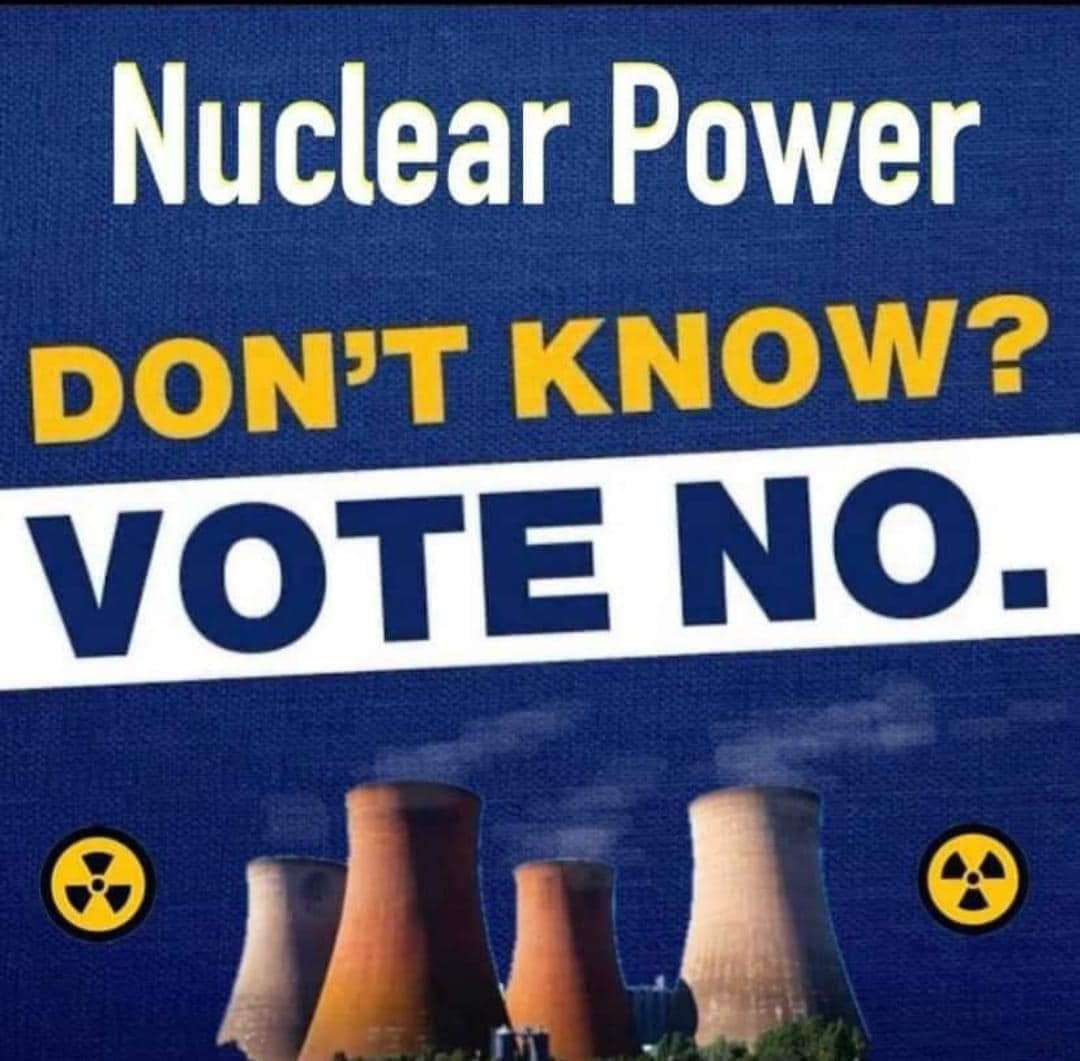
Headlines as they come in:
- Marles, with all pretension, flogging a dead seahorse.
- Indonesia, Solomon Islands join countries banning nuclear weapons, putting Australia at odds with neighbours
- Nuclear Concerns – Hiroshima, Maralinga and Dutton’s Australia .
- Memo to Dutton: It’s the final quarter, you’d better start kicking
- Renewable and Energy storage jobs will soon overtake those in coal and gas
- Nuclear Costs ‘In Due Course’
- Pro-nuke spin has a $377 billion price tag of government funding.
Stuck on repeat: why Peter Dutton’s ‘greatest hits’ on nuclear power are worse than a broken record. - Australians are installing batteries at a record rate, as rooftop solar heads for major new milestone.
- Dutton’s nuclear plan would mean propping up coal for at least 12 more years – and we don’t know what it would cost
- Climate Change Authority head Matt Kean contradicts Peter Dutton’s claim on nuclear and renewables working together.
- Households surge ahead in rooftop solar as renewable projects break bottleneck
- Dutton’s truth-sounding nuclear power arguments are for generating impressions, not information.
- Dutton’s baseload nuclear plan shows he does not understand energy systems, Bowen says.
And as coal power makes its way out of the mix, solar continues to grow, with a total installed capacity of 1.3 GW added so far this year – or 141,364 systems – taking the share of rooftop PV in the national electricity mix to 11.3 per cent, as of the end of June.
1 This month
7 April – WEBINAR – Australia and the Doomsday Clock – Preventing nuclear war through NoFirstUse and other policies
Online | Tuesday April 7, 4:00-5:30pm, Australian Eastern Time / 8:00-9:30am Central Europe Time
– Access the registration link
15 April – Zoom –Nuclear Power is Not the Solution
Apr 15, 2026 01:00 AM in Canberra, Melbourne, Sydney

Join the International Physicians for the Prevention of Nuclear War (IPPNW) on Tuesday, April 14th for a timely webinar exploring the risks associated with nuclear power and challenging the myth that it offers a simple, safe, carbon-free solution to the climate crisis

21 April Webinar: No Nuclear Weapons in Australia
Start: 2026-04-21 18:00:00 UTC Canberra, Melbourne, Sydney (GMT+10:00)
End: 2026-04-21 19:30:00 UTC Canberra, Melbourne, Sydney (GMT+10:00)
Event Type: Virtual
A virtual link will be communicated before the event.
Host Contact Info: australia@icanw.org

of the week – Australians for War Powers Reform (AWPR)
To see nuclear-related stories in greater depth and intensity
 Antinuclear