Stuck on repeat: why Peter Dutton’s ‘greatest hits’ on nuclear power are worse than a broken record.

Guardian, Graham Readfearn, 26 Sept 24
So far there are no costings and no details on what type of reactors there would be, their size or who would build them.
Usually you need a few genuine releases under your belt before you start putting out “greatest hits” albums, but when it comes to spruiking nuclear this hasn’t stopped Peter Dutton.
This week, the opposition leader gave a speech that some hoped – perhaps naively – would add some more detail to the Coalition’s scant policy proposal to build nuclear reactors at seven sites around Australia.
But instead, Dutton delivered a familiar run-down of “greatest hits”; nuclear will mean cheap power, everyone else is going nuclear (so why shouldn’t we?), and renewables are unreliable (did you know, for example, and I bet you didn’t, that “solar panels don’t work at night” or that “turbines don’t turn on their own”?).
Perhaps Dutton is banking on the illusory truth effect where, regardless of the truthfulness of a statement, the more people hear it the more they’re inclined to accept it.
So far there are no costings, no details on what type of reactors or how large they will be, or who will build them. We do know Dutton wants to fund them through the taxpayer.
But let’s run through the track listing.
Renewables-only redux
Take, for example, Dutton’s claim in his speech, at the Centre for Economic Development Australia in Sydney, that Labor is pursuing a “renewables-only” policy for the electricity grid – a phrase he repeated seven times.
Just as it has been for many months, the “renewables-only” claim is false.
While it’s true Labor does want the electricity grid dominated by solar and wind, backed up by storage such as batteries and pumped hydro, the current plan also includes gas-fired power that would act as back-up if solar or wind levels dropped too low…………………………………………………………………………………………………………………………….
28,000km – again
Also getting another go on the turntable was Dutton’s claim the government’s plan would require “28,000km of new transmission lines”.
The actual figure, according to AEMO, is 10,000km – or about a third of Dutton’s claim.
Only under a scenario where Australia gets very aggressive on green energy exports, such as hydrogen, does AEMO think you might need another 10,000km or more of transmission lines.
This has been pointed out before, but, like a broken record, Dutton continues to repeat it.
The nuclear train?
In a statement that will surprise nobody, Dutton said even if the various state and federal bans on nuclear power generation were lifted “we can’t switch nuclear power on tomorrow”.
“But what we can do is ensure that Australia doesn’t miss the nuclear train,” he said.
An independent report on the status of that global “nuclear train” was published last week.
The 500-page World Nuclear Industry Status report said in 2023 a record US$623bn was invested into non-hydro renewable energy, which was “27 times the reported global investment decisions for the construction of nuclear power plants”.
As of July, the report said there were 59 reactors under construction, 10 fewer than a decade ago, with almost half being built in China. Some 23 of those reactors were behind schedule………………………… more https://www.theguardian.com/environment/commentisfree/2024/sep/26/stuck-on-repeat-why-peter-dutton-greatest-hits-on-nuclear-power-are-worse-than-a-broken-record
Dutton’s nuclear plan would mean propping up coal for at least 12 more years – and we don’t know what it would cost
Alison Reeve, Deputy Program Director, Energy and Climate Change, Grattan Institute, 25 Sept 24, https://theconversation.com/duttons-nuclear-plan-would-mean-propping-up-coal-for-at-least-12-more-years-and-we-dont-know-what-it-would-cost-239720
Opposition leader Peter Dutton has revealed the Coalition’s nuclear energy plan relies on many of Australia’s coal-fired power stations running for at least another 12 years – far beyond the time frame officials expect the ageing facilities to last.
The claim has set off a new round of speculation over the Coalition’s plans – the viability of which has already been widely questioned by energy analysts.
Dutton offered up limited detail in a speech on Monday. He also revealed the plan relies on ramping up Australia’s gas production.
It seems increasingly clear the Coalition’s nuclear policy would prolong Australia’s reliance on coal, at a time when the world is rapidly moving to cleaner sources of power.
Coal: old and tired
The Coalition wants to build nuclear reactors on the sites of closed coal plants. It says the first reactors could come online by the mid-2030s. However, independent analysis shows the earliest they could be built is the 2040s.
Now it appears the Coalition’s plan involves relying on coal to provide electricity while nuclear reactors are being built. On Monday, Dutton suggested coal-fired electricity would be available into the 2030s and ‘40s.
But this is an overly optimistic reading of coal’s trajectory. The Australian Energy Market Operator says 90% of coal-fired power in the National Electricity Market will close by 2035.
All this suggests the Coalition plans to extend the life of existing coal plants. But this is likely to cost money. Australia’s coal-fired power stations are old and unreliable – that’s why their owners want to shut them down. To keep plants open means potentially operating them at a loss, while having to invest in repairs and upgrades.
This is why coal plant owners sought, and received, payments from state governments to delay exits when the renewables rollout began falling behind schedule.
So who would wear the cost of delaying coal’s retirement? It might be energy consumers if state governments decide to recoup the costs via electricity bills. Or it could be taxpayers, through higher taxes, reduced services or increased government borrowing. In other words, we will all have to pay, just from different parts of our personal budgets.
Labor’s energy plan also relies on continued use of coal. Dutton pointed to moves by the New South Wales and Victorian governments to extend the life of coal assets in those states. For example, the NSW Labor government struck a deal with Origin to keep the Eraring coal station open for an extra two years, to 2027.
However, this is a temporary measure to keep the electricity system reliable because the renewables build is behind schedule. It is not a defining feature of the plan.
New transmission is essential under either plan
Dutton claims Labor’s renewable energy transition will require a massive upgrade to transmission infrastructure. The transmission network largely involves high-voltage lines and towers, and transformers.
He claims the Coalition can circumvent this cost by building nuclear power plants on seven sites of old coal-fired power stations, and thus use existing transmission infrastructure.
Labor’s shift to renewable energy does require new transmission infrastructure, to get electricity from far-flung wind and solar farms to towns and cities. It’s also true that building nuclear power stations at the site of former coal plants would, in theory, make use of existing transmission lines, although the owners of some of these sites have firmly declined the opportunity.
But even if the Coalition’s nuclear plan became a reality, new transmission infrastructure would be needed.
Australia’s electricity demand is set to surge in coming decades as we move to electrify our homes, transport and heavy industry. This will require upgrades to transmission infrastructure, because it will have to carry more electricity. Many areas of the network are already at capacity.
So in reality, both Labor’s and the Coalition’s policies are likely to require substantial spending on transmission.
Climate Change Authority head Matt Kean contradicts Peter Dutton’s claim on nuclear and renewables working together

ABC News, By 7.30 chief political correspondent Laura Tingle
The head of the Climate Change Authority has contradicted the claim of Opposition Leader Peter Dutton that renewables and nuclear power can be ‘companions not competitors’, a claim that suggests a commitment to nuclear power will not derail the current transition to renewable energy.
Matt Kean is a former NSW Liberal energy minister and Treasurer, appointed by the Albanese government to chair the Climate Change Authority (CCA) earlier this year.
The Authority is due to make a recommendation to the government next month on what Australia’s 2035 emissions reduction target would be.
Mr Kean committed to making that target public.
On Monday, Mr Dutton spelt out some of his arguments in favour of nuclear energy, though he continues to decline to outline its cost.
The Opposition leader conceded on Monday that the upfront costs would be substantial but would ultimately prove cheaper than the cost of a transition to renewables, which he said was up to $1.5 trillion, partly because of the need to rewire the electricity system.
However, Climate Change and Energy Minister Chris Bowen has repeatedly quoted “the best guide to the cost” of the transition scheme being overseen by Labor was the Australian Energy Market Operator’s “integrated systems plan”, which he said “looked at the total cost out to 2050 of the entire generation, storage and transmission and came up at $121 billion”.
Asked on 7.30 whether nuclear had a role to play in Australia’s best energy mix, Mr Kean said that in the CCA’s recent review of pathways to net zero, “the CSIRO clearly set out the pathway to transition our electricity system and meet our commitments, international and domestic commitments, was renewables that are firmed up with technologies like batteries and storage.”
“That’s the pathway that’s been set out by the CSIRO that’s backed up by the Australian Energy Market Operator,” Mr Kean said…………………………………………………………………………………………………………….. more https://www.abc.net.au/news/2024-09-23/matt-kean-expert-advice-differs-peter-dutton-nuclear-plan/104386552?utm_source=abc_news_app&utm_medium=content_shared&utm_campaign=abc_news_app&utm_content=other&fbclid=IwY2xjawFgNZBleHRuA2FlbQIxMQABHd_YcXBdgR0x85pH_9LerLMxZMbM4Pcqj1mtf4s4-_JFiJSf218SwO5KUg_aem_Zu8m5MVQhLz_j1FEJkC4PQ
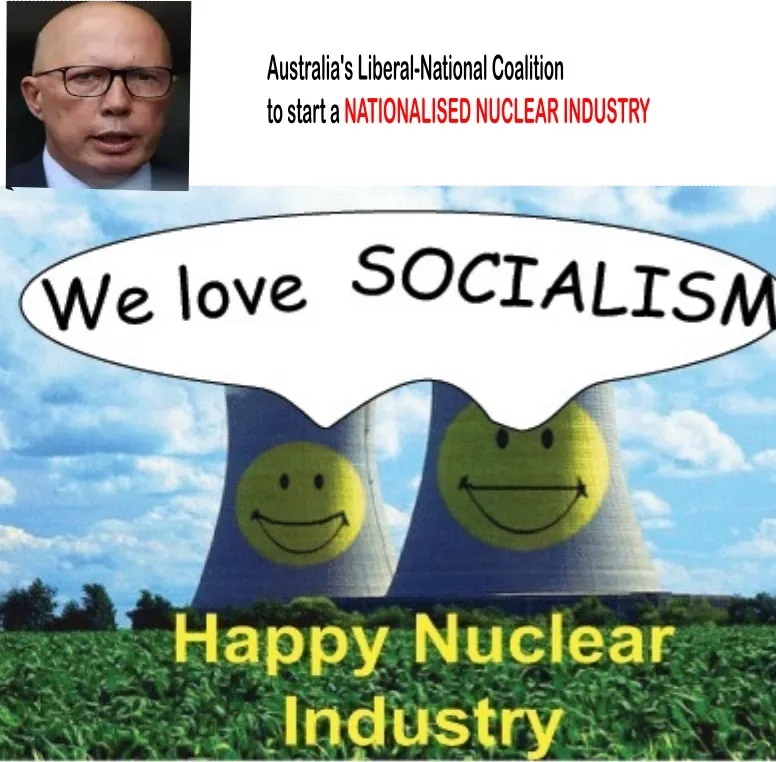
Pro-nuke spin has a $377 billion price tag of government funding
The Fifth Estate, Murray Hogarth, 26 September 2024
THE NUCLEAR FILES: Regional Australia being targeted for nuclear reactors may be in for way more reactors than they might have bargained for. Murray Hogarth finds the nuclear sales pitch to these communities is more revealing than the political spin, and sometimes they reveal more than our politicians do.
Pro-nuke advocates influencing the Liberal-National Coalition want Australia headed for a major nuclear energy power that’s much bigger than first revealed.
A lot more. In total, more than 30 large scale nuclear power stations!
At projected costs of around $377 billion, taking more than 29 years to build through to 2060 at the rate of $13 billion a year.
This would mean producing up to six times more nuclear generation capacity, as most people think the Coalition is currently proposing with its highly controversial energy and climate approach, with more than four times the number of reactors.
Except, what is the Coalition actually proposing? Do we really have any idea? Could there be a big surprise in store?
The total number of individual reactors proposed to be built with government funding and details of what its sketchy nuclear energy plans will cost remains a mystery, even though opposition leader Peter Dutton spoke on the issues a Committee for Economic Development of Australia (CEDA) business lunch in Sydney on Monday.
There are gaping holes in its nuclear ambition story that many critics denounce as an economic fantasy, a deliberate dead cat on the table distraction, a political hoax, an anti-renewables ruse, and a trojan horse aimed at propping up fossil fuels.
A “big nuclear” future?
Just last week, a major regional community was being wooed to support nuclear energy, based on transcripts from a public event shared with The Fifth Estate, with local people invited to join a very “big nuclear” future.

The invitation came from Robert Parker, founder of Nuclear for Climate Australia, who became a cause celebre for the nuclear lobby earlier this year when Engineers Australia cancelled a nuclear-themed lecture that he was scheduled to give, allegedly because of politicised content.
In the resulting furore, fanned by conservative media, the actively pro-nuclear, coalition-aligned right-wing think tank the Institute of Public Affairs (IPA) rallied to Parker’s defence and provided him with an alternative platform.

Last week, Parker argued that Australia should have 36.8 gigawatts of nuclear generation by 2060, which implies 30 or more largescale reactors or many more small modular reactors (SMRs).
This will sound like an incredibly optimistic ambition to many, given nuclear energy currently remains banned in Australia and the recent international history of massive delays and cost blowouts on nuclear power station projects. But it’s a future which Parker claims is realistic because:
Canadians, they built 18 reactors in 20 years. The French built 58 reactors in 22 years and put 63 gigawatts on to the grid. Here we’re talking around about 36.8 gigawatts. So it’s a lot less than the French did.
Parker claimed it would cost $13 billion a year for 29 years of construction through to 2060, which implies work starting circa 2031 and a total cost of $377 billion.
Exactly like the Coalition, he forecasted the first 600 megawatts (MW) to be built by 2035, which would be two SMRs at 300MW apiece.
But there was a catch. When pressed by audience members about when this nuclear plan would deliver carbon emission reduction benefits, he admitted that it would be 2060 because we’d be “starting far too late”, which also is too late for net zero by 2050
Is this a dress rehearsal for the coalition’s real agenda?
Parker’s plan begs the question of whether this is the Coalition plan, or at least close to it, being live-tested with a real audience…………………………………………………………………. https://thefifthestate.com.au/columns/columns-columns/the-nuclear-files/pro-nuke-spin-has-a-377-billion-price-tag-of-government-funding/
1 This month

of the week – Australians for War Powers Reform (AWPR)
To see nuclear-related stories in greater depth and intensity
 Antinuclear