Pro-nuke spin has a $377 billion price tag of government funding
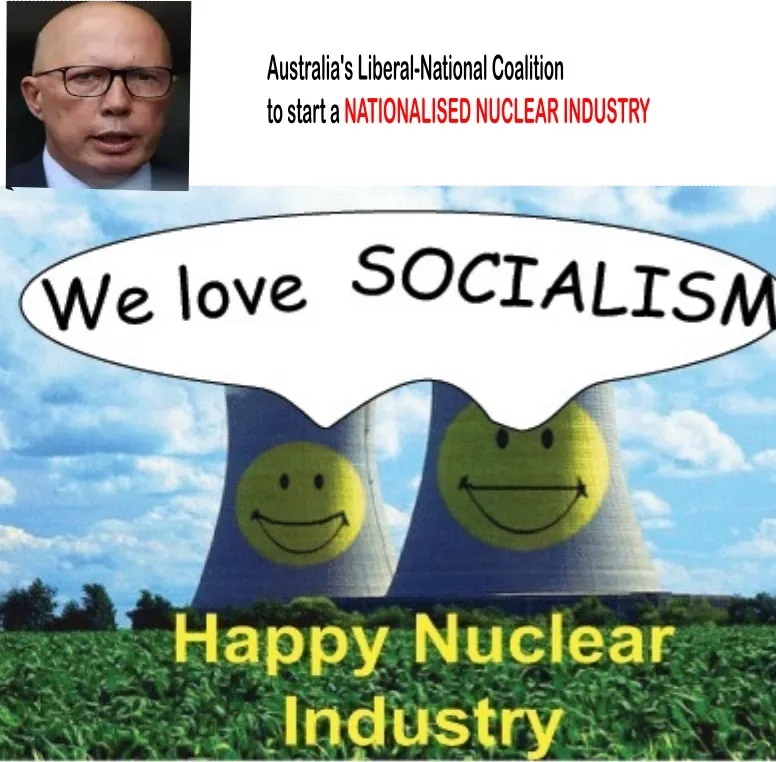
The Fifth Estate, Murray Hogarth, 26 September 2024
THE NUCLEAR FILES: Regional Australia being targeted for nuclear reactors may be in for way more reactors than they might have bargained for. Murray Hogarth finds the nuclear sales pitch to these communities is more revealing than the political spin, and sometimes they reveal more than our politicians do.
Pro-nuke advocates influencing the Liberal-National Coalition want Australia headed for a major nuclear energy power that’s much bigger than first revealed.
A lot more. In total, more than 30 large scale nuclear power stations!
At projected costs of around $377 billion, taking more than 29 years to build through to 2060 at the rate of $13 billion a year.
This would mean producing up to six times more nuclear generation capacity, as most people think the Coalition is currently proposing with its highly controversial energy and climate approach, with more than four times the number of reactors.
Except, what is the Coalition actually proposing? Do we really have any idea? Could there be a big surprise in store?
The total number of individual reactors proposed to be built with government funding and details of what its sketchy nuclear energy plans will cost remains a mystery, even though opposition leader Peter Dutton spoke on the issues a Committee for Economic Development of Australia (CEDA) business lunch in Sydney on Monday.
There are gaping holes in its nuclear ambition story that many critics denounce as an economic fantasy, a deliberate dead cat on the table distraction, a political hoax, an anti-renewables ruse, and a trojan horse aimed at propping up fossil fuels.
A “big nuclear” future?
Just last week, a major regional community was being wooed to support nuclear energy, based on transcripts from a public event shared with The Fifth Estate, with local people invited to join a very “big nuclear” future.

The invitation came from Robert Parker, founder of Nuclear for Climate Australia, who became a cause celebre for the nuclear lobby earlier this year when Engineers Australia cancelled a nuclear-themed lecture that he was scheduled to give, allegedly because of politicised content.
In the resulting furore, fanned by conservative media, the actively pro-nuclear, coalition-aligned right-wing think tank the Institute of Public Affairs (IPA) rallied to Parker’s defence and provided him with an alternative platform.

Last week, Parker argued that Australia should have 36.8 gigawatts of nuclear generation by 2060, which implies 30 or more largescale reactors or many more small modular reactors (SMRs).
This will sound like an incredibly optimistic ambition to many, given nuclear energy currently remains banned in Australia and the recent international history of massive delays and cost blowouts on nuclear power station projects. But it’s a future which Parker claims is realistic because:
Canadians, they built 18 reactors in 20 years. The French built 58 reactors in 22 years and put 63 gigawatts on to the grid. Here we’re talking around about 36.8 gigawatts. So it’s a lot less than the French did.
Parker claimed it would cost $13 billion a year for 29 years of construction through to 2060, which implies work starting circa 2031 and a total cost of $377 billion.
Exactly like the Coalition, he forecasted the first 600 megawatts (MW) to be built by 2035, which would be two SMRs at 300MW apiece.
But there was a catch. When pressed by audience members about when this nuclear plan would deliver carbon emission reduction benefits, he admitted that it would be 2060 because we’d be “starting far too late”, which also is too late for net zero by 2050
Is this a dress rehearsal for the coalition’s real agenda?
Parker’s plan begs the question of whether this is the Coalition plan, or at least close to it, being live-tested with a real audience…………………………………………………………………. https://thefifthestate.com.au/columns/columns-columns/the-nuclear-files/pro-nuke-spin-has-a-377-billion-price-tag-of-government-funding/
No comments yet.
1 This month

of the week – Australians for War Powers Reform (AWPR)
To see nuclear-related stories in greater depth and intensity
 Antinuclear
Leave a comment