Big Super is still investing in nuclear weapons: report

| Quit Nukes / The Australia Institute, 1 October 24 https://theaimn.com/big-super-is-still-investing-in-nuclear-weapons-report/ |
A new report has found that despite claiming not to invest in ‘controversial weapons’ 13 of the top 14 Australian super funds are still investing in nuclear weapons companies, in some cases even in an option described as ‘responsible’.
One of the 14, Hostplus, has excluded nuclear weapons companies across its portfolio since December 2021.
At least $3.4 billion of Australian retirement savings are invested by these funds in companies involved in making nuclear weapons, according to the new research conducted by Quit Nukes in collaboration with The Australia Institute.
The report analyses financial returns and finds that the exclusion of nuclear weapon companies from portfolios has an immaterial impact on returns.
Rosemary Kelly, Director, Quit Nukes:
“It’s frankly unconscionable to sell super fund members a responsible investment option and then use their money to invest in nuclear proliferation.
“The thing that makes this baffling is that investing in nuclear weapon companies is just completely unnecessary in the broader scheme of things..
“Superannuation funds should divest immediately from weapons manufacturers who produce nuclear weapons. If you’re a member of 13 of these 14 leading funds you can request that your fund divest or threaten to take your savings elsewhere.
“Super funds are being sneaky by boasting of policies to exclude “controversial weapons” but not counting nuclear weapons as “controversial.” That’s pretty hard to swallow when you consider that most ESG advisers now consider nuclear weapons as controversial weapons, given the UN Treaty on the Prohibition of Nuclear Weapons that came into force in 2021.
Alice Grundy, Research Manager, The Australia Institute
“The most frustrating thing about the lack of process in this area is that excluding nuclear weapon companies from super portfolios is so easy. Divesting has an immaterial impact on investment returns.
“Your super fund could divest your money from nuclear weapon companies without materially impacting your returns.
“So long as nuclear weapons exist, nuclear war is an ever-present risk. Its impacts would be catastrophic. Even a limited nuclear war, involving say 250 of the over 12,000 nuclear weapons in the world, would kill 120 million people outright and cause nuclear famine, putting 2 billion lives at risk. There would be massive impacts on global supply chains and manufacturing.
“The long-term financial implications should be factored into decisions about where to invest Australian super.”
The full report Media contacts: Anil Lambert 0416 426 722
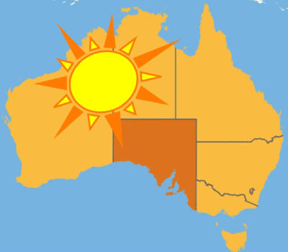
South Australia sets spectacular new records for wind, solar and negative demand
Giles Parkinson, Sep 30, 2024, https://reneweconomy.com.au/south-australia-sets-spectacular-new-records-for-wind-solar-and-negative-demand/
Records continue to tumble across Australia’s main grids as the spring weather boosts the output of wind and solar and mild weather moderates demand, but none are as spectacular as those being set in South Australia.
The state’s unique end-of-the-line grid already leads the country, and arguably the globe, in the integration of variable wind and solar, with an average of more than 70 per cent of its demand over the last year and a world-first target of 100 per cent net renewables by 2027.
On Sunday, at 9.35 am, the state set a new milestone, setting a new record share of wind and solar (as a percentage of state electricity demand) of 150.7 per cent, beating a record set on Christmas Day last year, when – for obvious reasons – there was little electricity demand.
As Geoff Eldridge, from GPE NEMLog, notes, this means that the rooftop PV, along with large scale wind and solar farms, were generating 50.7 per cent more power than the state’s total electricity demand at the time.
The scale of excess output was further crystallised later in the day with a new minimum record for instantaneous residual demand, which hit minus 927 megawatts at 12.35pm.
Eldridge says residual demand is what’s left for other generators to supply after wind and solar have met a share of the demand. A negative residual demand means wind and solar were producing more electricity than SA needed, resulting in excess renewable generation which can be managed by exporting and battery charging. The remainder is curtailed.
Of the surplus 927 MW, the state was exporting 685 MW to Victoria, while another 163 MW was being soaked up by the state’s growing fleet of battery storage projects, and 730 MW of output was curtailed. Prices at the time were minus $47/MWh, a good opportunity for batteries to charge.
A further 84 MW was being produced by a couple of gas generators – not because their power output was needed, but because the state, at least for the moment, relies on them for essential grid services such as system strength and fault current.
That will be reduced considerably when the new link to NSW is completed in a few years, and it will allow the state to both export more, and import more when needs be.
“Balancing the system with such high renewable penetration is challenging but necessary as the energy transition progresses,” Eldridge says. “Managing excess generation through exports, storage, and curtailment is critical to keeping the grid stable and efficient.”
It wasn’t the only record to fall over the weekend. In Queensland, the country’s most coal dependent state in terms of annual share of demand and generation, large scale solar hit a record share of 34 per cent, and coal output – in megawatt terms – hit a record low of 2,882 MW.
The Queensland coal fleet capacity is more than 8,000 MW, so that is about as low as it can run until more units are closed down.
In Victoria on Saturday, just before the AFL grand final, rooftop solar also hit a new record output of 3,164 MW – although it did not push operational demand down low enough for the market operator to enact Minimum System Load protocols and possibly switch off some rooftop solar panels to maintain grid stability.
It had flagged a potential MSL event on Friday but cancelled it in the morning. Those events will likely occur at other times in spring and over the summer holidays, although the market operator is now working on new rules for big batteries to avoid a potentially unpopular and unwieldy solar switch off.
Department of Justice Notified of Suspected Faulty Welds on SUBMARINES, Aircraft Carriers at Newport News Shipbuilding

Sam LaGrone, September 26, 2024 https://news.usni.org/2024/09/26/doj-notified-of-suspected-intentionally-faulty-welds-on-subs-aircraft-carriers-at-newport-news-shipbuilding
Shipuilder Newport News Shipbuilding, Va., informed the Department of Justice of faulty welds that may have been made intentionally on non-critical components on in-service Navy submarines and aircraft carriers, USNI News has learned.
HII reported to the Navy that welds on new construction and in-service submarines and Ford-class aircraft carriers were made not following welding procedure, according to a Tuesday memo from Assistant Secretary of the Navy for Research, Development and Acquisition Nickolas Guertin to Secretary of the Navy Carlos Del Toro and Chief of Naval Operations Adm. Lisa Franchetti.
Guertin told SECNAV and CNO the workers did not follow proper techniques to weld the suspect joints with an early indication that some of the welding errors were intentional. Based on the Newport News assessment of the welds, the shipyard notified the Department of Justice over the issue.
Portions of Guertin’s memo were first circulated on social media sites on Thursday.
Newport News acknowledged their internal quality assurance systems discovered production problems in a Thursday statement to USNI News
“We recently discovered through internal reporting that the quality of some welds did not meet our high-quality standards. Upon this discovery, we took immediate action to communicate with our customers and regulators, investigate, determine root cause, bound these matters and insert immediate corrective actions to prevent any recurrence of these issues,” reads the statement.
“HII’s Newport News Shipbuilding is committed to building the highest-quality aircraft carriers and submarines for the U.S. Navy. We do not tolerate any conduct that compromises our company’s values and our mission of delivering ships that safeguard our nation and its sailors.”
The Navy acknowledged the ongoing look into the scope of the welding problem in a Thursday statement to USNI News.
“The Navy is aware of the issue and a thorough evaluation is underway to determine the scope. The safety of our Sailors and our ships is of paramount importance. We are working closely with industry partners to address this situation and will provide additional information when available,” reads the statement.
The Department of Justice did not immediately respond to a request for additional information from USNI News on Thursday on the probe into the welds.
Newport News is one of two nuclear shipyards in the U.S. The yard builds the Ford-class aircraft carriers and the bow and stern sections of the Virginia-class attack submarines and the Columbia-class nuclear ballistic missile submarines in cooperation with General Dynamics Electric Boat.
Shipbuilders across the country have been wrestling with ongoing workforce problems due in part to a green labor pool that was exacerbated by the COVID-19 pandemic.
Week to 30 September- countering the nuclear-military-industrial-political spin

Some bits of good news.
– Women Wage Peace . Countries’ climate obligations could be legally defined at top UN court in December.Vertical Greening Brings Nature to Urban ‘Heat Islands’ Quickly and Easily.
TOP STORIES. How civilisation could end – an all-too-possible nuclear scenario.
The Israeli nuclear risk no one is talking about.
Cold War II: US Congress passes 25 anti-China laws in 1 week, funds propaganda campaign. https://www.youtube.com/watch?v=Tix5L5qDaNw
Ukraine’s Zelensky arriving in US….to pitch WWIII.
The Madness of Antony Blinken. Antony Blinken LIED?! State Dept Caught WITHHOLDING Humanitarian Aid From Gaza https://www.youtube.com/watch?v=hb30Sn6WR-s
Nuclear finance will rely on consumers’ stomach for risk. ALSO AT …… https://nuclear-news.net/2024/09/27/2-a-nuclear-finance-will-rely-on-consumers-stomach-for-risk/
From the archives. Questions still remain on the suspicious death of nuclear worker Karen SilkwoodWeek to 30 September.
Climate. Green campaigners lambast UN climate summit hosts for clinging to fossil fuels .
Noel’s notes. Hurricane Helene : when global heating collides with our dependence on digital systems. I would rather have tough-guy macho men, than slimy sweet-talk hypocrites.
***************************************
AUSTRALIA.
Defence Minister Marles, with all pretension, flogging a dead seahorse.
Nuclear Concerns – Hiroshima, Maralinga and Dutton’s Australia.
Climate Change Authority head Matt Kean contradicts Peter Dutton’s claim on nuclear and renewables working together.
Australians are installing batteries at a record rate, as rooftop solar heads for major new milestone. Renewable and Energy storage jobs will soon overtake those in coal and gas.
More Australian news headlines at https://antinuclear.net/2024/09/24/australian-nuclear-news-headlines-23-30-september/
***************************************
NUCLEAR ITEMS
ATROCITIES. Israel’s Tally of War Crimes in Lebanon Increases in Wake of Exploding Pagers.
CLIMATE.
Hurricane Helene Floods Closed Duke Nuclear Plant in Florida.
ECONOMICS. Nuclear fuel costs soar as conversion and enrichment bottleneck strains supply.
US company eliminated from race to build Britain’s first mini-nuclear. ALSO AT https://nuclear-news.net/2024/09/29/2-b1-us-company-eliminated-from-race-to-build-britains-first-mini-nuclear-plant/ Why NuScale Power Stock Dropped Today.
EDUCATION. “Peaceful” and war-making nuclear industries get together in tertiary education.
| ENERGY. Microsoft’s Three Mile Island deal: How big tech is snatching up nuclear power. US nuclear plants won’t power up Big Tech’s AI ambitions right away. |
| ENVIRONMENT. Charities call for greater transparency over Sizewell C. |
ETHICS and RELIGION
Cardinal Parolin: ‘World threatened by irreversible nuclear destruction’.
EVENTS. Sleepwalking into War? IPAN Conference 2024 –– October 4-6 in Perth,Australia or attend online The Independent and Peaceful Australia Network.
| HUMAN RIGHTS. Assange to Testify at Council of Europe. |
MEDIA. Losing The Narrative War: Israel Illegally Raids and Shuts Down Al Jazeera’s West Bank Bureau. Going From “The Civilian Buildings Are Hamas” To “The Civilian Buildings Are Hezbollah“. The Looming Catastrophe in the Middle East (w/ Gideon Levy) | The Chris Hedges Report.
PLUTONIUM. Japan and 11 other countries call for early start of fissile material ban talks.
POLITICS. A push for compensation for U.S. nuclear testing fallout resumes on Capitol Hill. . Mistaking Militarism for Statecraft, Empire for Democracy and Debt for Prosperity.
Nuclear Weapons and the U.S. Presidential Elections.
Weatherwatch: UK Labour’s stance on nuclear power is worryingly familiar. Scottish National Party blasts Labour for ‘frittering away’ money on nuclear plant instead of winter fuel payment.
POLITICS INTERNATIONAL and DIPLOMACY.
- Iran ready for nuclear talks at UN ‘if other parties willing‘, foreign minister says.
- Walking a fraying nuclear tightrope. The UN won’t protect Gaza, but can adopt a ‘Pact for the Future?’. Biden would rather defend Israeli impunity than stop a regional war.
- Julian Assange’s Interview with the Late Hezbollah Leader Hassan Nasrallah – https://www.youtube.com/watch?v=3M1fHfKenTM
- Public scrutiny of UK-US nuclear pact is essential.
- Indonesia, Solomon Islands join countries banning nuclear weapons, putting Australia at odds with neighbours
SAFETY.
- IAEA chief says situation tense around Russia’s Kursk plant, but no permanent mission planned.
- Swarm of over 100 earthquakes hits Hanford nuclear site near Tri-Cities in Washington.
- U.S. Outgoing French nuclear safety chief warns of 25% budget cut.
- Incident. China’s Newest Nuclear Submarine Sank, Setting Back Its Military Modernization.
SECRETS and LIES
Blinken Lied To Congress About Israeli War Crimes Because He Knows He’ll Get Away With It. https://www.youtube.com/watch?v=AYEBm0eKuo0
Karen Silkwood and Kerr-McGee: A Reinvestigation.
SPACE. EXPLORATION, WEAPONS. NASA’s uncrewed Artemis mission highlights radiation risk to astronauts.
Woomera Manual: International Law Meets Military Space Activities.
WASTES. Despite vastly different social and political contexts, Finland, Germany and France are all grappling with the question of safe nuclear waste disposal.
Spent nuclear fuel shipped to Japan’s 1st interim storage facility in Aomori.
New developments at Sellafield for endless storage of ever-increasing amounts of highly radioactive spent nuclear fuel.
WAR and CONFLICT. After destroying Ukraine and Gaza, Biden seeks a destroyed nation trifecta in Lebanon.
The Illusion of a Solution: Killing Hassan Nasrallah. Netanyahu: Israel Is Fighting a War on Seven Fronts . Israel: ‘Escalate to De-escalate’.
Putin outlines new rules for Russian use of vast nuclear arsenal. Ukraine army attacks nuclear plant substation: Russia.
Ambassadors called upon to refrain from military action involving nuclear plants. Wars, Propaganda Wars and Funding Them.
WEAPONS and WEAPONS SALES. US Gives Israel $8.7 Billion in Military Aid for Operations in Gaza and Lebanon. War Forever, Everywhere, War Doesn’t End When It “Ends“.
Japan’s new Prime Minister calls for deployment of US nuclear weapons.
‘Cheaper with nuclear’: What will Dutton’s nuclear plan really cost?

The Age, Mike Foley, September 27, 2024
Opposition Leader Peter Dutton is refusing to release the costings of his nuclear energy policy, despite claiming a national fleet of reactors would slash power bills.
But enough work has been done by independent agencies to give us some idea of the potential price tag.
What Dutton said
“We can have cheaper, cleaner and consistent energy if we adopt nuclear power,” Dutton said last week, adding that nuclear plants did not require the thousands of kilometres of transmission lines that link renewables to the grid, and took up less space than wind and solar farms.
A Coalition government would build seven nuclear plants on the sites of existing coal plants, including two small modular reactors and five large-scale plants, and plans to have the first operating by 2037.
Dutton says residents of Ontario, Canada enjoy cheaper power prices – 18¢ a kilowatt-hour (kWh) – courtesy of the province’s eight nuclear reactors generating about 60 per cent of the electricity supply.
He told Nine’s Today program on September 20 that Ontarians were “paying one-third the cost of electricity that we are here”. In July, he said they were “paying about a quarter of the price for electricity that we are here in Australia”.
These claims are overstated.
Power prices
Victoria pays about 28¢ a kWh, NSW 33¢ and Queensland 30¢. So rather than prices being three to four times higher, they are a bit less than twice the 18¢ figure. South Australians pay more than the other states at 45¢, but still less than Dutton’s claim.
However, this comparison is questionable because Australian prices include a range of costs that Ontarians must pay on top of their kWh charge. Network charges – the cost of building, running and maintaining power poles and wires across the grid – are listed separately on Ontario’s bills and can run into hundreds of dollars a year.
Construction costs
The CSIRO’s latest energy cost report card estimated a large-scale nuclear reactor in Australia would cost $16 billion, based on the low-cost construction of plants in South Korea, and take nearly two decades to build. It calculated that cost could fall to about $8 billion per reactor as efficiencies of scale were achieved after at least five and possibly 10 reactors were built.
Britain’s Hinkley Point C plant, which was announced in 2007 with an estimated $18 billion price tag, is set to be completed 13 years late at a cost of $90 billion.
If a Dutton government built reactors in Australia, that cost would have to be repaid, which could come via consumers’ electricity bills……………………………………………………………. more https://www.theage.com.au/politics/federal/cheaper-with-nuclear-what-will-dutton-s-nuclear-plan-really-cost-20240920-p5kc8z.html
AustralianSuper ESG option invested in nuclear weapons: report.

Hannah Wootton, 1 Oct 24 https://www.afr.com/wealth/superannuation/australiansuper-esg-option-invested-in-nuclear-weapons-report-20240926-p5kdpp .
Australia’s 14 biggest superannuation funds are investing about $3.4 billion of workers’ retirement savings in nuclear weapons despite many promising to avoid controversial arms, new research shows.
Industry fund gorilla AustralianSuper alone had $1.5 billion in nuclear weapons companies, while UniSuper, Aware Super and HESTA invested more than $200 million each.
Hostplus was the only major fund on the Australian market to exclude nuclear weapons, according to the study by Quit Nukes and the Australia Institute.
It comes as members ramp up engagement with super funds over concerns about unethical or environmental investments and regulators crack down on companies making false promises to consumers about their social good.
It also follows Treasurer Jim Chalmers saying there was an opportunity for super funds to “think more strategically” about how institutional capital flows into the defence industry as part of his push last year to tap $3.9 trillion for nation building investments, which funds and experts pushed back on.
Looking at funds’ default MySuper options, which account for the bulk of their members and funds under management, the report found Aware Super was the most exposed to nuclear weapons.
About 0.91 per cent of its total funds in the option were in nuclear weapons, outstripping AustralianSuper with 0.7 per cent and UniSuper and HESTA with just under 0.5 per cent.
Nuclear weapons ‘excluded’
Quit Nukes director and report co-author Rosemary Kelly said if funds wanted to keep pace with international law, global investment norms and members’ expectations and make the best risk-adjusted financial decisions, they would exclude atomic weapons.
“Super funds are being sneaky by boasting of policies to exclude ‘controversial weapons’ but not counting nuclear weapons as ‘controversial’,” she said.
“That’s pretty hard to swallow when you consider that the United Nations now considers nuclear weapons as controversial weapons.”
The report was based on portfolio holdings at December 31, 2023, and termed nuclear weapons companies as those which have a meaningful stake in the manufacture, maintenance, detonation or development of nuclear warheads and missiles or components exclusively used in them.
AustralianSuper and Spirit Super’s ESG options invested in them to the tune of $20.1 million and $400,000 respectively, despite targeting ethical investors and promising to exclude controversial (but not nuclear) weapons.
“That was a big surprise and it’s unacceptable. People read the headlines of funds’ websites and don’t have the tools to drill down into what’s actually happening – so if a fund says it excludes controversial weapons, a normal punter would think that includes nuclear,” Dr Kelly said.
Only Hostplus excluded nuclear weapons from its MySuper offering, while nine more funds ruled out controversial weapons but not atomic ones. AustralianSuper, Brighter Super, UniSuper and Care Super did not exclude any arms.
Financial sting
Dr Kelly, who is a former Aware Super director and headed its investment committee, said super funds needed to take the long-term economic implications of nuclear war seriously given their legal obligation to always act in the best financial interests of members.
“Any nuclear war, started intentionally or by accident, will be disastrous for global financial markets. This is clearly not in anyone’s best financial interest,” she said.
Even a “limited nuclear war”, which some conflict strategists view as a tactical alternative to full nuclear war should deterrence ever be deemed necessary, involving just 250 of the 12,000-plus atomic weapons in the world would kill 120 million people outright.
It would then risk a further 2 billion lives through a nuclear famine and have significant consequences for global supply chains and manufacturing.
Modelling included in the report showed there was no meaningful change in super fund returns when nuclear weapon companies were excluded from portfolios compared to when they were included.
An Aware Super spokeswoman said the fund’s investments in nuclear were only in companies where the weapons component was “a very small part of their overall business”, and its controversial weapons policy more broadly was under review.
A HESTA spokesman said only a small portion, 0.15 per cent, of the fund’s total assets were in nuclear weapons and that Quit Nukes’ data was outdated.
But the report acknowledged the fund had reduced its holdings since the data collection and sold out of four of the five companies it had previously held in breach of its own commitment to exclude companies earning more than 5 per cent of revenue from nuclear weapons.
An AustralianSuper spokesman said the fund’s members had “diverse values, preferences and attitudes when it comes to investing”, with any exclusions and screens communicated to them on its website.
Spirit Super planned to review its ESG and nuclear weapons positions after its current merger with Care Super completed.
1 This month
7 April – WEBINAR – Australia and the Doomsday Clock – Preventing nuclear war through NoFirstUse and other policies
Online | Tuesday April 7, 4:00-5:30pm, Australian Eastern Time / 8:00-9:30am Central Europe Time
– Access the registration link
15 April – Zoom –Nuclear Power is Not the Solution
Apr 15, 2026 01:00 AM in Canberra, Melbourne, Sydney

Join the International Physicians for the Prevention of Nuclear War (IPPNW) on Tuesday, April 14th for a timely webinar exploring the risks associated with nuclear power and challenging the myth that it offers a simple, safe, carbon-free solution to the climate crisis

21 April Webinar: No Nuclear Weapons in Australia
Start: 2026-04-21 18:00:00 UTC Canberra, Melbourne, Sydney (GMT+10:00)
End: 2026-04-21 19:30:00 UTC Canberra, Melbourne, Sydney (GMT+10:00)
Event Type: Virtual
A virtual link will be communicated before the event.
Host Contact Info: australia@icanw.org

of the week – Australians for War Powers Reform (AWPR)
To see nuclear-related stories in greater depth and intensity
 Antinuclear