Finally Free, Assange Receives a Measure of Justice From the Council of Europe
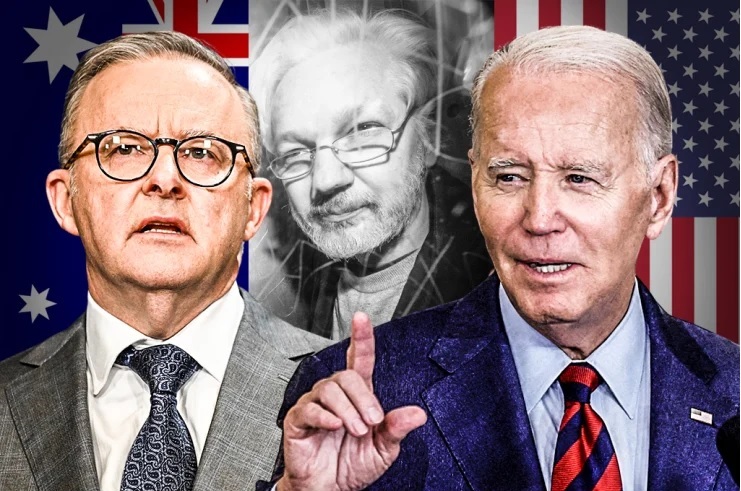
In the U.S., “the concept of state secrets is used to shield executive officials from criminal prosecution for crimes such as kidnapping and torture, or to prevent victims from claiming damages,” the resolution notes. But “the responsibility of State agents for war crimes or serious human rights violations, such as assassinations, enforced disappearances, torture or abductions, does not constitute a secret that must be protected.”
In his first public statement since his release, Assange said, “I’m free today … because I pled guilty to journalism.”
By Marjorie Cohn , Truthout, October 4, 2024
he Parliamentary Assembly of the Council of Europe (PACE), Europe’s foremost human rights body, overwhelmingly adopted a resolution on October 2 formally declaring WikiLeaks founder Julian Assange a political prisoner. The Council of Europe, which represents 64 nations, expressed deep concern at the harsh treatment suffered by Assange, which has had a “chilling effect” on journalists and whistleblowers around the world.
In the resolution, PACE notes that many of the leaked files WikiLeaks published “provide credible evidence of war crimes, human rights abuses, and government misconduct.” The revelations also “confirmed the existence of secret prisons, kidnappings and illegal transfers of prisoners by the United States on European soil.”
According to the terms of a plea deal with the U.S. Department of Justice, Assange pled guilty on June 25 to one count of conspiracy to obtain documents, writings and notes connected with the national defense under the U.S. Espionage Act. Without the deal, he was facing 175 years in prison for 18 charges in an indictment filed by the Trump administration and pursued by the Biden administration, stemming from WikiLeaks’ publication of evidence of war crimes committed by the U.S. in Iraq, Afghanistan and Guantánamo Bay. After his plea, Assange was released from custody with credit for the five years he had spent in London’s maximum-security Belmarsh Prison.
The day before PACE passed its resolution, Assange delivered a powerful testimony to the Council of Europe’s Committee on Legal Affairs and Human Rights. This was his first public statement since his release from custody four months ago, after 14 years in confinement – nine in the Ecuadorian Embassy in London and five in Belmarsh. “Freedom of expression and all that flows from it is at a dark crossroads,” Assange told the parliamentarians.
A “Chilling Effect and a Climate of Self-Censorship”
The resolution says that “the disproportionately harsh charges” the U.S. filed against Assange under the Espionage Act, “which expose him to a risk of de facto life imprisonment,” together with his conviction “for — what was essentially — the gathering and publication of information,” justify classifying him as a political prisoner, under the definition set forth in a PACE resolution from 2012 defining the term. Assange’s five-year incarceration in Belmarsh Prison was “disproportionate to the alleged offence.”
Noting that Assange is “the first publisher to be prosecuted under [the Espionage Act] for leaking classified information obtained from a whistleblower,” the resolution expresses concern about the “chilling effect and a climate of self-censorship for all journalists, editors and others who raise the alarm on issues that are essential to the functioning of democratic societies.” The resolution also notes that “information gathering is an essential preparatory step in journalism” which is protected by the right to freedom of expression guaranteed by the European Court of Human Rights.
The resolution cites the conclusion of Nils Melzer, UN Special Rapporteur on torture and other cruel, inhuman or degrading treatment or punishment, that Assange had been exposed to “increasingly severe forms of cruel, inhuman or degrading treatment or punishment, the cumulative effects of which can only be described as psychological torture.”
Condemning “transnational repression,” PACE was “alarmed by reports that the CIA was discreetly monitoring Mr. Assange in the Ecuadorian embassy in London and that it was allegedly planning to poison or even assassinate him on British soil.” The CIA has raised the “state secrets” privilege in a civil lawsuit filed by two attorneys and two journalists over that illegal surveillance.
In the U.S., “the concept of state secrets is used to shield executive officials from criminal prosecution for crimes such as kidnapping and torture, or to prevent victims from claiming damages,” the resolution notes. But “the responsibility of State agents for war crimes or serious human rights violations, such as assassinations, enforced disappearances, torture or abductions, does not constitute a secret that must be protected.”
Moreover, the resolution expresses deep concern that, according to publicly available evidence, no one has been held to account for the war crimes and human rights violations committed by U.S. state agents and decries the “culture of impunity.”
The resolution says there is no evidence anyone has been harmed by WikiLeaks’ publications and “regrets that despite Mr Assange’s disclosure of thousands of confirmed — previously unreported — deaths by U.S. and coalition forces in Iraq and Afghanistan, he has been the one accused of endangering lives.”
Assange’s Testimony
The testimony Assange provided to the committee was poignant. “I eventually chose freedom over realizable justice … Justice for me is now precluded,” Assange testified. “I am not free today because the system worked. I am free today after years of incarceration because I pled guilty to journalism.” He added, “I pled guilty to seeking information from a source. I pled guilty to obtaining information from a source. And I pled guilty to informing the public what that information was.” His source was whistleblower Chelsea Manning, who provided the documents and reports to WikiLeaks. “Journalism is not a crime,” Assange said. “It is a pillar of a free and informed society.”………………………………………………………………………………
PACE Urges US to Investigate War Crimes
The resolution calls on the U.S., the U.K., the member and observer States of the Council of Europe, and media outlets to take actions to address its concerns.
It calls on the U.S., an observer State, to reform the Espionage Act of 1917 to exclude from its operation journalists, editors and whistleblowers who disclose classified information with the aim of informing the public of serious crimes, such as torture or murder. In order to obtain a conviction for violation of the Act, the government should be required to prove a malicious intent to harm national security. It also calls on the U.S. to investigate the allegations of war crimes and other human rights violations exposed by Assange and Wikileaks.
PACE called on the U.K. to review its extradition laws to exclude extradition for political offenses, as well as conduct an independent review of the conditions of Assange’s treatment while at Belmarsh, to see if it constituted torture, or inhuman or degrading treatment.
In addition, the resolution urges the States of the Council of Europe to further improve their protections for whistleblowers, and to adopt strict guidelines to prevent governments from classifying documents as defense secrets when not warranted.
Finally, the resolution urges media outlets to establish rigorous protocols for handling and verifying classified information, to ensure responsible reporting and avoid any risk to national security and the safety of informants and sources.
Although PACE doesn’t have the authority to make laws, it can urge the States of the Council of Europe to take action. Since Assange never had the opportunity to litigate the denial of his right to freedom of expression, the resolution of the Council of Europe is particularly significant as he seeks a pardon from U.S. President Joe Biden. https://truthout.org/articles/finally-free-assange-receives-a-measure-of-justice-from-the-council-of-europe/
Dutton at odds with Queensland LNP over nuclear plans

Federal Liberal leader joined the state’s election campaign on Friday as David Crisafulli reiterated his objection to nuclear sites at Tarong and Callide
Andrew Messenger, Fri 4 Oct 2024, https://www.theguardian.com/australia-news/2024/oct/04/queensland-election-liberal-national-party-nuclear-plan-peter-dutton?fbclid=IwY2xjawFsifVleHRuA2FlbQIxMQABHatRzSolvCpDyme9yMGAFlBbI6wl6H_xHENLi2ILNvm4yPKbJbAux77dWQ_aem_EASDYfMnhAhutdbQArg8oA
The federal opposition leader, Peter Dutton, has dismissed the Queensland LNP’s rejection of his nuclear power plan as just a “difference of opinion” between friends as he joined the state’s election campaign on Friday.
At their first joint press conference since the controversial plan was announced, Queensland LNP leader David Crisafulli reiterated his defiance of Dutton’s plan for two nuclear plants in Queensland. Crisafulli said he would oppose them if elected at the 26 October poll.
It was their first joint appearance since June, when the federal leader announced plans for seven nuclear sites across Australia.
“Friends can have differences of opinion, that’s healthy,” Crisafulli said. Dutton agreed.
Dutton said he would have a “respectful” conversation with Crisafulli if he was elected.
“We can have that conversation,” Dutton said.
“The first step is to get David elected as premier. When the prime minister stops running scared, he’ll hold an election, and I intend to be prime minister after the next election, and we can have that conversation.
“In the end, we want the same thing, and that is cheaper electricity for Queenslanders.”
Crisafulli said he would not change his mind.
He has repeatedly ruled out repealing the state’s nuclear ban under any circumstances.
Dutton has previously suggested overriding state legislation.
“Commonwealth laws override state laws even to the level of the inconsistency. So support or opposition at a state level won’t stop us rolling out our new energy system,” he said in June.
Labor has repeatedly accused Crisafulli of secretly supporting the nuclear plan.
“He’ll have to roll over when it comes to nuclear power, because his entire state party, all of those state LNP MPs in the federal party, all of those state LNP senators in the federal Senate and all of his grassroots members, they want nuclear power, and he’ll have to roll over,” the deputy premier, Cameron Dick, said.
The LNP is widely tipped to win the election.
The prime minister, Anthony Albanese, is yet to appear alongside the premier, Steven Miles, on the campaign trail.
The associate director of research at the ANU’s initiative on zero carbon energy for the Asia Pacific Institute, Emma Aisbett, said having major policy differences between federal and state governments raised investment risk.
“It means that investors in energy will face higher policy uncertainty, which is also known as political risk,” she said. “It has a particularly strong depressing effect on investment for long-lived assets, which have high upfront costs, and both nuclear and renewables, either PV or wind, really fit into that category.”
She said having a dispute between governments could bring back the “energy wars”.
“What that does is slow and delay the net zero transition, and we do not have decades more to waste, slowing and delaying the transition away from fossil based energy.”
after newsletter promotion
“He’ll have to roll over when it comes to nuclear power, because his entire state party, all of those state LNP MPs in the federal party, all of those state LNP senators in the federal Senate and all of his grassroots members, they want nuclear power, and he’ll have to roll over,” the deputy premier, Cameron Dick, said.
The LNP is widely tipped to win the election.
The prime minister, Anthony Albanese, is yet to appear alongside the premier, Steven Miles, on the campaign trail.
The associate director of research at the ANU’s initiative on zero carbon energy for the Asia Pacific Institute, Emma Aisbett, said having major policy differences between federal and state governments raised investment risk.
“It means that investors in energy will face higher policy uncertainty, which is also known as political risk,” she said.
“It has a particularly strong depressing effect on investment for long-lived assets, which have high upfront costs, and both nuclear and renewables, either PV or wind, really fit into that category.”
She said having a dispute between governments could bring back the “energy wars”.
“What that does is slow and delay the net zero transition, and we do not have decades more to waste, slowing and delaying the transition away from fossil based energy.”
1 This month
7 April – WEBINAR – Australia and the Doomsday Clock – Preventing nuclear war through NoFirstUse and other policies
Online | Tuesday April 7, 4:00-5:30pm, Australian Eastern Time / 8:00-9:30am Central Europe Time
– Access the registration link
15 April – Zoom –Nuclear Power is Not the Solution
Apr 15, 2026 01:00 AM in Canberra, Melbourne, Sydney

Join the International Physicians for the Prevention of Nuclear War (IPPNW) on Tuesday, April 14th for a timely webinar exploring the risks associated with nuclear power and challenging the myth that it offers a simple, safe, carbon-free solution to the climate crisis

21 April Webinar: No Nuclear Weapons in Australia
Start: 2026-04-21 18:00:00 UTC Canberra, Melbourne, Sydney (GMT+10:00)
End: 2026-04-21 19:30:00 UTC Canberra, Melbourne, Sydney (GMT+10:00)
Event Type: Virtual
A virtual link will be communicated before the event.
Host Contact Info: australia@icanw.org

of the week – Australians for War Powers Reform (AWPR)
To see nuclear-related stories in greater depth and intensity
 Antinuclear