TODAY: The “tech bros” are going to have a global party with AI in warfare. Should we let them be in control?

Today I waded through a very worthy article – A new military-industrial complex: How tech bros are hyping AI’s role in war. Trouble is – I didn’t really understand it. Written by two highly qualified military experts, – it was couched in military jargon that was mostly impenetrable to me.
Good on them for knowing their stuff. But their underlying assumption seems to me that the world will continue to have whopping great wars, between the great powers, with the conflict being dominated by Artificial Intelligence methods – not only in physical, but also in psychological, warfare.
But, to be fair to these military experts, they do warn about the pitfalls of AI in warfare, and they do repeatedly remind us that the “primrose path” of AI warfare is being laid down, not by political leaders, not by military experts, but by the tech squillionaires:
“The current debate on military AI is largely driven by “tech bros” and other entrepreneurs who stand to profit immensely from militaries’ uptake of AI-enabled capabilities.”…….. “framing the future direction of war, despite their lack of military experience.”
We really are in a strange world – where we can let these ignoramuses (?ignorami) run things. You bristle at the term “ignoramus”? But the tech bros are ignorant – it seems, of all sorts of areas that really matter – ecology, biology, social history, diplomacy, ethics ….. They live in this wonderful STEM world, which is supposed to be the only part of knowledge that matters. Science, Technology, Engineering, Mathematics – yes those studies do matter – but they are not the only ones that matter.
I am grateful to these authors, Paul Lushenko and Keith Carter for tackling this timely subject.
They’ve done a great job, and I hope that military planners will pay attention to their work.
But even more, I hope that influential leaders of other kinds will also take up this question of should we let the tech squillionaires run things , especially war, for us?
Financing new nuclear. Governments paying the price?

WISE Netherlands commissioned this research to provide a clear picture of
the current-day construction costs of a nuclear power plant.
WISE Netherlands is specifically interested in the government’s share of
financing the construction of nuclear power plants, a price to be paid by
the taxpayer.
The research request follows up on the Dutch government’s
intention to build two (or even four) new nuclear power plant units in the
Netherlands.
The current nuclear site at Borssele has been designated as
the preferred location for the first two units (Borssele 2-3). Nuclear
power plant construction is not business as usual in a privatised energy
market. Governments regularly intervene heavily, either through direct
financing, providing loans and guarantees, or via risk-sharing and
interference with price measures.
This raises the question of how much a government will have to pay when planning a new nuclear power plant. Based on recent examples, what is the range of cost estimates that can be expected?
To this end, this study aims to provide a detailed analysis of
the actual costs and timelines of typical and recent large-scale
construction projects of new nuclear power plants. Six nuclear power plants
have been selected for this research. They are among the latest to be put
into operation globally: Olkiluoto 3 (Finland), Shin Hanul 1-2 (South
Korea), Barakah 1-4 (United Arab Emirates), Vogtle 3-4 (United States),
Flamanville 3 (France) and Hinkley Point C 1-2 (United Kingdom).
WISE Netherlands (accessed) 10th Oct 2024
Australia’s evolving nuclear posture: avoiding a fait accompli (Part 1 of 2)
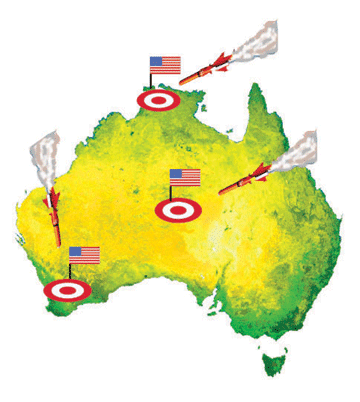
Pearls and Irritations, By Vince Scappatura, Oct 12, 2024
A monumental transformation: There has been a great deal of public criticism of Australia’s decision to acquire a fleet of nuclear-powered submarines (SSNs) via the AUKUS security partnership. The criticism has been both broad and deep, spanning political and industrial challenges, budgetary consequences, safety and environmental concerns, strategic risks, and the erosion of national sovereignty.
While these are all worthy issues to bring to the fore of the public debate, one set of issues that have not received nearly as much attention are the ways in which AUKUS implicates Australia in US nuclear war planning.
From one perspective this is understandable given AUKUS does not involve plans for Australia to acquire nuclear-armed submarines or to station US nuclear weapons on Australian soil. However, when viewed from a wider perspective, AUKUS epitomises Australia’s geostrategic transformation and evolving nuclear posture within the US alliance.
The significance of this transformation is reflected in the fact that Australia will soon become ‘the only ally in the world to host and support military operations by forward-deployed US strategic bombers and SSN attack submarines’. This comes in addition to hosting mature US expeditionary Marine capabilities and a more recent rotational presence of US Army personnel and permanent associated support infrastructure.
Perhaps more significant than providing a ‘vast military launchpad’ for multiple forms of US power projection is the developing role of the ADF to seamlessly integrate with American military forces and to provide what is approaching full-spectrum support operations, including for nuclear missions.
AUKUS and nuclear war
Although the focus of AUKUS ‘pillar one’ is the acquisition by Australia of nuclear-powered, but conventionally-armed submarines, there are in fact several nuclear war planning dimensions to the broader security partnership.
The Australian government refuses to publicly broach the questions of how, where and against whom Australia’s future SSN force might be expected to operate both in peacetime and in the event of conflict. …………………………………………….
It would not be surprising if all of these contingencies are perceived by Beijing as posing an existential threat, particularly as China’s nuclear submarine deterrent continues to develop into an assured second-strike capability…………………………………………………………………
Australia’s evolving nuclear posture
AUKUS is more than just an international arms agreement. By Scott Morrison’s admission the political framework is intended to secure a ‘forever partnership’ and a ‘forever responsibility’ between Australia and the United States. The unprecedented scale, cost, time frame and interdependence generated by the singular AUKUS deal clearly signals a decision to lock Australia into America’s distinctive military strategy for containing China into the future.
A key objective of America’s strategy is to achieve seamless high-end defence integration with its global network of allies and partners. While obstacles to full realisation remain, Canberra’s embrace of ‘integrated deterrence’ is already transforming Australia into both a critical base of operations and provider of full-spectrum support for US force projection into the region. It is also leading to the development of a new and unprecedented role for the ADF in support of US nuclear operations.
………………………………………………………………………………………. Avoiding a fait accompli
The situation emerging is one of enduring high-level tactical and institutional integration between the defence forces of Australia and the United States, creating the conditions for extreme political pressure and expectations from Washington of Australian support for any future US war with China……………………………………………………………..
The time to put a halt to any plans for expanding Australia’s nuclear posture is now. If no public pressure is forthcoming the Australian government is likely, in time, to move forward with precommitments to support US nuclear operations behind closed doors, and if presented to the public at all, will be done so as a fait accompli, as was the case with AUKUS, the forward-deployment of B-52 bombers and the US Force Posture Initiatives generally. https://johnmenadue.com/australias-evolving-nuclear-posture-avoiding-a-fait-accompli-part-1-of-2/
Electrical Trades Union questions Australia’s billion-dollar nuclear price tag
09 October, 2024, BY Aaliyah Rogan, https://mining.com.au/etu-questions-australias-billion-dollar-nuclear-price-tag/?fbclid=IwY2xjawF1SuRleHRuA2FlbQIxMQABHZuZOLhjX1n0h3g6EQL1ux1wMtrzMt09-VLVDSaM8enMFX4RZ8Fu8yOx0w_aem_1ulz0sgMMWof53yKtuqOUQ
The Electrical Trades Union (ETU) is pushing back against the Coalition’s proposal to build nuclear reactors in a new advertising campaign that queries the project’s price tag, and flags concerns it will destroy valuable job opportunities.
In mid-June 2024, Opposition leader Peter Dutton revealed the opposition’s plans to build several nuclear power plants that will begin rolling out in 2035 if the party wins the upcoming election.
Dutton’s plan involves reactors being built on the sites of end-of-life coal-fired power stations at locations including Gippsland in Victoria, Gladstone in Queensland, Port Augusta in South Australia, Collie in Western Australia, and the Hunter Valley in New South Wales.
Following Dutton’s proposal, the Smart Energy Council conducted a detailedanalysisusing CSIRO’s latest GenCost report and the Australian Energy Market Operator’s integrated system plan, which revealed the nuclear reactors will cost between $116 billion and $600 billion.
ETU National Secretary Michael Wright says the ad was prompted by electrical workers’ concerns that an abrupt shift towards nuclear energy will “rob the industry of a jobs and skills boom”.
“Renewables and batteries in Australia are producing so much low-cost energy we are on track to hit climate targets,” Wright says.
“This will create nearly 100,000 more jobs for electricians by 2050 — so many that we need to rewire our training system to skill up enough people.
“We are very concerned that a rapid change in direction to high-cost nuclear with decades-long timelines would derail this momentum and rob the next generation of electrical workers of renewable transition opportunities.”
Wright adds that people have the right to ask questions about Dutton’s nuclear plans, about the costs, the length of time, and why Australia needs nuclear energy when batteries and low-cost renewables are gathering momentum in a short period of time.
“People should get to form their views with the same information that electrical workers, energy investors, and businesses in the industry have access to,” he says.
“These insiders have reached a consensus view that nuclear is not right for Australia.
“People are questioning the financial cost of nuclear for relatively little output that won’t come online until the middle of the century. We think most people would prefer to see renewables and batteries bring down power bills and hit climate targets much sooner than that.”
ETU’s video advertisement will be launching initially for catch-up viewers across key areas of Queensland exposed to plans for nuclear energy, before being launched in other areas ahead of the 2025 federal election.
The ad will air on 7plus, 9Now, 10Play, SBS ON Demand, FoxtelGo, Kayo, Tubi, and Binge, as well as Youtube and Meta properties.
The Electrical Trades Union is an Australian trade union that is a division of the Communications, Electrical, and Plumbing Union. It is considered the largest of the three divisions.
1 This month
7 April – WEBINAR – Australia and the Doomsday Clock – Preventing nuclear war through NoFirstUse and other policies
Online | Tuesday April 7, 4:00-5:30pm, Australian Eastern Time / 8:00-9:30am Central Europe Time
– Access the registration link
15 April – Zoom –Nuclear Power is Not the Solution
Apr 15, 2026 01:00 AM in Canberra, Melbourne, Sydney

Join the International Physicians for the Prevention of Nuclear War (IPPNW) on Tuesday, April 14th for a timely webinar exploring the risks associated with nuclear power and challenging the myth that it offers a simple, safe, carbon-free solution to the climate crisis

of the week – Australians for War Powers Reform (AWPR)
To see nuclear-related stories in greater depth and intensity
 Antinuclear