Queensland premier will hold plebiscite on nuclear power if he wins state election
Exclusive: Steven Miles says law requires a referendum be called if the commonwealth is likely to build a ‘prohibited nuclear facility’ in the state
Andrew Messenger and Graham Readfearn, Mon 14 Oct 2024
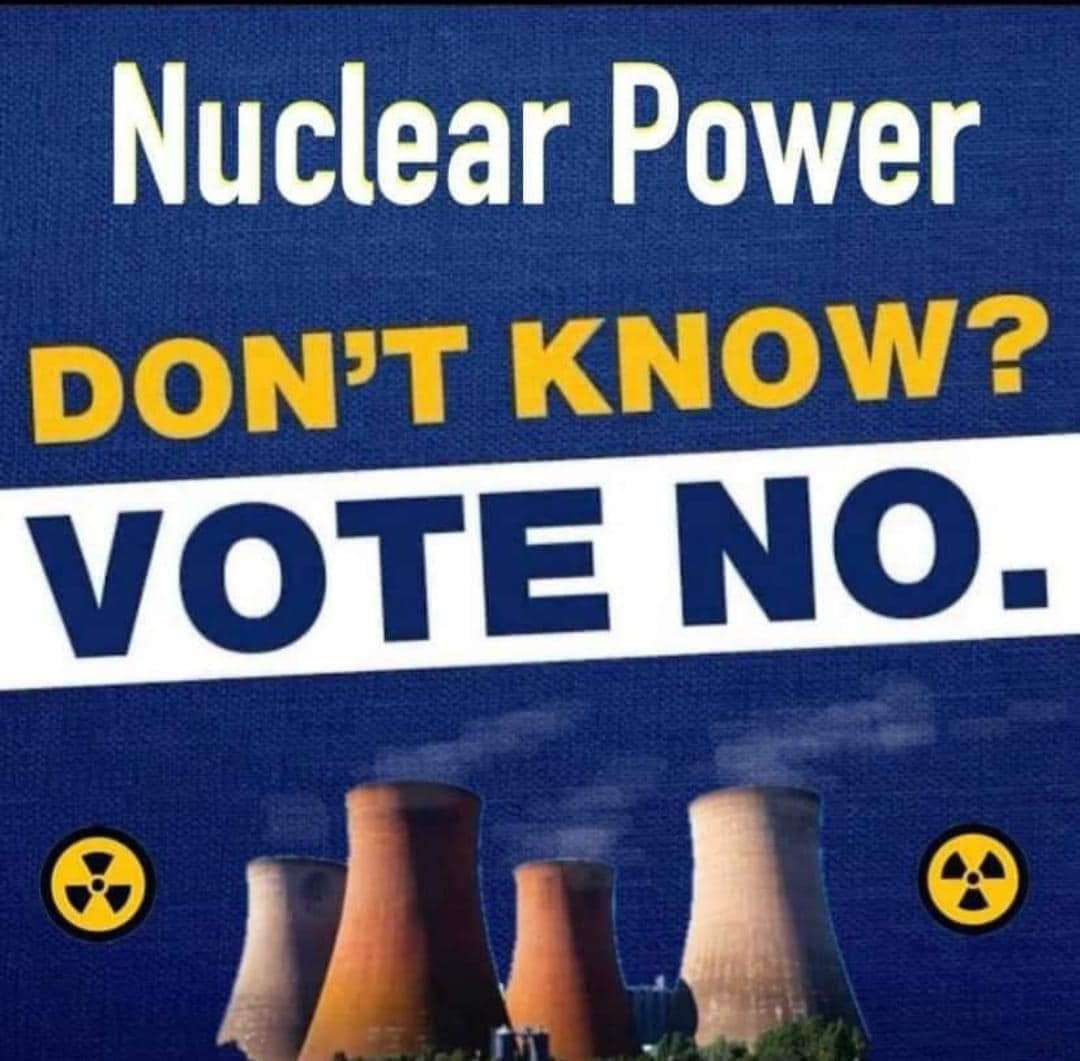
Steven Miles will hold a state plebiscite on Peter Dutton’s nuclear power plans if he wins the 26 October poll, a move that could polarise the electorate in the Coalition’s strongest state at the next federal election.
The Queensland premier said he had received legal advice on the nuclear issue and raised the possibility of initiating a plebiscite on the same day as the federal election.
“Depending on how things play out, you could even hold that plebiscite on the same day as the federal election, to save people going to the polls twice,” Miles said in an exclusive interview with Guardian Australia.
The federal opposition leader, Peter Dutton, will take a plan for seven Commonwealth-owned nuclear power stations to the next election. That includes two in Queensland, replacing existing coal plants at Callide and Tarong.
But an obscure provision in Queensland’s 17-year-old Nuclear Facilities Prohibition Act 2007 may stand in the way. The act bans granting a grid connection, development application or generating authority to any nuclear facility.
It also requires the minister call a plebiscite if “satisfied the government of the commonwealth has taken, or is likely to, take any step supporting or allowing the construction of a prohibited nuclear facility in Queensland”.
The state opposition leader, David Crisafulli, has repeatedly ruled out changes to the law, most recently at a joint press conference with Dutton this month……………………………………………………………………………………. more https://www.theguardian.com/australia-news/2024/oct/14/queensland-premier-will-hold-plebiscite-on-nuclear-power-if-he-wins-state-election
Two Peter Dutton policies may swing Teals to Labor in a minority government
Michael West Media by Michael Pascoe | Oct 14, 2024
The scenario: a minority government after the next election, as various polls forecast.
The question: in a close-run thing, to whom would the “Teals” give the keys to the Lodge?
The hypothesis: there are two Dutton policies that should force the genuine independents to select Albanese as Prime Minister.
The perversity: neither of those policies could be expected to appeal much to voters who weren’t already in the LNP camp.
May election likely
Slipping by without much attention last week was the government changing Budget Night to March 25, effectively confirming the early May election that has always been most likely. So seven months to win any hearts and minds that are not already committed.
The makeup of the crossbench will be different. Not all the community independents – to give Teals their official name – from the Class of ’22 may be returned (for starters, vale the scratched seat of North Sydney and, therefore, Kylea Tink) and there could be newbies. From here, though, it still looks likely that Teals will have the final say on who forms government. More on that later.
Enter stage right the two key LNP policies that should make it impossible for Teals to give Dutton the nod: nuclear power and housing.
The key common issues of the Teal wave in 2022 were climate, integrity, gender, and not being Scott Morrison, all based on a pledge of listening to and reflecting their communities’ concerns.
The nuclear “concept” of a plan
Dutton’s “concept of a plan” to build multiple nuclear reactors somewhere between a distant tomorrow and eternity – an excuse for extending fossil fuel burning and reducing investment in renewables – won’t and can’t wash with any Teal genuinely concerned about climate policy.
Enter stage right the two key LNP policies that should make it impossible for Teals to give Dutton the nod: nuclear power and housing.
The key common issues of the Teal wave in 2022 were climate, integrity, gender, and not being Scott Morrison, all based on a pledge of listening to and reflecting their communities’ concerns.
As Phil Coorey reported in the AFR ($):
“If they’re not going to release the detail, we’ll do it for them,” a government member said, speaking on condition of anonymity.
“The terms of reference include an examination of how soon a nuclear power plant could be operational; the cost of building and maintaining them, the storage and transportation of fuel and waste; the feasibility of using existing coal-fired power station sites and their power lines; federal, state, territory and local government legal and policy frameworks; and the impact of power prices.”
Generally forgotten is that we had a parliamentary inquiry into nuclear power only five years ago, chaired by the LNP’s Ted O’Brien, now the shadow energy spokesman tasked with selling Dutton’s nuclear gambit.
With the Coalition dominating that inquiry, the most O’Brien could come up with was that “nuclear energy should be on the table for consideration as part of our future energy mix”, not that we should go for it.
Then, like now, O’Brien was hoping small modular reactors might become a thing and other new large reactor technologies could be the economical go.
Generally forgotten is that we had a parliamentary inquiry into nuclear power only five years ago, chaired by the LNP’s Ted O’Brien, now the shadow energy spokesman tasked with selling Dutton’s nuclear gambit.
With the Coalition dominating that inquiry, the most O’Brien could come up with was that “nuclear energy should be on the table for consideration as part of our future energy mix”, not that we should go for it.
Then, like now, O’Brien was hoping small modular reactors might become a thing and other new large reactor technologies could be the economical go.
The only certainty about the LNP’s energy/climate policy is that it would delay efforts to reduce Australia’s carbon emissions. With climate denial strong in the party, the procrastinator’s golden rule rules: Put off to tomorrow what you don’t have to do today because you might get away with not doing it tomorrow.
There is no way Teals, in conscience, could choose such a policy. Climate 2000’s Simon Holmes à Court doesn’t call the Teals’ shots, but they couldn’t expect his support if they went with the deniers and sceptics………………………………………………………………………………………………..
The minority government scenario?
The post-election negotiations will test the integrity of cross-bench members. The Teals of Liberal heritage – most obviously Allegra Spender in Wentworth and Kate Chaney in Curtin – might have to hold their noses to appoint a Labor government, but they would forfeit all personal credibility if they empowered fraudulent nuclear and housing policies.
The others – Monique Ryan, Zali Steggall, Helen Haines, Zoe Daniel, Sophie Scamps and, possibly post-May, Nicolette Boele in Bradfield – have their own professed standards to live up to. If they do, they won’t be empowering a minority LNP government.
We may also assume that Bob Katter, Rebekha Sharkie ($) and Andrew Gee (if he is returned in Calare after quitting the Nationals over the Voice referendum) go LNP, while the Greens and Andrew Wilkie prefer Labor.
The self-declared opposite of a Teal, the former Liberal Dai Le ($) in the former Labor seat of Fowler, has never pledged herself on climate or anything else for that matter, winning by being an involved local and not the parachuted-in Labor candidate, Kristina Keneally.
Her gaffe in ignorantly suggesting the Lucas Heights research facility could generate electricity indicates she would not have a problem with the Dutton nuclear fantasy – unless the parliamentary inquiry convinces her otherwise. https://michaelwest.com.au/peter-duttons-policies-may-swing-teals-to-labor-in-election/
Nuclear – not the way ahead
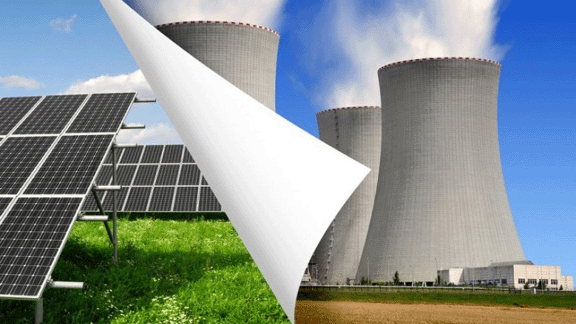
Renewable energies consistently outperform nuclear power in terms of cost and deployment speed and are therefore chosen over nuclear power in most countries’ – so says this years independent World Nuclear Industry status report (WNISR). It notes that in 2023, 5 new nuclear reactors (5 GW) started up and 5 were closed (6 GW), capacity thus declining by 1 GW. So overall it says that nuclear energy’s share of global commercial gross electricity generation declined from 9.2 % to 9.1%, little more than half of its peak of 17.5 % in 1996. In 2023, total investment in non-hydro renewable electricity capacity reached a record US$623 billion, 27 times the reported global investment decisions for the construction of nuclear power plants, with solar and wind power capacities growing by 73% and 51%, respectively.
Nevertheless, some countries are still pushing on with new nuclear, despite its poor economics, including the UK and Sweden. Sweden has mooted a new financing model but its critics say support for nuclear ‘is like throwing money down the drain’ since ‘the expansion of solar energy will make nuclear power obsolete and push it out of the electricity market by the 2030s’. In the UK, and also in France, it has been argued that part of the reason for the political commitment to new nuclear is link between civil and military nuclear, with cross-funding and technical collaboration seen as beneficial.
However, be that as it may, Emeritus Profs. Stephen Thomas (University of Greenwich) and Andrew Blowers (OU) do not see nuclear civil power prospering in the UK, indeed they say that ‘it is time to expose the Great British nuclear fantasy once and for all.’ They claim that ‘no amount of political commitment can overcome the lack of investors, the absence of credible builders and operators or available technologies let alone secure regulatory assessment and approval. Moreover, in an era of climate change there will be few potentially suitable sites to host new nuclear power stations for indefinite, indeed unknowable, operating, decommissioning and waste management lifetimes. And there are the anxieties and fears that nuclear foments, the danger of accidents and proliferation and the environmental and public health issues arising from the legacy of radioactive waste scattered on sites around the country’.
They go on to suggest backing off new nuclear projects. They do recognise that ‘abandoning Sizewell C and the SMR competition will lead to howls of anguish from interest groups such as the nuclear industry and trade unions with a strong presence in the sector. It will also require compensation payments to be made to organisations affected. However, the scale of these payments will be tiny in comparison with the cost of not abandoning them’.
Certainly the cost of construction is vast- and expanding. The EPR being built by EDF at Hinkley Point may in the event cost £35bn, with there’s still being a way to go- 2030 for unit 1 start up, maybe 2031 for Unit 2. And as industry commentators have noted ‘as the cost of Hinkley Point has increased, the backers have had to provide more funding. The souring of relations between Britain & China saw CGN stop providing any more money, leaving EDF to fund the shortfall. EDF has called upon the UK government to help out with the escalating cost but it has refused. EDF was fully nationalised in 2023, leaving the French taxpayer to pick up the tab for the cost overruns’.
UK consumers will of course pay the high cost of the power when it comes on the grid. They will also be expected to shell out for the next EPR that is planned in the UK, at Sizewell, but this time in advanced of completion, under the RAB financing system. However, although the government has provided £5.5bn to move things along, the final (private) investment decision on Sizewell C keeps being delayed. EDF aimed to secure funding by the end 2024, but that may now be extended to 2025 – and EDF is still looking for £4bn to finish Hinkley Point!
All in all, with EDF’s finances in a mess, and few other companies keen to take risks with this technology, it looks a bit uncertain. Even the UK government seems to be having doubts, with plans for a new large project on Wylfa in Wales may be subject to a review. Proposals are currently being considered for small modular reactors under a UK SMR competition, but the US NuScale PWR has just been eliminated from the race. It was once seen as the leader, but it had lost a US order. EDF had earlier dropped out. So that leaves Rolls-Royce, GE-Hitachi, Westinghouse, and Holtec Britain, with the newly formed agency, Great British Nuclear, expected to announce 2 winners later this year or early next year. Up to £20bn is at stake. However few see any power being available anywhere from SMRs until the early or mid 2030s. Despite a lot of hype, in reality it has been slow going. And there are risks.
Overall then, the prospects for new nuclear in the UK, or indeed elsewhere, do not look too good. Even in China, renewables are expanding very much faster, with according to the WNISR/IRENA, at the end of 2023, there being over 1000GW of wind and solar and around 421GW of hydro in place, compared to just 53GW of nuclear. Given the scale and rate of deployment, and the costs, it’s pretty clear which should be the way forward in terms of energy supply there and everywhere else.
Nuclear fission may have a small role to play in some isolated locations and in some applications, and fusion may be viable at commercial scale at some stage, but we have to be aware of hype and overselling in this area, and also in the wider nuclear debate, with nuclear sometimes being sold as the answer to climate change. It’s not. As I have indicated in earlier posts, there is no shortage of studies from around the world confirming the view that nuclear is a costly and risky distraction from renewables, which are the main energy supply solutions to climate change. And Germany has shown how the exit from nuclear can be done, led by renewables. Although they do have some issues in terms of balancing, renewables, along with energy efficiency, demand management and storage, are the way ahead to an economically viable and sustainable energy future.
Albanese and Dutton team up on toxic AUKUS nuclear waste deal
The Bill immediately creates two nuclear dump ‘zones’, one off the coast of Perth and the other at Port Adelaide, without any community consultation or local support.
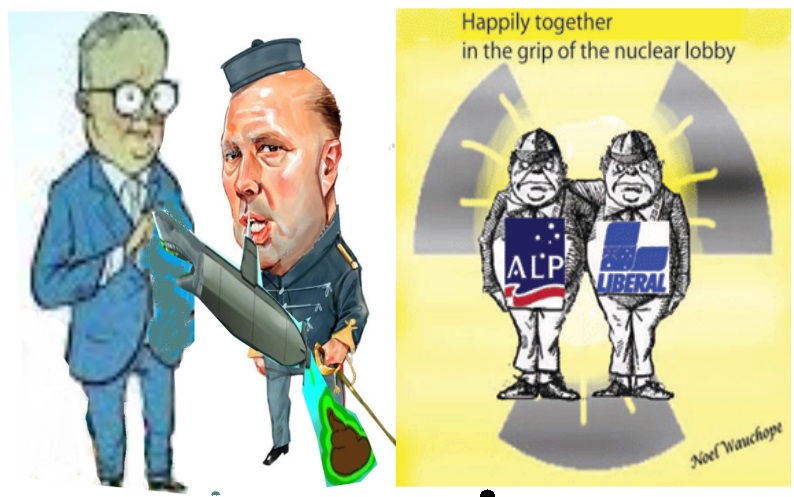
The Albanese Government today teamed up with Peter Dutton’s Coalition to push through a controversial AUKUS Bill that will allow the dumping of high-level naval nuclear waste anywhere in Australia.
The Albanese Government, in alliance with the Coalition, rammed the Australian Naval Nuclear Power Safety Bill through the Senate today without debate.
The Bill also created a new naval nuclear regulator as part of the AUKUS agreement with the UK and US on nuclear submarines. It initially allowed for all UK and US nuclear submarine waste to be dumped in Australia until the Albanese Government sheepishly amended it, due to growing public opposition, to prevent the dumping of UK or US ‘spent nuclear fuel’.
However, the amendments still allow the dumping of US and UK intermediate-level waste and other high-level nuclear waste from their nuclear submarines. The Greens moved amendments this afternoon that explicitly prevented this, and the major parties voted against these amendments and others.
The Bill immediately creates two nuclear dump ‘zones’, one off the coast of Perth and the other at Port Adelaide, without any community consultation or local support.
The Bill also allows nuclear dump zones to be declared anywhere in Australia that the Defence Minister chooses with the flick of their pen, again without any consent from local communities or First Nations traditional owners.
Senator David Shoebridge, Greens Spokesperson for Defence, said: “Albanese and Dutton have teamed up today to push this AUKUS nuclear waste legislation through the Senate without debate.”
“Today’s actions see both Labor and the Coalition joining hands to ram through legislation that will let the UK and US dump their naval nuclear waste in Australia.”
“The Albanese Labor Government initially tried to sneak through a law that would allow the UK and US to dump all types of nuclear waste in Australia. The Greens called the Government out on this, and then people around Australia pushed back.
“Even with last-minute Labor amendments, this legislation still allows the dumping of US and UK nuclear waste in Australia. Labor’s amendments only prohibit the US and UK dumping ‘spent nuclear fuel’ from their submarines in Australia, but do not prohibit any other highly irradiated UK and US nuclear waste.
“This legislation green-lights dumping of all Australian naval nuclear waste anywhere in Australia. To be clear, exposure to even intermediate-level waste is lethal to humans, and the risk lasts for hundreds of years.
“Everyone can see AUKUS is sinking, the question is now becoming how much environmental and financial damage it will do before it hits rock bottom,” Senator Shoebridge said.
1 This month
15 April – Zoom –Nuclear Power is Not the Solution
Apr 15, 2026 01:00 AM in Canberra, Melbourne, Sydney

Join the International Physicians for the Prevention of Nuclear War (IPPNW) on Tuesday, April 14th for a timely webinar exploring the risks associated with nuclear power and challenging the myth that it offers a simple, safe, carbon-free solution to the climate crisis

of the week – Australians for War Powers Reform (AWPR)
To see nuclear-related stories in greater depth and intensity
 Antinuclear