The price of nuclear in a cost of living crisis – media briefing
October 25, 2024, by: The AIM Network, https://theaimn.com/the-price-of-nuclear-in-a-cost-of-living-crisis-media-briefing/#google_vignette
The Climate Council
Australians are being told to look to the Canadian province of Ontario as a case study for why we should embrace nuclear energy. But is Ontario’s nuclear experience really the success story it’s made out to be? Join us on Monday, October 28 at 10:00 AM AEST (join HERE) for a critical briefing where an expert from Ontario will fact-check these claims and provide an analysis of the comparative costs of nuclear, gas, and renewables.
With a federal committee on Nuclear Energy now underway, and a cost-of-living federal election approaching, this briefing – hosted by the Climate Council and the Smart Energy Council – will focus on the costs and timelines of alternative energy options for Australia.
Our panel of respected experts will cover topics such as:
- Is nuclear energy in Ontario really providing cheap and clean power as Peter Dutton claims?
- The long-term costs of maintaining nuclear reactors
- Comparing the cost of new nuclear infrastructure with renewable alternatives
- How energy choices will impact household bills and cost of living
Speakers:
- Prof. Mark Winfield, York University (Canada) – academic and author specialising in energy and environment
- Dylan McConnell, Energy Analyst
- Nicki Hutley, Economist and Climate Councillor
The briefing will be held on Monday, October 28th at 10:00 AM AEST. You can join by clicking this link: https://us02web.zoom.us/j/82731815067?pwd=sDJwgpUT8GfwMohXPbGdHTu9i9TK5w.1
We look forward to seeing you there.
The Climate Council is Australia’s leading community-funded climate change communications organisation. We provide authoritative, expert and evidence-based advice on climate change to journalists, policymakers, and the wider Australian community.
For further information, go to: climatecouncil.org.au
Or follow us on social media: facebook.com/climatecouncil and twitter.com/climatecouncil
Fighting for More Evidence of Assange’s Political Prosecution
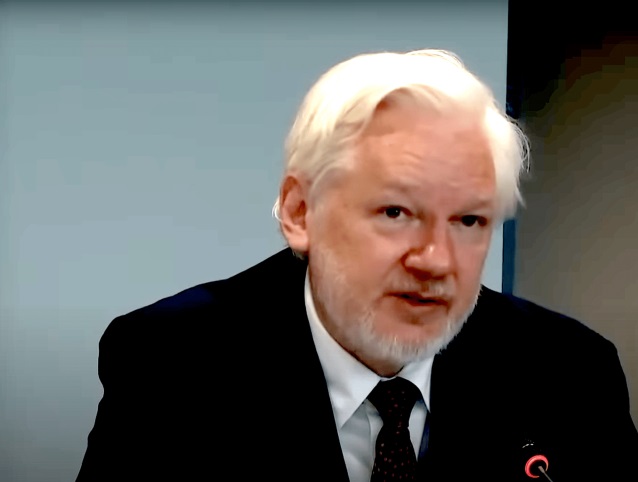
Italian journalist Stefania Maurizi has been in court trying to get some missing emails — or data about them — that could further expose the political motivation behind the prosecution of the WikiLeaks publisher.
Joe Lauria and Mohamed Elmaazi / Consortium News, October 23, 2024
A tribunal in Britain is set to decide whether to order the government’s Crown Prosecution Service (CPS) to prove it deleted emails that may have covered up more evidence of a politically motivated prosecution of Julian Assange.
The three judges heard arguments on Sept. 24 in the nearly decade-long freedom of information saga regarding the emails that top British prosecutors say were deleted.
They involved an exchange with Sweden during a Swedish prosecutor’s attempt, beginning in 2010, to extradite the WikiLeaks publisher from Britain. ……………………………………………………….
It was only when the U.S. realized it would lose on appeal after a four-year extradition battle that the Department of Justice cut a plea deal with Assange who was released on June 24 and returned to his native Australia.
Assange had been charged in the United States under the Espionage Act for possessing and publishing defense information, which revealed evidence of U.S. war crimes.
Britain took an active role in Assange’s prosecution. Its Crown Prosecution Service sought to stop Sweden from going to the embassy to question him.
Seeking to learn more about Britain’s role against Assange, Italian investigative journalist Stefania Maurizi first made a Freedom of Information Act (FOIA) request in 2015 for all emails between the British and Swedish governments concerning Assange.
Some of the emails she obtained showed political motivation on the part of the lead British prosecutor, Paul Close. One email Maurizi obtained from the Swedish Prosecution Authority (SPA) revealed that Close appeared to be pressuring Swedish prosecutors to continue seeking Assange’s extradition instead of dropping the case or questioning him at the Ecuadorian embassy, where Assange had been granted asylum………………………….
After Maurizi noticed a sizeable gap in the emails released to her she filed another FIOA seeking to obtain the missing emails.
The CPS first claimed that it had destroyed the emails. It said that when Close retired, his account along with his emails, were automatically destroyed.
But Maurizi did not buy it. She asked the court at the hearing last month to order the CPS to turn over “metadata” — data about data, such as file creation and modification dates, email sender and recipient addresses, timestamps, email routing information, keywords, and subject lines — proving the emails really were deleted and when.
“We have NO certainty whatsoever” that the emails were destroyed, Maurizi wrote in a message to Consortium News. Maurizi is in court because she believes the allegedly deleted emails could provide additional evidence of a politically motivated prosecution of Assange.
……………………………………………‘When, How & Why’ Were the Emails Deleted?
Maurizi, who travelled to London from Rome to attend the Sept. 24 hearing at the First-Tier Tribunal (General Regulatory Chamber), is challenging the ongoing failure of the CPS to respond adequately to her December 2019 FOIA about the missing emails.
………………………………………………………………….Maurizi is betting the tribunal will agree with her that metadata is clearly information that can be requested under the Act and which can clearly be provided with little difficulty. If she succeeds, future FOIA requests will also be able to demand metadata if and when an individual thinks it may be useful.
Hillary, who was called to testify for the CPS, freely admitted to the tribunal that she could easily provide the metadata Maurizi requested and that she would be happy to do so, as long as any information which identified individuals is redacted.
The tribunal will also consider whether to “order the CPS to carry out a proper, full search for information held” as to “when, how and why?” the thousands of emails were allegedly deleted while Assange’s Swedish extradition case was still very much active.
No date has yet been set for the announcement of the tribunal’s decision. https://consortiumnews.com/2024/10/23/fighting-for-more-evidence-of-assanges-political-prosecution/
Nuclear lobby on track to sabotage COP29

By Noel Wauchope | 24 October 2024, https://independentaustralia.net/environment/environment-display/nuclear-lobby-on-track-to-sabotage-cop29,19101
The nuclear lobby is on track to sabotage the COP29 UN Climate Change Conference next month in Azerbaijan — lobbying governments for support and investors for money, writes Noel Wauchope.
IT’S NOT SO LONG AGO that the global nuclear energy lobby used to deny the threat of climate change. Even as recently as 2020, a leading nuclear propagandist, Michael Shellenger, was downplaying climate change, while trashing renewable energy.
But that’s changed.
In the face of public anxieties about nuclear health and safety dangers – and above all, of nuclear costs – the propagandists desperately needed a new shtick.
The answer was — nuclear power to beat climate change!
COP28 UN Climate Change Conference in December 2023 — the global nuclear lobby trumpeted its “success”

But, in reality, only a tiny minority at COP28 agreed that nuclear power was needed to address global warming.
198 Parties (197 countries plus the European Union) attended this climate summit in Dubai in 2023. Only 22 agreed to the pro-nuclear declaration proposed by France’s President Emmanuel Macron — the Declaration to Triple Nuclear Energy Capacity by 2050, Recognizing the Key Role of Nuclear Energy in Reaching Net Zero.
And, 31 countries that do have nuclear power — why didn’t Russia and China sign up?
Thirteen other countries that have key nuclear programs were also missing from the declaration — five in Europe (Armenia, Belarus, Belgium, Switzerland and Spain), two in South Asia (India and Pakistan) three in the Americas (Argentina, Brazil and Mexico), South Africa (the only nuclear energy producer in Africa), and Iran.
COP29 United Nations Climate Change Conference November 2024, Baku, Azerbaijan
The global nuclear lobby is much better organised now — and will try again.
It’s well to keep in mind that the United Nations is beholden to the nuclear industry.
On 28th May 1959, the International Atomic Energy Agency (IAEA) – not yet two years old! – and The World Health Organisation (WHO) signed an agreement referred to as WHA 12-40. Though, it might, on paper, appear balanced and reciprocal, in practice the WHA 12-40 puts WHO in a subordinate position to the IAEA.

So, the United Nations (UN) is tethered to the nuclear industry. The IAEA is part of the UN system — and its brief is to promote the “peaceful” nuclear industry.
COP29 is all about the money
So, the global nuclear push is well prepared with the recent release of an IAEA report on Climate Change and Nuclear Power focussing on the need for investment.
‘The 2024 edition of the IAEA’s Climate Change and Nuclear Power report has been released, highlighting the need for a significant increase in investment to achieve goals for expanding nuclear power.’
According to the report, global investment in nuclear energy must increase to USD$125 billion annually – up from the around USD$50 billion invested each year from 2017-2023 – to meet the IAEA’s high case projection for nuclear capacity in 2050.
The more aspirational goal of tripling capacity – which more than 20 countries pledged to work towards at COP28 last year – would require upwards of USD$150 billion in annual investment.
IAEA Director General Rafael Mariano Grossi said:
“Across its near century-long lifetime, a nuclear power plant is affordable and cost-competitive. Financing the upfront costs can be a challenge however, especially in market-driven economies and developing countries, ….the private sector will increasingly need to contribute to financing, but so too will other institutions. The IAEA is engaging multilateral development banks to highlight their potential role in making sure that developing countries have more and better financing options when it comes to investing in nuclear energy.”
The new report also examines ways to unlock private-sector finance — a topic that is gaining increasing attention worldwide.
Last month, 14 major financial institutions including some of the world’s largest banks came together during a New York Climate Week event to signal a willingness to help finance nuclear newbuild projects.
On the sidelines of Climate Week in New York City, major banks, government representatives and industry executives met at the Financing the Tripling of Nuclear Energy Leadership Event.
Note that this event was sponsored by the IAEA and the Clean Energy Ministerial’s (CEM) Nuclear Innovation: Clean Energy Future (NICE) initiative. The CEM’s role is to run forums for propagandising the nuclear industry.
The IAEA report continues:
‘Nuclear power’s inclusion in sustainable financing frameworks, including the European Union (EU) taxonomy for sustainable activities, is having a tangible impact. In the EU, the first green bonds have been issued for nuclear power in Finland and France in 2023. Electricité de France (EDF) was one of the first recipients, with the award of €4 billion in green bonds and around €7 billion in green loans between 2022 and 2024.’
The report makes the case for policy reform and international partnerships to help bridge the financing gap and accelerate nuclear power expansion into emerging markets and developing economies — including for small modular reactors.
What does this mean for COP29?
Well, despite the IAEA hype, the nuclear push at COP28 was a bit of a flop.
Forcefully led by France, which is stuck with its unfortunate situation of nuclear monopoly on its energy system. The pro-nuclear declaration was not a global success.
The aim then was to get governments to promote the industry. And, that’s still the aim, despite the pleas for private investment.
But the two go together – lobbying governments to weaken safety regulations, assume the financial risk and provide tax breaks and incentives – while simultaneously encouraging investors about government support.
Ideally, like France, governments could nationalise the nuclear industry. After all, the taxpayer is the most reliable customer.
Sustainability campaigner and author, Jonathon Porritt, predicts COP 29 will be:
‘Baku will be worse than Dubai – as the capital of an even more corrupt, even more misogynistic, and more autocratic petrostate than the UEA.’
The polluting industries will be there in force to counter any real action — as they did in 2023.
In a happy partnership with them will be Rafael Grossi and his nuclear crew.
The much-touted nuclear resurgence – if it happens at all – will be so long coming that it will be irrelevant to the galloping global heating.
Meanwhile, the nuclear push will enable coal, oil and gas to rocket on — while investment in renewable energy will be stymied.
Climate is the big argument. That is for now.
If they win world acceptance that financing nuclear power is essential for climate action, the nuclear lobby can then go on to erase other lingering concerns — on health, safety, wastes, weapons proliferation, indigenous rights.
The world media has dutifully regurgitated the promotion of those mythical beasts — the small nuclear reactors (SMRs).
The digital age – so far – has enabled such myths to be widely promoted and widely accepted.
Ever-increasing AI is becoming accepted as essential — along with its ever-increasing lust for electricity.
I see the global belief in “nuclear for climate” as the first of many global successes in perpetrating lies.
1 This month
15 April – Zoom –Nuclear Power is Not the Solution
Apr 15, 2026 01:00 AM in Canberra, Melbourne, Sydney

Join the International Physicians for the Prevention of Nuclear War (IPPNW) on Tuesday, April 14th for a timely webinar exploring the risks associated with nuclear power and challenging the myth that it offers a simple, safe, carbon-free solution to the climate crisis

of the week – Australians for War Powers Reform (AWPR)
To see nuclear-related stories in greater depth and intensity
 Antinuclear