Weep for Gaza, the Palestinians, weep for the Jews
It has now become so horrible – is the world turning away? Is it atrocity fatigue?
Look at the courage of the Jewish people in B’Tselem – The Israeli Information Center for Human Rights in the Occupied Territories, based in Jerusalem. If they have the guts to speak out – why is everybody else – especially the Biden administration and the corporate media pretending it’s all OK?
As I’ve pointed out before – there was some excuse for the Western world pretending not to notice the atrocity- the genocide – going on in Germany 1936 – 1945, because it was not so widely known – no big media coverage in the press and radio then available.
There’s no excuse now – with extraordinary journalistic evidence coming out daily – first hand videos, audios, – the courage of ordinary people and those few journalists still able to report from Gaza. Israel stops journalists from entering Gaza, and kills those who are there.
Apart from the small matter of Israel’s military aggression leading to World War 3, the Israeli government’s systematic killing of Gazans has reached a point where it is so horrendous and should be stopped now while there are still some Gazans left.

How can the world continue to believe the blitherings of Blinken and Biden?
Biden could stop the Gaza killings today – could stop supplying the weapons to Israel
Apart from the horrors suffered by the Palestinians right now – what’s going to happen to the Jews after all this?
In the USA, we have the absurdity of the arresting of Jews who protested against this Gaza genocide – and these Jews are being called “anti-semitic”.
In fact – anti-semitism is on the rise – because people are confusing the barbarity of the Netanyahu government with true Jewish religion.
While many of us – distant onlookers – feel for the suffering of the Palestinians – we may later also feel for Jews worldwide – perhaps victims of a new wave of anti-semitism.
UK Snubs Council of Europe Over Assange Inquiry

Politicians across Europe want Britain to investigate why the WikiLeaks founder spent five years in jail.
MARK CURTIS, 25 October 2024, https://www.declassifieduk.org/uk-snubs-council-of-europe-over-assange-inquiry/
Britain’s Home Office is making a “grave mistake” by ignoring a call from the Council of Europe to review its treatment of Julian Assange, the WikiLeaks founder’s wife has warned.
The Council’s parliamentary assembly, of which the UK is a member, passed a resolution earlier this month designating Assange as a “political prisoner”.
Assange endured five years in Belmarsh maximum security prison in London before being released in June, and flying to his native Australia. The UK government had incarcerated him while the US pursued extradition proceedings in the British courts.
His treatment has outraged the Council of Europe, which was created in the aftermath of World War Two with strong backing from Winston Churchill.
Its resolution urged the UK authorities to conduct a review “with a view to establishing whether he [Assange] has been exposed to torture or inhuman or degrading treatment or punishment, pursuant to their international obligations”.
It found the UK authorities “failed to effectively protect Mr Assange’s freedom of expression and right to liberty, exposing him to lengthy detention in a high-security prison despite the political nature of the most severe charges against him.”
Declassified asked Britain’s Home Office what its response was to the Council of Europe’s call.
The government department deflected the question, replying: “The longstanding extradition request for Julian Assange has been resolved. As is standard practice, all extradition requests are considered on an individual basis by our independent courts and in accordance with UK law.”
The demands of the parliamentary assembly are not binding on European governments but they are “obliged to respond”.
‘Cover-up’
Stella Assange, Julian’s wife, told Declassified the Home Office is making a “grave mistake” in refusing to heed the Council of Europe’s call.
She said: “We know that the Crown Prosecution Service has disappeared key documents relating to Julian’s imprisonment and refused to provide information, first to a journalist, and now to the court, that might shed a light on the political side of Julian’s persecution in the UK.
“It is one thing for rogue elements in the CPS to collude with foreign governments to persecute a publisher and attempt to cover their tracks. It is quite another for the UK government to stonewall in this manner in the wake of an independent report by the Council of Europe and a vote by the overwhelming majority of the chamber calling on the UK to carry out an investigation.”
She added: “The UK government is effectively partaking in the cover-up, in a way that only a guilty party would.”
‘Psychological torture’
Assange’s detention in maximum security Belmarsh was “out of proportion in relation to his alleged offence”, the Council of Europe’s resolution found.
It recalled the findings of the then United Nations special rapporteur on torture, Nils Melzer, that Assange had been exposed to “progressively severe forms of cruel, inhuman or degrading treatment or punishment, the cumulative effects of which can only be described as psychological torture”.
Melzer’s report, produced in 2019 while Assange had secured asylum in the Ecuadorian embassy in London, called on UK officials to be investigated for possible “criminal conduct” in their treatment of Assange. It was never reported in the UK national media.
The Council of Europe found that the UK authorities “appear to have ignored” Melzer’s findings.
Its resolution was passed with 88 in favour, 13 against and 20 abstentions. All four UK members of the parliamentary assembly voted against, including Lord Richard Keen, a Conservative peer, who expressed a dissenting opinion.
Keen argued that it was “legally incorrect” to find that Assange had been detained unlawfully, as he had violated bail conditions before and was considered a flight risk.
Keen also rejected the accusation of torture against the UK, saying that Assange’s “regrettable psychological state” identified by Melzer was due to Assange’s “self-imposed lengthy isolation in the Ecuadorian embassy in London and cannot be blamed on the UK authorities.”
‘Chilling effect’
The Council of Europe concluded that the treatment of Assange “creates a dangerous chilling effect and a climate of self-censorship affecting all journalists, publishers and others reporting matters essential for the functioning of a democratic society”.
It added: “It severely undermines the role of the press and the protection of journalists and whistle-blowers around the world.”
The resolution also noted that the Council was “alarmed” by reports that the US Central Intelligence Agency had covertly surveyed Assange while he was in the Ecuadorian embassy in London and was allegedly developing plans to poison or even assassinate him on UK soil.
Rebecca Vincent, campaigns director at Reporters Without Borders, told us that Julian Assange’s sentencing by UK courts to 50 weeks in prison for breaking bail was “disproportionate”.
She added: “His subsequent prolonged detention in a high-security prison with no charges against him in the UK, held purely on remand, constituted a gross violation of his rights.”
Vincent said: “We faced unusual restrictions from UK authorities in trying to do our jobs advocating in this case, including extreme difficulties securing consistent access to monitor extradition proceedings against Assange in UK courts, and access to visit him in Belmarsh prison. These aspects all merit a serious independent review.”
Union slams “false hope” in nuclear push, warns energy jobs at risk

Marion Rae, Oct 23, 2024, https://reneweconomy.com.au/union-slams-false-hope-in-nuclear-push-warns-energy-jobs-at-risk/
Queensland’s sparkies have been warned of the “huge risk” to thousands of jobs in renewable energy posed by nuclear plans.
The Electrical Trades Union told electricians and apprentices in a mass mailout on Wednesday that nuclear energy was a “radioactive pipe dream” that could not replace coal-fired power stations.
National policy director Katie Hepworth says the “false hope” offered by the LNP on the premise that coal-powered stations can keep running is “letting down coal communities”.
“The ETU members, our maintenance workers, who work in these power stations know that they’re being held together by all the will in the world, but they know they can’t hold on forever,” Dr Hepworth told AAP.
“There is a huge risk that if what they’re being given is a fantasy of a nuclear power station without an entire industrial plan and a renewable plan, that they’re just going to be thrown on the scrap heap again.”
Apprentices are among those voting for the first time on Saturday when Queensland goes to the polls.
Dr Hepworth said the ETU was trying to give them a vision of the economy they were stepping into as the next generation of workers.
She said there was “huge excitement” among apprentices in the type of work they would be able to do, such as working on EVs, installing appliances and building clean energy generation.
“By calling into question that renewable transition, we’re really putting all of that at risk,” Dr Hepworth said.
The union’s Nuclear Energy Report for 2024 found nuclear reactors would be more expensive, could not be built before coal exits the electricity grid, and were “simply unnecessary” given abundant renewable energy sources.
The report authored by Dr Hepworth found nuclear power would be the most expensive form of energy for Australia, at 1.5 to three times the cost per kilowatt hour of coal-fired electricity and four to eight times of solar.
Small modular reactors, still unproven on a commercial scale, would be even more costly, the CSIRO has estimated.
The Smart Energy Council has calculated the federal opposition’s proposed fleet of seven nuclear reactors at up to $600 billion, for a mere four per cent of energy supply in the grid.
Nor can nuclear power be considered a clean source of energy because radioactive waste management was “costly, complex, contested and unresolved” in Australia and globally, Dr Hepworth said.
Even countries with existing nuclear capability are choosing renewables over nuclear, including China, because of the speed of deployment, and because the cost curve is low and continues to fall.
The federal opposition’s nationwide nuclear plan, includes two Queensland sites for nuclear generation – the Callide and Tarong coal-fired power stations.
“The Queensland LNP is committed to affordable, reliable and sustainable power,” an LNP spokeswoman told AAP.
“Keeping the lights on at Callide with our Electricity Maintenance Guarantee will ensure power bills are affordable, reliable and sustainable until alternatives are ready to power Queensland,” she said.
Union boss Peter Ong said massive changes to the energy system were already affecting workers and the union had been working hard to move them into well-paid, secure jobs.
“Peter Dutton’s nuclear fantasy will throw ETU members’ jobs in the gutter,” he said.
Australia the guinea pig for the safety risks of USA deploying their nuclear submarines on the land of their “friends”?
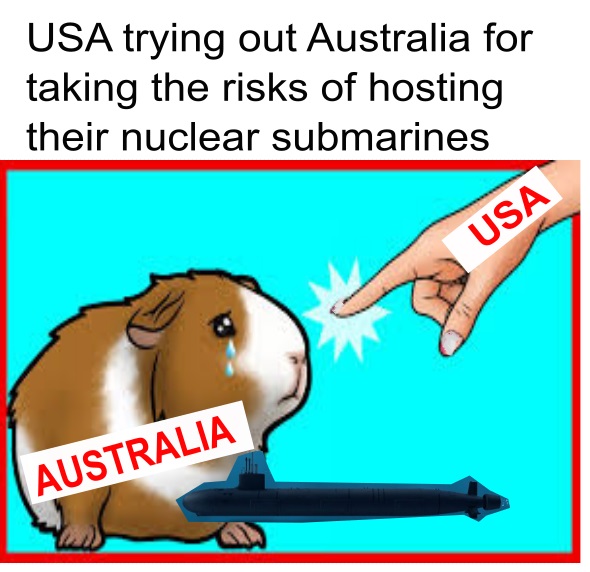
Why nuclear inspections in Australia have suddenly spiked
The Age, By Matt Wade, October 26, 2024, https://www.theage.com.au/national/why-nuclear-inspections-in-australia-have-suddenly-spiked-20241023-p5kkrl.html
International inspections of Australia’s nuclear facilities and materials have increased by a third in the past year as the nation’s nuclear risk profile changes due to AUKUS.
Since Australia is a signatory to the Nuclear Non-proliferation Treaty, it is required to submit to regular inspections by the International Atomic Energy Agency (IAEA) to verify compliance with nuclear safeguards.
Dr Geoffrey Shaw, director general of the Australian Safeguards and Non-Proliferation Office (ASNO), which ensures compliance with nuclear treaties, said there has been “a 30 per cent increase in inspections in Australia in the last couple of years”.
Under AUKUS, the navy will acquire nuclear-propelled submarines, and Shaw said that has raised Australia’s “risk setting” with the IAEA.
“This country is now going to be acquiring naval nuclear propulsion – it will have high enriched uranium in a country where we don’t currently have high enriched uranium,” he said. “That changes the equation.”
Australia’s nuclear proliferation risk profile is low; it has one research nuclear reactor in Sydney, which uses low-enriched uranium, three uranium mines and some institutions and companies permitted to handle nuclear materials.
But Shaw said the IAEA wants more assurances that there are no undeclared nuclear activities. It is now conducting inspections across the country with “as short as two-hour notification”.
In the year to June 2024, the IAEA made 22 inspections at locations including the Australia Nuclear Science and Technology Organisation (ANSTO), universities, defence facilities and private companies. That compares with 16 the previous year.
The first AUKUS submarines are due to be delivered to the Australian navy in the late 2030s.
When Australia, a non-nuclear-armed nation, acquires nuclear-propelled submarines, a “first-of-a-kind” regulatory approach will be needed to ensure the nation complies with its non-proliferation treaty obligations.
Corey Hinderstein, acting principal deputy administrator of America’s National Nuclear Security Administration (NNSA), said the nuclear safeguards developed in Australia for AUKUS will set a global benchmark for other nations that seek naval nuclear propulsion.
“We know that there are other countries that are interested in developing or partnering on naval nuclear propulsion programs, and those countries are by and large non-nuclear weapon states under the NPT, so they will have the safeguards obligation,” she said………………… https://www.theage.com.au/national/why-nuclear-inspections-in-australia-have-suddenly-spiked-20241023-p5kkrl.html
Electric Boat Slows Down Submarine Production Because of Delayed Parts
The Maritime Executive, 4 Oct 24
On Wednesday, in a confirmation of the concerns of U.S. Navy leadership, the head of General Dynamics said that her company would be slowing down the pace of construction on new submarines to match the behind-schedule pace of component deliveries.
GD’s Electric Boat division and Huntington Ingalls Industries build the Navy’s Virginia-class and future Columbia-class nuclear-powered subs. Beset by workforce and supply-chain issues, both programs have been hit with long delays – more than a year in the case of the Columbia-class. The Navy says that it can’t afford to wait for its stealthiest and deadliest platforms in an era of great power competition, and it has invested billions in infrastructure and workforce initiatives to shore up the submarine industrial base, with unclear results……………………………………………………. more https://maritime-executive.com/article/electric-boat-slows-down-sub-production-because-of-delayed-parts
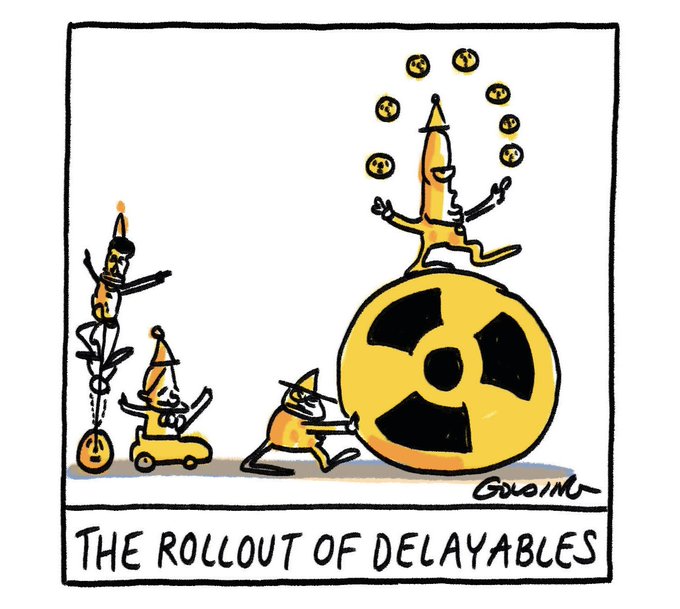
I’ll be the best friend you ever had, Peter Dutton promises miners
ABC, By chief digital political correspondent Jacob Greber, 26 Oct 24
In short:
Peter Dutton wants to fast-track more than 420 mining and energy projects if the Coalition wins government…………..
Peter Dutton will jettison Australia’s medium-term carbon budget by “turbocharging” a pipeline of more than 420 mining and energy projects as part of a broader pledge to make himself the best friend the resources sector has “ever had”.
“I want to see more excavators digging, more gas flowing, and more trucks moving,” Mr Dutton will tell the Minerals Council of Australia conference in Canberra on Wednesday morning.
……………………………………………………… Conservation groups are likely to be alarmed by Mr Dutton’s unabashedly pro-resources pitch given a significant portion of the potential pipeline includes high-emissions gas and coal projects.
If they were all to be approved, the nation’s international pledge to cut emissions by 43 per cent in 2030 would likely collapse under a Coalition government.
…………………”And I want to lean into growing opportunities like critical minerals, rare earths and uranium.”
………………….He will also move to limit the ability of third parties, including some Indigenous groups, to challenge decisions under the Environment Protection and Biodiversity Conservation Act…………………………… https://www.abc.net.au/news/2024-09-10/peter-dutton-mining-best-friend-renewables-weapons/104334636?fbclid=IwY2xjawGJdiRleHRuA2FlbQIxMQABHUWLGwbckO97hXoFhsOwoCItJ235y1Q_QaHLBY43_QY9zxxEYL-AI60fCQ_aem_6-Je95cEWe3TOYTXCeGLNA
Too old, too expensive: Coal can’t wait for nuclear, says energy regulator
SMH, Mike Foley, October 24, 2024
Australia’s top independent energy officials are warning the nation’s fleet of coal power plants is too old and costly to keep running until Opposition Leader Peter Dutton’s proposed nuclear reactors are ready to replace them.
A high-stakes parliamentary inquiry began on Thursday with witnesses from national energy agencies and nuclear authorities. It was launched to expose flaws in the opposition’s nuclear policy, but has the potential to backfire as the Coalition challenges the costs of the government’s ambitious renewable energy rollout.
The opposition has dubbed its energy election pitch a “coal-to-nuclear plan”, which would cut short the government’s renewables rollout and establish seven emissions-free nuclear plants across the country from 2035 to help the nation reach net zero by 2050.
However, Australian Energy Regulator chair Clare Savage, who heads the agency that develops the regulations for the electricity market, raised a hurdle for the opposition when she said Australia would only be ready to start building nuclear plants by the time coal plants have all but disappeared
“We cannot keep the current coal fleet running long enough for nuclear to be here,” Savage told the hearing.
The timeline for a nuclear fleet is a crucial issue because Australia’s coal-fired power plants, which supply upwards of 50 per cent of power in the electricity grid, must be replaced by 2035.
Coal plants are bringing forward closure dates as ageing equipment becomes less reliable and less competitive against cheaper renewables. The Australian Energy Market Operator expects 90 per cent of them to shut within 10 years.
Under the Albanese government’s plan, renewables will replace coal under its goal to raise the share of electricity from wind, solar and batteries to 82 per cent of the grid by 2030.
The opposition has said that coal plants should not shut “prematurely”, and it plans to start bringing the first nuclear plant online by 2037 and completing its rollout of six more before 2050
Savage said that based on her experience, it would take eight to 10 years to establish the rules needed to govern nuclear power before construction could begin.
The Australian Nuclear Science and Technology Organisation (ANSTO) said it could take about 10 years to build the first reactor in Australia after industry regulations have been established.
…………………… nuclear power is currently outlawed in state and federal laws and Savage said it would take many years to overcome this hurdle and establish inter-jurisdictional regimes. …………………….. https://www.smh.com.au/politics/federal/too-old-too-expensive-coal-can-t-wait-for-nuclear-says-energy-regulator-20241024-p5kkxn.html
BHP’s untenable extraction of Great Artesian Basin waters for the Olympic Dam copper-uranium mine.
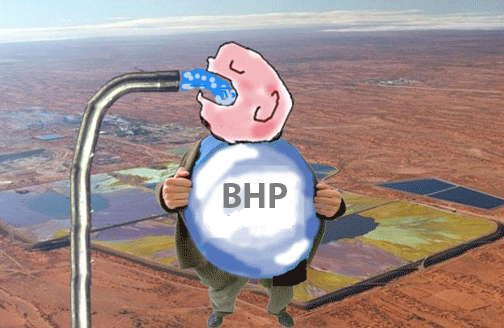
Jim Green, 26 Oct 24. BHP has had to move on Mound Springs protection issues regarding untenable extraction of GAB waters for the Olympic Dam copper-uranium mine, and an important Springs Study had now been released by SA Gov modelling reduced water extraction scenarios and affects on Springs & GAB waters.
A significant – if belated and partial – formal public commitment from BHP:
Milestone : FY2030 – cease abstraction from Wellfield A through switching to coastal desalination supply in partnership with the South Australian Government on the Northern Water Supply Project.
This partial win is a key if limited step toward proper protection for the unique and fragile Mound Springs of the GAB in SA, requiring:
is a key if limited step toward proper protection for the unique and fragile Mound Springs of the GAB in SA, requiring:
- closure of untenable BHP Wellfield A operations as soon as possible, that is warranted far sooner than by end of FY2030;
- BHP could prioritise and pay for whatever extent of water recovery at Olympic Dam to replace continued extraction from Wellfield A, which is projected to be run at 3.9 million litres a day ( Ml/d ) over next few years – about 10% of the volume BHP water take from the GAB;
- a campaign path to realise a phase out of the far larger adversely impacting Wellfield B operations that runs at 32 Ml/day, at least from when Northern Water supply becomes available at/after 2028 (this is difficult as BHP & SA Gov now think closing Wellfield A is all they have to do);
- a continued public interest campaign building on a lot of people’s roles and contributions over time…
an important Springs Study:
“Potential Impacts of Reducing Groundwater Abstraction from the Southwestern Great Artesian Basin: Modelled Aquifer Pressure and Spring Flow Response”
By Daniel Partington, Andrew Love, Daniel Wohling, Mark Keppel.
Goyder Institute for Water Research Technical Report Series No. 2024/01https://yoursay.sa.gov.au/84866/widgets/401081/documents/297652
see an extract from Goyder Institute Springs Study (at p.21 of doc & at p.31 of the pdf file, my bold below) citing the BHP commitment:
3.5 Output From the Modelled Scenarios Six experimental abstraction scenarios were proposed by Infrastructure SA to provide a spectrum of stimuli to assess the responsiveness of the aquifer to a change in abstraction volumes. The future abstraction rates from Wellfield A and B have not been confirmed, however there has been public commitment to cease abstraction from Wellfield A if water from the Northern Water project is available (see Olympic Dam Context- Based Water Targets).
1 This month
15 April – Zoom –Nuclear Power is Not the Solution
Apr 15, 2026 01:00 AM in Canberra, Melbourne, Sydney

Join the International Physicians for the Prevention of Nuclear War (IPPNW) on Tuesday, April 14th for a timely webinar exploring the risks associated with nuclear power and challenging the myth that it offers a simple, safe, carbon-free solution to the climate crisis

of the week – Australians for War Powers Reform (AWPR)
To see nuclear-related stories in greater depth and intensity
 Antinuclear