‘No bigger rent-seeking parasite’ than nuclear industry, Matt Kean tells former Coalition colleagues in heated debate
Kean, a former Liberal energy minister turned Climate Change Authority chair, clashes with senators Gerard Rennick and Ross Cadell
Lisa Cox Environment and climate correspondent, Guardian, 4 Nov 24
Matt Kean, the chair of the Climate Change Authority and a former New South Wales Liberal energy minister, has told a parliamentary estimates hearing there is “no bigger rent-seeking parasite than the nuclear industry” during a heated exchange with pro-nuclear senators.
Appearing at estimates for the first time since his appointment in June, Kean argued with the independent senator Gerard Rennick about the cost of nuclear, telling the hearing: “If you want to see who are needing rent-seeking [and] trying to pull one over the eyes of the Australian public, it’s the nuclear industry.”
Kean said the nuclear industry was “there propping up the coal industry, who want to extend their business models, squeeze out the last bits of profit at the expense of Australian consumers”.
He also clashed with the Nationals senator Ross Cadell over analysis by Australia’s science agency CSIRO, which found nuclear was the most expensive form of large-scale energy available, estimating an initial plant could cost more than $16bn.
Kean told Cadell “most rational people do trust the CSIRO, this is the body that developed wifi” and that their advice “is good enough for me and it should be good enough for our political leaders”……………….
He later told Rennick that advice from CSIRO and the Australian Energy Market Operator was that the cheapest way to replace Australia’s ageing electricity infrastructure was with renewables.
The Coalition has proposed seven sites where it says it would eventually replace coal-fired power plants with nuclear plants but not how much this would cost.
Multiple energy analysts have argued nuclear energy would be more expensive than other options and a nuclear industry would not be possible in Australia until after 2040………………………………………..
The chair of the Australian Energy Regulator, Clare Savage, told a parliamentary inquiry she did not believe nuclear plants could be built in time to cover the closure of coal-fired power plants. https://www.theguardian.com/australia-news/2024/nov/04/no-bigger-rent-seeking-parasite-than-nuclear-industry-matt-kean-tells-former-coalition-colleagues-in-heated-debate
Why Nimbys are wrong about solar farms- even in the UK!
Opponents of solar farms often say that solar panels should be put on roofs and that fields should be left for agriculture so i asked the experts on whether they agreed
By Tom Bawden, Science & Environment , November 3, 2024 ,
https://inews.co.uk/news/environment/why-nimbys-are-wrong-about-solar-farms-3355702
Tory leadership loser Robert Jenrick said that solar panels are “for roofs not fields” when asked byi last month if he supported a proposed giant solar farm in his Nottinghamshire constituency.
He is by no means alone in that view, which is a common argument given by opponents of solar farms.
Those who protest against solar farm developments argue fields would be better used for growing food, while solar panels could and should be concentrated on roofs, of which there are quite literally millions in the UK.
“I’ve said that we must ban solar farms from prime agricultural land and I mean it. These facilities are despoiling our beautiful countryside and jeopardising our food security. We must end it,” Mr Jenrick added.
But since Labour came to power Energy Secretary Ed Miliband has approved four of the five biggest solar farms to be given planning permission in the UK.
Mr Miliband has vowed to take on “the blockers, the delayers, the obstructionists” who oppose large solar and onshore wind development to help the UK meet its ambitious targets to make the country’s energy supply virtually carbon neutral in just six years.
As the Government steps up its campaign to drive through new solar and wind projects, it is likely we will be seeing more projects of a similar scale too that opposed by Mr Jenrick in the coming years.
i asked experts whether it was feasible for the UK to do without new solar farms and instead confine new solar panel installations to the rooftops of households, offices and other business properties, and what effect this could have on food security.
The sale of the solar challenge
Experts were clear that there needs to be a huge and rapid increase in renewable energy generation if the UK is to have any chance of meeting its highly ambitious climate targets.
And, as the cheapest source of renewable energy – now costing less than onshore and offshore wind, according to government figures – solar will inevitably play a key role in the transformation of the UK’s energy supply.
The Conservative’s British Energy Strategy in April 2022 outlines the need for 70 gigawatts (GW) of solar power to be installed by 2035 – enough to power 20 million homes, according to National Grid.
As of June 2024, the UK only had about 17GW installed capacity (powering around 4.5million homes), meaning the country needs to quadruple its solar power generation in the next 11 years.
Two thirds of the current solar power is generated by solar farms with panels on the ground – known as “ground mount” – with the remaining third coming from the rooftops of businesses and over 1.5 million homes.
Meanwhile, government advisor the Climate Change Committee estimates that we will need 90GW of solar by 2050 (5.3 times current capacity) if we are to hit our legally binding target of becoming Net Zero.
Dr Simon Harrison, a member of the Government’s new advisory commission to help make the UK’s power generation virtually carbon neutral by 2030, told i the task is so great that it’s “going to require vastly more renewable energy generation” – meaning that “in practice both solar farms and roof top solar will be needed at scale to meet our needs”.
“There’s a significant role for both,” added Professor Rob Gross, who also sits on the commission.
What are the advantages of solar farms?
The first major advantage of solar farms is the sheer amount of energy they produce.
The 600 MW Cottam Solar farm that was granted planning permission in September would be the UK’s largest – supplying 180,000 homes, or 1,500 homes for every 5MW of energy generated.
By contrast, large solar rooftop installs, say over an airport or large of space, typically generate hundreds of kilowatts (kW) potentially up to a few megawatts (MW).
While the average solar rooftop installation size on someone’s home for their own use is typically 4kW.
So the Cottam Solar project would generate at least 200 times the electricity of the very largest commercial roof top installations and around 150,000 times as much as a typical household solar panel setup.
Tony Slade, technical director of Beaverbrook Energy, which designs, finances and builds low-carbon energy generators, told i: “Ground mounted solar farms also suffer from less ‘shading’ (blocking of direct sunlight through obstacles and obstructions) and ‘directional losses’ by being angled in the wrong direction.
“About 50 per cent of roofs face the wrong way and of those that face the right way about 25 per cent suffer from shading issues,” he said.
Are solar farms cheaper than roof panels?
Yes, in part because they benefit from economies of scale. In other words, the bigger the solar farm, the cheaper each unit of electricity will be, as more panels can benefit from the infrastructure.
Professor Gross, who is also director of the UK Energy Research Centre coalition of researchers, told i “the principal advantages are economic”.
“It is far cheaper to install each solar panel in a large array of thousands of panels than it is to install a handful of panels on a roof.
“Ground mounted is cheapest, followed by larger arrays on commercial units, followed by new build, followed by residential retrofit. All categories are getting cheaper but it is impossible to get away from the fundamentals – the cheapest solar will always be the simplest to install, in the largest arrays,” he said.
“And ground mounted developers building large schemes may also be able to negotiate the best deals for panels and equipment,” he added.
Mr Slade explains that greenfield ground mount solar panels on fields typically cost two thirds as much, per unit of energy, as large scale solar panel arrays on commercial buildings such as warehouses, shopping centres and factories – as well as new build domestic and commercial buildings, where the solar panels are fitted as part of the original construction.
Meanwhile, installing solar panels above car parks is typically twice as expensive as wind farms and retrofitting homes is about three times as expensive, he said.
What about food security?
Opponents of large solar farms often argue that the land would be better used for agriculture and that too many of them could impact food security.
But the Department for Energy Security and Net Zero firmly rebuts those suggestions, arguing the amount of agricultural land involved would make very little difference to the UK’s food production.
“Our plans to boost solar power do not risk the UK’s food security. The total area of agricultural land used for solar is very small and is often the lowest grade quality for food production.
“Even in the most ambitious scenarios, solar would still occupy less than 1 per cent of the UK’s agricultural land, while bringing huge benefits for the British public and our energy security,” the spokesperson added.
Meanwhile, in July, National Farmers’ Union boss Tom Bradshaw warned MPs against making “sensationalist” claims about food security.
“It’s a small amount of land which is being taken out of production,” he told the Politico Europe website.
The role of rooftop solar panels
“They can potentially play a very important role, accounting for perhaps 40 per cent of new installation of solar. But it’s important to be clear that rooftop and ground based are additive not competitive,” Professor Gross said.
Dr Harrison says “there are serious considerations to make on where solar is placed”, meaning that sometimes roof top solar power can be far more suitable than those in fields.
“In the simplest terms, there is more space in rural areas for solar panel installations and it is often easier to optimise their positioning for greater energy capture. But they are generally further from existing grid connections and with sometimes competing requirements for land use,” he said.
“On the other hand, rooftop solar, most commonly in urban settings, often avoids use of congested electricity networks, especially when combined with local batteries, and when used in homes tends to drive greater awareness and action by residents in other areas such as energy efficiency improvements, as well as reducing bills. In practice both will be needed at scale to meet our needs.”
The Government estimates there are 250,000 hectares of south-facing, industrial roof space across the country. That’s an area bigger than London and Manchester combined, with the potential for a vast amount of solar panels.
Even a very conservative estimate suggests that this commercial roof space could provide an area big enough to generate approximately 25GW of energy.
This amounts to nearly half the total amount recommended by the Climate Change Committee (CCC), according research by University College London for the Campaign to Protect Rural England (CPRE).
Mr Ramandani agrees that fields and rooftops can play different, complementary, roles in UK energy generation.
“We need about 18GW more of rooftop solar to hit 70GW by 2035 to keep us on the right path to Net Zero. So it will play a massive role,” he said.
“Rooftop solar can power people’s homes and business onsite without needing to pull from the grid, and excess generation can be stored or exported back to the grid, which supports the flexibility and security of the grid. And they operate at a smaller scale with some export to the overall grid system.
“Solar farms, meanwhile, are not onsite generation – they operate at a much bigger scale and power the grid with greater quantities of energy, which is used by the whole system and not specific to a home or business (before they export the excess generation that they don’t use or store).”
Is there a big role for household solar panels?
UK households are already waking up to solar panels, receiving record sums last year for the amount of excess energy they generated that they sold back to the grid, Ofgem said last week.
Homeowners received more than £30m for the energy they didn’t need in the year to March 2024, four times the £7.2m they made the previous year.
Although this amounted to a relatively small amount of energy – enough to power 88,000 homes – experts say there is considerable scope to increase this and they expect this to happen in the coming years.
“There is definite major role for rooftop solar in the UKs future energy mix,” said Mr Slade. “As installations become cheaper and the market for excess generation becomes fairer to the home owner rooftop domestic solar will continue to grow,” he said.
Mr Ramandani says: “Onsite solar rooftop generation takes money off consumer’s bills as they purchase less from the grid, and excess generation can be exported to the grid for income. This in turn creates a stable grid system with less demand side pressure, as well as supplementary energy generation from homes and businesses.
For a typical house, installing a PV system could lower bills by the equivalent of nearly 330 every year over the 30-year lifespan of the system, according to a study by Cambridge University and the Think Three property development company for Solar Energy UK.
To 4 November – nuclear news, and more

Some bits of good news – Public health wins in Kenya, Uganda, Bangladesh, and Tanzania. Peace on the horizon between China and India.
A decline in carbon emissions in China is still in play.
People power – 30 years of renewable energy: one company’s success story
**********************************
TOP STORIES.
The Rise and Fall of NuScale: a nuclear cautionary tale.
“Ford Watch: The Largest Nuclear Expansion in Canada’s History”.
New Nuclear – Unaffordable, Undesirable and Unachievable
***********************
Climate. UK lobbyists accused of ‘greenwashing’ oil-rich Azerbaijan before Baku COP summit
Record levels of heat-related deaths in 2023 due to climate crisis, report finds. Half of world’s biggest cities to face severe climate risks by 2050, LSEG finds. Why were the floods in Spain so bad? A visual guide. Climate Researchers Warn: Warmer Climate Could Lead To “Cold Waves Across Northern Europe”!
Noel’s notes. Canadians are waking up to the nuclear scam– Why are the media and other nations pretending that nuclear is just dandy?
******************************************************
AUSTRALIA.
Australian Civil Society Statement for COP29Baku, Azerbaijan. Australia votes at the UN General Assembly. More Australian news at https://antinuclear.net/2024/10/24/australian-nuclear-news-21-28-october/
NUCLEAR ITEMS
| ATROCITIES. Banning United Nations Relief and Works Agency (UNRWA) is a new way to kill children, aid groups warn. Oxfam reaction to Knesset decision. Israeli Knesset Passes Bill To Ban UN Palestinian Relief Agency. |
| CLIMATE. New Paper: Nuclear Weapons and Our Climate. |
| CIVIL LIBERTIES. Witnesses say the Israeli army is using facial recognition technology in its assault on north Gaza. |
| CULTURE. The Mainstream Western Worldview Pretends The Global South Does Not Exist. Israel will eventually pay price for Gaza genocide going on for a year: Turkish President Erdogana- https://www.youtube.com/watch?v=dtoWptrhPOM |
ECONOMICS.
- Next ERA No Longer Bullish on Nuclear SMRs.
- Lepreau nuclear headaches could add up to an extra $150M.
- Ontario’s huge nuclear debt and other things Dutton doesn’t understand about cost of electricity.
- Race to build Britain’s first mini-nukes delayed again in Budget.
- Ultra Safe” Nuclear Corp.-Major Microreactor Developer Enters Bankruptcy
- Sizewell C nuclear project proceeds by stealth – vast sums of public money spent, with no public disclosure about its true cost.
- Czech watchdog prohibits nuclear power contract signing amid appeals.
- IEA: Global clean tech market set to be worth $2tr a year by 2035.
EVENTS. CND to protest return of US nuclear weapons to Britain ahead of US presidential election. PETITION. Call for Peacekeeping Forces to Stop Israel’s Genocide
| INDIGENOUS ISSUES. Saugeen Ojibway Nation stands firm on nuclear waste decision despite South Bruce vote |
| LEGAL. South Africa Files 750 Pages of ‘Overwhelming’ Evidence in ICJ Genocide Case Against Israel. |
| MEDIA. Israel Kills Five Journalists in Sunday Gaza Attacks. Israel kills the journalists-Western media kills the truth of genocide in Gaza . Despite History of Fabrication, Press Uncritically Covers IDF-Provided Documents on Hamas. 101 BBC journalists say it is biased against Palestine. Atomic Reaction – a highly recommended feature-length documentary film. |
| OPPOSITION to NUCLEAR .South Bruce Deep Geological Repositary (DGR) opposition promises to keep fighting. Gravelines nuclear power plant: EDF refuses to respond on flood risks and tries to silence whistleblowers. Campaigners slam chancellor Rachel Reeves for £2.7 billion pledge to nuclear power station. After two months, Nuclear Free Local Authorities receive vague response on Advanced’ Gas-Cooled Reactors (AGRs). |
POLITICS.
- Settlers prepare for ’resettlement in Gaza’.
- Labour just railroaded a secretive US-UK nuclear treaty renewal deal. Nuclear Free Local Authorities (NFLAs) believe UK budget is opportunity to lobby Ministers to ditch Sizewell C. Will Susan Holt’s new government continue New Brunswick’s nuclear fantasies ?
- Launch of papers on UK’s unachievable nuclear programme.
- New Brunswick’s nuclear plant’s ongoing troubles an early threat to Holt government finances. South Bruce Municipality narrowly votes to host underground nuclear waste disposal site.
POLITICS INTERNATIONAL and DIPLOMACY.
- Ukraine and Russia in talks about halting strikes on energy plants.
- UK urged to break with France, North Korea and Russia on UN nuclear war resolution.
- WILL THE 2024 U.S. PRESIDENTIAL ELECTION BRING AN END TO THE WAR IN UKRAINE?.
| SAFETY. Reeves urged not to cut Sellafield funds amid concern at rise in ‘near misses’. The non-proliferation considerations of nuclear-powered submarines. Onagawa nuclear plant’s restart sparks concerns over evacuation routes. |
| SECRETS and LIES. Yeah, Yeah, United Nations Relief and Works Agency (UNRWA) Is Hamas. Everyone Israel Hates Is Hamas. Lest we forget – Nuclear Power Runs on Dirty Money: The Corporate Scandal of the Proposed National Nuclear Subsidy. Congress Must Investigate Corruption in Nuclear Energy Industry. |
SPACE. EXPLORATION, WEAPONS.
ExoAnalytic observes 500 pieces of debris from Intelsat 33e breakup
WASTES.
- The global nuclear industry has no idea how to decommission Fukushima nuclear plant, but hopes that a tiny robot might help. Nuclear fuel debris retrieved at Tepco Fukushima plant.
- France wrestles with the idea that nuclear wastes might be useful, “retrievable” for future generations.
- South Bruce voters narrowly approve being host to nuclear waste.
- Technical troubles delay new tests at huge Eastern WA radioactive waste melter.
- The Wylfa nuclear power station site needs “better storage facilities for waste” .
- NGOs call for more secure interim storage facilities for Germany’s nuclear waste.
- Safety analysis is not yet approved for Sweden’s nuclear waste dump plan, despite the hype.
| WAR and CONFLICT. South has raised risk of nuclear war, North Korea says. |
| WEAPONS and WEAPONS SALES. Report: US Sitting on Nearly 500 Reports of US Weapons Killing Civilians in Gaza. Department of Defense Releases Fiscal Year 2024 Military Intelligence Program Budget – just the bare $29.8 billion. Why ‘British’ nuclear weapons are really very American. |
Support for nuclear power will evaporate at next election, Chris Bowen predicts
Polling shows that Australians prefer renewables, climate change and energy minister says
Adam Morton Climate and environment editor, https://www.theguardian.com/australia-news/2024/nov/04/nuclear-power-support-australia-election-chris-bowen
Support for nuclear power is likely to evaporate once Australians face a clear choice at the next election and realise the Coalition’s policy would mean relying more on old coal plants and increased risk of blackouts, Chris Bowen says.
The climate change and energy minister said that while some polling had suggested some voters were open to nuclear plants being allowed in Australia surveys had also consistently found they preferred renewable energy.
“Every bit of research I’ve seen, public and private, says that when shown details and given a choice between nuclear and other forms of energy, nuclear fares very, very badly,” he said. “If you look at the popularity of different forms of energy, it’s solar, wind, gas, daylight, coal, nuclear, in that order, every single time.”
Support for nuclear power is likely to evaporate once Australians face a clear choice at the next election and realise the Coalition’s policy would mean relying more on old coal plants and increased risk of blackouts, Chris Bowen says.
The climate change and energy minister said that while some polling had suggested some voters were open to nuclear plants being allowed in Australia surveys had also consistently found they preferred renewable energy.
“Every bit of research I’ve seen, public and private, says that when shown details and given a choice between nuclear and other forms of energy, nuclear fares very, very badly,” he said. “If you look at the popularity of different forms of energy, it’s solar, wind, gas, daylight, coal, nuclear, in that order, every single time.”
The Coalition has named seven sites where it says it would eventually replace coal-fired power plants with nuclear plants but not how much this would cost. Multiple energy analysts argue nuclear energy would be more expensive than other options and a nuclear industry would not be possible in Australia until after 2040. The bulk of the country’s coal plants are scheduled to close in the 2030s.
The opposition has suggested it would limit the rollout of large-scale renewable energy – it has criticised Labor’s goal of 82% renewable energy by 2030 – and bridge the gap by keeping ageing coal plants running longer and using more gas-fired power.
It has not yet said what type of gas plants this means. With nuclear banned, gas is the most expensive form of electricity in the national electricity market and it use is largely restricted to “peaking” power turned on only when needed. It provided less than 3% of electricity in the national grid over the past month.
The chair of the Australian Energy Regulator, Claire Savage, told a parliamentary inquiry she did not believe that nuclear plants could be built in enough time to cover the closure of coal-fired power plants. More than a quarter of the coal power capacity in the national grid was offline on the day she gave evidence due to planned and unplanned outages.
Australia votes at the UN General Assembly

A few days ago, Australia voted on a number of nuclear weapons resolutions at the UN General Assembly. Thank you to the hundreds of you that emailed Foreign Minister Wong urging Australia to vote in the right way! In good news, Australia voted “Yes” on the scientific research resolution (L.39) supporting a major new UN-mandated study on the effects of nuclear weapons. Several nuclear-armed states were trying to mobilise supporters to vote against this resolution so we know they are threatened by it. Knowledge is power!
Disappointingly, Australia continued its abstention on the TPNW resolution (L.37) and humanitarian impacts resolution (L.36), instead of voting “Yes”.
Earlier in October ICAN visited Parliament to advocate for the TPNW with parliamentarians across the political spectrum. We were also delighted to have met with Siswo Pramono, Indonesia’s Ambassador to Australia, and congratulate him on Indonesia’s recent ratification of the TPNW. Mr Pramono addressed the Parliamentary Friends of the TPNW group and stated that the success of the TPNW also hinges upon the participation of countries who possess nuclear weapons. “We need a concerted effort to convince them to become Parties to the Treaty,” he said. “In doing so, leadership from developed countries such as Australia is needed.”
New Paper: Nuclear Weapons and Our Climate

Today, we are launching a new briefing paper: ‘Nuclear Weapons and Our Climate’ written by ICAN co-founder, A/Prof Tilman Ruff AO.
In the lead up to the climate COP29, this timely paper sharply lays out how the “two paramount human-made existential threats we confront—nuclear weapons and climate change—exacerbate each other and need to be addressed together—with utmost urgency,” writes A/Prof Ruff. “One harms us and our biosphere every day, the other could deplete it irrevocably and end human civilisation and many species in less than a day.”
The paper’s key findings are:
- Smoke from burning cities ignited by a nuclear war involving 2% of the global arsenal would suddenly plummet temperatures worldwide to ice age levels, decimate agriculture, disrupt ocean food chains and starve to death over two billion people.
- Militaries are large and mostly unconstrained greenhouse gas emitters. Growing conflicts and nuclear threats undermine international cooperation needed to address the climate crisis. Rising military spending and nuclear arsenals have huge opportunity costs and make conflicts more dangerous. An increased risk of war leading to nuclear escalation is the greatest danger of the climate crisis.
- Nuclear power inseparably creates the capacity to build nuclear weapons. In most nuclear-armed states, the infrastructure, personnel, expertise, industrial capacity and government investments in nuclear power are also key to their nuclear weapons programs.
- Nuclear reactors, spent fuel storage ponds and reprocessing plants are effectively pre-positioned large radiological weapons, vulnerable to direct attack or disruption of power and water for essential cooling. Russia’s invasion of Ukraine has seen, for the first time, multiple nuclear power plants attacked and weaponised in war, risking a radiological disaster.
| The paper is a call to action, as “everyone everywhere, everything we treasure and our living planet is threatened by nuclear weapons, this is everyone’s business.” Please share the report with your friends and networks and discuss how you can help prevent climate disruption and nuclear war in your work and daily lives. |
Grazing sheep among solar panels could produce higher quality wool, study finds
Sophie Vorrath, Nov 1, 2024,
https://reneweconomy.com.au/grazing-sheep-among-solar-panels-could-produce-higher-quality-wool-study-finds/
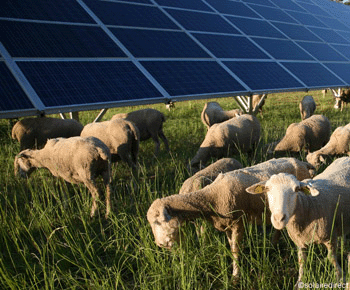
The co-location of solar farming with sheep grazing does not have a negative affect on wool production and could even improve the quality of the wool produced, a new study has found.
The study is based on the results of a second round of wool testing at the Wellington solar farm, south east of Dubbo in New South Wales, which has shared its site with 1,700 merino sheep for the past three years.
Legend has it that the decision to graze sheep at the solar farm came about when an employee of Lightsource bp, the owner of the Wellington project, complained to a local, sixth-generation wool farmer about the hassle and cost of mowing the solar farm six times a year.
According to Tony Inder, who heads up the Allendale Merino Stud, the effect on his sheep has been a lot better than he thought it would be – he says the wool quality they are producing has “increased significantly.”
But Lightsource bp – which is now wholly owned by the oil and gas giant BP, after completing the acquisition of the remaining 50.03% interest – has used the opportunity to gather some formal data.
The study, conducted by EMM Consulting with support from Elders Rural Services, compares two groups of merino sheep – one group grazed in a regular paddock and the other at the Wellington solar farm.
The latest findings show grazing sheep among solar panels does no harm to wool production, even in the case of pre-existing high-quality standards. And it says that some parameters even indicate an improvement in wool quality, although conclusive benefits require further long-term measurement.
Lightsource bp says that while the study at the Wellington solar farm is ongoing, it is another indication that solar farms can exist side-by-side with sheep farming, for the benefit of both enterprises.
“These results are very encouraging and highlight the potential for solar farms to complement agricultural practices,” says Emilien Simonot, Lightsource bp’s head of agrivoltaics.
“By integrating sheep farming with solar energy production, we can achieve dual benefits of sustainable energy together with agricultural output.” . By co-locating grazing with renewable energy, land can remain in agricultural use, offering farmers additional revenue while contributing to cleaner energy for the planet.
“Finding ways for agriculture and clean energy to work together is crucial for a more sustainable future,” says Brendan Clarke, interim head o environmental planning Australia and NZ at Lightsource bp.
“The promising results from this study indicate that we are on the right path, and working closely with farmers to grow our knowledge in this area is paramount.”
As for the sheep, Inder says they “just do really well” when grazing among the Wellington solar farm panels.
“I like to say that panel sheep are happy sheep.”
Sophie is editor of One Step Off The Grid and deputy editor of its sister site, Renew Economy. She is the co-host of the Solar Insiders Podcast. Sophie has been writing about clean energy for more than a decade.
1 This month
15 April – Zoom –Nuclear Power is Not the Solution
Apr 15, 2026 01:00 AM in Canberra, Melbourne, Sydney

Join the International Physicians for the Prevention of Nuclear War (IPPNW) on Tuesday, April 14th for a timely webinar exploring the risks associated with nuclear power and challenging the myth that it offers a simple, safe, carbon-free solution to the climate crisis

of the week – Australians for War Powers Reform (AWPR)
To see nuclear-related stories in greater depth and intensity
 Antinuclear