Secrecy ramping up as problems mount in the UK nuclear programme

The reliability issues in the Vanguard fleet, and extended patrols they have caused, are the most visible issues, but there are many more.
HMS Vanguard has rejoined the fleet after its extended seven year deep maintenance and refuelling, but appears not to have been sent out on patrol for many months after rejoining the fleet. We saw a failed missile test-firing earlier this year and the fire on HMS Victorious in 2022. The entire Astute-class fleet was unable to put to to sea for five months this year, and it’s possible that the problems that caused this may surface in the incoming Dreadnought fleet.
David Cullen NIS 12th Nov 2024
The UK’s nuclear weapons programme is at a critical stage with mounting problems, and secrecy is being increased when transparency and accountability are more vital than ever. Routine public disclosures of information are now months overdue, nearly a year in one case. At the same time, the increasingly draconian approach to secrecy from the Ministry of Defence (MOD) is limiting the information that they will disclose through Freedom of Information (FOI) requests, or in response to Parliamentary Questions.
The current level of public disclosure about the programme is lower than any time since at least the early 1990s. Without proper scrutiny there is no meaningful way for the public to understand what is happening, or for elected representatives to challenge it, and the likely result will be greater mismanagement, increased safety risks and a waste of huge sums of public funds.
At Nuclear Information Service (NIS) we prefer to focus on the content of our work, rather than drawing attention to ourselves and what we do, but these levels of secrecy are unprecedented during the 24 years we have been operating and we have decided to speak out. Whatever your position on nuclear weapons, the current information black hole is antithetical to good governance, and fundamentally unacceptable in a democracy.
Missing updates to Parliament
From 2011 to 2023, the MOD published an annual update to Parliament on the progress of its nuclear weapon upgrade programmes. The first of these was the ‘Initial Gate’ report on what is now known as the Dreadnought Programme, summarising the first few years of scoping work undertaken by the MOD and the plans for the new submarine class. From 2012 to 2021 these were routinely published shortly before Christmas (with the exception of 2015, when the Strategic Security and Defence Review published that November was deemed to have included enough information that there was no separate update).
The 2022 update was not published that year. NIS submitted an FOI request in January 2023 asking for a publication date and we were told in early February the update was “expected to be released in the coming weeks”. In response to a Parliamentary Question in late February from John Healy, who has since become Minister for Defence, the MOD said the update was “undergoing final clearance procedures”. No reason was given for the delay, despite this being explicitly asked by Healy and in a subsequent question submitted by Baroness Blower. The update was finally published on 8th March. The end of the update stated that the MOD planned “to next report progress to Parliament in late 2023”.
The 2023 update has not been published at all. NIS contacted the MOD in early December 2023 to ask what the planned publication date was and were told the annual update was “an enduring commitment by the MOD to Parliament…[but] there is no prescribed timeframe for its release” and the MOD was “unable to provide a date for its publication”. It is now early November 2024, nearly two years after the time period covered by the last update. In what sense can the MOD credibly describe these updates as annual?
Major Projects data not yet released
The other annual release of information about the progress of the MOD’s nuclear upgrades is the government’s Major Projects Data releases. These are coordinated by the Infrastructure and Projects Authority (IPA), a quasi-independent branch of government which sits under the Cabinet Office and is supposed to help ensure the government’s large projects are well managed and provide value for money. Projects are given a traffic-light colour rating, with many of the projects relating to the nuclear weapons programme being given ‘Amber’ or ‘Red’ rating, indicating respectively that they face serious problems, or appear unachievable.
Alongside the report published by the IPA which summarises the ratings for each programme and makes some general observations about programme management, data is published by each government department on their respective programmes. This includes predicted end dates, costs and a brief explanation of progress and/or problems. Since 2016 these have been published each July. Although the election this year may have interfered with the publication timetable, the data is typically assembled in March of each year, two months before the election was called. As it is now four months since the election, it is difficult to understand why the data has not been published.
Resistance to information disclosure
These missing information releases come at a time when the MOD is significantly more resistant to disclosing information to the public and parliamentarians than it has been in the past. In recent years key pieces of information have even been withheld in the MOD Major Projects releases. The 2022 release had redactions relating to the Astute, Dreadnought, Core Production Capability, Mensa, Pegasus and Teutates projects.
When NIS challenged these redactions we were told that that some were the consequence of an “anomaly” which caused them to be “withheld erroneously”. However, the planned end dates for the Astute and Dreadnought programmes were still withheld, as was the MOD narrative on the timetable for those two projects. The MOD took eight months to complete an internal review of this decision, instead of the maximum expected time of forty working days, and upheld the decision.
The FOI requests we submitted for our recent briefing on the US-UK Mutual Defence Agreement were treated similarly, although the delays were shorter. No information has been disclosed to us on the transfer of nuclear materials under the MDA between 2014 and 2024, and only three years of data on the transfer of non-nuclear components of nuclear weapons has been released, with the excuse that extracting the information would take too much time……………………………………………………………………………………….
This antipathy to disclosure is reflected in the recent changes to the government’s stance on official figures relating to its nuclear stockpile. These came in the 2021 Integrated Review, alongside the announcement of an increase to the UK’s warhead stockpile cap, breaking with a decades-long trend of reductions. Figures for the numbers of operational warheads that the UK owns, for deployed warheads, or deployed missiles are no longer published. These changes are a breach of commitments made by the UK and other nuclear-weapon states at the 2000 and 2010 Non-Proliferation Treaty (NPT) review conferences to increased transparency about their capabilities.
Foreclosed FOI avenues
The questionable role of the ICO, which is responsible for regulating FOI matters in the UK, is sadly not limited to the dubious interpretation of the rule on ‘similar’ requests. Our appeals to the ICO over the missing data from the 2022 Major Projects release and on the transfer of nuclear material under the MDA have both been recently rejected………………………………..
Under the FOI Act, we technically have the right to appeal to the Information Tribunal, but in this case there is no prospect of us being meaningfully able to exercise that right. In previous Information Tribunal cases, such the 2019 case over the government’s withholding of reports from its internal nuclear safety regulator, the MOD can refrain from making its key arguments in open court, and will instead make them in a closed session which we would not be able to attend.
If we wished to make a meaningful case at tribunal with any realistic hope of success, we would face the kafkaesque prospect of needing to employ a barrister who we could not even properly instruct, as we do not know what arguments are being made by the MOD. The position of the ICO suggests that most of the case would be heard in closed session and we would have little chance of winning. As rulings of the tribunal create FOI case law, it would actually be irresponsible for us to bring a case under these circumstances.
State of the programme
It is not hard to think of reasons why the MOD wishes to minimise information in the public domain about the weapons programme, considering what we do know about the state of the programme and its upgrade projects. The reliability issues in the Vanguard fleet, and extended patrols they have caused, are the most visible issues, but there are many more.
HMS Vanguard has rejoined the fleet after its extended seven year deep maintenance and refuelling, but appears not to have been sent out on patrol for many months after rejoining the fleet. We saw a failed missile test-firing earlier this year and the fire on HMS Victorious in 2022. The entire Astute-class fleet was unable to put to to sea for five months this year, and it’s possible that the problems that caused this may surface in the incoming Dreadnought fleet. It seems likely that US submarines had to help during the recent change in Vanguard patrols. There may be additional delays to the Dreadnought programme, particularly after the recent fire at Barrow, which would put additional strain on the Vanguard fleet.
There may be additional details of, or implications from, any of these problems, or undisclosed connections between them, which could prove highly embarrassing to the MOD. There may also be additional issues beyond those we currently know about or suspect.
From the responses that we have had to our FOI requests, it seems the MOD’s argument in favour of its recourse to secrecy is fairly consistent in general terms. It claims that disclosing any information relating to the UK’s nuclear programme could allow ‘adversary’ states, particularly Russia, to draw conclusions about the capabilities and vulnerabilities of the programme. The so-called ‘mosaic effect’, where multiple pieces of individually inconsequential information can be drawn together to form a wider picture, is frequently invoked. These conclusions could then be leveraged by Russia or others to disrupt the weapons programme and degrade the UK’s ability to keep one nuclear-armed submarine at sea at all times.
It is not possible to know to what extent this hypothetical risk would remain credible when subjected to detailed critique and analysis. We only know that the MOD has been able to successfully convince the ICO and Information Tribunal of its veracity in closed forums with no external scrutiny. However, it stands to reason that this convoluted scenario would appear more credible if the UK is already struggling to maintain patrols. To what extent are the vulnerabilities the MOD cites to justify its secrecy a function of its own mismanagement? It is not possible to say, but a clear inference can be drawn from the conspicuous absence of the 2023 Update to Parliament: the MOD has chosen to say nothing rather than provide a basic overview of how its upgrade programmes are progressing.
Is the spectre of Russian interference being used as an excuse to hide MOD mismanagement and emerging problems in the programme from the public? How close is the programme to being unable to field its nuclear armed-submarines safely? What is the MOD trying to hide? The public deserve answers to these questions, and there is no reason that they cannot be given in a form that poses no risk to the security of the UK and its population. At NIS we will continue to seek what information we can to highlight these issues, but regular detailed parliamentary scrutiny is long overdue.
Members of the public have the right under the FOI Act to be provided with information on request, and ministers are expected to be candid and transparent towards Parliament under the ministerial code. When the approach of the government is to frustrate that right and avoid those obligations, and the ICO does not challenge them, this is a serious threat to democratic oversight and accountability. We welcome the recent calls from the House of Lords following the changes to the Mutual Defence Agreement, but as the Public Accounts Committee stated earlier in the year, there is also gap in the parliamentary scrutiny of government nuclear spending. We believe the gap is actually much wider, and it is time for regular and detailed scrutiny by Parliament of the whole UK nuclear weapons programme. https://www.nuclearinfo.org/comment/2024/11/secrecy-ramping-up-as-problems-mount-in-the-uk-nuclear-programme/
Nuked: The Submarine Fiasco that Sank Australia’s Sovereignty, book by Murray Horton

Global Peace and Justice Aotearoa, 12 Nov 24, Reprinted from Covert Action Magazine
Andrew Fowler’s book Nuked: The Submarine Fiasco That Sank Australia’s Sovereignty (Melbourne University Press, 2024) was not written by a member of the peace movement. That is both a strength and a weakness. A strength, because Andrew Fowler is an award-winning investigative journalist, who has worked in mainstream Australian current affairs TV. So, it can’t be dismissed as “anti-American, anti-military” propaganda.
But it is a weakness because the author never questions the basic tenet of the book’s subject—why does Australia need any submarines at all, regardless of whether they are conventionally powered or nuclear powered. The book’s focus is a forensic analysis of who won the highly lucrative battle to supply Australia’s new subs—it was all set up to be France but then, after hidden, sub-surface maneuvering worthy of one of the book’s subjects, Australia and the U.S. torpedoed the French and did a deal among themselves.
This book is about AUKUS (Australia, UK, U.S.), the new kid on the “Indo-Pacific” block—although it should be pointed out that the UK is an awfully long way away from either the Indo or the Pacific. It is an attempt to build a new Western military alliance, initially between those three countries but with the prospect of other countries (including New Zealand) joining the ill-defined AUKUS Pillar Two at some unspecified time in the future. But let’s not get ahead of ourselves. The book is about the birth of AUKUS, which is all about submarines.
AUKUS
I’ve written about AUKUS previously in Covert ActionMagazine, so I refer you to that for the back story. In 2016 Australia signed a $A50 billion contract for France to build it 12 state of the art conventionally powered submarines for the Australian Navy. It was the largest defence contact in the history of both France and Australia. The right-wing Liberal Party was in Government in Australia, headed by Prime Minister Malcolm Turnbull…………………………………………………………………………………………………………………….
The book names names—the man who fronted the deception and betrayal of France was Scott Morrison, who replaced Turnbull as the Liberal Prime Minister in 2018, in an internal Party coup (a common occurrence in Australian politics). Behind the scenes, the key man was Andrew Shearer, “a vehemently pro-American China hawk” who went on to become Director-General of National Intelligence. Right up until just before AUKUS was announced in 2021, Morrison’s government continued to assure France that it was proceeding with the contract to buy French submarines.
Dumping France For the U.S.
Instead of 12 diesel-powered French subs, Australia signed up to have the U.S. and UK build eight nuclear-powered (but not nuclear-armed) subs for its Navy. The cost is astronomical—up to $A368 billion by 2055. Yes, that’s right—those eight subs will not be ready for more than 30 years. The first of them is unlikely to be ready until the 2040s so, to fill that gap, Australia will buy three existing U.S. subs from the early 2030s, at a cost of up to $A58b, with an option to buy two more. This is a staggering amount to spend on one military project from a country with a population of just under 27 million people.
“(AUKUS) was a clear victory for Washington, which had been concerned for some time that France had a different view on how to deal with the rise of China… There was barely a murmur of opposition from the media. Morrison had pulled off a major achievement of what U.S. public intellectual Noam Chomsky describes as the political art of ‘manufacturing consent’…”.
“How did it happen that the bulk of analysis and criticism of the submarine deal came from two former Prime Ministers, Paul Keating (Labor) and Malcolm Turnbull (Liberal) who, though on opposing sides of politics, were united in warning that the submarine deal stripped away Australia’s sovereignty……………………………..
Australia Expected To Fight Alongside U.S. In War With China
There is only the feeblest pretense that these nuclear submarines (still decades away from reality) will be used to defend Australia. Their role will be to patrol close to the Chinese coast, to hem in the Chinese Navy and, in the event of war, to attack China with cruise missiles. That’s the theory, anyway. The advantage of their being nuclear-powered is that they don’t have to return to port to refuel. U.S. hawks expect Australia to fight on its side in any war with China over Taiwan………………………………………………………………………………………..
Integration With U.S. Military
There is a lot more to the U.S.-Australia military relationship than some exorbitantly expensive nuclear submarines that may or may not ever materialise. There is the top-secret Central Intelligence Agency/National Security Agency Pine Gap spy base near Alice Springs, in central Australia, which is crucial to the global warfighting abilities of the U.S. There is the North West Cape facility on the westernmost point of mainland Australia, which the US Navy uses to communicate with its nuclear attack subs. There is Australia’s increasing involvement with the U.S. military and intelligence satellite programme, in preparation for war in space.
“Australia’s integration with the U.S. military was, of course, well underway before the AUKUS agreement. As already noted, Pine Gap and North West Cape are part of this. But there is also the basing of thousands of U.S. Marines in Darwin (northern coast), the stationing of nuclear-capable B-52s at Tindal (Australian Air Force base, northern Australia), and the stationing of U.S. military throughout the Australian Defence Force, including from the National Reconnaissance Office at the military headquarters in Canberra… Though Defence Minister Richard Marles has ruled out automatic support of the United States in any war over Taiwan, it is difficult to see how Australia won’t be involved. Pine Gap, Tindal, North West Cape and Perth (Western Australia’s biggest city) will all be integral to the battle.”
Change Of Government; No Change Of Foreign Policy
Scott Morrison’s Liberal government was voted out at the 2022 Australian election and was replaced by Anthony Albanese’s Labor Party. But Australia’s commitment to AUKUS remained unchanged………………………………………………………………………………
“Nuked” specifically attributes Labor’s fervent desire not to be seen as “anti-American” to the events of 1975, when the Central Intelligence Agency and its local collaborators, succeeded in getting Gough Whitlam’s Labor government overthrown in a bloodless coup. The U.S. covert state was particularly concerned about Whitlam’s revelations about its Pine Gap spy base and possible threats to close it. Jeremy Kuzmarov has recently written about this in CovertAction Magazine (15/11/23), so I refer you to that.
For half a century the Australian Labor Party has lived in fear of the same thing happening again, and has bent over backwards to prove its loyalty to the U.S.
………The consequences of the fear that drove the ALP leadership to embrace AUKUS with barely a second thought will haunt them for years to come. Just as Morrison was only too willing to trade Australian’s independence for the chance to win an election, so too was Labor. Now it is left to make work a deeply flawed scheme that, more than ever before, ties Australia’s future to whoever is in the White House.”
Jobs For The Boys
And what has happened to Scott Morrison, who retired from politics in 2024? “Along with Trump’s former CIA Director, Mike Pompeo, Morrison became a strategic adviser to U.S. asset management firm DYNE Maritime, which launched a $157 U.S. million fund to invest in technologies related to AUKUS. ………
“Morrison also became Vice-Chair of American Global Strategies (AGS), headed by former Trump National Security Advisor Robert O’Brien. AGS, stacked with former Pentagon, White House and State Department officials, boasts that it ‘assists clients as they navigate U.S. government processes,’ a useful addition to any company wanting to boost profits in the burgeoning area of military spending.”
New Zealand & AUKUS
…………………………………………………………………………… There are plenty of similarities between Australia and New Zealand but also significant differences. Whereas Australian governments of either party fall over themselves to loyally serve the U.S. empire, New Zealand has been nuclear free by law since the 1980s (and it was an Australian Labor government, on behalf of the U.S., which tried to pressure New Zealand to drop the policy. That pressure backfired).
……………………………………………………………….But there is a constant push to get New Zealand further entangled in the U.S. war machine, including Pillar Two of AUKUS (which has been, thus far, only identified as involving “advanced military technology”). New Zealand currently has a very pro-American Government, which is already a non-member “partner” of NATO and which is eager to serve the U.S……………………………………..
Not All New Zealand Politicians Lining Up To Grovel To Uncle Sam.
For a refreshing contrast, here’s an extract from a recent (2/10/24) press statement from Te Pāti Māori, the indigenous party, which has six Members of Parliament (out of 123). “Meanwhile the New Zealand Government is in talks with the United States about joining AUKUS to further support their war efforts. This represents the next phase of global colonisation, and it is being negotiated behind closed doors,” Co-Leader Rawiri Waititi said.
“The U.S. wants to use Aotearoa as a Pacific spy base. This could mean the end of our longstanding nuclear free policy to allow their war ships into our waters. AUKUS threatens our sovereignty as an independent nation, and the Mana Motuhake of every nation in the Pacific. It threatens to drag Aotearoa into World War 3,” said Waititi.
“The New Zealand government is putting everyone in Aotearoa at risk through their complicity. They must end all talks about joining AUKUS immediately. They must sanction Israel and cut ties with all countries who are committing and aiding war crimes,” said Co-Leader Debbie Ngarewa-Packer………………………………. more https://gpja.org.nz/2024/11/12/nuked-the-submarine-fiasco-that-sank-australias-sovereignty-by-murray-horton/
TODAY. The International Atomic Energy Agency in full force with its lying propaganda, at COP 29, with at least 20 ‘Events”.
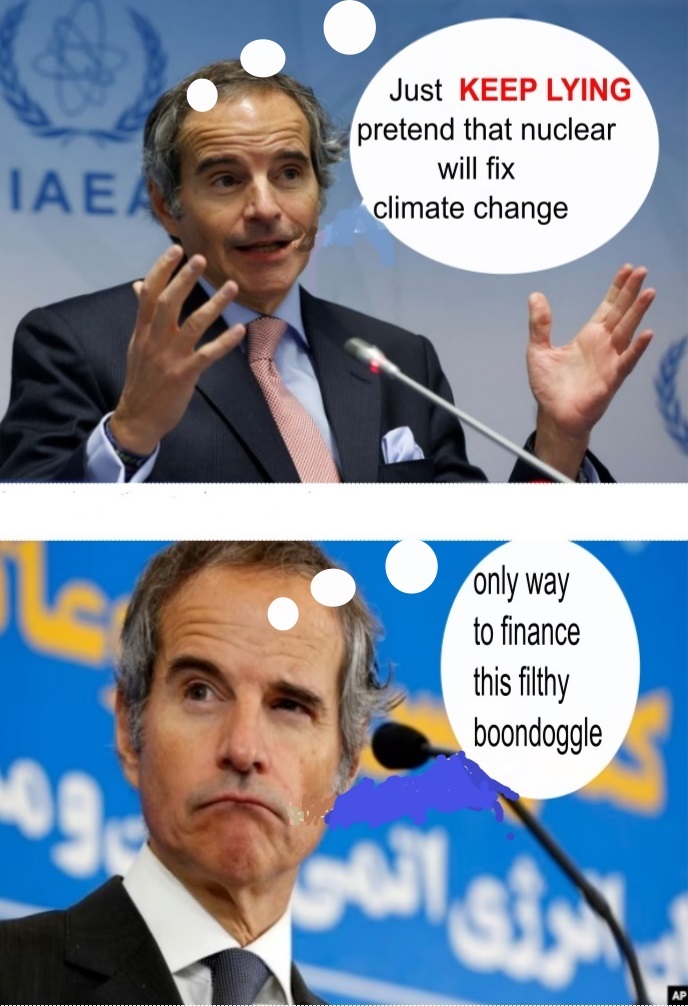
COP 29 will be a flop anyway – so I suppose that is some kind of twisted comfort – in that very few will trust the outcome of this hijacked UN Climate Summit
From IAEA website’s disgusting propaganda:
“ a rich programme of IAEA and partner events to showcase nuclear science and technology solutions for climate change “
“The IAEA is organizing a series of events on four thematic areas: energy, food, the ocean and water. “
“an informed debate on the tools and benefits offered by nuclear technology”
Hijacked by all the polluting industries, but the biggest liar of the lot is the IAEA – with their full knowledge that nuclear does nothing to fight climate change. And in fact – climate change effects will kill the nuclear industry,

1 This month

of the week – Australians for War Powers Reform (AWPR)
To see nuclear-related stories in greater depth and intensity
 Antinuclear