TODAY. Time to ban Israeli sporting teams, just as the world banned South African teams in the 1970s

The Western corporate media has done a terrific job in depicting Israeli hooligans in Amsterdam as victims of anti-semitism . We must hand it to the media for yet again depicting Zionists as the victims.
What happened in Amsterdam has been reported documented and videoed by those on the ground there. A November 8 video report by a 16-year-old who publishes YouTube reports under the moniker “Bender” provided extensive on-the-ground footage of a mob of armed Tel Aviv Maccabi ultras hunting victims, throwing metal poles at police vehicles, threatening journalists, and even being detained after attacking undercover police officers.
These were Israelis who travelled to Amsterdam ahead of the Uefa Europa League match against Amsterdam club Ajax, and provoked clashes with pro-Palestinian protesters. Ahead of match on Thursday, fans heading to the Johan Cruyff Arena stadium were seen shouting: “Let the IDF [Israeli army] fuck the Arabs”. After the match ,and later into the night, the Israelis provoked fights with the pro-Palestine youths.
The Gaza known death toll now approaches 44.000 – the media continues to report this as “reported by Hamas” – implying that perhaps we shouldn’t believe that number. In reality, with the unknown bodies beneath the rubble, the number would be much greater.
Yes, Jews have been the victims, over time – with the European pograms, culminating in the holocaust. Like some abused children, the Zionists have grown up to become the abusers, believing in an apartheid system, wherein Jews are the superior beings, and Arabs the inferiors.
In the 1970s and 80’s, the world condemned South Africa’s despicable regime of white superiority, and people in many countries took action, banning South South African goods. Musicians and artists boycotted South Africa, even some banks stopped lending to South Africa. And most painful of all, to the “superior” white South Africans, they were excluded from excluding sporting events, particularly football.
Not that this exclusion put an end to apartheid. Black South Africans, and eventually white ones too, did this. But the movement to end apartheid was greatly helped by international protest and action. The sporting boycott was symbolic of rejection of apartheid.
It is so appropriate, that South Africa is now leading the charge, in international law. South Africa filed 750 pages of “overwhelming” proof that Israel is committing genocide in Gaza to the International Court of Justice in The Hague, Netherlands. South Africa got rid of its apartheid policy, and now wants Zionist apartheid to end, too.
I am quite proud that my country, Australia, was prominent and outspoken in its banning of apartheid South Africa from sporting events. Now, Australia is joining 158 other countries in backing UN resolution recognising ‘permanent sovereignty’ of Palestinians.
It’s time to recognise who are the victims of the Zionist regime – and it’s not the Zionists – much as the media portrays them as victims.
Time to exclude Israeli sporting teams.
B-2 Bomber Strikes in Yemen and their significance for Australia
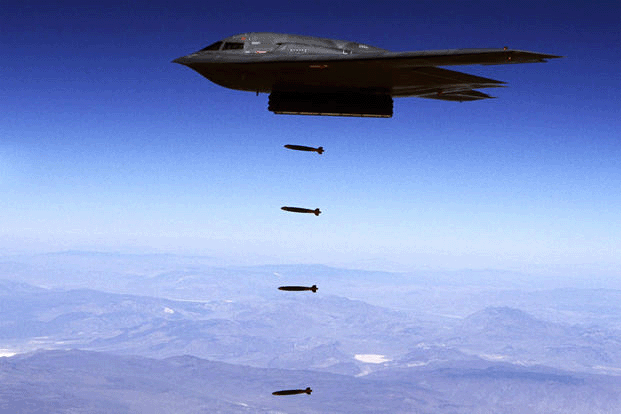
Australia is the only foreign country publicly known to have provided direct military support for the B-2 strikes in Yemen.
The obvious question that comes to mind therefore is why the Australian government acquiesced to involving Australia in the B-2 strikes?
what, if any, are the limits to Australia’s support for US strategic bomber operations should the region become engulfed in all-out war?
s. Washington now views Australia as ‘the central base’ of its Indo-Pacific operations squarely targeted at China
By Vince Scappatura Nov 12, 2024
Australian territory has been used in supporting US B-2 bombers en route and in return from strikes against Houthi targets in Yemen on October 17, and highlights the profound strategic significance of this event for the future role Australia may play in US strategic bomber operations against China, in the Asia Pacific and beyond.
NAPSNet Special Report:
Vince Scappatura, “B-2 BOMBER STRIKES IN YEMEN AND THEIR SIGNIFICANCE FOR AUSTRALIA”, NAPSNet Special Reports, November 11, 2024, https://nautilus.org/napsnet/napsnet-special-reports/b-2-bomber-strikes-in-yemen-and-their-significance-for-australia/
I. Introduction
Washington now views Australia as ‘the central base’ of its Indo-Pacific operations squarely targeted at China; and the strikes in Yemen make clear that the United States is willing and able to utilise its new base capabilities in Australia to devastating effect.[1]
Vince Scappatura documents the novel use of Australian territory in supporting US B-2 bombers en route and in return from strikes against Houthi targets in Yemen on October 17, and highlights the profound strategic significance of this event for the future role Australia may play in US strategic bomber operations in the Asia Pacific and beyond.
Vince Scappatura is Sessional Academic in the Macquarie School of Social Sciences at Macquarie University, and author of The US Lobby and Australian Defence Policy,………………………………………….
The global significance of B-2 strikes in Yemen
In a statement published late on the evening of Wednesday 16 October 2024 (EDT), Secretary of Defense Lloyd Austin revealed US forces had conducted strikes against five hardened underground weapons storage locations in Houthi-controlled areas of Yemen.[1] Although the US Navy also played a role in the operations, US Central Command announced the use of US Air Force B-2 Spirit long-range stealth bombers.[2]
The decision to launch strikes using the distinctive bat-wing bomber, which has been employed relatively infrequently in combat operations, contains a significance beyond the immediate conflict with the Houthis and carries implications that have assumed greater importance in light of the results of the recent US presidential election.
In the first instance the strikes signal the possibility of a larger conflagration in the Middle East, with the B-2’s unique combination of stealth and ‘bunker buster’ capabilities sending a clear message to Iran about America’s commitment to the defence of Israel; a commitment Washington has made even as Israel has taken a series of escalatory steps against Iran that have placed the region on the brink of all-out war.
However, they also carry a broader significance in demonstrating the ability of the US Air Force to deliver devastating strikes worldwide, including nuclear strikes due to the dual-capable role of the B-2, which is particularly salient for any future operations against both China and Russia.
Moreover, the B-2 strikes have momentous strategic implications for Australia, although this fact was left unexamined in media coverage of the event.
The Australian Department of Defence (hereafter Defence) confirmed to the Australian Broadcasting Commission (ABC) that Australian airspace and airbases were accessed in support of the strikes.[3] This participation marks the first time since World War II that Australian territory has been directly used to support US strategic bomber operations.
This novel use of Australian territory follows significant infrastructure developments at airbases across the north of the country, still ongoing, that are ultimately being developed to enable full-spectrum support for US ‘deterrence’ operations against China.[4]
The B-2 strikes in Yemen are the first active demonstration of these developing capabilities and a harbinger of more comprehensive Australian support for any future US strategic air operations, including potential nuclear missions, perhaps in the Middle East, but also ultimately against China and even Russia.
The Australian government is yet to acknowledge the profound strategic implications foregrounded by the strikes in Yemen, while Defence has been unnecessarily opaque about the details of the operation. A full account and wide understanding of Australia’s role in the strikes and what it portends are crucially important for democratic transparency and accountability, while the spectre of the forthcoming Trump administration contributes to the urgency.
Trump’s erratic and unpredictable decision-making, combined with the president’s sole authority over the use of nuclear weapons, highlights the risks of the United States, and by implication, Australia, becoming engulfed in a fateful conflict that is neither anticipated nor desired by their respective peoples. If there was a time for Australian political leaders to be forthright about the dangers of positioning Australia in the frontline of US strategic bomber operations it is now more than ever.
A rare bomber strike; and a message to Iran
…………………………………………….The Pentagon refused to divulge the specific type of ordinance that was employed in the strikes, although an anonymous source revealed to a specialist military journal that the B-2s dropped 2,000-pound BLU-109 JDAM ‘bunker buster’ bombs.[8]
Of particular significance for Iran is the fact that the B-2 is uniquely capable of employing the 30,000-pound GBU-57 Massive Ordinance Penetrator (MOP) in combat operations, reportedly reaching targets of up to 200 feet underground.[9] Iran’s nuclear facilities are known to be deeply embedded underground at Fordow and Natanz and could only plausibly be destroyed by the employment of the MOP.[10]
Although Iran wasn’t mentioned by name, the Pentagon made it clear that the employment of the B-2 was not only a message to the Houthis but any ‘potential adversaries that hide things deep underground. It’s a message to them as well.’[11]
An historic first for Australia
Although aspects of the Australian role in supporting the B-2 strike mission remain unclear, the fact that it prefigures future support for a range of US missions involving conventional and nuclear forces in contingencies anywhere in the world demands a full account and understanding.
Australia is the only foreign country publicly known to have provided direct military support for the B-2 strikes in Yemen. Moreover, achieving this level of logistical cooperation represents a significant milestone in Australia-US military cooperation.
In its statement to the ABC, Defence declared that support for US strikes in Yemen was provided ‘through access and overflight for US aircraft in northern Australia’. The ABC also reported that air-to-air refuelling aircraft were part of the mission, although Defence declined to confirm this claim.[12]
The precise extent and nature of Australia’s support is still unknown, including whether any Australian Defence Force (ADF) capabilities were employed in support of the B-2 bombers. Defence has so far declined to comment further about Australia’s involvement, citing operational security. However, a Defence department spokesperson did issue a clarification to the ABC that American B-2s were not operating out of RAAF Base Tindal in the Northern Territory at the time of the strikes.
RAAF Base Tindal is currently undergoing a major infrastructure expansion project to support the future forward-deployment of up to six B-52 (and eventually, possibly B-2 and B-1) strategic bombers, along with refuelling and transport aircraft. The upgrades include a squadron operation facility for mission planning, crew briefings and intelligence, along with maintenance facilities, strategic fuel reserves, and earth covered magazines for stockpiling munitions. The massive fuel storage facilities at Tindal have already been completed.[13]
B-2 bombers are known to have been operating out of RAAF Base Amberly in Queensland across the months of August and September in a Bomber Task Force mission that saw the aircraft covering vast distances throughout Australia and the Indo-Pacific, including ‘hot pit’ refuelling at the US base in Diego Garcia. However, the BTF mission had concluded by September 18.[14]
The clarification about Tindal issued by Defence, along with the nondescript use of the term ‘US aircraft’, leaves open the possibility that B-2 bombers operated from other RAAF bases in northern Australia, either en route or in return from Yemen, although there is no operational reason for the B-2s to have landed in Australia as against overflying and refuelling from aircraft operating from Australian airfields.
……………………………..photos taken by local Australian aviation enthusiasts provide evidence for a plausible scenario whereby US tankers operating out of Australia were used to refuel US B-2 bombers both enroute and in return from strikes in Yemen.
Western route to the Middle East
To fly over Australian airspace enroute to Yemen, US B-2 bombers are likely to have flown west over the United States and out across the Pacific Ocean before continuing over northern Australia and across the Indian Ocean to their eventual target.
A similar route, although traversing further to the north of Australia into Southeast Asia, was used when B-2 bombers launched strikes against the Taliban in Afghanistan in the aftermath of the terrorist attacks on 11 September 2001. To reach their targets without landing, the bombers were required to carry out aerial refuelling five times off the coasts of California, Hawaii, Guam, the Strait of Malacca and finally Diego Garcia (see figure 1).[16]
Although there is a shorter and more direct route to Yemen flying east from the United States, this path has the advantage of avoiding the need to inform and seek permission from several countries in Europe and the Middle East whose airspace would otherwise be traversed. Flying a carefully plotted western path over northern Australia would avoid the airspace of several Southeast Asian states with large Islamic populations and potential political sensitivities to the strikes. Whether intended or not, it also signals to China and Russia that US strategic airpower can attack them via their ‘soft’ southern underbelly as was planned and exercised during the Cold War.
Overflying northern Australia
The presence of B-2s over Australian airspace at the time of the strikes in Yemen can be confirmed by aircraft communications with civilian air traffic control towers responsible for managing Australia’s airspace.[17] This type of communications is publicly available via online sources such as LiveATC.net.[18]
………………………………………………….Having left their location in the Coral Sea after checking in with the Brisbane Centre on October 16 at 3pm AEST, the B-2 bombers arrived at their target destinations in Yemen approximately 19 hours later at around 3am in local time on October 17.[24]
As reported by ABC News, air-to-air refuelling aircraft were a part of the B-2 mission that logistically required ‘access and overflight’ in northern Australia. This claim was neither confirmed nor denied by Defence…………………………………………………………………………………………………………………..
Unanswered questions
There was no immediate post-strike assessment provided by the Pentagon when the strikes in Yemen were first announced on October 16………………………………………..
Although the Pentagon provided only scant details of the strikes, there has not to date even been an official statement about Australia’s participation in the operation made by the Minister for Defence or released on the website of the Australian Department of Defence. Nor has there been a post-operation account about the success or otherwise of the strikes.
This lack of transparency by Defence is typical but especially unwelcome given the operation marks an escalation in Australia’s participation in the conflict in the Middle East and especially its contested role in providing direct and indirect support to Israel in its wars in Gaza and Lebanon where there are reasonable grounds for believing war crimes and even genocide have been committed.[33]
Defence frequently promotes capability demonstrations of increased interoperability between the ADF and US military forces in official media releases, and Australia’s participation in the US strikes in Yemen represents the first combat demonstration of how Enhanced Air Cooperation under the framework of the US Force Posture Initiatives can be successively used for strategic bomber operations.[34] But if the joint operation was intended to contribute to ‘deterrence’ then the logical approach would have been to draw attention to it.
The obvious question that comes to mind therefore is why the Australian government acquiesced to involving Australia in the B-2 strikes? Australia’s long history of reflexive support for US military operations probably goes a long way in explaining the decision. But incremental decisions announced in a series of recent AUSMIN consultations has led to an unprecedented degree of Australia-US defence integration with implications for Australian participation in US global military operations that political leaders in Australia may not have fully appreciated.[35]
Whatever the rationale, Australians have a right to know about the nature and extent of Australia’s support for the strikes in Yemen, including what US aircraft were involved and what Australian bases they may have operated from. Specifically, Defence should be transparent with the Australian people about the following questions:
- Although it seems unlikely, did the B-2s in fact land at any Australian bases?
- US aerial refuelling aircraft were undoubtedly part of the mission. But did they draw from Australian or US dedicated fuel reserves?
- Were any ADF capabilities employed to support the B-2 strikes during their overflight of Australia or in the region more broadly?
- What assessment was made to ensure Australia’s participation in the strikes was compliant with International Humanitarian Law?
Finally, participation in the B-2 strikes in Yemen have taken Australia a step closer to becoming further entangled in the conflict in the Middle East. This leads to the obvious question of what, if any, are the limits to Australia’s support for US strategic bomber operations should the region become engulfed in all-out war?
Merely citing ‘operational security’ in refusing to answer such questions is wholly inadequate. Democratic transparency and accountability require any potential operational security concerns to be fully explained and justified.
The future of US strategic bomber operations in Australia
Although the strikes in Yemen point to the risks Australia faces in reflexively supporting its ally in yet another conflict in the Middle East, ultimately this unique demonstration of Australia’s growing capabilities to contribute to US strategic air operations is a harbinger of more comprehensive support for any future US conflict with China and/or Russia.
The Australian government has displayed no willingness to publicly acknowledge, let alone debate, the implications of America’s steady military buildup in the north of the country and the deepening integration of the ADF with US armed forces. Washington now views Australia as ‘the central base’ of its Indo-Pacific operations squarely targeted at China; and the strikes in Yemen make clear that the United States is willing and able to utilise its new base capabilities in Australia to devastating effect.[36]
It is critical therefore that the Australian public and its political leaders at all levels comprehend the profound implications of participating in the B-2 strikes in Yemen. It prefigures similar and more prominent roles for Australia in American conventional and nuclear operations not only in the Middle East, but in East Asia and the Pacific, and especially around China and even Russia.
Although tactical surprise may require opacity before and during such a joint operation, there is no excuse for the failure to share with the Australian people what Australia has done, not least so that they are prepared to make informed judgements that will restrain or enable future expanded joint operations now envisioned by the two governments under the 2014 Force Posture Agreement and more recent AUKUS rubric, but not shared with their respective peoples.[37]
Until a full official account is provided, observers could be forgiven for assuming that supine acquiescence on the part of the Australian government in supporting American strikes combined with Defence’s utter lack of accountability explains how Australian airbases and airspace were utilised to support the B-2 strikes in Yemen.
III. ENDNOTES – 1 – 37…………………………………more https://johnmenadue.com/b-2-bomber-strikes-in-yemen-and-their-significance-for-australia/
1 This month
15 April – Zoom –Nuclear Power is Not the Solution
Apr 15, 2026 01:00 AM in Canberra, Melbourne, Sydney

Join the International Physicians for the Prevention of Nuclear War (IPPNW) on Tuesday, April 14th for a timely webinar exploring the risks associated with nuclear power and challenging the myth that it offers a simple, safe, carbon-free solution to the climate crisis

of the week – Australians for War Powers Reform (AWPR)
To see nuclear-related stories in greater depth and intensity
 Antinuclear