Signing US/UK nuclear deal would shred Australia’s credibility: Turnbull
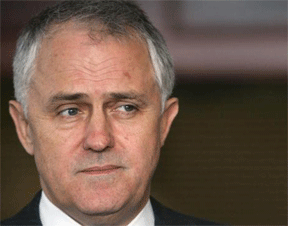
Australia would kill its credibility internationally if it were to embrace domestic nuclear power to please key foreign allies, Malcolm Turnbull has warned, accusing the Coalition of gaslighting voters over power prices.
Amid a heated fight in parliament over a nuclear agreement signed by the United States and the United Kingdom at the COP29 talks in Azerbaijan this week, the former prime minister said Australia had distinct advantages on renewable energy and must make decisions in its national interest.
“The job of the Australian prime minister is to stand up for Australia and recognise Australia has distinct interests and distinct characteristics,” Mr Turnbull told The Australian Financial Review.
“Simply falling into line and being some sort of sycophantic copier of everybody else’s agendas doesn’t bring you in any respect.”
The former Liberal leader’s comments followed Britain and the US signing a deal for civil nuclear collaboration at the summit in Baku, part of plans to combine billions of dollars for research and development of new technologies.
An early version of the British government’s statement announcing the deal said Australia would be among a number of other countries signing on. But the UK government conceded on Tuesday that Australia had been included in the statement erroneously.
The original statement, viewed by the Financial Review, said countries signing on would include Canada, France, Japan, South Korea, South Africa, China, Switzerland and Australia.
But the updated agreement, published online by UK Energy Secretary Ed Miliband, has the names of participating countries removed and says only that Russia will remain excluded because of its invasion of Ukraine.
A spokeswoman for Energy Minister Chris Bowen, who is representing Australia at the talks, ruled out any participation, noting Australia had no nuclear energy industry and a federal ban on nuclear power is in place.
The government said Australia would remain as an observer to the deal, and support scientists in other nuclear research fields.
In question time on Wednesday, Acting Prime Minister Richard Marles accused the Coalition of exaggerating the significance of the statement.
“Every expert out there makes it completely clear that what we are awaiting is a 20-year duration before we could reasonably expect to have nuclear energy in this country, were we to go down that path,” he said.
“Even then, all we are talking about is a contribution of 4 per cent to the electricity grid.
“What we are pursuing is policies in the here and now, which are being pursued around the world: firmed renewable energy, which is the cheapest form of energy, which is being brought online around the world.”
Mr Dutton accused the government of a stubborn refusal to consider nuclear, as countries including South Korea, Turkey and Nigeria had joined another pledge to triple global nuclear power by 2050. He said nuclear could “reduce emissions and deliver energy at a reasonable cost”.
Long a critic of Mr Dutton’s leadership, Mr Turnbull said nuclear would not complement renewable energy.
“That is nonsense. That’s gaslighting, quite frankly,” he said. “What complements renewables is something that is flexible. We have 4 million households in Australia. Over a third of all Australian homes have got solar panels on. It’s the highest percentage of solar household solar penetration in the world.”
Tom McIlroy is the Financial Review’s Canberra Bureau Chief based in the press gallery at Parliament House. He was previously the AFR’s political correspondent. Connect with Tom on Twitter. Email Tom at thomas.mcilroy@afr.com
Paul Smith edits the technology coverage and has been a leading writer on the sector for 20 years. He covers big tech, business use of tech, the fast-growing Australian tech industry and start-ups, telecommunications and national innovation policy. Connect with Paul on Twitter. Email Paul at psmith@afr.com
Albanese government gives firm ‘no’ to joining UK-US agreement to advance nuclear technology
The Conversation, November 19, 2024, Michelle Grattan, Professorial Fellow, University of Canberra
The Albanese government has been put on the spot by a new agreement – which it has declined to join – signed by the United Kingdom and the United States to speed up the deployment of “cutting edge” nuclear technology.
The original version of the British government’s press release announcing the agreement said Australia, among a number of other countries, was expected to sign it.
But the reference was removed from the statement.
The UK Energy Secretary Ed Miliband and the US deputy Secretary of Energy David Turk signed the agreement in Baku during COP29…….
A spokesperson for Energy Minister Chris Bowen, who is at the COP meeting, said: “Australia is not signing this agreement as we do not have a nuclear energy industry.
“We recognise that some countries may choose to use nuclear energy, depending on national circumstances.
“Our international partners understand that Australia’s abundance of renewable energy resources makes nuclear power, including nuclear power through small modular reactors, an unviable option for inclusion in our energy mix for decarbonisation efforts.”
Australia would remain as observers to the agreement to continue to support its scientists in other nuclear research fields, the spokesperson said………
In parliament, acting Prime Minister Richard Marles said for Australia to pursue a path of nuclear energy would add $1200 to the bills of each household in this country.
………………………Update: UK government seeks to clear things up
Later The Guardian reportred: “The UK government has conceded it made a mistake in including Australia in a list of countries that has signed up to a US-UK civil nuclear deal”. https://theconversation.com/albanese-government-gives-firm-no-to-joining-uk-us-agreement-to-advance-nuclear-technology-244041
Rio Tinto to take full control of controversial mine in Kakadu
By Simon Johanson, 20 Nov 24, https://www.smh.com.au/business/companies/rio-tinto-moves-to-shut-down-controversial-mine-in-kakadu-20241120-p5ks2q.html
The last chapter in one of Australia’s big environmental battles is set to play out after mining giant Rio Tinto moved to take full control of the controversial Ranger uranium mine near the World Heritage-listed Kakadu National Park.
Rio, the world’s second-biggest miner by market value, told the ASX on Wednesday it will compulsorily acquire the remaining shares it does not own in its subsidiary Energy Resources of Australia (ERA), taking control of the contentious Ranger uranium mine and neighbouring Jabiluka deposit, one of the world’s richest known sources of untapped uranium.
ERA wound up its uranium oxide operation at Ranger in 2021, but the cost of rehabilitating the mine is on track to exceed $2.2 billion and concerns have lingered among traditional owners, the Mirarr people, about ERA’s intentions, particularly after it applied for a 10-year mining lease extension over Jabiluka in March this year.
Rio, which owned a large stake in ERA, began working with ERA on rehabilitating the mine in 2021. ERA was legally required to rehabilitate the operation by 2026 estimating it would cost $500 million, but budget blowouts and differences between ERA’s board and Rio led to a fractious relationship with its majority shareholder before Rio reached an agreement with ERA to take over management of the mine’s rehabilitation in April this year.
The push to mine Jabiluka at one stage sparked fierce opposition among traditional owners and environmental campaigners in 1998. Thousands of protesters took part in a human blockade at the site and hundreds were arrested in the ensuing clampdown.
The lease area covers a sacred site with hundreds of ancient rock art galleries. In the end, Jabiluka was never mined, and ERA pledged it would not develop the area as long as the Mirarr remain opposed to it.
Rio’s Australia chief executive Kellie Parker reaffirmed the dual London-Australia listed miner had “no intention to invest in mining or development of the Jabiluka deposit”.
“Proceeding with compulsory acquisition, after participating for our full entitlement in the ERA capital raising, underlines our commitment to Ranger’s rehabilitation,” Parker said.
Australian Conservation Foundation campaigner Dave Sweeney said Rio’s takeover of Ranger brings certainty to the delivery of rehabilitation works.
“There is a massive shortfall in funding for the Ranger clean-up and Rio has deeper pockets, more talent and greater reputational exposure than ERA,” Sweeney said.
ERA launched a capital raising in October that resulted in $766.5 million to fund rehabilitation of the Ranger mine. Rio bought its maximum entitlement in the raising, which pushed its shareholding up from 86 per cent to 98 per cent.
It immediately said it would move to mop up the remaining shares held by minority investors in ERA under the compulsory acquisition rules of the Corporations Act for the same price, $0.002 per ERA share, as the entitlement offer.
“We remain committed to the successful rehabilitation of the Ranger Project Area to a standard that will establish an environment similar to the adjacent Kakadu National Park, a World Heritage site,” Parker said.
ERA’s board said it would keep shareholders informed of any subsequent developments and steps taken by Rio Tinto.
The global miner’s purchase of new shares under the capital raising will boost its voting power in ERA to 98.43 per cent, overwhelming a vocal minority of shareholders who were seeking to block Rio boosting its stake and who have been pushing for the Jabiluka deposit to be developed.
Britain’s Nuclear Bomb Scandal: Our Story review – how the UK’s atomic testing programme devastated lives

Trauma, terror and potential medical effects that last for generations – those who experienced the fallout of nukes in Australia and the Pacific tell their horrifying tale
Jack Seale, Thu 21 Nov 2024 https://www.theguardian.com/tv-and-radio/2024/nov/20/britain-nuclear-bomb-scandal-our-story-review
Grenfell, the Post Office, infected blood, Hillsborough … Britain has witnessed a long series of injustices where walls of silence and lies have stopped the powerless inconveniencing the powerful by telling their whole truths. To that list, in the section where further disclosure is still urgently required, we should add the UK’s nuclear testing scandal. This calmly scathing documentary sets out the case.
Post-second world war, the US and the USSR engaged in a nuclear arms race, and Britain – desperate to cling to its place at the world’s top table – felt obliged to join them. As it tried to keep up with developments in atomic and hydrogen bombs, nuclear tests were desired, but letting off nukes anywhere near regular British citizens was politically unviable, so distant lands were sought and human guinea pigs identified.
The locations chosen were Pacific atolls and the Australian outback and coast; the unwitting human test subjects were, as well as the local people, around 39,000 British and Commonwealth servicemen and scientists. Between 1952 and 1963, they witnessed 45 atomic and hydrogen bombs being detonated, along with hundreds of other radioactive experiments. Many of those affected, who had been stationed at the blast sites so the effects on humans could be monitored, are interviewed in this film.
Leading the talking heads are British veterans who, as young men in the 1950s and 60s, were offered the chance to sail halfway around the world to serve their country. Initially, when they arrived at, say, Christmas Island or the Monte Bello archipelago off the coast of north-western Australia, they were in paradise, living a life of sunshine, beer, seafood and beach football with, as one says, “no idea what we were letting ourselves in for”. Now, they live with cancers and other health problems they are convinced are linked to what they experienced – or with the traumatic memories of coming face to face with humanity’s most powerful, awful creation.
Not every study has backed the men’s claims about the negative health impacts of the nuclear tests, but plenty have and, in any case, the problem is that the picture is incomplete. Court cases and dogged freedom of information requests have been required to access records from the Ministry of Defence, the existence of which the MoD had previously denied. But the veterans still wouldn’t have enough to claim for compensation, even if Britain had an equivalent to the nuclear-testing compensation schemes that exist in other countries.
Here and now, we have the men’s own testimony, which is frightening. Their recollection of sitting on a beach with their bare hands over their eyes, waiting for an unholy explosion to go off in the sea behind them, is eerie and nightmarish. One man’s memory of being flown in a plane through a mushroom cloud, looking down at a crimson inferno below before being flipped upside down by the force of the explosion, is hard to even comprehend.
Almost more upsetting are the tales of what came next, particularly among the men’s offspring. Children were born with disabilities and disfigurements; grandchildren show signs of genetic defects. The official line remains that there is no correlation between this and the tests, and that “no information is withheld from veterans”. The veterans, bitterly and tearfully, disagree.
Then there is the small matter of the Indigenous Australians whose ancestral homelands were deemed to be uninhabited before British nuclear tests were carried out. At Emu Field in south Australia in 1953, warnings about the prevailing wind were ignored, and the radioactive cloud was blown towards an Indigenous community that included the late Yami Lester, who was blinded by radiation exposure and became an anti-nuclear campaigner. We hear his famous description, given in 1999, of “this black mist coming over and quietly rolling through the mulga trees, black and shiny, oily looking”. Community members reported unusual, serious health issues within hours.
There is also an interview with Australian air force veteran and whistleblower Avon Hudson, who risked imprisonment to draw attention to the effects of the tests at Maralinga, a little south of Emu Field. Hudson, a resolute but deeply sad man, leads the film-makers to the programme’s starkest image: the cemetery in the small military town of Woomera, with its rows of tiny graves. The surge in infant deaths and stillbirths was never satisfactorily explained.
Hudson fought for a royal commission, which convened in 1984 and went some way to healing the damage done in Australia, but the surviving Brits – now grandfathers, sharp of mind but with faces etched by worry, and with their time running out – are still waiting for a public inquiry, for compensation, and for the release of their own full medical records. Answering their questions honestly looks like the least we can do.
Britain’s Nuclear Bomb Scandal: Our Story aired on BBC Two and is on iPlayer.
1 This month
15 April – Zoom –Nuclear Power is Not the Solution
Apr 15, 2026 01:00 AM in Canberra, Melbourne, Sydney

Join the International Physicians for the Prevention of Nuclear War (IPPNW) on Tuesday, April 14th for a timely webinar exploring the risks associated with nuclear power and challenging the myth that it offers a simple, safe, carbon-free solution to the climate crisis

of the week – Australians for War Powers Reform (AWPR)
To see nuclear-related stories in greater depth and intensity
 Antinuclear