TODAY. Surprise ! surprise! – the nuclear lobby has co-opted an ex-politician with a dubious history – Tony Blair
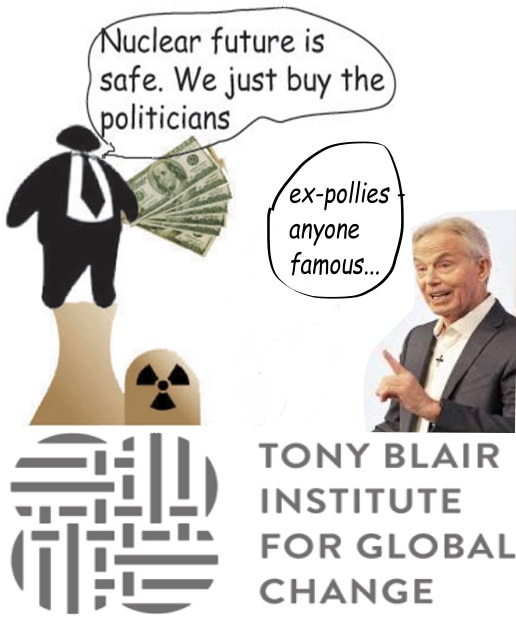
Ross Clark, writing in The Spectator, bemoans the fact that the Tony Blair Institute, as it touts nuclear power, dismisses the problems of safety and costs. Tom Pashby, writing in The New Civil Engineer, goes further in criticism, looking more deeply at the problems that Blair ignores: nuclear’s poor performance in comparison with renewables, and the shady pressure of industry-dominated think tanks, and the military lobby.
For a shady industry dominated think tank – you couldn’t find a better example than the Tony Blair Institute for Global Change (TBI). Tony Blair set up the TBI in 2017. Its purpose – “to help governments and leaders make their vision for development a reality. Providing analysis, commentary and lessons from their work with governments in fragile, developing and emerging states” It started out as a general do-gooder think tank, with a strong religious slant. It is a non-profit, and Blair does not receive a salary, but its analysts are paid for their work.
Over time, Blair and his Institute have been been accused of profiting from business and consultancy roles, and of conflicts of interest. The Tony Blair Institute confirmed that it had received donations from the U.S. State Department and Saudi Arabia. In 2024, the Tony Blair Institute provided paid work for the authoritarian regime in Azerbaijan when Azerbaijan hosted the COP29 Climate conference. There is a remarkable lack of transparency about Blair’s earnings from his own consultancy and speaking roles.
Even when Prime Minister, Blair was already helping BAE weapons corporation to make lucrative deals with corrupt regimes in Egypt. Later, as Peace Envoy, Blair made much money bolstering business opportunities with Egypt and other repressive regimes, Saudi Arabia, the UAE, Kazakhstan, Kuwait Colombia . Blair came to:
“epitomise the corruption at the heart of British public life. That’s not to say he’s done anything illegal. And it’s not just about the vast income, the seven houses, the £2m retainer with JP Morgan or the trading of influence and advocacy with corrupt authoritarian governments – all based on the contacts he built up as an elected British political leader.“
That was all over 10 years ago. Fast forward to now, and the Tony Blair Institute for Global Change (TBI) has become something much more influential and dangerous. Kiran Stacey, writing in The Guardian writes:
“the former prime minister has arguably become more powerful thanks to the work of the Tony Blair Institute for Global Change (TBI), which has exploded in size and revenue during the last few years. Its accounts show it made over $81m (£65m) in revenue in 2021, a 78% increase on the previous year.”
“This is an organisation bankrolled by billionaires, which continues to advise and take money from the murderous Saudi government. What’s worse, its solutions reflect these corporate interests“
Tony Blair has become far more powerful now, than he was as Prime Minister. He is keen for the TBI to expand its interests to many more countries. Blair is known to have a strong influence on UK Prime Minister Keir Starmer.
And guess what – Blair – with his enthusiasm for new technology, is besties with Elon Musk – surely a good step for Blair, to get in good with President Trump – great for his Institute and for the global nuclear lobby!
The seven ways the Federal Coalition could cook the books on nuclear costings

December 5, 2024, The AIM Network, Climate Council, https://theaimn.com/the-seven-ways-the-federal-coalition-could-cook-the-books-on-nuclear-costings/
Australians are being kept in the dark about the true costs of the Federal Coalition’s risky and expensive nuclear scheme.
The Federal Coalition’s heavy reliance on the first of two Frontier Economics reports paints a damning picture of the methods they may use to fudge the nuclear numbers and mislead Australians. We’ve already seen them cherry-pick numbers and use them to make misleading claims in Parliament.
Climate Councillor and economist Nicki Hutley said: “The Federal Coalition’s nuclear scheme would cost Australians a bomb. It’s a risky, expensive fantasy that would see Australians paying more than $100 billion for a fraction of the electricity we need. The real danger is delaying real solutions–like building more renewables, which is the most affordable way to keep the lights on.”
The Climate Council has identified five furphies Australians are likely to see in the Federal Coalition’s nuclear costings:
1) Comparing apples with oranges: We’ve already seen the Federal Coalition use inaccurate comparisons in the first Frontier Economics report on the cost of the shift to renewables. They inflated the cost by including ongoing fuel and maintenance expenses—which we’re already paying and which will actually drop in a renewables-led grid. On top of that, they didn’t use present value terms, a standard economic practice that accounts for the true cost over time.
Nicki Hutley, Climate Councilor and Senior Economist, said: “It’s alarming to see the Federal Coalition knowingly compare costs that are for totally different things. If we’re going to have a debate on the economics of building renewable power and storage, it needs to be based on best practice economics, not a false and misleading comparison.”
2) Excluding the cost of attempting to keep our ageing coal stations open: AEMO expects all our outdated, unreliable and polluting coal-fired power stations to close by 2038 at the latest, with over 90% shutting down in the next 10 years. But the Federal Coalition wants to keep these creaking old coal power stations open while waiting at least 15 years or more for nuclear reactors. This would cost taxpayers a bomb in constant maintenance and fault repairs. Keeping just one coal power station open, Eraring in NSW, could cost taxpayers more than $225 million per year. Renewable power back by storage is the only solution ready now to fill that gap left by coal and secure reliable, affordable power for Australian homes and businesses.
3) Excluding the cost of managing highly radioactive nuclear waste:Toxic nuclear waste needs to be safely stored for 100,000 years – an enormous and costly responsibility. In Canada, storing the long-term waste from their nuclear program in an underground facility is expected to cost at least $33 billion AUD, excluding the costs already incurred to manage waste on nuclear reactor sites.
Nicki Hutley, Climate Councilor and Senior Economist, said: “Any plans to build nuclear reactors must include the staggering long-term costs of managing highly radioactive nuclear waste. Ignoring these costs now will unfairly burden our kids, grandkids and future generations.”
-Advertisement-
4) Failing to consider the cost of climate change: The Federal Coalition’s nuclear scheme won’t cut climate pollution. In fact, building nuclear reactors would mean burning more polluting coal and gas in the meantime, which could see a further 1.5 billion tonnes more harmful climate pollution produced by 2050 – the equivalent of running the Eraring coal power station in NSW for another 126 years. Australians would pay the price in worsening unnatural disasters and skyrocketing insurance costs.
Nicki Hutley, Climate Councilor and Senior Economist, said: “Nuclear would cost us dearly, by delaying urgent cuts to climate pollution that would expose Australians to more unnatural disasters like bushfires, floods and heatwaves and driving up economic losses through higher insurance costs and disaster recovery bills. We should be focusing on cutting costs and climate pollution by rolling out more clean, reliable and affordable renewable power.
5) Ignoring Australia’s growing electricity needs: As Australia’s population and economy grows, keeping up with the community’s electricity needs is essential. The Australian Electricity Market Operator’s plan for our grid, the Integrated System Plan, expects power demand to double by 2050. We need more power to meet this need, and any assessment of cost needs to account for this. Assuming less might make costs look cheaper, but is inaccurate.
6) Ignoring the risk of cost blowouts: The Federal Coalition’s nuclear costings are likely to rely on rose-tinted assumptions, ignoring the very real possibility of massive cost overruns and delays that have plagued international nuclear projects.
For example, the UK’s Hinkley Point C energy facility is running 14 years late, at a cost three times its original estimate—now sitting at a staggering $90 billion AUD. Assuming nothing will go wrong with nuclear reactors in Australia flies in the face of international experience and puts taxpayers at enormous financial risk.
Nicki Hutley, Climate Councilor and Senior Economist, said: “Nuclear is simply a non-starter for Australia. The risks are immense—blowouts in cost and time, unresolved waste storage issues, and outdated technology. Projects like the UK’s Hinkley Point C show that nuclear is a financial black hole, while renewables are delivering results today.”
7) Ignoring the cost of transmission upgrades: The Federal Coalition assumes nuclear reactors can avoid the costs of necessary transmission upgrades, despite these investments being approved and supported by the previous Liberal-National Government.
Australia’s electricity grid needs substantial upgrades to meet growing energy demands and replace ageing coal-fired power stations. Building reactors near old coal stations won’t avoid the need for new transmission: the transmission previously used for coal is already being used by new batteries, wind and solar, and more investment is being planned. New transmission is needed no matter which energy source we build, and will make our grid stronger and more efficient.
Amanda McKenzie, CEO of the Climate Council, said: “Peter Dutton could cook the books with some creative accounting to sell this fantasy. Our old coal plants are retiring in the next decade, and we need to keep investing in low cost renewables to keep the lights on, create thousands of jobs in regional Australia, and ensure we cut climate pollution further and faster.
“Let’s focus on what’s already working. Renewables are cutting pollution, creating jobs, and lowering power bills right now.”
Women strongly opposed to nuclear power, just one in three men willing to live near a plant

Marion Rae, Dec 4, 2024, https://reneweconomy.com.au/women-strongly-opposed-to-nuclear-power-just-one-in-three-men-want-to-live-near-one/
Women are strongly opposed to nuclear energy and are most concerned any consideration of the controversial power source will delay the switch to renewables, polling shows.
A national survey released on Wednesday to coincide with a federal inquiry found a stark gender divide, with a mere 26 per cent of women saying nuclear would be good for Australia, compared with 51 per cent of men.
But only one in three of the men surveyed were willing to live near a nuclear plant.
Almost two-thirds (63 per cent) of women said they do not want to live near a nuclear plant and more than half (57 per cent) do not think transporting radioactive waste is worth the risk.
The DemosAU poll of 6709 adults between July 2 and November 24 also found a higher percentage of men (42 per cent) said they were concerned about the safety of the technology than those who were not concerned.
A women’s climate change movement, 1 Million Women, surveyed an additional 3351 women and found 93 per cent of its supporters were concerned about nuclear energy, with the top-ranked concern its potential to derail the rollout of renewable energy.
The findings come as a federal inquiry into nuclear power generation is scheduled to hold a public hearing in Melbourne with industry, health and climate witnesses listed to speak.
Community leaders, unions and grassroots organisations plan to gather outside to declare “our shared energy future is renewable, not radioactive”.
“Shadow energy minister Ted O’Brien is the ultimate triple threat of energy politics: his nuclear plan will increase power bills, increase taxes and increase climate pollution,” said Sanne de Swart, co-ordinator of the Nuclear Free Campaign with Friends of the Earth Melbourne.
Mr O’Brien said on Tuesday only the coalition was committed to delivering “cheap, clean and consistent energy” to all Australians.
“We need a coalition government elected to build nuclear power plants and get more gas into the market to provide cheaper and consistent energy for all Australians,” he said.
The opposition is readying to fight for nuclear energy at the next federal election, with plans to build reactors at seven sites across Australia but no details as yet on how they will be paid for.
The independent Climate Council said it was concerned the coalition was relying on one private sector “base case” rather than expert costings on nuclear power from bodies such as the Australian Energy Market Operator.
The industry’s Clean Energy Council said it would confuse policy makers and confound the public’s understanding of the cost of replacing ageing energy infrastructure.
“Ultimately what’s crucial is that any new investment is made at the least cost to Australian consumers,” a council spokesperson told AAP.
“Only renewable energy – solar, wind, hydro – together with energy storage, is capable of delivering on this – and it’s being built right now,” the council said.
1 This month
7 April – WEBINAR – Australia and the Doomsday Clock – Preventing nuclear war through NoFirstUse and other policies
Online | Tuesday April 7, 4:00-5:30pm, Australian Eastern Time / 8:00-9:30am Central Europe Time
– Access the registration link
15 April – Zoom –Nuclear Power is Not the Solution
Apr 15, 2026 01:00 AM in Canberra, Melbourne, Sydney

Join the International Physicians for the Prevention of Nuclear War (IPPNW) on Tuesday, April 14th for a timely webinar exploring the risks associated with nuclear power and challenging the myth that it offers a simple, safe, carbon-free solution to the climate crisis

21 April Webinar: No Nuclear Weapons in Australia
Start: 2026-04-21 18:00:00 UTC Canberra, Melbourne, Sydney (GMT+10:00)
End: 2026-04-21 19:30:00 UTC Canberra, Melbourne, Sydney (GMT+10:00)
Event Type: Virtual
A virtual link will be communicated before the event.
Host Contact Info: australia@icanw.org

of the week – Australians for War Powers Reform (AWPR)
To see nuclear-related stories in greater depth and intensity
 Antinuclear