Nuclear energy debate draws stark gender split in Australia ahead of next year’s election.
Lisa Cox, 5 Dec 24, https://www.theguardian.com/environment/2024/dec/04/nuclear-energy-debate-draws-stark-gender-split-in-australia-ahead-of-next-years-election
Survey finds 25 percentage point gender gap across all age brackets on whether nuclear power would be positive for the country, with majority of men saying it would.
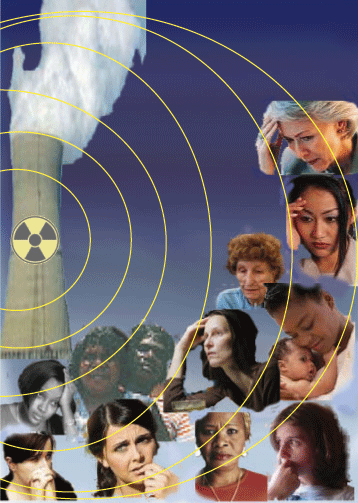
New data points to a stark gender split in attitudes towards nuclear energy, with women much more likely to say they don’t support it or think the risks are too great.
Research company DemosAu surveyed 6,000 people on behalf of the Australian Conservation Foundation and found 26% of women thought nuclear energy would be good for Australia, compared with 51% of men.
DemosAu head of research, George Hasanakos, said the 25 percentage point gender gap was “the sharpest divide in attitudes between men and women” that the research firm had seen on any issue.
The polling found the split was pronounced regardless of the age of the people surveyed, with young men and women just as divided as those from older generations.
While 51% of men agreed nuclear energy would be good for Australia, that support dropped when asked if they would be happy to live near a nuclear plant.
A reported 38% of men agreed they would support a nuclear plant being located close to their city, with 44% disagreeing and 18% neutral. Among women, just 18% agreed they would be happy to have a nuclear plant near their city, with 63% disagreeing and 19% neutral.
“Men support nuclear much more than women,” the ACF chief executive, Kelly O’Shanassy, said.
“But as soon as you ask men more details such as ‘Would you be happy to live next door to a plant?’ or ‘Do you think one will be built within the next decade?’ – that level of support really comes down.”
The report found female respondents were more likely to answer “neutral” compared with male respondents. It identified this as both “a risk and opportunity for campaigners on both sides of the issue” as Australia approaches a federal election but said pro-nuclear campaigners would have to contend with widely held safety concerns about nuclear among women.
On the subject of transporting nuclear waste, the poll found 57% of women and 43% of men said it wasn’t worth the risk.
The prime minister, Anthony Albanese, has said the next election will be a referendum on nuclear power.
The Coalition has proposed seven sites where it says it would eventually replace coal-fired power plants with nuclear plants but not how much this would cost. The government has rejected the idea and the federal House of Representatives is conducting an inquiry into the consideration of nuclear power in Australia.
Multiple energy analysts have argued nuclear energy would be more expensive than other options and a nuclear industry would not be possible in Australia until after 2040.
O’Shanassy said among the report’s more interesting findings was that despite the gender gap on many aspects of nuclear, men and women were aligned in the view that renewables were cheaper.
A reported 47% of men agreed renewables would deliver cheaper energy, compared with 31% who disagreed (with 22% neutral).
While 47% of women also agreed renewables would deliver cheaper energy, 20% disagreed and 33% were neutral.
In separate data, the climate advocacy organisation 1 Million Women surveyed an additional 3,351 women among its own supporters and found 93% were concerned about nuclear.
“Nuclear energy is a distraction to meaningful climate solutions and women don’t have the time or patience to entertain the Coalition’s proposal,” its founder, Natalie Isaacs, said.
Peter Dutton cops backlash over push to build seven nuclear power stations in Australia

Opposition wants nuclear power plants over Anthony Albanese’s renewables
Daily Mail 4th Dec 2024, By BRETT LACKEY FOR DAILY MAIL AUSTRALIA
Aussies have hit back at plans to build nuclear power stations in the country as the Coalition ramps up its push to establish seven sites as part of its election promise.
Parliament’s House Select Committee on Nuclear Energy is investigating the proposal and is travelling around the country hearing views from local communities.
At a meeting in Traralgon in Victoria’s Gippsland region on Tuesday angry locals fired up at the plan, which would see one of the new nuclear plants built at the currently winding down Loy Yang coal plant just 10 minutes out of town.
The other six locations Peter Dutton has outlined for nuclear plants are at the coal plant sites of Tarong and Callide in Queensland, Liddell and Mount Piper in NSW, Port Augusta in SA and Muja in WA.
‘We do not need nuclear in Australia. We need to be pushing more renewable energy and the technology will develop more and more as we go to keep the lights on,’ president of community group Voices of the Valley, Wendy Farmer, told the meeting.
Shadow energy minister Ted O’Brien, also the committee’s deputy chair, asked if it was ‘just a no’ from Ms Farmer or if she was interested in studying whether nuclear could be a safe and effective form of electricity.
‘The Coalition have told us that they would consult with us for two and a half years but then they would go ahead with nuclear, whether we wanted it or not and our community would have no rights of veto,’ Ms Farmer fired back.
‘How can we trust the Coalition to have an independent study when you say proposal but where’s the proposal?’
Darren McCubbin, the CEO of Gippsland Climate Change Network, got a standing ovation when he told the meeting renewables were ‘ready to go’ while nuclear power stations would require years of consultations and reports.
‘I’d like to congratulate Mr O’Brien for recognising that we don’t have the science, that we need a work plan, that we need two and a half years of consultation,’ Mr McCubbin said.
‘Good on him for coming here and saying we don’t know the answers and we need to find them because they don’t have the answers.’
Mr McCubbin pointed to the 2GW of Victorian offshore wind power projects slated to be online by 2032, which would increase to 5GW by 2035.
Look right now we’ve got a stream towards renewables, we’ve got targets in place. We’ve got an industry waiting to go, we’ve got people coming from all over the world looking in Gippsland and saying we have a way of transitioning out [of coal-fired electricity].
‘We’ve got the science, we’ve got the community [support]. We’ve had Star of the South [wind farm project] here for five years doing community consultation and I appreciate that you recognise you haven’t done that.
‘So we’re ready to go and putting things off for two and a half years to have work plan after work plan and work plan is not a solution for jobs and growth within our region.’
A recent Demos AU poll of 6709 adults between July 2 and November 24 found that 26 per cent of women said nuclear would be good for Australia, compared with 51 per cent of men.
But only one in three of the men surveyed were willing to live near a nuclear plant.
Almost two-thirds (63 per cent) of women said they don’t want to live near a nuclear plant and more than half (57 per cent) said transporting radioactive waste isn’t worth the risk.
The report card follows polling by Farmers For Climate Action that found 70 per cent of rural Australians support clean energy projects on farmland in their local areas and 17 per cent were opposed.
That support came with conditions, including proper consultation and better access to reliable energy.
Sanne de Swart, co-ordinator of the Nuclear Free Campaign with Friends of the Earth Melbourne, claimed nuclear electricity would ‘increase power bills, increase taxes and increase climate pollution’.
The independent Climate Council said it was concerned the coalition was relying on one private sector ‘base case‘ for nuclear costings rather than expert advice such as from the Australian Energy Market Operator.
‘What’s crucial is that any new investment is made at the least cost to Australian consumers,’ a council spokesperson said. ‘Only renewables – solar, wind, hydro – together with energy storage is capable of delivering on this, and it’s being built right now,’ the council said.
Minister for Climate Change Chris Bowen recently took a swipe at Peter Dutton and the Coalition’s nuclear proposal saying that it would take too long to get the plants up and running.
‘Net zero by 2050 is not optional. Which means the critical decade is now.’
With six years to go to reach the legislated target of a 43 per cent reduction in greenhouse gas emissions, he said the nation was on track to meet it and to make 82 per cent renewable electricity in the national grid by 2030.
On Wednesday the House Select Committee was told legal requirements to make the former coal sites safe to build nuclear reactors will take decades of rehabilitation before they can be used.
‘We’re talking significant periods of time of two or three decades,’ Victoria’s Mine Land Rehabilitation Authority chief executive Jen Brereton said. https://www.dailymail.co.uk/news/article-14154479/Australia-nuclear-power-plant-locations-backlash.html
1 This month
15 April – Zoom –Nuclear Power is Not the Solution
Apr 15, 2026 01:00 AM in Canberra, Melbourne, Sydney

Join the International Physicians for the Prevention of Nuclear War (IPPNW) on Tuesday, April 14th for a timely webinar exploring the risks associated with nuclear power and challenging the myth that it offers a simple, safe, carbon-free solution to the climate crisis

of the week – Australians for War Powers Reform (AWPR)
To see nuclear-related stories in greater depth and intensity
 Antinuclear