TODAY. Misplaced jubilation as UK’s old brittle nuclear reactors allowed to crack on
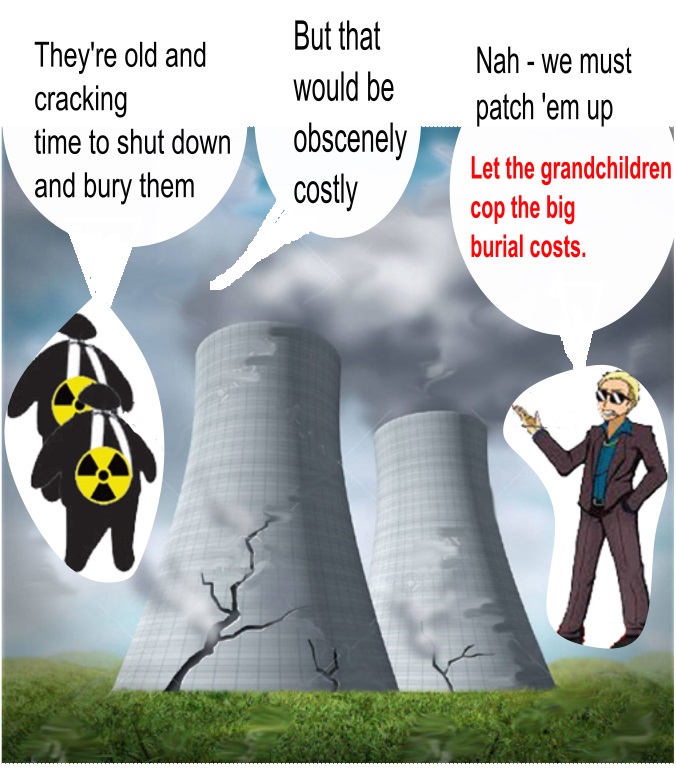
Joy and delight expressed by one corporate media outlet after another, as they report the announcement from (debt-laden) French nuclear company EDF that four UK nuclear power stations will be allowed to crack on, way past their use-by date.
“Crack” is the operative word here. Take for example, the Torness nuclear reactor in East Lothian – with 46 cracks in the nuclear core reported last July. It was scheduled to close in 2023.
Hunterston B, in North Ayshire is at long last to be decommissioned. In 2020 one of its reactors had an estimated 377 cracks, while the other had 209. The reactors were beginning to crumble, with cracks causing at least 58 fragments and pieces of debris to break off.
The Office for Nuclear Regulation (ONR has said that cracking could cause debris to inhibit vital cooling of highly radioactive reactor fuel. This can lead to a reactor meltdown, which can result in the escape of radioactivity to the environment.
Nobody in the prevailing establishment – corporate media, politicians, industry executives – nobody is facing up to the huge problem and huge cost of dismantling dangerous old nuclear reactors – so much better to pretend that it’s the charitable thing to just keep them going, Then it’s “jobs jobs jobs” and “community benefit” and “clean cheap energy” and “improved safety” “isn’t it wonderful” So say EDF 4th Dec 2024, the BBC, and Business Green 4th Dec 2024, and New Civil Engineer 4th Dec 2024, and Independent 3rd Dec 2024, The Herald, Lancs Live 4th Dec 2024.
Nary a word about the costs and dangers of the transport of radioactive materials, the ever-growing piles on nuclear wastes, the risks of terrorist attacks – and the completely unethical postponing of problems – just leave them for future generations to cope with.
Not nearly as much fuss was made about the world’s largest liquid air energy facility to be built at Hunterston – to store renewable energy, and provide 1000 jobs in the construction phase and 650 jobs in the local supply chain by its completion in 2030.

I try to be polite – but I empathise with Sir Jonathon Espie Porritt, 2nd Baronet, CBE who has just got so fed up with the cheerful glowing stories about prolonging the lives of decrepit nuclear reactors – “the whole deep nuclear state working away behind the scenes – as well as the UK’s astonishingly gullible media which just goes along with all this nuclear crap, year after year after year.“
Before you swallow Dutton’s nukes, look at the evidence

When it comes to a politician versus Australia’s peak scientific body about the cost of nuclear energy, I know who I’d rather believe.
So, Peter Dutton tells us that his nuclear policy will be cheaper than Labor’s renewables policy (“Dutton to claim nuclear rollout will end up cheaper than renewables”, December 6). I would recommend to readers the Climate Council’s myth-busting article “The seven ways the federal Coalition could cook the books on nuclear costings”.
Some points it includes are: excluding the cost of keeping our ageing power stations open until 2038, estimated at $225 million per year for the Eraring station alone; excluding the prohibitory costs for storing nuclear waste for no less than 100,000 years and giving no consideration to the cost of continuing to burn possibly 1.5 billion tonnes of carbon by 2050, which will increase the number of climate disasters and a rise in insurance premium costs for all of us.
It also ignores the reality of cost blowouts for building a nuclear system, and the cost of transmission upgrades that are needed at the ageing power stations that they are pretending to be cost-neutral sites for their nuclear plants and are already being used for new battery, wind and solar power. Charmain Brinks, Newcastle
The Intergovernmental Panel on Climate Change has stated that solar- and wind-produced energy is 10 times more effective at reducing carbon dioxide emissions than nuclear energy, which delivers far less power per dollar and is now adding as much energy in a year as renewables do in just a few days. Stanford University studies show new nuclear plants cost up to seven times as much as onshore wind or solar per kilowatt hour, and take five to 17 years to deploy. It will be interesting to compare Dutton’s estimated cost to store nuclear waste safely with the current estimated cost in Britain of £53 billion ($105 billion). Peter Nash, Fairlight
The claim that nuclear, in Australia, is cheaper than renewables is simply false. It ignores price changes over the past 20 years, whereby the cost of renewables, as predicted, has fallen by 90 per cent. Also, 2050 is 25 years away; anyone who thinks solar power will be the same 25 years from now is deluding themselves. Batteries will be much cheaper, in real terms, in 25 years’ time. Critical materials such as lithium will be in the recycling phase by then. On the other hand, since nuclear energy depends so much on the fuel cycle, it could become more expensive. Meanwhile, renewables will continue to get cheaper as transmission lines with aluminium cables improve, and get cheaper, and hydrogen-generation costs fall by a factor of 10 or more with natural gas feed. Noel Thompson, Riverview
It appears that the Coalition is pushing its nuclear power idea solely based on dubious capital cost estimates produced by a friendly associate. Nobody is considering such important issues as waste disposal, plant location with cooling water supply security or the availability of specialist labour and construction timelines. Giorgio Genocchio, Lane Cove
Rather than pouring hundreds of billions of dollars into nuclear submarines, our money would be better spent on building a national fast train network to the advantage of all Australians. The estimated cost of the submarines is $368 billion, while the estimated cost of a national fast train network is $150 billion. The days of manned submarines are limited, and nuclear subs bring with them all the attendant problems of basing, manning and maintenance – for a questionable defence benefit. The rail job should be put out to international tender. In a fair competition, China might well be the winner, as China has the world’s largest fast train network. Clive Williams, Forrest (ACT)
At $500 billion, Peter Dutton’s 2045 nuclear plan is not only late, it’s expensive. At that price, we could put $33,000 worth of batteries on each of Australia’s 15.2 million buildings and abandon the grid altogether. Sarah Hart, Gordon
When it comes to a politician versus Australia’s peak scientific body about the cost of nuclear energy, I know who I’d rather believe. Dave Horsfall, North Gosford
Nuclear energy inquiry draws emotional response in Port Augusta

By Annabel Francis and Arj Ganesan, ABC North and West SA, 7 Dec 24
In short:
The select committee conducting an inquiry into nuclear power generation in Australia has triggered strong opinions from both sides of the fence.
Aboriginal leaders, resident representatives, and leaders from the mining and energy sector have spoken during a hearing at Port Augusta.
What’s next?
Should the opposition win the next election, it has promised to hold a two-and-a-half year consultation period over its nuclear plans.
The federal government’s select committee inquiry into nuclear power generation at Port Augusta has stirred strong emotions among those making a submission.
For anti-nuclear activist and Yankunytjatjara Anangu woman Karina Lester, it is a debate she is tired of having.
“Governments change, committee members change … organisations, company members, CEOs of companies change,” Ms Lester said.
“Those of us that are in the frontline are constantly needing to remind governments of the impacts of nuclear in our communities.
“Aboriginal people of South Australia have always said no to nuclear.”
Ms Lester, who gave evidence at a select committee hearing in Adelaide, describes herself as a survivor of the Emu Field nuclear tests.
She said Indigenous people had seen the impacts of nuclear technology first-hand.
Her father, Yami Lester, went blind at the age of 16 following British weapons testing in Maralinga in South Australia in the 1950s.
Ms Lester said she feared Indigenous groups would suffer if the federal opposition’s nuclear plans went ahead.
“Aboriginal communities are always the solution or pressured to be the solution for the waste issues,” she said.
“The history shows us that locations identified are locations that are First Nations or Aboriginal people’s traditional lands.”
Port Augusta’s former coal power station was one of seven sites that was earmarked as a possible location for the opposition’s nuclear energy plan.
The Nukunu Wapma Thura Aboriginal Corporation, which holds native title over the proposed site, has voiced strong opposition to any nuclear proposal.
“Aboriginal people throughout the region and state of South Australia have historically and overwhelmingly opposed nuclear energy, and the storage of its waste,” a spokesperson said.
Greg Bannon from the Flinders Local Action Group gave evidence at the public hearing in Port Augusta about the potential risk of a nuclear accident.
He has opposed nuclear technology for decades and said the time to switch to nuclear energy had passed. “I think it’s old technology, and I don’t think we need it,” he said.
Mr Bannon said any accident or error would not only have a devastating impact on the local community but also on vulnerable marine ecologies, such as the giant Australian cuttlefish that aggregates about 50 kilometres away from Port Augusta……………………………https://www.abc.net.au/news/2024-12-06/nuclear-energy-hearing-emotional-port-augusta/104694596
Baseload power generators not needed to guarantee supply, say science and engineering academies
Sören Amelang, Dec 5, 2024 https://reneweconomy.com.au/baseload-power-generators-not-needed-to-guarantee-supply-say-science-and-engineering-academies/
An energy system dominated by solar and wind energy does not require baseload power stations to guarantee supply security, German research academies have said.
“The academy project ‘Energy Systems of the Future’ (ESYS) has concluded that a secure energy supply is also possible without baseload power plants,” said the National Academy of Science and Engineering (acatech), the German National Academy of Sciences (Leopoldina), and the Union of the German Academies of Sciences and Humanities.
Baseload power plants supply electricity continuously, whereas so-called residual load plants run only intermittently when needed.
“A combination of solar and wind energy with storage, a flexible hydrogen system, flexible electricity demand and residual load power plants will be necessary for a climate-friendly and reliable electricity supply,” the academies said.
The German government plans to use hydrogen-fuelled gas turbine plants to back up its renewables-based future electricity system.
The researchers modelled the potential of four baseload technologies: nuclear power plants, geothermal energy, natural gas power plants with CO2 capture, and nuclear fusion power plants.
Their results showed that baseload plants could become part of future energy systems if they save costs – a scenario the scientists consider unlikely. Baseload plants’ greatest impact on the overall system is that their surplus electricity could be used to run electrolysers, which would turn electricity into hydrogen, they said.
“For baseload power plants to lead to a substantial cost reduction, their costs would have to fall significantly below the level forecast today,” said Karen Pittel, who heads the ifo Institute’s Center for Energy, Climate and Resources, and is also deputy chair of the ESYS board of directors.
“In fact, we estimate that the risks of cost increases and delays in baseload technologies tend to be even higher than with the further expansion of solar and wind energy.”
1 This month
7 April – WEBINAR – Australia and the Doomsday Clock – Preventing nuclear war through NoFirstUse and other policies
Online | Tuesday April 7, 4:00-5:30pm, Australian Eastern Time / 8:00-9:30am Central Europe Time
– Access the registration link
15 April – Zoom –Nuclear Power is Not the Solution
Apr 15, 2026 01:00 AM in Canberra, Melbourne, Sydney

Join the International Physicians for the Prevention of Nuclear War (IPPNW) on Tuesday, April 14th for a timely webinar exploring the risks associated with nuclear power and challenging the myth that it offers a simple, safe, carbon-free solution to the climate crisis

21 April Webinar: No Nuclear Weapons in Australia
Start: 2026-04-21 18:00:00 UTC Canberra, Melbourne, Sydney (GMT+10:00)
End: 2026-04-21 19:30:00 UTC Canberra, Melbourne, Sydney (GMT+10:00)
Event Type: Virtual
A virtual link will be communicated before the event.
Host Contact Info: australia@icanw.org

of the week – Australians for War Powers Reform (AWPR)
To see nuclear-related stories in greater depth and intensity
 Antinuclear