CSIRO reaffirms nuclear power likely to cost twice as much as renewables
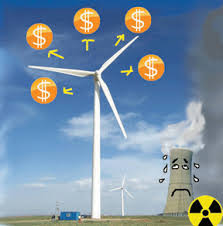
By energy reporter Daniel Mercer and National Regional Affairs Reporter Jane Norman, ABC News, 9 Dec 24
In short:
The CSIRO’s new GenCost report again says a nuclear power plant for Australia would likely cost twice as much as renewable energy.
Australia’s leading science agency also said nuclear power plants enjoyed relatively little financial advantage from their long lives and would run at a capacity similar to coal.
What’s next?
Opposition Leader Peter Dutton prepares to release the much-anticipated costings of the Coalition’s nuclear power policy this week.
Building a nuclear power plant in Australia would likely cost twice as much as renewable energy even accounting for the much longer life-span of reactors, according to a new report from Australia’s leading science agency.
In its latest economic analysis of the cost of building various energy projects, the CSIRO found nuclear plants enjoyed relatively little financial advantage from their long lives, which could be double a solar or wind farm.
It comes as the Opposition Leader Peter Dutton prepares to release the much-anticipated costings of the Coalition’s nuclear power policy this week. Mr Dutton has repeatedly said the policy would help bring down power bills, a claim challenged in this latest report.
The CSIRO regularly releases the GenCost report, which looks at the cost of Australia’s energy sources. It has consistently found renewable to be the cheapest option, despite a run of inclusions at the request of critics to make changes to the modelling — the latest being the life span of a nuclear plant.
And the agency said there was little evidence to suggest nuclear reactors in Australia would be able to benefit from running flat-out around the clock, noting they would face the same forces that are hollowing out the business case for coal.
The conclusions come after the CSIRO copped heavy criticism over a report in May that found Australia’s first nuclear power plant would cost up to $17 billion in today’s dollars and not be operational until 2040.
At the time, critics including opposition energy spokesman Ted O’Brien, who is spearheading the Coalition’s case for nuclear power, said the CSIRO analysis was flawed.
………………….an update of its GenCost report — which it carries out annually alongside the Australian Energy Market Operator — the CSIRO has largely stood by its earlier findings.
Nuclear’s long life ‘no advantage’
………………….CSIRO chief economist Paul Graham said even if a nuclear project could get a loan with a 60-year term, higher interest payments would wipe out many of the supposed gains.
……………………… low costs would be short-lived because nuclear reactors faced substantial refurbishment costs running into billions of dollars after about 40 years of operation.
For these reasons, Mr Graham said there was no “unique” cost advantage offered by nuclear compared with renewable energy projects backed by transmission lines and so-called firming technologies such as batteries and gas plants.
…………………………………………………………………………… No plant likely until 2040
On the subject of lead times to build nuclear, Mr Graham was steadfast.
He said suggestions Australia would be able to build its first nuclear reactor in sooner than 15 years seemed to stretch plausibility.
Nuclear proponents have pointed as an example to the United Arab Emirates, which went from having no reactors to commissioning its first project in 12 years.
Mr Graham said the UAE was, in many ways, a best-case scenario for the nuclear industry but the country was hardly comparable to Australia.
The UAE was an absolute monarchy with an autocratic style of government but Mr Graham said Australia was a democracy where policies were subject to many checks and balances.
Accordingly, he said overturning Australia’s ban on nuclear power, “planning, permitting and financing” a reactor would be a daunting task that took a lot of time.
……………………… “After we evaluated these three topics, potential for longer life, how often nuclear generates throughout the year, when we applied those numbers, we are still finding that large-scale nuclear would be 1.5 to 2.5 times the cost of generating from firmed solar and wind,” Mr Graham said.
……………………………….In line with its earlier findings, the CSIRO concluded renewable energy and the technologies required to back it up would be the cheapest way of meeting Australia’s future energy needs.
Energy Minister Chris Bowen said the CSIRO had accommodated the Coalition’s concerns and still found that Labor’s renewables-led approach was the cheapest way of overhauling the electricity grid.
He described the nuclear policy as “wildly optimistic”, in light of the report’s findings.
“[It] thought about those criticisms, analysed those criticisms and found that those criticisms don’t stack up,” Mr Bowen said.
………………………………..In what Mr Graham described as an “amazing achievement” in an inflationary environment, the CSIRO found battery costs had tumbled 20 per cent in the 12 months to June 30, while there had been back-to-back decreases of 8 per cent for large-scale solar.
Wind projects, by contrast, increased by 2 per cent last year following a whopping jump of 35 per cent in 2022-23 and an 8 per cent hike in 2023-24.
Cost estimates for miniature nuclear plants called small modular reactors (SMRs), meanwhile, were still by far and away considered the most expensive type of new energy project……https://www.abc.net.au/news/2024-12-09/nuclear-power-plant-twice-as-costly-as-renewables/104691114
No comments yet.
1 This month
15 April – Zoom –Nuclear Power is Not the Solution
Apr 15, 2026 01:00 AM in Canberra, Melbourne, Sydney

Join the International Physicians for the Prevention of Nuclear War (IPPNW) on Tuesday, April 14th for a timely webinar exploring the risks associated with nuclear power and challenging the myth that it offers a simple, safe, carbon-free solution to the climate crisis

of the week – Australians for War Powers Reform (AWPR)
To see nuclear-related stories in greater depth and intensity
 Antinuclear
Leave a comment