Peter Dutton’s bid to politicise top science agency is ‘absurd’, former CSIRO energy director says.

Glenn Platt says opposition leader’s ‘lazy’ response to report undermines science.
Graham Readfearn, Guardian, 11 Dec 24
A former CSIRO energy director has said Peter Dutton’s attempt to politicise the national science agency’s work on the likely costs of nuclear reactors is “incredibly disappointing” and “absurd”.
The opposition leader attacked the CSIRO after its latest GenCost report reaffirmed that electricity from nuclear energy in Australia would be at least 50% more expensive than power from solar and wind, backed up with storage.
Dutton claimed: “It just looks to me like there’s a heavy hand of Chris Bowen in all of this.”
Prof Glenn Platt, of the University of Sydney and an energy industry entrepreneur, was research director on energy at CSIRO before leaving the national science agency in 2021.
He said instead of debating the substance of the CSIRO’s report, Dutton’s response was “lazy” and undermined the scientific process.
“It’s incredibly disappointing. It’s lazy just to say that you must have been politicised because the answer isn’t what you like,” said Platt, a fellow of the Australian Academy of Technological Sciences & Engineering.
The Coalition is expected to reveal details this week on the costs of building taxpayer-funded nuclear reactors at seven sites of coal-fired power stations around the country.
CSIRO’s annual GenCost report details the likely costs of different electricity generation technologies in Australia.
Bowen, the energy minister, said GenCost was “an independent report with no role by any member of parliament or minister”, and said Dutton should apologise to the agency.
Dutton has previously claimed the agency’s GenCost report had been “discredited”, prompting the agency’s chief executive, Doug Hilton, to hit back, saying the criticism was unfounded.
The latest report said evidence from other western democracies suggested it would take at least 15 years to plan, develop and build a nuclear reactor in Australia. A future Coalition government would have to repeal federal laws banning nuclear energy and negotiate on several state bans…………………………..more https://www.theguardian.com/australia-news/2024/dec/11/peter-duttons-bid-to-politicise-top-science-agency-is-absurd-former-csiro-energy-director-says
How anger at Australia’s rollout of renewables is being hijacked by a new pro-nuclear network

Facebook groups opposing renewables projects are now increasingly full of pro-nuclear content, and groups such as Nuclear for Australia have set up dedicated social media accounts targeting specific sections of the community – such as an Instagram account titled “Mums for Nuclear” – as they gear up for the election campaign.
Facebook groups opposing renewables projects are now increasingly full of pro-nuclear content, and groups such as Nuclear for Australia have set up dedicated social media accounts targeting specific sections of the community – such as an Instagram account titled “Mums for Nuclear” – as they gear up for the election campaign.
An alliance of political groups is harnessing real fears about the local impact of wind and solar farms – and using them to spruik nuclear power.
By Ariel Bogle and Graham Readfearn
The entrance is marked by an AI-generated image of a dead whale, floating among wind turbines. On the first floor of the East Maitland bowling club, dire warnings are being shared about how offshore wind may impact the Hunter region – alongside a feeling of not being consulted, of being steamrolled.
“Environment and energy forums” like this one in late November have been held up and down the east of Australia, aiming to build a resistance to the country’s renewable energy transition.
Today’s event is being cohosted by No Offshore Turbines Port Stephens (NOTPS) and the National Rational Energy Network (NREN), a group with informal National party links that was behind February’s Reckless Renewables rally in Canberra. The advocacy group Nuclear for Australia is also here.
“We’re not a political group,” the NOTPS secretary and a Port Stephens resident, Leonie Hamilton, tells Guardian Australia.
“We’re not there to push [politicians] into parliament, but we are going to listen to what they have to say.”
Hamilton says she’s undecided on the issue of nuclear power.
The coastline of the Hunter was declared a potential area for offshore wind in mid-2023 after “extensive community consultation”, according to the federal government. But some, such as NOTPS’ Ben Abbott, are still angry about a perceived lack of detail about the project.
Today’s forum is about raising awareness across the Hunter, Hamilton says. “We think it’s important it happens before the election, so that people understand what the costs are.
“[The coast] belongs to everyone and they should have the opportunity to understand what’s going on.”
There are local groups like NOTPS around Australia that want their broad concerns about the rollout of renewable energy to be heard but say they do not want to be used for a political agenda and do not advocate for particular energy sources.
But working alongside those groups is an increasingly coordinated alliance of conservative thinktanks, political lobby groups and politicians who are flatly opposed to the clean energy transition.
Fears about the environmental and social impact of renewables projects are finding purchase in an information gap critics say has been ceded by the government, the industry and environmental groups – and there are plenty of interested parties willing to step in.
An earlier NREN event in Sydney was sponsored by the Institute of Public Affairs.
Sandra Bourke, a cohost of the Maitland event, is an NREN member but also a spokesperson for the conservative lobby group Advance – which was a key player in the defeat of the Indigenous voice to parliament and is now fundraising on a “lies of renewables” campaign.
A Facebook account under Bourke’s name is present in almost 20 community Facebook groups and pages opposing renewable projects, from Kilkivan, Queensland, to Bunbury, Western Australia, regularly sharing Advance clips and links to Sky News.
The upcoming election is a “crossroads”, she tells the crowd, while declining an interview with Guardian Australia. There’s an Advance sign-up form on every seat.
Up the back of the room are “Where’s Meryl?” posters, referring to the Labor incumbent MP Meryl Swanson, who holds the local electorate of Paterson.
The Liberal candidate Laurence Antcliff is here, along with three men in T-shirts bearing his name. He tells the room he is opposed to the offshore wind project in Port Stephens and will “fight every single day” to ensure it does not go ahead.
Swanson, who has said “many, many meetings” were held with local groups about the proposal, was not invited.
The nuclear energy wedge
In June the Coalition announced it would lift the bans on nuclear energy if it won next year’s election, then build nine publicly owned reactors at sites around the country.
The announcement gave extra fodder to advocacy groups and conservative thinktanks that have long opposed the shift to renewables.
Last week the opposition leader, Peter Dutton, appeared in Port Stephens alongside Antcliff. “It’s in this community’s best interest that [the windfarm] project does not proceed,” he said, as he spruiked the alternative of nuclear power.
Facebook groups opposing renewables projects are now increasingly full of pro-nuclear content, and groups such as Nuclear for Australia have set up dedicated social media accounts targeting specific sections of the community – such as an Instagram account titled “Mums for Nuclear” – as they gear up for the election campaign.
A new report looking at the pro-nuclear information ecosystem, funded by the progressive campaign group GetUp, found a “likely-coordinated and sophisticated ecosystem” of thinktanks, not-for-profits and political operatives engaged in pro-nuclear messaging.
For these interests, the focus on nuclear energy is a chance to “present a solutions-based response to climate change, and divert attention from their pro-coal and gas positions”, the report concluded.
“Nuclear energy provides a wedge for the environmental movement, climate independents, the Labor party and Greens, because it stokes division and can bog them down in technical explanations of why nuclear is neither desirable nor viable in Australia.”
Ed Coper, who is the chief executive of the communications agency Populares and has worked on teal campaigns, says the volume of noisy opposition to renewables is disproportionate to community attitudes. Nevertheless, he predicts nuclear will be an effective election campaign wedge.
For parties opposed to the clean energy transition, this is an opportunity to “peel off” environmental support from renewables support. The message to this cohort is broadly that “renewable energy generation is ruining pristine farming land and is not a good use of land and destroys the habitats of protected species and pristine views”, he says.
“That gives [the Coalition] a whole new constituency. If Labor goes into the election assuming everyone is against nuclear energy, they’ll be in for a shock.
“Energy transition requires an enormous amount of social licence.”
Solar plans discovered by chance
About 200km north-east of Melbourne, John Conroy and his family have been producing beef in Bobinawarrah since the 1960s. In a neighbouring paddock are plans for the large Meadow Creek solar farm and battery – plans he discovered by chance in September 2022 after a visit from the electricity distribution company AusNet.
“We alerted the community,” he says. “The project had been in the process for 12 months before we even knew about it
He says the main concerns of the community surround fire risk – both from the project but also the liability of landholders if fires on their properties spread to the solar farm.
In April the Victorian government removed the rights of landholders to appeal against planning decisions made on renewables projects.
“That is a real slap in the face,” Conroy says. “We’re a community of working-class people, producing food, doing our best to keep footy clubs going, and then the government takes away your rights to have a say.”
The independent federal MP for Indi, Helen Haines, says questions about insurance liability “should have been answered long ago”.
“We should be having these conversations long before a project is up for a planning permit.”
Families like the Conroys in her electorate are spending hundreds of hours getting across technical details of projects and government rules. “It shouldn’t be that way,” she says.
Haines says communities are operating in a “vacuum” and she wants to see information hubs in regional centres where people can go for trusted information and support.
The MP, with Senator David Pocock, last year successfully pushed for a government review into the way communities were being asked to host major renewables projects.
More than 700 people attended 75 meetings, with the review making nine recommendations the government said it would implement in collaboration with the states.
Governments needed to allow only reputable developers to build projects, the review said, and zones should be identified to avoid projects targeting inappropriate land areas.
“There is pushback – this is real and the concerns that communities have are existential,” Haines says. “We have to stop trying to generate social licence after a decision has been made.”
Instead, she says, the transformation should be about regional development and making sure communities have genuine long-term benefits from any projects.
“I want to look back and see better roads, better healthcare and internet, better childcare services, and see that the renewable energy transformation helped us get there. But communities are just not seeing that.”
Locals want ‘some control and influence’
“The fundamental issue here is there’s an assumption that there is no time to properly talk to people and give them not just a tokenistic say, but give them some control and influence in managing their local environment,” says Georgina Woods, who has 25 years of climate change activism and advocacy behind her.
Woods is head of research and investigations at the campaign group Lock the Gate, an organisation that emerged from the unrest among farmers and landholders at the coal seam gas boom in Queensland in the 2000s.
Governments have failed to clearly articulate why the transformation is needed and the urgency of climate action, she says. “We are getting further away from a broad consensus on why these projects are being done in the first place.”
“Until we put people and landscapes and nature at the centre, we’re at risk of repeating the same mistakes with renewable energy that we made with mining.”
West of the Blue Mountains in New South Wales are the gently rolling hills of Oberon. Outside town are plans for a 250-turbine windfarm on pine plantations owned by the state government.
Chris Muldoon, a committee member of Oberon Against Wind Towers, says that would mean local landholders would miss out on any financial benefits of hosting turbines while the town would have to live with the sight of turbines almost 300 metres tall in an area known for its postcard aesthetic.
“They’re chasing the wind and the towers, but there’s no consideration of the economic or social impact,” says Muldoon, who manages Mayfield Garden in Oberon, a tourist attraction owned by the wealthy Sydney-based businessman Garrick Hawkins.
Hawkins has contributed to the campaign to block the windfarm, says Muldoon, as have many locals.
In September the group put up nine candidates for the Oberon council elections, with two elected. Their pitch was uncompromising. “Oberon First are the only candidates who have committed to slamming the door in the face of greedy, arrogant wind tower developers,” the group said.
Oberon has a lot of hobby farmers and second homes for people in Sydney, says Muldoon, which means they have “city skills” that have mobilised against the development, something other communities do not have.
The group is not against windfarms or renewable energy, insists Muldoon, but “you just need to make less invasive decisions about the rollout”.
He points to people living in renewable energy zones, where surveys have shown broad support among farmers for renewables projects.
Outside those areas, he says, projects often come as a surprise to communities that are ill-prepared to navigate the technicalities of dealing with planning regulations, or wading through environmental impact statements “that can be 1,000 pages long”.
“Outside the renewable energy zones, the framework isn’t working,” he says. “It’s the wild west.”
Oberon is in the federal electorate of Calare, where the independent Kate Hook is trying to unseat Andrew Gee, who quit the Nationals to sit on the crossbench in 2022 over the party’s opposition to an Indigenous voice to parliament.
Hook left her job in September working for a not-for-profit to help communities negotiate with governments and renewable energy companies to get the most benefit from projects.
She says the “missing piece” causing communities to push back is a lack of understanding of why the transition away from fossil fuels is needed and how it could benefit them.
“People shouldn’t have to rely on Google, but this is why people are anxious,” she says. “There’s a tsunami of misinformation.”
“People might not like the look of windfarms, but do they want farmers to be able to stay on their land? Because these projects can help them do that.
“What we need is discussion, not division.”
A spokesperson for the climate change and energy minister, Chris Bowen, said the government was “working with local communities to secure regional jobs and provide energy security”.
“Unfortunately, the former Coalition government spent 10 years failing to make the necessary reforms to improve community engagement in a rapidly changing energy market,” she said.
The government was implementing the community engagement review “to enhance community support and ensure that electricity transmission and renewable energy developments deliver for communities, landholders and traditional owners”.
Will Donald Trump kill US-UK-Aussie sub defense deal?

The landmark defense agreement between the U.S, U.K. and Australia could be in jeopardy with the maverick Republican back in the White House.
Politico, December 9, 2024, By Stefan Boscia and Caroline Hug
LONDON — There are few issues on which we do not know Donald Trump’s opinion.
After thousands of hours of interviews and speeches over the past eight years, the president-elect has enlightened us on what he thinks on almost any topic which enters his brain at any given moment.
But in the key area of defense, there are some gaps — and that’s leading global military chiefs to pore over the statements of the president’s allies and appointees to attempt to glean some clues, specifically over the $369 billion trilateral submarine program known as AUKUS he will inherit from Joe Biden.
Trump does not appear to have publicly commented on the AUKUS pact — named for its contingent parts Australia, the United Kingdom and the United States — which would see the U.S. share technology with its partners to allow both countries to build state-of-the-art nuclear submarines by the 2040s.
This uncertainty has left ministers and government officials in London and Canberra scrambling to discover how the Republican is likely to view the Biden-era deal when he returns to the White House in January.
Two defense industry figures told POLITICO there were serious concerns in the British government that Trump might seek to renegotiate the deal or alter the timelines.
This is because the pact likely requires the U.S. to temporarily downsize its own naval fleet as a part of the agreement — something Trump may interpret as an affront to his “America First” ideology.
Looking east
There is hope in Westminster that Trump would be in favor of a military project which is an obvious, if unspoken, challenge to China.
The deal would see American-designed nuclear submarines right on China’s doorstep and would form a part of Australia’s attempts to bolster its military might in the Indo-Pacific.
When former U.K. Prime Minister Boris Johnson said in September 2021 that the deal was not “intended to be adversarial toward China,” President Xi Jinping simply did not believe him.
The Chinese leader said AUKUS would “undermine peace” and accused the Western nations of stoking a Cold War mentality.
Mary Kissel, a former senior adviser to Trump’s ex-Secretary of State Mike Pompeo, said “you can assume Trump two will look a lot like Trump one” when it comes to building alliances with other Western countries against China.
“We revivified the Quad [Australia, India, Japan and the U.S.], got our allies to bolster NATO funding and worked to prevent China from dominating international institutions,” she said.
However, the deal also forces the U.S. government to sell Australia three to five active Virginia attack submarines, the best in the U.S. Navy’s fleet, by the early 2030s as a stopgap until the new AUKUS subs are built.
Is America first?
This coincides with a time where there is a widely recognized crunch on America’s industrial defense capacity.
In layman’s terms, the U.S. is currently struggling to build enough submarines or military equipment for its own needs.
One U.K. defense industry figure, granted anonymity to speak freely, said there was “a lot of queasiness” in the U.K. government and a “huge amount of queasiness in Australia” about whether Trump would allow this to happen.
“There is a world in which the Americans can’t scale up their domestic submarine capacity for their own needs and don’t have spare to meet Australia’s needs,” they said.
“If you started pulling on one thread of the deal, then the rest could easily fall away.”
One U.K. government official played down how much London and Canberra are worried about the future of the deal, however.
They said the U.K. government was confident Trump is positive about the deal and that the U.S. was “well equipped with the number of submarines for their fleet.”………………………………………………………………………………………………………………………………..
‘Everyone’s a winner
This attempted U.K.-China reset will likely be high on the list of talking points when Healey meets with his Australian counterpart Richard Marles next month in London for an “AUKMIN” summit.
The Australian Labor government, after all, has conducted a similar reset with the Chinese government since coming to power in 2022 after relations hit a nadir during COVID.
Also at the top of the agenda will be how to sell the incoming president on the AUKUS deal in a positive way.
A second defense industry insider said the British and Australian governments should try to badge the deal in terms that make it look like Trump has personally won from the deal.
“Everybody is worried about America’s lack of industrial capacity and how it affects AUKUS,” they said.
“He is also instinctively against the idea of America being the world’s police and so he may not see the value in AUKUS at all, but they need to let him own it and make him think he’s won by doing it.”………………………………………………………………………..
Pillar II
While the core nuclear submarine deal will get most of the headlines in the coming months, progress on the lesser-known Pillar II of AUKUS also remains somewhat elusive.
Launched alongside the submarine pact, Pillar II was designed to codevelop a range of military technologies, such as quantum-enabled navigation, artificial intelligence-enhanced artillery, and electronic warfare capabilities.
One Pillar II technology-sharing deal was struck on hypersonic missiles just last month, but expected progress on a range of other areas has not transpired.
Ambitions to admit Japan to the Pillar II partnership this year have also gone unfulfilled……………………………………………………………
https://www.politico.eu/article/donald-trump-aukus-kill-us-uk-aussie-sub-defense-deal/
The Coalition told the CSIRO to redo its nuclear report. It’s bad news for Dutton
Mike Foley, December 9, 2024 , https://www.smh.com.au/politics/federal/the-coalition-told-the-csiro-to-re-do-its-nuclear-report-it-s-bad-news-for-dutton-20241205-p5kw6t.html
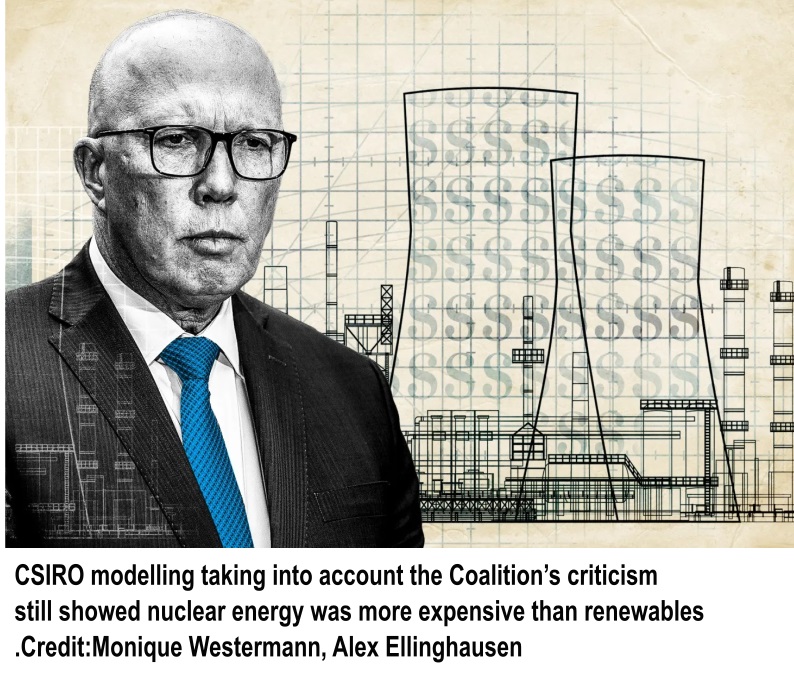
Nuclear power is still about 50 per cent more expensive than renewables, the CSIRO has found, even after the science organisation changed its modelling to accommodate criticism from the Peter Dutton-led Coalition that it had unfairly favoured wind and solar energy sources.
The report found the lowest cost projections for nuclear power would only match the highest projections for renewable energy, a major challenge to Dutton’s claim that nuclear is needed to cut electricity bills.
Dutton is preparing to release the long-anticipated costings of his party’s nuclear policy this week.
Dutton has fiercely criticised the government’s plan to boost the share of renewables to 82 per cent of the grid by 2030, claiming it is making electricity supply less reliable and more expensive.
He has instead pledged to create a “coal-to-nuclear transition” if elected, overturning state and federal bans on nuclear energy and building seven plants across the country.
“When you look at 19 of the top 20 economies in the world, they all have nuclear, or they’ve signed up to the latest generation nuclear technology. Australia is the only outlier,” Dutton told reporters in Tasmania on Sunday.
Highlighting the significance of the CSIRO’s findings, opposition energy spokesperson Ted O’Brien met with the science agency after its previous GenCost report in May found renewables were the cheapest form of energy and asked it to redo the modelling with key assumptions changed.
O’Brien declared that CSIRO should acknowledge a nuclear plant would be in near-constant use – generating power 93 per cent of the time – while also extending the assumed lifespan from 30 years to 80 years.
Proponents consider these factors crucial to reflect the real-world benefits of nuclear power plants and have argued that renewables get an unfair advantage when they are not adequately reflected in modelling.
CSIRO accommodated these requests and still found the cost of nuclear energy was significantly higher than “variable renewables”, namely wind and solar power backed up with batteries and a major transmission-line rollout.
“The cost range for variable renewables with integration costs is the lowest of all new-build technology capable of supplying reliable electricity in 2024 and 2030,” GenCost said.
The ratio of how long an energy generator is operational compared with sitting idle, known as the capacity factor, is key to the cost of its energy.
O’Brien claimed in May that CSIRO modelling should use the United States’ average capacity factor for a nuclear plant of 93 per cent.
In responding to O’Brien, CSIRO said it was appropriate to use a range of capacity factors, given the 15 coal plants in eastern Australia ran on average 60 per cent of the time and a nuclear plant would slot into the grid as a replacement for coal.
CSIRO’s modelling showed that, adjusted for Australian conditions, a traditional large-scale nuclear plant that was operational 90 per cent of the time would generate electricity at $155 a megawatt hour. With a utilisation rate of 53 per cent, it would cost $252 a megawatt hour.
In contrast, wind farms would generate power at $56 to $96 a megawatt hour, using a conservative range of capacity factors based on how often they were expected to run. Under a similar calculation, solar farms would generate power for between $35 and $62 a megawatt hour.
O’Brien’s second contention, that CSIRO should factor in an 80-year life span for a nuclear plant, rather than the 30-year life it assumed, made the economics more favourable because there was more time to repay loans.
CSIRO ran the numbers for a plant over 60 years. It found this would deliver a discount of 11 per cent on the original cost. However, most of this saving would be gobbled up by refurbishment costs, typically about $3 billion, needed when a plant was 40 years old.
The figures would be similar for a 100-year-old plant because it would need several refurbishments.
“Long-term operation of nuclear is not costless,” GenCost said. “Extension costs are incurred and are significant.”
CSIRO found a grid with 90 per cent renewables would produce electricity for between $106 and $150 a megawatt hour, including $40 billion in expenditure on the rollout, with new transmission lines as well as batteries and gas plants to back up wind and solar farms.
While GenCost provided a range of projections, the above costs were calculated in today’s dollars and assumed the current price of construction.
GenCost uses a levelised cost of energy calculation to price energy from various technologies. This represents the price needed for an electricity generation plant to earn back the cost of its construction and running costs over its lifespan.
CSIRO will update its GenCost report based on further feedback from stakeholders.
1 This month
7 April – WEBINAR – Australia and the Doomsday Clock – Preventing nuclear war through NoFirstUse and other policies
Online | Tuesday April 7, 4:00-5:30pm, Australian Eastern Time / 8:00-9:30am Central Europe Time
– Access the registration link
15 April – Zoom –Nuclear Power is Not the Solution
Apr 15, 2026 01:00 AM in Canberra, Melbourne, Sydney

Join the International Physicians for the Prevention of Nuclear War (IPPNW) on Tuesday, April 14th for a timely webinar exploring the risks associated with nuclear power and challenging the myth that it offers a simple, safe, carbon-free solution to the climate crisis

21 April Webinar: No Nuclear Weapons in Australia
Start: 2026-04-21 18:00:00 UTC Canberra, Melbourne, Sydney (GMT+10:00)
End: 2026-04-21 19:30:00 UTC Canberra, Melbourne, Sydney (GMT+10:00)
Event Type: Virtual
A virtual link will be communicated before the event.
Host Contact Info: australia@icanw.org

of the week – Australians for War Powers Reform (AWPR)
To see nuclear-related stories in greater depth and intensity
 Antinuclear