Is big tech going all in on nuclear? Google and Microsoft have just pledged $45 billion on renewables
Sophie Vorrath, Dec 13, 2024, Renew Economy
https://reneweconomy.com.au/is-big-tech-going-all-in-on-nuclear-google-and-microsoft-have-pledged-45-billion-spend-on-renewables/
Did you hear the one about big tech going nuclear? One of the lines being trotted out in support of nuclear power by shadow energy minister Ted O’Brien – and faithfully reproduced by the Murdoch press – is that everyone’s doing it, including global tech giants Google and Microsoft.
“Not only does Labor claim to know the economics of nuclear better than companies like Microsoft who signed a massive nuclear deal, but they also think they can run the numbers better than (US banks and financiers) who have come out in favour of nuclear energy,” O’Brien said in September.
Microsoft did announce, in September, a 20 year power purchase agreement with Constellation Energy to reboot one unit at the mothballed Three Mile Island nuclear power plant in Pennsylvania and rebadge it as the Crane Clean Energy Centre.
Three Mile Island was, in 1979, the site of the worst commercial nuclear power accident in US history. It was shuttered in 2019 for economic reasons, with Constellation’s then parent company Exelon Corp, saying in 2017 that its closure was due to lack of financial rescue from the state.
This is not unusual. According to TechCrunch, in the last decade, seven nuclear reactors have been decommissioned in the US, while only two new ones have been switched on.
Notwithstanding the fact that restarting a nuclear plant that has been shut down for five years has never been done before (according to reports, Constellation Energy is reportedly seeking a taxpayer-subsidised loan it hopes will save it $122 million in borrowing costs) this somewhat baffling deal is expected to supply around 850 MW.
Google, meanwhile, in October announced plans to invest in small modular reactors to meet its own growing data centre needs and Amazon followed suit, with news of “three new agreements to support the development of nuclear energy projects,” again with a focus on the the as-yet commercially unproven SMR technology.
So, yes – all three of these companies have recently announced plans to invest in nuclear power – albeit in markets where it already exists (although not in the case of SMRs) and in technology and applications that are highly speculative.
Does this mean they have come over all Team Nuclear? Hardly.
Amazon, as it bragged in October, has been the largest corporate purchaser of renewable energy in the world for four years running, according to Bloomberg NEF, having invested billions of dollars in more than 500 solar and wind projects globally, which together are capable of generating enough energy to power the equivalent of 7.6 million US homes.
Amazon met its goal of sourcing 100% of the electricity its uses with renewable energy in 2023 – seven years ahead of the 2030 target.
Google announced just this week that it was funding $US20 billion ($A31 billion) worth of renewable power projects across the US, in a deal with Intersect Power and investment fund TPG Rise Climate to develop power to drive several gigawatt-scale data centers.
Microsoft, last week, joined a US investor Acadia Infrastructure Capital and other companies to launch the Climate and Communities Investment Coalition (CCIC) to develop a $US9 billion ($A14 billion) pipeline of renewable energy projects across the country, as reported in Reuters.
On its website, Microsoft says it invested in over 23.6 million megawatt-hours of renewable energy in 2023 financial year – “enough to power Paris with renewable electricity for about two years.”
Earlier this year, the company announced plans to procure some 9.5GW of solar panels from Qcells for PPAs through 2032 – adding about 1.5GW every year. In April Microsoft revealed in a job listing that it had more than 20GW of renewable energy under contract.
Australian nuclear news 10 -16 December,
Headlines as they come in:
- Solar switch off: Dutton’s nuclear plan amounts to declaration of war against household energy systems
- The Coalition’s nuclear energy plan takes a sharp turn away from a cheaper, cleaner future
- Folly of Fission Impossible exposed by the fiscal facts
- The Coalition’s nuclear costings and their rubbery assumptions take us back to being a climate pariah.
- Less power, more climate pollution: Four ways Dutton is cooking the books on nuclear.
- Coalition’s eye-watering nuclear price tag could buy solar for every Australian home that doesn’t have it (five times over)
- Dutton’s nuclear promises billions for fossil fuels and a smaller economy for the rest of us
- Biggest losers from Coalition’s nuclear plan will be Australia’s 4 million solar households, industry says
- “South Australia’s Copper Strategy lacks ‘social license’ and fails contemporary public interest expectations and environmental and legislative standards”
- Energy generators poke holes in Dutton’s nuclear plan as questions over costings pile up
- Peter Dutton’s nuclear fantasy equals soaring power bills.
- Nuclear Neverland: The Lost Boys of Costings | The West Report -masse? https://www.youtube.com/watch?v=fSeaybp9oAA
- The Coalition’s master plan: Bring large scale wind, solar and battery storage installations to a halt.
- Peter Dutton’s nuclear plan: Mad, bad, and extremely dangerous
- The Coalition reveals the cost of its nuclear power plan – but the devil is in the missing detail.
- Dutton’s nuclear plan: An energy grid powered by endless spin.
- Is big tech going all in on nuclear? Google and Microsoft have just pledged $45 billion on renewables
- Fears nuclear power ‘may stop people moving to the bush’ .
- Dutton to reveal just how much he’s gambling on nuclear power,
- Not a hope in hell’ nuclear power can replace Australian coal-fired power by 2040, inquiry hears
- Inquiry into nuclear power generation in Australia: Exposing Ted O’Brien’s dishonest
- Peter Dutton’s bid to politicise top science agency is ‘absurd’, former CSIRO energy director says.
- CSIRO’s nuclear costings have recklessly ignored construction risk, and the taxpayer will pay
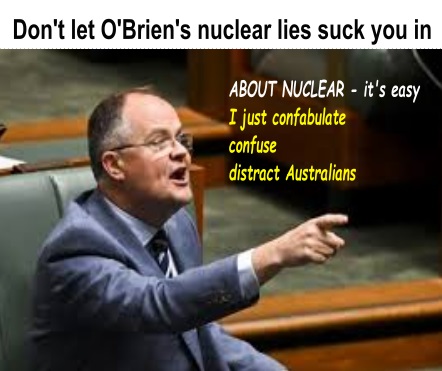
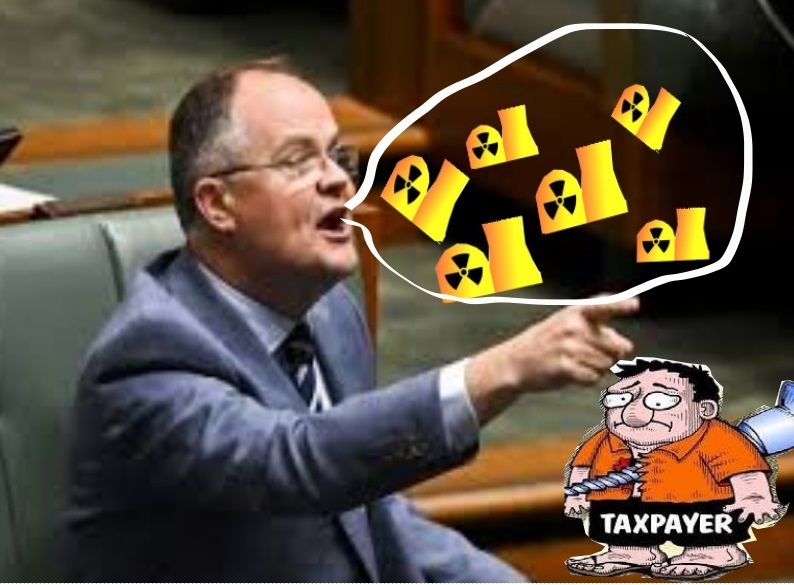
Inquiry into nuclear power generation in Australia: Exposing Ted O’Brien’s dishonesty.
| Philip White, 11 Dec 24 |
Ted O’Brien’s (Opposition energy spokesperson) disrespectful and dishonest questioning of witnesses during the hearings of the Inquiry into nuclear power generation in Australia.
At today’s hearing in Lithgow one of the witnesses started to call him out. This is the first time that I can remember anyone really challenging him. It would be helpful if he was called out more clearly, ideally in a way that strikes at the heart of his dishonesty. Make it hard for him to use these tactics.
He regularly asks questions along the following lines:
“Have you read such and such a report?” (99% of the time the witnesses have not.) He then quotes or paraphrases (or misrepresents) something out of the report and asks the witness to answer “Yes” or “No” to some loaded proposition. When the witness doesn’t give him the Yes/No answer he wants, he interrupts them and insists that they answer Yes or No. Loaded questions might be along the following lines:
Based on this report, would you agree that nuclear is a viable option?
Or
Do you think you know better than the [unquestionably authoritative] author of this report?
(These are not direct quotes, just the general gist. See below for a specific example.)
This approach is disrespectful, because it is unreasonable to expect witnesses to have read every official report that O’Brien chooses to use (or misuse) to back up his position. Of course, O’Brien knows they haven’t read the report.
It is also disrespectful, because it is generally used for the purpose of making a fool of the witness in order to destroy their credibility.
It is dishonest, because he quotes or paraphrases the reports selectively, out of context, and probably misrepresents the reports.
An example from today’s hearing in Lithgow (11/12/2024) illustrates the point. It can be heard from 1.24.55 on the following link:
These two witnesses stood up for themselves, but on many other occasions throughout these hearings, the witnesses have been left looking silly, even though the fault is with O’Brien’s dishonest approach. (Note that a similar approach is used by Coalition “Supplementary Member” of the Inquiry, Simon Kennedy.)
Ted O’Brien: “My question was going to go to your comments on the timing for the construction of those plants — Generation 3, Generation 3+. And my question is, Do you recognise the experience of the International Atomic Energy Agency with respect to advice on the timing of introducing nuclear energy to new nations? And also the experience and authority of ANSTO, the government’s nuclear technology advisers, when it comes to the construction of nuclear power plants?”
Geoffrey Miell (retired mechanical engineer): “I look at the actual construction times around the world….”
O’Brien then interrupted Miell’s very reasonable answer and demanded that he give a Yes/No answer to the question “Do you recognise…?”
When Miell offered a variation of his original response, O’Brien asked, “Does that mean you do not recognise their experience and expertise sir?”
After this, at 1.28.25, Sarah Elliot (nursing academic and member of NSW Nurses and Midwives Association) called O’Brien out:
“I will say that I have read transcripts Mr O’Brien where you have misled …[interrupted by bickering between Chair Repacholi and Deputy Chair O’Brien]… Mr O’Brien can I ask you to afford this panel the respect you gave to the last ones. We may not be in agreeance with your views, but can you please respect this panel that is before you right now … I’m disgusted with your behaviour as a representative of…”
The dishonesty of O’Brien’s line of questioning is exposed when you read the latest CSIRO GenCost draft report. That report makes the following comment about the IAEA’s timing estimates:
Nuclear development lead time
“The development lead time includes the construction period plus all of the preconstruction activities such as planning, permitting and financing. Many stakeholders have agreed with the GenCost estimate of at least 15 years lead time for nuclear generation. Those stakeholders that are more optimistic cite two alternative sources, the International Atomic Energy Agency (IAEA) who have an estimate of 10 to 15 years and the recent completion of a nuclear project in the United Arab Emirates (UAE) had a 12 year lead time. Both estimates are in relation to building nuclear for the first time. This consultation draft provides additional analysis of nuclear lead times to examine this issue more closely. We examine recent construction times and their relationship with the level of democracy in that country.
“In the last 5 years, median construction time has increased to 8.2 years compared to 6 years when the IAEA made their estimate in 2015.” (Executive Summary, p. x)
So the IAEA’s estimate is a 2015 estimate. In the 9 years since then we’ve seen massive blowouts in construction times in the US, UK, France and Finland. Those projects were already in trouble in 2015, but since then they’ve blown out much more, while the VC Summer plant in South Carolina was abandoned part way through construction. But O’Brien still uses the 2015 IAEA estimate to put witnesses on the spot. As for ANSTO, their credibility was demolished by John Quiggen in the following article.https://www.crikey.com.au/2024/03/20/coalition-nuclear-power-ansto-csiro-small-modular-reactors/
If you can’t access Crickey’s article, please read the quote on pages 15 and 16 of the submission by FoE Adelaide. Submission to House Select Committee on Nuclear Energy No. 88 at https://www.aph.gov.au/Parliamentary_Business/Committees/House/Select_Committee_on_Nuclear_Energy/Nuclearpower/Submissions
Another example was when O’Brien used the first Frontier Economics report (the second can be expected any day) to say the total system cost of the electricity grid in 2050 will be five times what the ALP Government has claimed (AEMO’s ISP report). He also completely misrepresented Minister Bown’s response to that report. However, on this occasion, Tennant Reed (Australian Industry Group), who had actually read the Frontier Economics report, interrupted him (5.55.50). This caused a problem for O’Brien, because his brazen dishonesty was exposed by a real expert. Unfortunately, Reed was too polite. He didn’t call out O’Brien’s dishonesty. He just explained the source of the difference between AMEO’s ISP figure and the figure in Frontier Economics report. “The two numbers are different sorts of number, rather than greatly in disagreement with each other.”
See the YouTube link from from 5.53.50:
The above two examples are examples of where O’Brien was actually challenged, but, unfortunately, not exposed for the charlatan that he is. I am hopeful that if witnesses are forewarned of his tactics, they might be in a better position to stand up to him, ideally to expose him, but definitely not to be intimidated by his dirty tactics.
Not a hope in hell’ nuclear power can replace Australian coal-fired power by 2040, inquiry hears

Energy industry group calls for policy push on faster renewables rollout as ACTU energy adviser says Coalition’s proposal won’t create ‘a single job’
Graham Readfearn, 12 Dec 24, https://www.theguardian.com/australia-news/2024/dec/12/not-a-hope-in-hell-nuclear-power-can-replace-australian-coal-fired-power-by-2040-inquiry-hears
Australia’s industry group for electricity retailers and generators told a nuclear inquiry the country should focus on policies that will drive a faster rollout of renewable energy and storage, saying nuclear is unlikely to be a viable coal-fired power replacement.
As the Coalition prepares to reveal costings this week for its plan to put reactors at seven sites around Australia, high profile energy commentator Simon Holmes à Court told the parliamentary inquiry on Thursday there was “not a hope in hell” of nuclear reactors producing power before 2040.
The chief executive of the Australian Energy Council, Louisa Kinnear, who represents electricity generators, retailers and gas sellers, said the electricity grid’s transition “needs to continue at a significant pace to ensure a cost-effective and low-emissions transition, as thermal (coal) generation is phased out”.
She said the lowest cost path for Australia’s electricity grid to lower its emissions was through solar and wind, backed by storage and gas, but added “whether that says energy is cheaper into the future than prices people are paying now” was “up for debate”.
Kinnear said it was “highly unlikely” that nuclear would be a viable replacement for coal-fired power over the next 10 to 15 years.
“We would hate progress on the transition to be stalled because we are focused on technologies that are not available at this moment in time,” she said.
Baseload electricity generators, such as coal and nuclear, faced problems in Australia because the electricity network was increasingly being designed to accommodate a mix of generators, including renewables, she said.
Kinnear said rooftop solar was also displacing significant amounts of coal-fired power, and if nuclear could play a role in the future, it would need to be able to generate flexibly, similar to gas plants.
“The likelihood of us needing generation sources that run 24 hours a day, seven days a week, into the future is very limited,” she said.
A future Coalition government would need to see federal and state bans lifted and has insisted it could have a large-scale nuclear reactor working by 2037.
The Climate 200 founder and energy expert, Holmes à Court, told the inquiry: “There’s not a hope in hell that we would have nuclear in Australia before 2040.”
“I have shown with a set of fantastical assumptions such as bipartisanship across federal and state level of government that 2044 is an optimistic schedule.”
Holmes à Court, who was appearing in a personal capacity but is a high profile figure due to his group’s support of independent federal candidates, said he was a big fan of nuclear technology and wished Australia had gone nuclear in the 1970s.
But he said his 2044 estimate relied on several generous assumptions, including smooth approvals, projects sticking to schedule and budget, and the public ignoring the “terrible economics” of nuclear.
“2044 would be an optimistic target for commercial operation of a first nuclear power unit,” he said.
“It is practically impossible to go faster, and even 2044 relies on the Coalition controlling the House and Senate six months from now, the states dropping bans and keeping that support in place for 20 years.”
He gave an example of Czechia, which he said in 2022 had agreed on a new nuclear plant to be built by a South Korean company. Holmes à Court said the current schedule had the company pouring first nuclear-grade concrete in 2029 and the plant delivering power in 2038 – a 16-year timeline.
Helen Cook, a nuclear law expert and former chair of a group within the World Nuclear Association, said it was feasible Australia could have its first nuclear reactor working within 10 to 12 years.
Australia was well placed to launch a nuclear power programme, she said, and the most efficient approach was to roll out multiple deployments of the same type of reactor.
Daniel Sherrell, a senior adviser on climate and energy at the Australian Council of Trade Unions, told the inquiry the Coalition’s proposal for nuclear power would not “create a single job” for Australia.
“It cannot attract investors and cannot compete economically, and is forecast to remain the most expensive power source in Australia for decades,” he said.
“We don’t have to count on the [nuclear] mirage appearing – we have jobs now in the renewable economy.”
CSIRO’s nuclear costings have recklessly ignored construction risk, and the taxpayer will pay
On Monday, the CSIRO released updated estimates for the cost of nuclear as
well as a range of other power generation technologies. According to the
CSIRO’s analysis, producing power from a conventional, large-scale
reactors would cost between one and half and two and half times more than
from a 90% renewables system backed up by batteries and gas.
Unfortunately, the CSIRO’s costing for nuclear power was not a particularly
comprehensive one. It doesn’t adequately take account of the complexity
involved in nuclear power plant construction and high risk of budget cost
blow-outs with this technology.
The CSIRO’s Gencost publication assumes
the cost of building a nuclear reactor in 2030 will be around $8.5 billion
for a one gigawatt unit. Yet the experience from real world projects across
Europe and the United States indicates the lower bound cost is $14.9
billion and the upper end is $27.5 billion.
Renew Economy 11th Dec 2024 https://reneweconomy.com.au/csiros-nuclear-costings-have-recklessly-ignored-construction-risk-and-the-taxpayer-will-pay/
1 This month
15 April – Zoom –Nuclear Power is Not the Solution
Apr 15, 2026 01:00 AM in Canberra, Melbourne, Sydney

Join the International Physicians for the Prevention of Nuclear War (IPPNW) on Tuesday, April 14th for a timely webinar exploring the risks associated with nuclear power and challenging the myth that it offers a simple, safe, carbon-free solution to the climate crisis

of the week – Australians for War Powers Reform (AWPR)
To see nuclear-related stories in greater depth and intensity
 Antinuclear