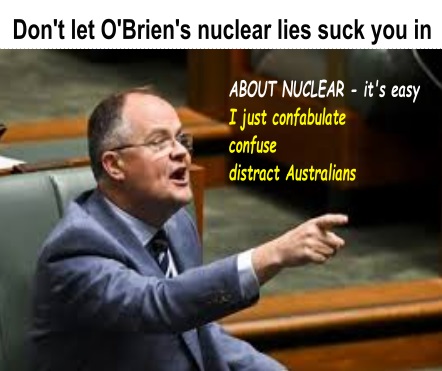
Comments about Ted O’Brien’s (Opposition energy spokesperson) disrespectful and dishonest questioning of witnesses during the hearings of the Inquiry into nuclear power generation in Australia. Maybe these comments could even be useful to future witnesses, if they were forewarned.
At today’s hearing in Lithgow one of the witnesses started to call him out. This is the first time that I can remember anyone really challenging him. It would be helpful if he was called out more clearly, ideally in a way that strikes at the heart of his dishonesty. Make it hard for him to use these tactics.
He regularly asks questions along the following lines:
“Have you read such and such a report?” (99% of the time the witnesses have not.) He then quotes or paraphrases (or misrepresents) something out of the report and asks the witness to answer “Yes” or “No” to some loaded proposition. When the witness doesn’t give him the Yes/No answer he wants, he interrupts them and insists that they answer Yes or No. Loaded questions might be along the following lines:
Based on this report, would you agree that nuclear is a viable option?
Or
Do you think you know better than the [unquestionably authoritative] author of this report?
(These are not direct quotes, just the general gist. See below for a specific example.)
This approach is disrespectful, because it is unreasonable to expect witnesses to have read every official report that O’Brien chooses to use (or misuse) to back up his position. Of course, O’Brien knows they haven’t read the report.
It is also disrespectful, because it is generally used for the purpose of making a fool of the witness in order to destroy their credibility.
It is dishonest, because he quotes or paraphrases the reports selectively, out of context, and probably misrepresents the reports.
An example from today’s hearing in Lithgow (11/12/2024) illustrates the point. It can be heard from 1.24.55 on the following link:
These two witnesses stood up for themselves, but on many other occasions throughout these hearings, the witnesses have been left looking silly, even though the fault is with O’Brien’s dishonest approach. (Note that a similar approach is used by Coalition “Supplementary Member” of the Inquiry, Simon Kennedy.)
Ted O’Brien: “My question was going to go to your comments on the timing for the construction of those plants — Generation 3, Generation 3+. And my question is, Do you recognise the experience of the International Atomic Energy Agency with respect to advice on the timing of introducing nuclear energy to new nations? And also the experience and authority of ANSTO, the government’s nuclear technology advisers, when it comes to the construction of nuclear power plants?”
Geoffrey Miell (retired mechanical engineer): “I look at the actual construction times around the world….”
O’Brien then interrupted Miell’s very reasonable answer and demanded that he give a Yes/No answer to the question “Do you recognise…?”
When Miell offered a variation of his original response, O’Brien asked, “Does that mean you do not recognise their experience and expertise sir?”
After this, at 1.28.25, Sarah Elliot (nursing academic and member of NSW Nurses and Midwives Association) called O’Brien out:
“I will say that I have read transcripts Mr O’Brien where you have misled …[interrupted by bickering between Chair Repacholi and Deputy Chair O’Brien]… Mr O’Brien can I ask you to afford this panel the respect you gave to the last ones. We may not be in agreeance with your views, but can you please respect this panel that is before you right now … I’m disgusted with your behaviour as a representative of…”
The dishonesty of O’Brien’s line of questioning is exposed when you read the latest CSIRO GenCost draft report. That report makes the following comment about the IAEA’s timing estimates:
“Nuclear development lead time
“The development lead time includes the construction period plus all of the preconstruction activities such as planning, permitting and financing. Many stakeholders have agreed with the GenCost estimate of at least 15 years lead time for nuclear generation. Those stakeholders that are more optimistic cite two alternative sources, the International Atomic Energy Agency (IAEA) who have an estimate of 10 to 15 years and the recent completion of a nuclear project in the United Arab Emirates (UAE) had a 12 year lead time. Both estimates are in relation to building nuclear for the first time. This consultation draft provides additional analysis of nuclear lead times to examine this issue more closely. We examine recent construction times and their relationship with the level of democracy in that country.
So the IAEA’s estimate is a 2015 estimate. In the 9 years since then we’ve seen massive blowouts in construction times in the US, UK, France and Finland. Those projects were already in trouble in 2015, but since then they’ve blown out much more, while the VC Summer plant in South Carolina was abandoned part way through construction. But O’Brien still uses the 2015 IAEA estimate to put witnesses on the spot. As for ANSTO, their credibility was demolished by John Quiggen in the following article. https://www.crikey.com.au/2024/03/20/coalition-nuclear-power-ansto-csiro-small-modular-reactors/
Another example was when O’Brien used the first Frontier Economics report (the second can be expected any day) to say the total system cost of the electricity grid in 2050 will be five times what the ALP Government has claimed (AEMO’s ISP report). He also completely misrepresented Minister Bown’s response to that report. However, on this occasion, Tennant Reed (Australian Industry Group), who had actually read the Frontier Economics report, interrupted him (5.55.50). This caused a problem for O’Brien, because his brazen dishonesty was exposed by a real expert. Unfortunately, Reed was too polite. He didn’t call out O’Brien’s dishonesty. He just explained the source of the difference between AMEO’s ISP figure and the figure in Frontier Economics report. “The two numbers are different sorts of number, rather than greatly in disagreement with each other.”
See the following YouTube link from 5.53.50:
See the following YouTube link from 5.53.50:
Inquiry Into Nuclear Power Generation In Australia, Melbourne, 04/12/2024
The above two examples are examples of where O’Brien was actually challenged, but, unfortunately, not exposed for the charlatan that he is. I am hopeful that if witnesses are forewarned of his tactics, they might be in a better position to stand up to him, ideally to expose him, but definitely not to be intimidated by his dirty tactics.
Re: “South Australia’s Copper Strategy”, Submission To: The Department of Energy and Mining c/o DEM.engagement@sa.gov.au
“SA’s Copper Strategy lacks ‘social license’ and fails contemporary public interest expectations and environmental and legislative standards”
By: Mr David Noonan B.Sc., M.Env.St., Independent Environment Campaigner and Consultant, 12 Dec 2024
The SA Copper Strategy is potentially an important way forward for the SA Gov to instigate and require needed reform in the copper – uranium mining sector in our State.
As an individual I provide this public input and 8 x Public Interest Recommendations (p.11) toward required reform in the sector ‘as part of the development of the refreshed SA Copper Strategy’ due to be released in 2025.
The Department of Energy and Mining should provide a Public Forum on the Copper Strategy before finalisation, I request to attend and participate and offer to be a Member of a Panel Discussion. I raise part of my relevant Background at p.12.
At this stage, the SA Copper Strategy lacks ‘social licence’ and the BHP run copper sector continues to fail contemporary public interest expectations and proper environmental and legislative standards.
Further, the core related Northern Water Project lacks needed ‘social license’ as the SA Gov has to date failed to set clear public commitments to ‘shared benefits’ in protection for the Mound Springs.
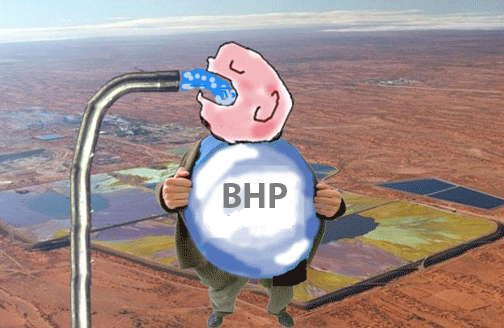
It is most important for SA’s Copper Strategy and Northern Water Project realise priority protection for the unique and fragile Mound Springs of the Great Artesian Basin (GAB) with a clear commitment to replace BHP extraction of GAB waters across both Wellfields A and B.
And it is axiomatic the SA Premier can-not credibly look to spend billions of dollars of public monies on water supply and not respect, save and protect the Mound Springs of GAB. – as gems of our State.
Social license, the Gov’s political credibility and public interest standing depend on this outcome.
Please feel free to contact on any aspect of these issues.
Yours sincerely
David Noonan B.Sc., M.Env.St., Independent Environment Campaigner and Consultant, Conservation SA Representative on the Northern Water Project ‘Stakeholder Reference Group’, Seaview Downs, South Australia
It’s hard to take the Coalition’s nuclear energy policy seriously, so we didn’t. And frankly, why would they put taxpayers on the hook for the biggest public funded project in history when renewables are crowding private investment en masse? https://www.youtube.com/watch?v=fSeaybp9oAA
The Coalition has released long-awaited detail on its nuclear energy policy, claiming its plan to build seven nuclear power stations would be A$263 billion cheaper than Labor’s renewables-only approach.
The figures are contained in an analysis prepared by Frontier Economics. I’ve conducted preliminary analysis of the document, and found key assumptions that differ from other similar analyses, including that from Australia’s premier science organisation, CSIRO.
What’s more, the analysis is lacking crucial information about how the figures were calculated. This prevents researchers and the public from understanding the full implications of the Coalition’s policy.
A successful transition to clean energy is vital if Australia is to tackle the climate crisis. It’s also central to addressing rising power bills and keeping the economy on track. There is more than one way to lower Australia’s emissions, but the Coalition has work to do before next year’s election to show voters it has a reliable plan.
The Coalition goes nuclear
The Coalition’s nuclear plan involves building seven nuclear reactors at the sites of former or current coal plants.
The Coalition says under its plan, Australia’s energy mix in 2050 would comprise 54% renewables, 38% nuclear and the rest a mix of storage and gas. In contrast, Labor’s plan would have Australia running almost entirely on renewable energy by mid-century.
The Coalition’s plan could increase emissions and allow polluting coal-fired power stations to continue running for longer than currently forecast.
The thorny question of cost
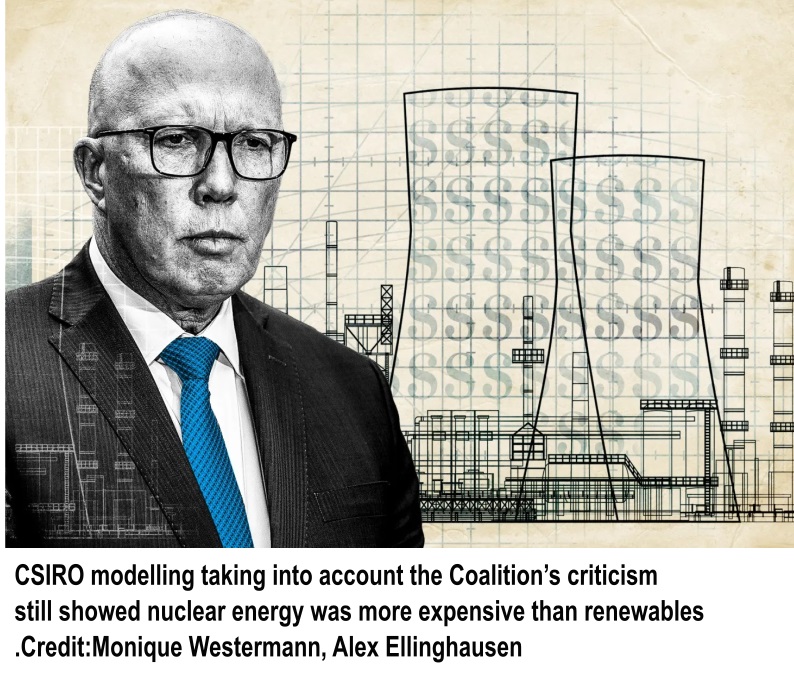
The cost of the Coalition’s proposal is a key point in the debate. According to CSIRO analysis, “nuclear power does not currently provide the most cost-competitive solution for low-emission electricity in Australia”. This position is at odds with the Coalition’s claims.
Earlier this week, CSIRO released its draft GenCost report. It estimates the cost of building new electricity generation, storage, and hydrogen production in Australia out to 2050.
The analysis involves calculating average costs over the plant’s life, which takes into account the costs of both building and running it. This calculation is formally known as the “levelised cost”.
The levelised cost helps investors understand how much the plant’s electricity must sell for, if they are to get a return on their investment.
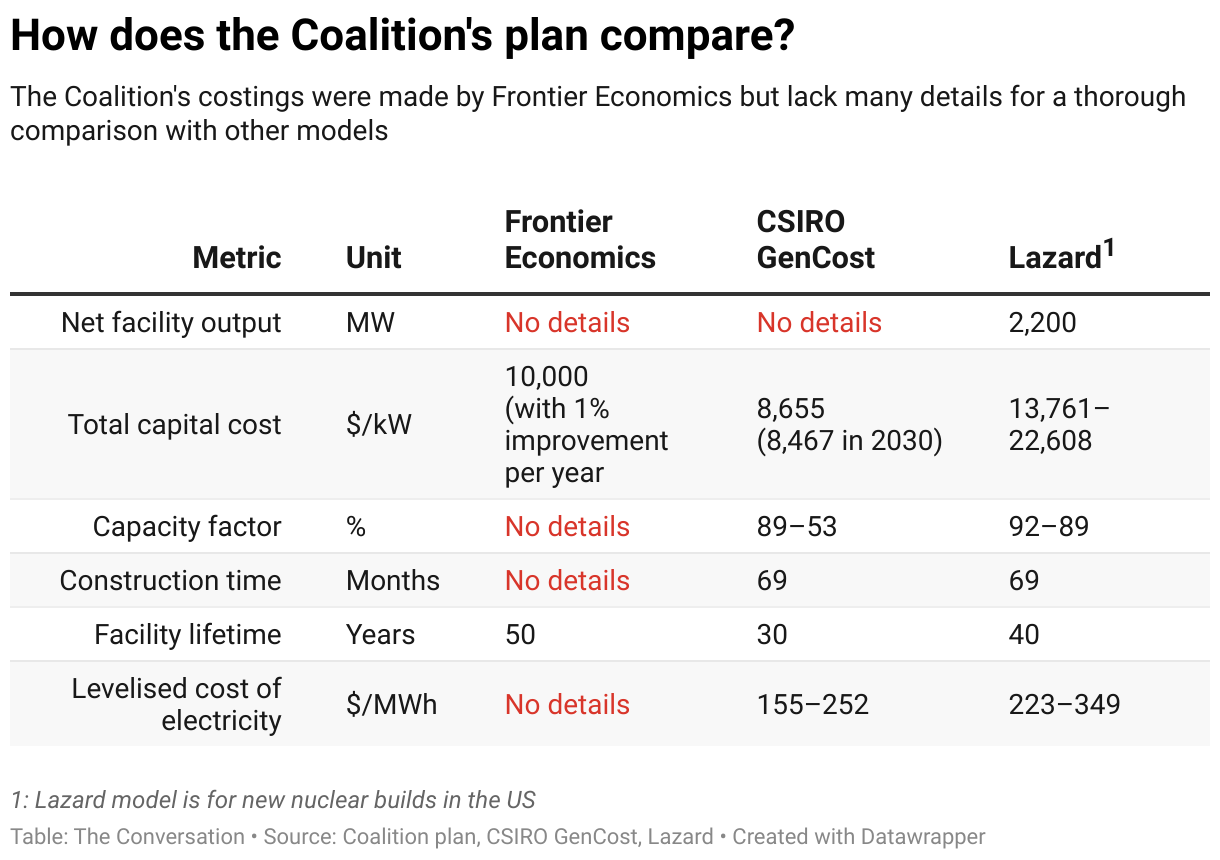
The Frontier Economics report does not contain a levelised-cost estimate or a “capacity factor”, which captures how often a plant is running at maximum power. This makes it difficult to probe the figures it provides. This oversight must be corrected to allow robust scrutiny of the Coalition’s costings.
How does the Coalition’s plan compare?
The Coalition’s costings were made by Frontier Economics but lack many details for a thorough comparison with other models
Metric
Unit
Frontier Economics
CSIRO GenCost
Lazard1
Net facility output
MW
No details
No details
2,200
Total capital cost
$/kW
10,000 (with 1% improvement per year
8,655 (8,467 in 2030)
13,761–22,608
Capacity factor
%
No details
89–53
92–89
Construction time
Months
No details
69
69
Facility lifetime
Years
50
30
40
Levelised cost of electricity
$/MWh
No details
155–252
223–349
1: Lazard model is for new nuclear builds in the US
The scenario presented by Frontier Economics also reportedly assumes the Coalition plan will not need notable additions of transmission infrastructure to transport electricity under its plan. This is because the proposed nuclear plants would be built at the sites of old coal-fired power stations, where transmission infrastructure already exists.
The Coalition has used this purported benefit when promoting its plan, and says the transmission infrastructure needed under Labor’s renewables policy would be prohibitively expensive.
However, as others have noted, the Coalition may need to build substantial new transmission infrastructure. This is because Australia’s electricity demand is forecast to surge in coming decades, and transmission infrastructure will have to be upgraded to cope.
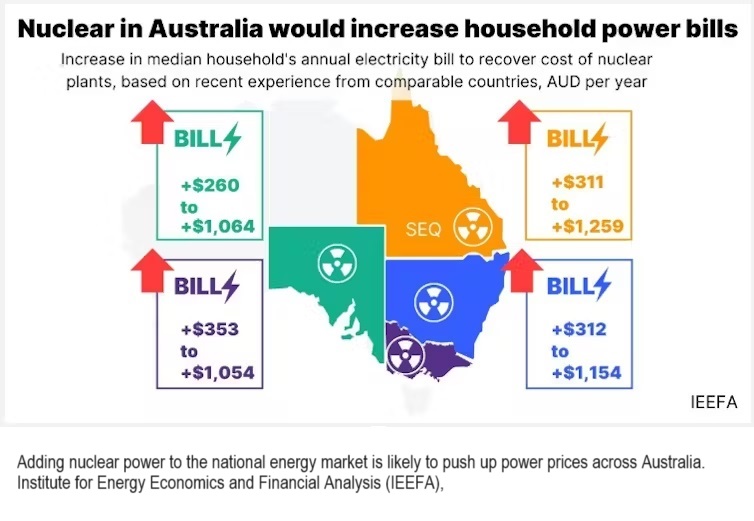
Analysis also suggests the Coalition’s plan will not reduce consumers’ power bills. The Institute for Energy Economics and Financial Analysis found household electricity bills could rise by $665 a year, on average, if nuclear energy were introduced in Australia. For a four-person household, the bill rise would be $972 a year.
The institute also noted the tendency for huge cost overruns among nuclear power plants built overseas.
A time-critical issue
CSIRO’s GenCost analysis assumes nuclear power plants operate for 30 years. Frontier Economics assumes capital construction costs are averaged out over 50 years, which could partly explain its lower cost estimate.
Meanwhile, the Coalition claims the plants would operate for 80-100 years.
Long lifetimes are possible for nuclear reactors. For example, in the United States, 20 reactors are expected operate for up to 80 years. But many reactors have retired long before this age.
The time required to build the seven nuclear plants is also fiercely debated. CSIRO says the quickest possible time frame for developing and building a nuclear reactor in Australia is 15 years.
In the Frontier report, the first nuclear reactors would come online from 2036 and production would ramp up between 2040 and 2050.
Australian voters will decide
The Coalition says adding nuclear power to the energy mix will make electricity cheaper, cleaner and more reliable. But it has not yet provided solid evidence to support these claims.
What’s more, we don’t yet know how the Coalition plans to overcome community opposition to nuclear power, how it plans to store nuclear waste, and how it will get around state government bans on nuclear energy. Having reliable water sources will also be important, as France discovered during drought.
Clearly, the debate has a long way to run before voters make their choice at the ballot box next year. Let’s hope by that time, we have the information we need.
It might seem weirdly appropriate that the federal Coalition should release its nuclear power policy costings on Friday the 13th, considered an unlucky day in western superstition. But that would be to downplay the sheer lunacy, rank dishonesty, and clear danger in Peter Dutton’s energy plans.
Shows like Edward Scissorhands are horror fantasies played out on a screen. But the Peter Dutton and Ted O’Brien nuclear plan is a horror show we may have to live and breathe. After so many years, the Coalition is still playing culture wars on the most fundamental issues of our time – and all at the behest of the fossil fuel industry.
It doesn’t matter at which level you look at it, this energy policy makes no sense at all. You could look at it backwards, from behind, sideways, leave it out in the sun for a few days, or even bury it in the garden (please do), the only thing that would change is that it might smell more than it does now.
It would likely take until Christmas to go through all the lies, deceptions and misunderstandings that comprise this policy and these costings, but let’s just focus on a couple of the important ones for now.
The reference to the sheer lunacy and the danger of the Coalition policy comes in Dutton’s desire to simply ignore climate science, along with basic engineering and economics.
Emissions reductions are put off to the never never. And, as Dutton revealed in his press conference through his comments on rooftop solar, he simply does not have a clue about the basic concepts of the energy system.
Dutton and Co simply want to bring a crashing halt to Australia’s only successful emission reductions efforts – the transition to green energy – and walk away from the country’s natural advantages in wind, solar and storage and the industries that are emerging from that.
They even have the chutzpah to claim that it will result in lower emissions. Which, inevitably, is pure bunkum. But, as Donald Trump has demonstrated, if you “flood the zone with shit”, something will stick – mostly to the front pages of mainstream media.
And that’s what we saw on Friday. A planned leak of the findings resulted in claimed headline “savings” – emblazoned across the front pages of the cheer-leading Murdoch media and the AFR this morning – that the nuclear power plan will save $264 billion.
It is of course, a complete nonsense, and obviously so to anyone who is paying attention, or even bothered to read the Coalition document. We are talking about completely different scenarios, and taking traditional accounting methods away from the international norm.
Dutton and his media followers have made a big deal of Frontier Economics costings of the Australian Energy Market Operator’s Integrated System which is the basis of Labor policy.
Frontier concedes, however, that the cost of AEMO’s “step change” plan is about what it says it is – $122 billion, based on the standard accounting practice of “net present value.”
But, at the urging of the Coalition, Frontier has published an additional number, around $600 billion, based on the “real cost” and throwing in some more transmission spending.
Dutton has used that number to insist that AEMO and Labor had lied to the Australian people. But it was the former Coalition government who instructed AEMO to cost it this way. And for good reason – it is standard international accounting practice. It is Dutton and O’Brien who are now spreading the lies.
Indeed, the Frontier Economics report actually reveals that the claimed $264 billion in savings parroted by the mainstream media are from two entirely different scenarios. One is from AEMO’s “Step Change”, the other from the Coalition’s version of “progressive change.”
The actual savings on a like for like basis are much smaller, if you can believe Frontier’s costings of nuclear.
Progressive change assumes that demand will not be as great as forecast by AEMO. It assumes much smaller electrification (thanks to the gas industry) and slower uptake of EVs (thanks to the oil industry). It then ignores the $75 billion a year of extra fuel costs that would result from that.
Now let’s go to the Coalition’s plan to shut down just one third of the main grid’s ageing coal fired generators by 2034 – with the rest trying to stay on line until nuclear power plants can be built.
The Coalition says it still thinks the first nuclear power plant can be built by the mid-2030s. The rest of the industry says this will be pretty much impossible until the mid 2040s.
Keeping the coal fired power stations open will not just increase pollution – both within the grid and the industries that depend on it – it will also puts grid reliability at risk.
This week, AEMO had to issue several lack of reserve alerts as another heatwave approached the eastern states. The main reason was that Origin, despite being promised up to $450 million to keep Australia’s biggest coal generator on line for another two years, reported another breakdown at Eraring.
At Bayswater, a unit is offline because of a tube leak. One third of the coal units in Victoria are also offline due to unplanned outages, and so is the country’s newest and “most efficient” coal generator at Kogan Creek, which is also the country’s largest single generation unit.
Dutton and O’Brien insist that these ageing and increasingly decrepit coal fired power plants will only have to operate “a few years longer”. But they are kidding themselves. Their own modelling confirms that.
They are still setting a timeline of 2035 for the first reactors. Will these be large scale of small commercial small modular reactor. No one has built one, or even got a licence to build one.
The Coalition insists that new nuclear can be built, from scratch, in a country with no nuclear infrastructure or know-how to speak of, no work force and no regulatory base ,in about a dozen years. There’s also a golden replica of the Sydney Harbour Bridge at the bottom of your packet of Cornflakes.
A dozen years is the average “delay” in the big nuclear power plants being built in western democracies – the UK, France, and Finland – all of whom have been operating nuclear power plants for decades.
Dutton and O’Brien are now telling us their nuclear plan will result in 14 gigawatt of nuclear capacity – double what they previously said. And Frontier’s modelling shows that coal is going to have to last a lot longer, beyond the official lifetime limits of the coal generators.
Even the Australian Energy Council, one of the most conservative of lobby groups that represents the coal generator owners, believes this is a bad idea and “could result in reliability issues.”
But let’s go back to the conventional way of measuring costs – net present value. The Frontier report includes it, at the very last page of its report. It shows that the difference in costs, on their calculations, is actually $62 billion over 25 years for the step change scenario.
But even that is on the basis of some heroic assumptions on the costs of nuclear. Frontier puts the total cost, including 14 GW of new nuclear power plants, at $142 billion (see table above).
Let’s look at the cost of Hinkley C, the first nuclear power station to be built in the UK for decades. At just 3.2 GW, its cost has already blown out to $A92 billion and is running at least 14 years late from its promised timeline. What does the Coalition know that the rest of the nuclear world does not know?
The Coalition’s vision for renewables also beggars belief. Under its modelling, it estimates the share of wind, solar and hydro will be less than 50 per cent in 2050. That’s in the “progressive” plan that appears to be their chosen one.
If you take the current level of renewables, the already committed large scale projects, and the continued roll out of rooftop and behind the metre solar, the Coalition is essentially telling everyone that the construction of new large scale wind and solar more or less comes to an end with their election next year.
The stupidity of the idea is frightening. Quite how the Coalition figures it could keep the lights on in the 2030s and 2040s is beyond belief.
The Coalition are also trying to convince people that somehow their plan does not need new transmission, or much back-up.
All generation needs back-up, and all generation needs transmission. A 1.4 GW nuclear power plant will be nearly twice the size of the current biggest unit in Australia’s main grid, the currently broken Kogan Creek coal fired generator.
That means it needs twice as much back-up, because if it trips suddenly – which it inevitably will, just look at the patchy performance of the new nuclear power plant in Finland – then the market operator needs to be able to fill in the gaps at a moment’s notice. That’s expensive.
And then, of course, is what to do with your rooftop solar. If the Coalition wants its fleet of nuclear power plants to run “always on” then there may be no room on the grid for your rooftop solar.
Your best bet might be to buy a battery, or better still an electric vehicle. You don’t have to leave the grid, but you will want to make sure that you can have power without it. And you sure don’t have to believe Dutton’s nonsense about solar not being able to charge EVs and batteries at the same time.
But the safest and cheaper option might be to ensure these idiots don’t get elected.
Apr 15, 2026 01:00 AM in Canberra, Melbourne, Sydney
Join the International Physicians for the Prevention of Nuclear War (IPPNW) on Tuesday, April 14th for a timely webinar exploring the risks associated with nuclear power and challenging the myth that it offers a simple, safe, carbon-free solution to the climate crisis


 Antinuclear