Peter Dutton in his ignorance is pushing nuclear reactors in Australia – including small nuclear reactors
Helen Caldicott, 16 Dec 24
Here are the facts re SMRs.
Basically there are three types which generate less than 300 megawatts of electricity compared with
current day 1000 megawatt reactors.
- Light water reactors designs – these will be smaller versions of present-day pressurized water
reactors using water as the moderator and coolant but with the same attendant problems as
Fukushima and Three Mile Island. Built underground, they will be difficult to access in the event
of an accident or malfunction. - SMRs will be expensive because the cost per unit capacity increases with decrease in reactor size. Billions of dollars of government subsidies will be required because Wall Street is allergic to nuclear power. To alleviate costs, it is suggested that safety rules be relaxed including reducing security requirements and a reduction in the 10 mile emergency planning zone to 1000 feet.
SMRs will be expensive because the cost per unit capacity increases with decrease in reactor size.
Billions of dollars of government subsidies will be required because Wall Street is allergic to nuclear
power. To alleviate costs, it is suggested that safety rules be relaxed including reducing security
requirements and a reduction in the 10 mile emergency planning zone to 1000 feet.
- High-temperature gas cooled reactors HTGR or pebble bed reactors. Five billion tiny fuel kernels
consisting of high-enriched uranium or plutonium will be encased in tennis-ball-sized graphite
spheres which must be made without cracks or imperfections –or they could lead to an
accident. A total of 450,000 such spheres will slowly and continuously be released from a fuel
silo, passing through the reactor core, and then re-circulated ten times. These reactors will be
cooled by helium gas operating at high very temperatures (900 C).
A reactor complex consisting of four HTGR modules will be located underground, to be run by just two
operators in a central control room. Claims are that HTGRs will be so safe that a containment building
will be unnecessary and operators can even leave the site – “walk away safe” reactors.
However should temperatures unexpectedly exceed 1600 C the carbon coating will release dangerous
radioactive isotopes into the helium gas, and at 2000C the carbon would ignite creating a fierce graphite
Chernobyl-type fire.
If a crack develops in the piping or building, radioactive helium would escape, and air would rush in, also
igniting the graphite.
Although HTGRs produce small amounts of low level waste they create larger volumes of high level
waste than conventional reactors.
Despite these obvious safety problems and despite the fact that South Africa has abandoned plans for
HTGRs, the US Department of Energy has unwisely chosen the HTGR as the “Next Generation Nuclear
Plant”.
- Liquid metal fast reactors (PRISM)
It is claimed by proponents that fast reactors will be safe, economically competitive, proliferation
resistant, and sustainable.
Fueled by plutonium or highly enriched uranium, and cooled by either liquid sodium, or a lead-bismuth
molten coolant. Liquid sodium burns or explodes when exposed to air or water and lead-bismuth is
extremely corrosive producing very volatile radioactive elements when irradiated.
Should a crack occur in the reactor complex, liquid sodium would escape, burning or exploding. Without
coolant, the plutonium fuel could reach critical mass, triggering a massive nuclear explosion scattering
plutonium to the four winds. One millionth of a gram of plutonium induces cancer and it lasts for
500,000 years. Extraordinarily, claims are that fast reactors will be so safe they will require no
emergency sirens and emergency planning zones can be decreased from 10 miles to 1300 ft.
There are two types of fast reactors, a simple plutonium fueled reactor and a “breeder” in which the
plutonium reactor core is surrounded by a blanket of uranium 238 which captures neutrons and
converts to plutonium.
The plutonium fuel, obtained from spent reactor fuel will be fissioned and converted to shorter lived
isotopes – cesium and strontium which last 600 years instead of 500,000. Called “transmutation”, the
industry claims that this is an excellent way to get rid of plutonium waste. But this is fallacious, because
only 10% fissions leaving 90% of the plutonium for bomb making etc.
Construction. Three small plutonium fast reactors will be grouped together to form a module and three
of these modules will be buried underground. All nine reactors will then be connected to a fully
automated central control room operated by only three operators. Potentially then, one operator could
simultaneously face a catastrophic situation triggered by loss of off-site power to one unit at full power,
in another shut down for refueling and one in start-up mode. There are to be no emergency core cooling
systems.
Fast reactors require a massive infrastructure including a reprocessing plant to dissolve radioactive
waste fuel rods in nitric acid, chemically removing the plutonium and a fuel fabrication facility to create
new fuel rods. A total of 10,160 kilos of plutonium is required to operate a fuel cycle at a fast reactor
and just 2.5 kilos is fuel for a nuclear weapon.
Thus fast reactors and breeders will provide extraordinary long-term medical dangers and the perfect
situation for nuclear weapons proliferation. Despite this, the industry is clearly trying to market them to
many countries including it seems, Australia.
The Coalition’s nuclear energy plan takes a sharp turn away from a cheaper, cleaner future
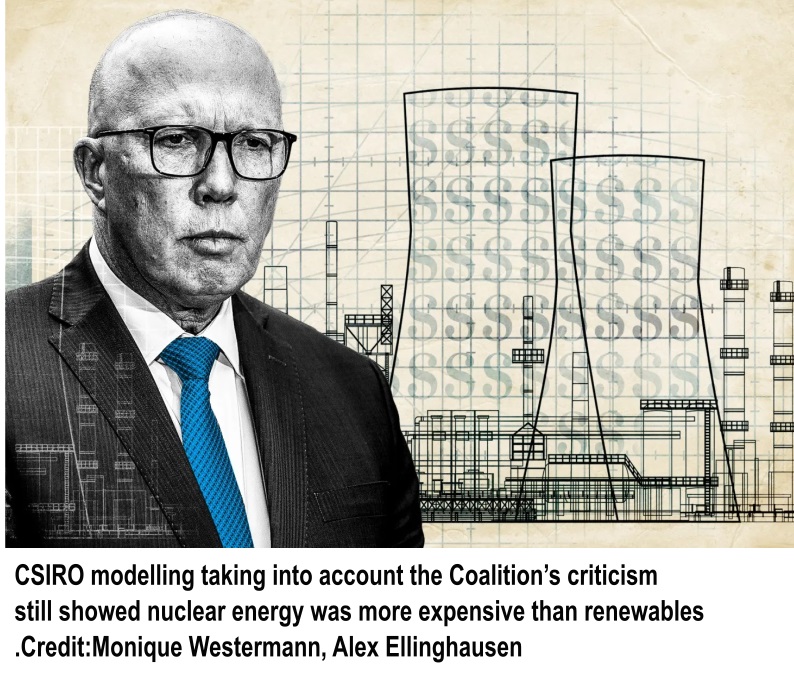
Simon Holmes à Court, 15 Dec 24, https://www.theguardian.com/australia-news/commentisfree/2024/dec/16/coalition-nuclear-energy-plan-peter-dutton-government-ntwnfb? [good graphs]
After 22 failed energy policies, the Coalition is being guided by a roadmap to higher bills and higher emissions.
On the front cover of Frontier Economics’ costings of the Coalition’s nuclear policy is a stock photo entitled fork in road, implying that we’re at some kind of juncture where we must decide between a nuclear or renewables path.
In 1969 John Gorton’s Liberal government chose the nuclear path with the construction of the Jervis Bay nuclear power plant project. As Gorton later said, “We were interested in this thing because it could provide electricity to everybody and it could, if you decided later on, it could make an atomic bomb.”
In 1971 Billy McMahon’s Liberal government cancelled the project after a review deemed it too expensive. The cleared site became a massive car park at Murray’s Beach.
No nuclear power station was built in the intervening 27 years before John Howard introduced a federal ban on nuclear power. There were no attempts to overturn the ban during the next 18 years of Liberal government.
At the start of the 1970s we were indeed at an energy crossroads, we took the road towards coal, and as one of those who’d like to pass a safe climate on to the next generation, I wish we had taken the road towards nuclear instead. Our emissions would be dramatically lower
In 1997, just before he banned nuclear, Howard took us down a different path – he announced the mandatory renewable energy target, a plan to add a tiny slice of renewable energy to our sliver of hydroelectricity. In 2009, in what was perhaps the last act of bipartisanship on domestic energy, parliament agreed to massively increase the target to 20% renewables by 2020. Today we’re just shy of 40%, and the government’s policy is to double it again by the end of this decade.
Howard’s modest renewable energy target was surely more successful than he ever intended, in great contrast to the 22 failed energy policies the Coalition famously held during its last tenure. Its latest energy policy began shortly after the last election, when in August 2022 Peter Dutton tasked Ted O’Brien to “examine the potential for advanced and next-generation nuclear technologies to contribute to Australia’s energy security and reduce power prices”. We had to wait until Friday for the costings, published after many of the country’s journalists had filed their last stories for the year.
Here are four reasons why in my opinion the costings, prepared by Frontier Economics, completely undermine the Coalition’s 23rd energy plan:
1. The Coalition plans for lower household income and the collapse of heavy industry
Of the three scenarios the independent market operator Aemo published in June, the Coalition has chosen what’s known as progressive change, giving Aemo’s preferred scenario, known as step change, to Labor.
Under the Coalition’s scenario, large industrial load collapses in 2030, signalling the closure of smelters and presumably datacentres – goodbye AI! By 2050 industrial demand is down by 62%. Over the 25-year modelling period, household disposable income will be down a whopping $2.8tn more compared to Labor’s plan.
With a pivot away from electrification, under the Coalition’s plan Australians will burn an additional 273bn litres of petrol and diesel through to 2050 costing $465bn and an additional 1,831 PJ of gas costing at least $36bn. Even if the Coalition’s purported cost savings were credible, this $501bn would mean that Australia’s total energy bill would be considerably higher.
On top of this, the Coalition’s plan would see a 61% reduction in rooftop solar, meaning that millions fewer Australians would be able to slash their electricity bills.
Currently we are paying hundreds of millions to three coal power stations to stay open for a couple of years. The Coalition budgets nothing to coax the other 14 coal power stations on the east coast to extend their lives by a decade or more.
Economist Steven Hamilton has calculated that the Coalition’s plan would see the power sector emit about 1,000 million tonnes of carbon dioxide above our current trajectory. The Coalition’s crabwalk away from electrification would add a further 723 MtCO2.
The Coalition has chosen an energetically and fiscally poorer Australia with higher energy bills and higher emissions. I’ve long suspected that the Coalition hasn’t bothered to read or understand Aemo’s last seven years of modelling, and this pretty much clinches it.
2. The analysis lowballs nuclear’s cost then punts it over the horizon
Frontier appears to have made the rookie error of confusing the nuclear industry term nth of a kind (Noak) with next of a kind. The Noak cost is not what we’d pay for the next reactor built, but a cost target we’d theoretically hit eventually if we got really good at building them. If you build, say, eight identical reactors on a site, the last one should cost a lot less – and provided nothing goes wrong, theoretically you’d approach the Noak cost.
If Australia were to achieve Frontier’s costs, it’d be the cheapest nuclear built in the western world this century, by a wide margin. Frontier’s head, Danny Price, told the ABC on Friday that he wouldn’t put himself in the category of a nuclear expert, so maybe it’s no surprise that the modelling appears to confuse Noak with next-of-a-kind pricing.
Frontier are, however, modelling experts, so the next thing they did was with eyes wide open. The modelling pushes the vast majority of the cost of nuclear beyond 2050, so if the program is delayed it would appear cheaper and if the cost triples, it’d barely show in the analysis. Nice work!
Next, Frontier assumes that building nuclear reactors will get cheaper every year – what’s known as a positive learning rate. In reality, the US nuclear industry is famous for its negative learning rate – is that a forgetting rate? – meaning that Noak costs are more theory than practice.
3. The Coalition’s unrealistic schedule leaves us short of power
As I told a recent nuclear inquiry – the eighth since 2005 – there’s not a hope in hell that Australia can deliver its first nuclear power reactor producing power before 2040. Even with fantastical assumptions, such as a Coalition that controls both Houses of Parliament, states quickly overturning their bans, the first project sailing through environmental approvals and court challenges and fast build times, it’s almost impossible to achieve the first nuclear kilowatt hour before 2044.
Czechia, a country with 66 years of nuclear experience, embarked on a nuclear construction project in 2022. If all goes well the first unit will start commercial operation in 2038. Australia is at least six years behind this project, and we face many more barriers, so 2044 for our first really does seem optimistic.
4. Our grid doesn’t have room for these reactors
Frontier’s analysis assumes that Australia builds 13.3GW of nuclear, equivalent to 12 AP-1000 reactors, and that these run flat out when they’re not off for refuelling and maintenance.
The problem is that for much of the year Australia uses less power. Our minimum system load (MSL) is already below 10GW and on its way down to 2GW around the end of this decade, thanks to rooftop solar. The inflexible manner in which the Coalition plans to run the reactors would result in masses of excess power and require that we turn off massive amounts of renewables, both utility-scale and rooftop solar. Alternatively we could soak up the excess nuclear energy with gigantic battery farms.
Over the weekend I sent a polite text message to Danny Price, the consultant behind the Coalition’s modelling, explaining that I’m not a newcomer to nuclear and outlining three of the above flaws. Price replied:
“Thanks for sending me your credentials and your generous offer to set me straight, but I will decline. I’ve got all the help and technical advice I need. I know you are just protecting you (sic) financial interest. I get it, but please don’t contact me again.”
Contrary to Coalition belief, I am not a large investor in renewable energy (nor am I a billionaire). This shows the depths of the culture wars we’re in – where impugned motives trump rational discussion. I took the opportunity to reply:
“Since you misinterpreted my motives, allow me this: Less than 2% of my investments are in Australian renewables – similar to millions of superannuation accounts I’m advised – and if the renewables transition slows, the value of those investments would likely increase.”
The fact is, over the last six years, Australia has added wind and solar generation equivalent to the annual output of six gigawatt scale nuclear reactors, according to data from OpenElectricity.
If we’re at a crossroads it’s one where the Coalition took a sharp turn, based on what looks to me like some really sloppy advice. Let’s hope that Australians stay on the path to a cheaper, cleaner and more prosperous energy future.
- Simon Holmes à Court is a Director of The Superpower Institute, convener of Climate 200 and an adviser to the Smart Energy Council
The Coalition’s nuclear costings and their rubbery assumptions take us back to being a climate pariah

Nicki Hutley, Guardian 14th Dec 2024, https://www.theguardian.com/commentisfree/2024/dec/15/the-coalitions-nuclear-costings-and-their-rubbery-assumptions-take-us-back-to-being-a-climate-pariah
Despite a clever comms strategy, there are significant credibility issues around the assumptions on which the cost estimates are based.
The Coalition has moved a considerable way on climate and energy since Scott Morrisson brought a lump of coal into the parliament and told us not to be afraid. On Friday, the Coalition finally released the long-awaited details of the nuclear plan it will take to the election and, once again, asks us not to be afraid – of the price tag, the higher climate pollution and a range of other variables.
However, despite a clever comms strategy, there are significant credibility issues around the assumptions on which the cost estimates are based, and there are other critical issues that have been left unanswered. Australians have a right to consider all the issues they are being asked to vote on, with facts rather than political rhetoric. These issues can be broadly listed under three headings: the economics, the environment and the law.
The Coalition makes the point that many countries use nuclear power. It is true that 9% of global energy capacity comes from nuclear power, which the International Energy Agency (IEA) estimates could increase to about 11% if and when planned projects come online. But the world is voting with its feet, with the IEA reporting that around the world 560GW of new renewable power was installed in 2023, compared with 7.1GW of new nuclear. At COP29 in Baku this year, the conversations were not about whether to invest in renewables, but how to roll them out faster.
The primary reason the world is not embracing nuclear energy on a grand scale is simple: cost (although in Japan’s case, it’s also about safety).
The Frontier Economics report, which the Coalition is using to make its case, is written in an opaque way that makes direct comparisons difficult. Essentially, the report admits that the capital cost of nuclear is $10,000/kW, while solar and wind are $1,800 and $2,500 respectively.
So how is it that the Coalition’s modelling suggests that a world where nuclear makes up more than a third of the east coast energy grid could possibly be cheaper?
It’s easy to come up with the answer you want when you base your modelling on rubbery assumptions.
Firstly, we should appreciate that even a $10,000/kW estimate for nuclear is considerably optimistic if we look at the experience of comparable countries over the past decade. The cost at the off-cited Hinkley C plant in the UK has, to date, risen to $27,515/kW. Three others – France (Flamanville 3), Finland (Olkilutoto 3) and the US (Vogtle) – are between $15,000 and $16,900.
Delays have been a key factor in driving up the cost of nuclear power. The longer it takes to build and operate a plant, the higher the cost of finance. The Coalition believes we can overturn national and state legislation and acquire land and planning approvals virtually overnight. And then we’ll just install an ‘off-the-shelf’ nuclear power plant, ready to run.
By its own admission, having to tweak nuclear power plants so they operate at maximum safety and efficiency can blow out build times and costs. It beggars belief that the Coalition claims Australia, which has no nuclear energy capability, could ship, build and integrate into the grid with no challenges, with a 50,000-strong nuclear workforce appearing by magic.
There is no mention of the costs of extending the life of existing ageing coal-fired power stations, or the likelihood that these plants will increasingly fail as they reach end-of-life, raising energy costs as supply falls short and, increasingly, the likelihood of blackouts. And, apparently, nuclear waste can be transported and stored without cost
The Coalition also argues that, because wind and solar energy are not always “on”, we’ll need to build a lot more capacity, along with transmission and storage. It calls this “overbuild”, but its assumptions have overegged what that need might realistically look like, especially as battery storage becomes cheaper over time (unlike the experience of nuclear) and of longer duration.
Finally, to arrive at these rose-tinted costs, the Coalition has had to cut back on estimates of the amount of energy we will demand over the next two decades by almost half what the Australian Energy Market Operator says we need. That’s because it’s assumed we won’t worry about EVs or electrification. This is why the Coalition will undo Australia’s 2030 43% emissions reduction target, which we are set to get very close to, taking us back to our Morrison-era status of global climate pariah.
And this is the kicker. Under the Coalition’s plan, our modelling shows Australia’s domestic emissions will rise by around one billion – yes billion – tonnes, at a cost of $240bn to the economy, society and environment, based on Infrastructure Australia’s cost of carbon methodology.
The Coalition’s track record on climate and energy has always been poor. In this latest iteration supporting nuclear power, its credentials have been further diminished on climate, energy and the economy.
- Nicki Hutley is an independent economist and councillor with the Climate Council
Dutton’s promises billions for fossil fuels and a smaller economy for the rest of us.
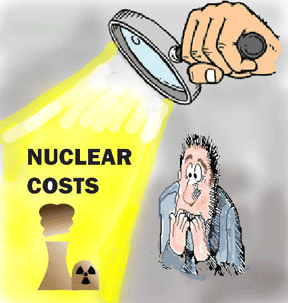
John Howard once warned climate action would lead to a smaller economy. Now Peter Dutton promises a smaller economy with no action.
Bernard Keane, Crikey, Dec 16, 2024
Peter Dutton’s steady progress away from the traditions of his own party continued in Friday’s nuclear policy costings, one of the more disingenuous documents foisted on Australians by either party for quite some time.
While experts rapidly spotted the deep flaws, bizarre assumptions and inconsistencies in the freebie modelling performed by the Coalition’s longtime advisers at Frontier Economics — and the implications for Australia’s millions of solar rooftop owners — the problems were so apparent that mainstream media commentators spotted them. Even right-wing economists tore the numbers apart.
Given that the job of the Coalition and Frontier Economics was to invent a set of numbers to claim that a build-from-scratch nuclear power industry would be cheaper than renewables with storage — when the objective truth is the latter is far cheaper — it’s unsurprising the modelling was so shambolic…………………………….. (Subscribers only ) https://www.crikey.com.au/2024/12/16/peter-dutton-nuclear-plan-costing-fossil-fuels-coal-economy/
1 This month
15 April – Zoom –Nuclear Power is Not the Solution
Apr 15, 2026 01:00 AM in Canberra, Melbourne, Sydney

Join the International Physicians for the Prevention of Nuclear War (IPPNW) on Tuesday, April 14th for a timely webinar exploring the risks associated with nuclear power and challenging the myth that it offers a simple, safe, carbon-free solution to the climate crisis

of the week – Australians for War Powers Reform (AWPR)
To see nuclear-related stories in greater depth and intensity
 Antinuclear