World’s largest iceberg on the move again after months spinning on the spot
The iceberg is about three times the size of New York City and more than twice the size of Greater London
Rituparna Chatterjee, Independent 15th Dec 2024, https://www.independent.co.uk/climate-change/news/world-largest-iceberg-a23a-moving-antarctic-b2664564.html
The world’s largest iceberg is on the move again after decades of being grounded on the seafloor and more recently spinning on the spot, according to the British Antarctic Survey (BAS).
The mega A23a iceberg has broken free from its position north of the South Orkney Islands and is now drifting in the Southern Ocean, scientists said.
“It’s exciting to see A23a on the move again after periods of being stuck. We are interested to see if it will take the same route the other large icebergs that have calved off Antarctica have taken. And more importantly what impact this will have on the local ecosystem,” Dr Andrew Meijers, an oceanographer at the BAS, said.
The iceberg, known as A23a, split from the Antarctic’s Filchner Ice Shelf in 1986. But it became stuck to the ocean floor and had remained for many years in the Weddell Sea.
Scientists anticipate that A23a will continue its journey into the Southern Ocean following the Antarctic Circumpolar Current, which is likely to drive it towards the sub-Antarctic island of South Georgia. In that region it will encounter warmer water and is expected to break up into smaller icebergs and eventually melt.
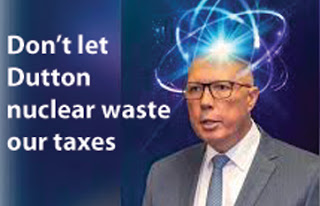
Less power, more climate pollution: Four ways Dutton is cooking the books on nuclear
Climate Council , 13 Dec 24
“PETER DUTTON’S NUCLEAR numbers have more holes than Swiss cheese, leaving out big ticket items like the costs of dealing with radioactive waste,” says the Climate Council CEO Amanda McKenzie, slamming the Federal Coalition’s misleading modelling.
“Dutton must be honest with the Australian people. CSIRO tells us nuclear is double the cost of renewables, no amount of dodgy accounting can change the facts.”
Nicki Hutley, Climate Councillor and economist, said: “It’s shocking to see the Federal Coalition knowingly mislead Australians on the true costs of nuclear. If we’re going to debate the economics of energy it must be based. on real-world evidence – not dodgy modelling that obscures the real price tag.”
The Climate Council has identified four ways that the Federal Coalition appear to be cooking the books with their dodgy nuclear numbers:
1) Ignoring the costs of keeping our ageing coal-fired generators operating for longer, which would cost a bomb in constant maintenance and fault repairs, and produce far more climate pollution.
2) Failing to account for Australia’s growing electricity needs, producing up to 45% less power than our current plan by 2050. The Australian Electricity Market Operator expects power generation to double by 2050, and assuming any less is inaccurate.1
3) Underestimating the cost and timeline of building nuclear reactors, which international experience has shown cost on average 2.2 times more to build than their initial estimate, and take at least 15 years for construction alone.
-Advertisement-
4) Excluding significant and certain costs from their estimates, including the costs of managing highly radioactive nuclear waste.
Nicki Hutley, Climate Councillor and economist, said: “Nuclear doesn’t add up for Australia. The CSIRO tells us that nuclear energy will cost twice as much as renewables, and the risks of further budget and bill blowouts are simply not worth it. International experience has proven that nuclear is a financial black hole, with the average project costing more than double its original estimate, and projects like the UK’s Hinkley Point C costing triple. We’re already seeing renewables deliver power faster and at lower cost today.”
Amanda McKenzie, CEO of the Climate Council, said: “The Federal Coalition’s nuclear scheme would send our kids’ future up in smoke. Waiting up to 20 years for nuclear reactors means burning coal and fossil gas longer—adding 1.5 billion tonnes of climate pollution by 2050. That means more deadly bushfires, floods, and heatwaves.”
Greg Bourne, energy expert and Climate Councillor, said: “Australians can’t afford to wait 20 years for nuclear. All our coal-fired generators are due to close before even the first nuclear reactor could be built, and keeping our old coal clunkers running past their use-by-date presents a critical risk to our energy security. We need more renewables backed by storage now so it’s online before more coal is retired.”
Amanda McKenzie, CEO of the Climate Council, said: “Investing in renewable power backed by storage is the only way we can tackle climate change and replace our ageing coal fleet this decade. More than four million Australian households have already put solar panels on their roofs, saving $3 billion a year on electricity bills. Expanding access to rooftop solar will cut bills further, reduce climate pollution, and drive a cleaner, safer energy future. Let’s focus on what’s already working.”
1 Based on total generation implied by 14 GW of nuclear capacity, providing 38% of total generation at an 89% capacity factor.
Inquiry into Nuclear Power Generation in Australia travels to Collie for public hearing

- By Bridget McArthur
- Anthony Pancia
- ABC South West WA 17 Dec 24, https://www.abc.net.au/news/2024-12-16/collie-inquiry-into-nuclear-power-generation-in-australia-/104732722
In short:
The South West town of Collie is in the spotlight once again as the federal government hosted an inquiry into nuclear energy.
The WA government is in the middle of transitioning the town away from coal by 2030.
What’s next?
The federal Opposition wants to turn the site of one of Collie’s coal fired stations into a small modular reactor if elected.
Usually the domain of the blue collar worker, the small town of Collie has played host to numerous federal politicians in tailored suits in recent months.
Both parties have sent their leaders and a steady stream of federal and state MPs to talk about their respective energy plans to the community, which is expecting to transition away from coal by 2030.
On Monday, the federal parliament’s Inquiry into Nuclear Power Generation in Australia travelled to the town, 200km south of Perth, to hear the views of local experts and residents on the prospect of having a nuclear power plant in their backyard.
The proposal
The Coalition has identified Collie’s coal fired power station as one of seven sites where it would like to build a nuclear plant if elected.
Under the proposed policy, Collie would host a small modular reactor (SMR).
Small modular reactors have a capacity of up to 300 megawatts per unit — about a third of traditional plants.
Currently none are in commercial operation in any Organisation for Economic Co-operation and Development (OECD) country.
Several are in planning stages but they remain largely theoretical and the lack of completed projects makes it difficult to accurately project costs.
On Friday, the Opposition released a report detailing cost and time estimates for rolling out its nuclear plan.
However, it did not include reference to Collie or SMRs.
Coalition says there’s support for nuclear
The gap in existing commercially operational SMR projects internationally was a central sticking point in the Collie hearing.
Shadow Assistant Minister for Trade and Federal Member for O’Connor Rick Wilson said more than two-thirds of respondents he had surveyed supported the Coalition’s nuclear plan.
He said he had sent a hard copy survey to every house in Collie and followed it up with a targeted social media survey.
Traditional owners at hearing
Noongar elder Phillip Ugle said at the hearing he held concerns about the impact a nuclear reactor could have on local waterways, which he said were central to cultural ceremonies.
He also said traditional owners should have been the first group the Opposition spoke to about the proposal.
The deputy chair of the hearing, Liberal MP Ted O’Brien, said there would be a two-and-a-half year consultation process in each location.
He asked the panel of traditional owners if they had any advice for how they would like to see those consultations run.
Noongar elder Karim Khan said he felt it was late in the game to be asking this question.
South West Aboriginal Corporation Gnaala Karla Booja CEO Bruce Jorgensen said the group had not yet asked its more than 1,000 members for their opinions as they felt they did not have enough information.
Workers confused
Representatives from WA’s Electrical Trades Union (ETU) and Australian Manufacturing Workers Union (AMWU) said workers had been thrown back into uncertainty over their futures.
AMWU WA branch secretary Steve McCartney said workers had just made peace with and begun to embrace the Just Transition plan, focused on renewable energy and battery storage.
“There’s been a lot of consultation with the whole public. Everyone knows what’s happening here,” he said.
ETU WA branch organiser Simon Brezovnik said the “nuclear fantasy” had sewn chaos and uncertainty among workers.
Edith Cowan University Associate Professor Naomi Joy Godden said the community had the right to continuing consent over what happens to their community.
“This dialogue around nuclear has not happened yet and certainly the proposal was launched onto the community [without] any level of dialogue that is required,” she said.
The last hearing of the parliamentary inquiry will happen on Tuesday in Perth.
A final report is due by the end of April 2025.
Solar switch off: Dutton’s nuclear plan amounts to declaration of war against household energy systems

Giles Parkinson, Dec 16, 2024, https://reneweconomy.com.au/solar-switch-off-duttons-nuclear-plan-is-a-declaration-of-war-against-household-energy-systems/
Did you notice the headlines when Australia’s energy regulators gave notice of new protocols that would allow rooftop solar systems to be switched off – maybe once a year in an emergency to ensure that the lights stay on?
Imagine, then, the potential response to news that rooftop solar system might have to be switched off, or curtailed, on an almost daily basis – just to accommodate the 14 gigawatts of nuclear power that the Coalition says it intends to jam into the Australian grid should it be returned to government.
That is the reality from Peter Dutton’s focus on large centralised, baseload power systems, which, to be successful, must put a stop of the switch towards distributed and flexible consumer energy resources, much of it owned and operated by households and small businesses.
The Dutton nuclear plan has already shocked many with its cavalier disregard for climate science, grid engineering, energy reliability, and the costs to the country and consumers.
It says it is unable to say if or when its power plan might deliver a reduction in energy prices, but the biggest shock of all might be what it means for households, and the consumer energy resources (CER) that they might want to own – rooftop PV, home batteries and electric vehicles.
Basically, it assumes that the growth of CER and the electrification of home heating, cooling and other gas use is stopped.
The dominance of the grid is retained, initially by the big utilities who have so comprehensively screwed consumers in recent years, and then by big government, who will have to be the owners of the nuclear plants because no private investor will risk its money on the technology.
Some in the industry are describing this as an effective declaration of war against household solar and consumer resources on behalf of the fossil fuel industry and nuclear ideologues – a triumph of big government over the rights and opportunities of individual households and businesses.
Federal energy minister Chris Bowen has seized on this, and held a press conference over the weekend with the head of the Smart Energy Council to underline the fact that rooftop solar systems may have to be heavily curtailed – switched off, in effect, on a daily basis to accommodate Dutton’s nuclear plans.
This is supported by the likes of Tesla, which in a late submission to the federal nuclear inquiry sent on Friday says that rooftop PV will have to “severely curtailed” to accomodate nuclear power. Tesla says there is no room on the main grid for more than 2 gigawatts of “baseload power”.
But, first, a recap on what the Coalition has said it will do to accommodate its proposed fleet of 14 gigawatts of nuclear power capacity.
It has made clear it will scrap Australia’s near term Paris climate target, and delay any meaningful emission cuts until the 2040s because it wants to keep burning coal and gas, rather than installing wind, solar and storage.
It has vowed to cancel at least half of the proposed offshore wind zones, and rip up contracts signed by the government.
The Coalition’s own modelling suggests that the roll out of large scale wind and solar will be slowed to a crawl, but it offers no explanation as to how energy reliability will be maintained when it seeks to force two thirds of the country’s ageing and increasingly decrepit coal fired power station to stay on line until the 2040s.
We now know it will cost NSW up to $450 million to keep half of the 42-year-old Eraring coal generator on line for an extra two years – so how much will it cost to extend the life of an entire fleet of similarly aged generators, some even older, for another decade? The Coalition doesn’t say.
The Coalition claims nuclear will cost $264 billion less than Labor’s renewable focused plan. But its own modelling makes clear this is not the case, and that number comes from comparing two completely different scenarios.
And on a like for like basis, the difference is much smaller, just $64 billion, and that number is rubbery at best is only because it models 13.2 GW of new nuclear built at a cost of just $140 billion, even though it is costing the UK, with a nuclear arsenal and long established civilian nuclear industry, $92 billion to build a single 3.2 GW nuclear plant.
The Coalition has refused to say how, or even if, consumer prices will fall given the greater dependence on expensive and polluting fossil fuel generation over the next two decades, followed by the construction of the most expensive source of generation, nuclear.
But its own modelling depicts a dystopian future that should concern all households. It assumes significantly less electricity production, suggests a much smaller economy and a slow take up of electrification and electric vehicles.
This is critically important. Almost every energy expert in the country predicts that more than half of all electricity production by the 1940s will come from consumers themselves – through rooftop solar, smart appliances and supported by household batteries and EVs that will provide crucial support for the grid.
In the Coalition’s plan, this does not exist.
And the reason for that is quire simple: If the Coalition’s fleet of nuclear power plants are to deliver the modelled 38 per cent of all power generation, they will need to be operating at very high capacity factors, meaning they will seek to be “always on”.
That means generating at or near 13 GW at all times. Even in the middle of the day, when rooftop solar has been eating into demand to such an extent that minimum “operating” demand levels – the demand that must be met by large scale energy sources – has already fallen to 10 GW.9
Another 50 GW of rooftop solar is predicted by the time that the Coalition’s nuclear power plants are built.
Federal energy and climate minister Chris Bowen says this would result in rooftop solar being curtailed about 67 per cent of the time – or several hours a day, every day, on average, and a lot not being installed.
“What we would see is solar, Australia’s booming solar industry stopped in its tracks,” Bowen said.
“Analysis shows that more than 60% of the rooftop solar operating during the day would have to be switched off in that circumstance, couldn’t feed into the grid.
“More than 60% on a regular basis, would just not be able to operate and feed into the grid at any particular time.
“Now that undermines the fundamental economics of the rooftop solar industry, which is developed in Australia in no small part due to the Renewable Energy Target the previous Labor government put in place, which the Liberal Party opposed, which Tony Abbott tried to abolish, and which they still don’t believe in.”
SEC chief executive John Grimes agreed, noting that there are 4 million households and small business owners saving money with rooftop solar.
“This is a solar stopper policy. Peter Dutton wants to take that away from Australians, and worse than that, he wants to take away the pathway for the 4 million more who want to get solar on their rooftop.
“What we should be doing is backing in the government scheme to make solar cheaper for all Australians. We should be putting solar on every rooftop, because that is the pathway to cost of living reductions.”
Others agree. Tesla, the Australian market leader in electric vehicles and household batteries, says rooftop solar will have to be “severely curtailed” if nuclear is jammed into the grid. It says there is barely room for 1 GW of baseload in big grids such as NSW and Queensland, and no room at all in South Australia and Western Australia.
“Any large-scale build out of this type of inflexible baseload supply will therefore be impacted by minimum generation levels, resulting in either low-capacity factors for the nuclear plants and/or unit decommitment (bidding out of the market), or severe curtailment of cheaper rooftop solar and renewables,” Tesla writes
Dutton’s obsession with baseload, and his failure to understand the flexibility and advantages of consumer resources and new technologies, was revealed on Friday when he sought to demonise rooftop solar by claiming it could not charge an EV and a household battery at the same time.
Of course, that is complete nonsense. But it continues a disturbing theme among the Coalition front bench, who have taken turns to mock EVs, big batteries, and in Duttons’s case even make fun of the fact that climate change is threatening the very existence of low-lying Pacific nations.
Clean Energy Council chief Kane Thornton says Dutton’s plan will be a massive shock and concern to investors who have invested $40 billion into large-sale renewable energy in Australia since 2020.
“A nuclear-powered energy grid would also be a disaster for the four million Australian homes that have already installed a rooftop solar system as a way to lower their power bills,” Thornton said in a statement.
“These systems would have to be switched off regularly if Australia was to move to inflexible nuclear power.
“This would be absurd, forcing the cheapest form of generation on people’s homes to turn off so that the most expensive could continue to operate around the clock.”
Folly of Fission Impossible exposed by the fiscal facts
The Age 15th Dec 2024 , Ian Walker, Leonay
I worked in the nuclear energy business in England in the 1960s and I have monitored disappointment after disappointment for the past 50 years (“Coalition nuclear plan a risk to growth”, December 14). The Fast Breeder reactors haven’t worked. The Tokamak “Donut” fission reactor was abandoned by Harwell (in Britain) in the 60s only to be “invented” by the Russians in the 70s. It’s still failing to make progress. There have been many proposals to improve reactor efficiency, none of which have won universal acceptance. Small modular nuclear power plants are still in development, by fewer participants. They might work one day; let’s hope it’s before Earth’s supply of uranium runs out in 80 years’ time.
Tony Lewis, Mount Victoria, I have an array of solar panels on my roof, rated at 13,000 watts. The total cost of such panels, including all wiring and electronics, is $10,000 in today’s prices. That is $800 per kilowatt. The CSIRO estimates the capital costs of a 2200Mwe nuclear power station, in the range of one of Peter Dutton’s nuclear power stations, is $7675 to $12,500 per kilowatt. That is a minimum of a 10-fold increase in costs over what Australians will now pay for their rooftop solar panels. I pay no electricity bills and the 13,000 watts of panels also charges my EV for free.
Nuclear power stations have huge running costs. Rooftop solar panels have zero running costs for a life span of at least 25 years. We can now run not only our homes but our cars for zilch. Will Chris Bowen stop telling the public the costs of nuclear power are twice as expensive than solar? For domestic purposes nuclear power is at least 10 times more expensive.
Wind, solar, and hydro energy are cheap and proven and they are being adopted on a worldwide scale. Cost reductions continue to happen. These investments should last, with maintenance, for four billion years. A good battery changes everything. Put your money on the vast amount of research achieving a battery breakthrough.
Margaret McDonald, Deakin (ACT), Australia is one of the driest places on earth, with erratic or inadequate rainfall and devastating droughts. Nuclear power plants require enormous amounts of water to function. The examples that are being talked about at the moment are all located in the northern hemisphere in countries like Canada and Britain, where lack of water is not an issue. Where is the water going to come from? Which farmers are going to lose their water allocation? Which towns are going to have their water supply reduced? None of these issues are being addressed.
Robyn Lewis, Raglan, Dutton predicts Australia will need less electricity in 2050 than the government is planning for. If the nuclear plan goes ahead, Australians will be using candles because they will not be able to afford to turn the lights on. The exorbitant cost will probably mean higher taxes and bigger power bills.
Paul Fletcher, Berowra, We know the installation of solar-generated electricity is accelerating as we head towards 2030. What will be the financial impact of the Coalition’s nuclear energy plan on the 4 million (or so) domestic homeowners with existing solar generation systems? A nuclear power generation plant has to be operational about 90 per cent of the time. Which I presume means that 90 per cent of the operational time, each nuclear plant must be able to sell all of its electricity to paying consumers. Does the Coalition propose to block our solar-generated electricity exports to the grid during the day and take away the rebates we currently get from our exports to the grid? It appears quite clear the Coalition is proposing that all solar from households will be switched off by the grid operators in each state during the peak solar generation hours during the day. That will affect our solar investments. https://www.theage.com.au/national/nsw/folly-of-fission-impossible-exposed-by-the-fiscal-facts-20241215-p5kygj.html
Coalition’s nuclear plan will hit Earth with 1.7bn extra tonnes of CO2 before 2050, experts warn

Adam Morton, Guardian, 17 Dec 24
Peter Dutton’s path ‘would be an absolute failure’ in decarbonising the electricity sector and meeting Australia’s emission targets, analyst says.
Coalition’s nuclear plan will hit Earth with 1.7bn extra tonnes of CO2 before 2050, experts warn
Peter Dutton’s path ‘would be an absolute failure’ in decarbonising the electricity sector and meeting Australia’s emission targets, analyst says
- Follow our Australia news live blog for latest updates
- Get our breaking news email, free app or daily news podcast
Adam Morton Climate and environment editorTue 17 Dec 2024 01.00 AEDTShare
Australia would emit far more climate pollution – more than 1.7bn extra tonnes of carbon dioxide – between now and 2050 under the Coalition’s nuclear-focused plan than under Labor’s renewable energy dominated policy, analysts say.
The opposition last week released modelling of its “coal-to-nuclear” plan that would slow the rollout of renewable energy and batteries and instead rely on more fossil fuel generation until a nuclear industry could be developed, mostly after 2040.
Experts have questioned whether that would be possible while maintaining a reliable grid, given the country’s ageing coal plants have suffered regular planned and unplanned outages.
Using the modelling report relied on by the Coalition – which was formulated by the consultancy Frontier Economics – experts have also calculated the emissions that would result from extending the life of coal plants beyond what is expected under Labor.
Under a “step change” scenario in transforming the source of electricity, which is roughly in line with Labor’s plan to have 82% of electricity from renewable energy by 2030, it is forecast about 90% of the country’s remaining coal-fired capacity would shut by 2035. The Coalition assumes about a third of existing coal capacity would shut by that date.
Dylan McConnell, an energy systems expert at the University of New South Wales, said this would lead to more than 1bn tonnes of CO2 being pumped into the atmosphere by 2051 under the Coalition’s preferred path. A separate analysis by economist Steven Hamilton, published in the Australian Financial Review, produced a similar result.
They found the nuclear plan would result in cumulative emissions from the electricity grid of more than 1.6bn tonnes between 2025 and 2051. Labor’s policy – moving more rapidly to running on renewable energy supported by batteries, pumped hydro, transmission lines and “fast start” gas plants – would be expected to result in a little more than 600m tonnes over that time.
“It shows [the nuclear policy] would be an absolute failure in decarbonising the electricity sector and meeting our emissions reduction goals,” McConnell said.
He said total additional emissions under the Coalition’s preferred path would be significantly higher again as it also assumed less “electrification” – a lower uptake of electric vehicles, a longer life for petrol cars, and that industry and households would burn more fossil fuels, particularly gas, rather than switch to renewable energy.
The convener of Climate 200, Simon Holmes à Court, also a director of The Superpower Institute, estimated this “progressive change” path backed by the Coalition would lead to an extra 723m extra tonnes of CO2 by 2050 from transport and industry in addition to the extra 1bn tonnes from the power grid.
Australia’s total annual emissions are about 440m tonnes of CO2. If correct, the extra 1.7bn tonnes of pollution that could be released under the Coalition’s preferred path compared with Labor’s plan could add about four years worth of pollution to the atmosphere over the next 25 years.
Within the electricity grid, Hamilton said the Coalition’s plan would lead to 2 ½ times more emissions than Labor’s plan.
He said that would mean Australia could “say goodbye” to its international climate commitments, including a 43% cut in emissions by 2030 compared with 2005 levels…………………………………… more https://www.theguardian.com/australia-news/2024/dec/16/coalition-nuclear-plan-will-hit-earth-with-1bn-extra-tonnes-of-co2-before-2050-experts-warn?CMP=share_btn_url
Dutton says nuclear will cost $331 billion. Chalmers adds $4 trillion to that

The Age, By Shane Wright and Mike Foley, December 17, 2024
A nuclear Australia would grow 12 per cent slower every year until 2050, according to government analysis of Opposition Leader Peter Dutton’s power plan, with economists warning that less energy for the country will lead to a smaller economy.
The long-awaited economic costings of Dutton’s nuclear energy policy, released last week, revealed the opposition is banking on an electricity grid that ends up 40 per cent smaller by 2050 than the government’s plan, which predicts the country to be almost entirely powered by renewables.
Government figures revealed to this masthead project that under Labor’s energy plan the economy would grow at 2.12 per cent a year. But under the opposition’s plan for a smaller grid, the figures state the economy would grow at 1.89 per cent a year.
That equates to a 12 per cent difference in annual economic growth, compounding each year.
The government has not provided this masthead with the analysis used to produce these figures.
Treasurer Jim Chalmers, while not revealing his expectation of how large the economy will be, said the cost to Australia under the opposition’s proposal would equate to $4 trillion by 2050.
“What these characters are proposing is a recipe for less growth in a smaller economy, with less energy at higher prices,” Chalmers said, referring to CSIRO findings from earlier this month that nuclear energy is at least 50 per cent more expensive than renewables.
“It means an economy which is $294 billion smaller by 2050, and the lost output between now and then would be about $4 trillion.”
………………………………………………………..Treasurer Jim Chalmers, while not revealing his expectation of how large the economy will be, said the cost to Australia under the opposition’s proposal would equate to $4 trillion by 2050.
“What these characters are proposing is a recipe for less growth in a smaller economy, with less energy at higher prices,” Chalmers said, referring to CSIRO findings from earlier this month that nuclear energy is at least 50 per cent more expensive than renewables.
“It means an economy which is $294 billion smaller by 2050, and the lost output between now and then would be about $4 trillion.”
…………………………………………….One key reason the Coalition’s plan forecasts lower demand is it predicts fewer people will be driving electric vehicles.
The government’s ambitious renewable plan is based on a scenario identified by the Australian Energy Grid Operator that assumes the capacity of the country’s electricity grid will need to nearly quadruple in the next 25 years.
However, the opposition’s model assumes the grid will only grow just over half as much and also assumes some existing energy-intensive businesses will either reduce their power usage or disappear.
The opposition’s forecast for the energy grid, based on energy market operator modelling of a scenario where electricity grows more modestly than forecast by the government, assumes electricity demand from heavy industry drops about a third between 2027 and 2030.
That could spell bad news for aluminium smelters like those located in NSW’s Hunter Valley and Portland, in Victoria, which are the largest individual electricity customers in the grid and major regional employers.
Australian Aluminium Council chief executive Marghanita Johnson said smelters used about 10 per cent of all the electricity in the grid, and the industry may have to shut if power costs become internationally uncompetitive.
“The next five years are critical for Australia’s aluminium sector,” Johnson said. “High energy costs, regulatory uncertainty, and more attractive policies in competitor nations make the future of our industry far from certain.”
……………………………………………Grattan Institute energy and climate change deputy program director Alison Reeve said the issue of electricity grid planning hinged on assumptions about economic growth.
“If you choose to have a larger economy, you will need a larger electricity grid,” Reeve said.
Independent economist and member of the advocacy group Climate Council Nicki Hutley said it was illogical to argue that power supply can be reduced as much as the opposition plans to do without also reducing economic growth.
“You can’t curtail the supply side to the degree that the nuclear plan does while using the most expensive form of energy without it increasing energy costs,” Hutley said.
The Australian Industry Group, which represents big energy users like manufacturers and smelters, said its members depended on the delivery of reliable and affordable power.
“Energy-intensive industries like aluminium, steel and ammonia are vital and should be able to make an even bigger contribution to our national economy if Australia delivers on our potential for energy advantage,” said AIG principal national adviser Tennant Reed.
“But they could shrink or exit altogether if they can’t secure energy that is internationally competitive, sufficiently reliable and clean enough to meet expectations from investors, customers and policymakers.” https://www.theage.com.au/politics/federal/dutton-says-nuclear-will-cost-331-billion-chalmers-adds-4-trillion-to-that-20241216-p5kymd.html
Netanyahu and Australia
By Peter Henning, Dec 13, 2024, https://johnmenadue.com/netanyahu-and-australia/?fbclid=IwY2xjawHIojtleHRuA2FlbQIxMAABHUWJqNvizL8WHJZxYN7U779UH03pCltHRtwXoRrjUiF8YZ4f9tCoCURbqQ_aem_ZfzYMXvnUoiUkusIlGg3lANetanyahu has demonstrated that he has the complete measure of the Labor-Coalition political class, that he only has to snap his fingers and bark an order and they will all do his bidding and follow his instructions with alacrity.
Netanyahu’s direct intervention into the Australian political scene has been a complete success for him. He now knows that he can control the political agenda in Australia whenever he feels like it. He gained control of the narrative of the synagogue fire almost as soon as it occurred, all Labor-Coalition politicians hastily falling into genuflection at his command, some only being briefly tardy by suggesting maybe the police should investigate before conclusions were finalised.
No Australian prime minister has ever been subject to such a public attack by the head of a foreign government as that delivered by Netanyahu on 6 December, so it’s somewhat unprecedented to watch Albanese so wretchedly buckle at the knees and capitulate like he was a little boy pleading sorry for doing something wrong.
To briefly summarise Netanyahu’s success. It was interestingly a very rapid response to the destruction by fire of two of three buildings of the Adass Israel synagogue in Melbourne, a synagogue by the way whose congregants are decidedly apolitical, not actively Zionist in any way.
Not with standing this, Netanyahu brazenly excoriated “the federal government’s extreme anti-Israeli position” for “the reprehensible arson attack”, linking the synagogue fire to what he described as Australia’s “scandalous decision to support the UN resolution calling on Israel ‘to bring an end to its unlawful presence in the Occupied Palestinian Territory, as rapidly as possible’, and preventing a former Israeli minister from entering the country”.
Netanyahu was immediately accepted by the pro-Likud Australian mainstream media as the man who should be in charge of Australian decisions, the vitriolic attack against the Albanese government reported as if Netanyahu was entitled to force his interpretation of events and allocation of responsibility as his essential unchallengeable prerogative, beyond question and to be endorsed as a matter of course.
Such is the level of grotesque obsequiousness now entrenched in the Australian political and media culture, that the direct intervention of Netanyahu in Australian affairs for his own political purposes is regarded not merely as acceptable but welcomed wholeheartedly, even by those he attacks, especially the increasingly out-of-depth, embarrassingly ignorant and easily manipulated prime minister.
Irrespective of the identity and motives of those who lit the fire, which are not known, the investigation has been quickly transformed into a “terrorism” incident by the police, which is exactly what Netanyahu sought to achieve, for it opened the door like magic to labelling any opposition to Israeli policies in relation to Palestinians anywhere, however criminal, as promoting “terrorism”.
It went like clockwork. We can expect to see bans against anti-genocide protests legislated post-haste, further clamps imposed on reliable information about Israeli atrocities, a strengthening of censorship and a McCarthyist-style “taskforce against antisemitism” designed to silence and destroy opposition to the annihilation of Palestinian society.
The extreme inability of Albanese to assert a strong voice as an Australian prime minister even against a man like Netanyahu, wanted for war crimes, is no longer surprising, but it is also not the right way to frame the terms of the relationship which now exists between the Australian political establishment – including the Dutton-led Coalition, not just Labor – and Netanyahu’s Likud party regime in Israel.
Consider that not once throughout the daily slaughter of Palestinians for more than a year have Albanese and Dutton spoken against it. Not once have they mentioned the wanton destruction of all places of worship in Gaza, whether Christian or Muslim, even when those places have been destroyed while (and because) civilian women and children in large numbers were seeking refuge in those places.
Their silence about massive atrocities contrasts sharply with their zeal to smear anti-genocide protesters as responsible for the synagogue fire, as abettors of “terrorism”. Even while Netanyahu was successfully imposing his will on Australia his own forces were killing Palestinians in Gaza in refugee camps, in tents and food-lines, as well as killing patients and staff in the Kamal Adwan hospital, not things that Albanese and Dutton regard as worthy of comment.
Netanyahu’s interference was notable for revealing his utter contempt for the Albanese government. With an Australian election not far away it could be said that he seeks to influence the outcome in favour of the more Trump-aligned, and more hard-right Dutton, who he probably sees as more amenable to the Likud party project now in full swing to eliminate any possibility of the creation of a Palestinian state.
As Israeli finance minister Smotrich said after the fall of the Assad government in Syria, it is an opportune time for the Netanyahu government to “create facts on the ground that prevent the establishment of a Palestinian state and remove this possibility from the agenda once and for all”, something which a Dutton administration in Australia would fully support.
The abject failure of the Australian political class to take a principled stance in full support of international law and conventions, and its failure to comply with directives from the ICJ and its distinct lack of support for the ICC’s arrest warrant of Netanyahu, due to its obsequious servility to the US, has now come full circle.
Just as Washington is the boss that actually allows Australia a little room to pretend to be an “independent nation” within its “rules-based order”, now it has been fully exposed that Tel Aviv is also the boss. And it’s a boss which won’t tolerate its Australian political pawns from deviating from the Likud Party agenda to silence all opposition to the creation of Eretz Israel encompassing all of Palestine, south Lebanon, the Golan Heights and other parts of Syria (as a minimum), which means the utter and complete destruction of Palestinian society in Gaza by any means whatsoever.
The Labor-Coalition political class will most certainly comply. The Asia-Pacific, including everyone from Indonesia to China, won’t forget or forgive. That’s Australia’s future. That’s the legacy of the Albanese-Dutton political class, whatever they might do in Canberra during the rest of their political careers.
Biggest losers from Coalition’s nuclear plan will be Australia’s 4 million solar households, industry says
Sophie Vorrath, Dec 14, 2024, https://reneweconomy.com.au/biggest-losers-from-coalitions-nuclear-plan-will-be-australias-4-million-solar-households-industry-says/
Introducing nuclear power into Australia’s energy mix would be a disaster for the climate and for electricity prices and for renewable energy investors – but the biggest loser would likely be Australia’s four million-and-counting solar households.
Reactions to the release of the Coalition’s long awaited nuclear power policy costings have flooded Renew Economy’s inbox on Friday, ranging from disbelief and astonishment to anger, frustration and dismay.
“Promising Australians a doubling of their power bills in a cost of living crisis is the worst Christmas present ever,” Smart Energy Council chief John Grimes said.
Introducing nuclear power into Australia’s energy mix would be a disaster for the climate and for electricity prices and for renewable energy investors – but the biggest loser would likely be Australia’s four million-and-counting solar households.
Reactions to the release of the Coalition’s long awaited nuclear power policy costings have flooded Renew Economy’s inbox on Friday, ranging from disbelief and astonishment to anger, frustration and dismay.
“Promising Australians a doubling of their power bills in a cost of living crisis is the worst Christmas present ever,” Smart Energy Council chief John Grimes said.
“To create space for inflexible nuclear power plants ramming energy into the grid, millions of household solar systems will be the first casualty,” Grimes said in September when the analysis was released, noting that solar is already being switched off in South Australia when it exceeds demand.
“Nuclear reactors cannot be switched off, meaning they continue forcing power into the grid even when solar is literally producing free electricity for 4 million Australians,” he added on Friday.
“Nuclear and solar do not mix, and it will be Australians who have to pay the price for that.”
The Smart Energy Council has also slammed the Coalition’s costings of its nuclear plans, describing every single line as contestable.
“The renewable energy transition will cost a fraction of the real world cost of nuclear, is largely being paid for by private capital, and is forming the cheapest, cleanest and most reliable power grid,” Grimes says.
“The renewable energy transition will cost a fraction of the real world cost of nuclear, is largely being paid for by private capital, and is forming the cheapest, cleanest and most reliable power grid.”
It’s a common criticism.
“Peter Dutton’s nuclear numbers have more holes than Swiss cheese, leaving out big ticket items like the costs of dealing with radioactive waste,” says the Climate Council CEO Amanda McKenzie.
Nicki Hutley, Climate Councillor and esteemed economist, said on Friday that it was “shocking” to see the the LNP “knowingly mislead Australians on the true costs of nuclear.”
“If we’re going to debate the economics of energy it must be based on real-world evidence–not dodgy modelling that obscures the real price tag.”
“Nuclear doesn’t add up for Australia. …International experience has proven that nuclear is a financial black hole, with the average project costing more than double its original estimate, and projects like the UK’s Hinkley Point C costing triple. We’re already seeing renewables deliver power faster and at lower cost today.”
Clean Energy Council chief Kane Thornton says Dutton’s plan will cap renewable energy at 54 per cent by 2050, despite the nation being on track to hit 48 per cent by the end of next year.
“This new target would represent a dramatic slowdown in the installation and investment of renewable energy across Australia and will be a massive shock and concern to investors who have invested $40 billion into large-sale renewable energy in Australia since 2020,” Thornton said on Friday.
“A nuclear-powered energy grid would also be a disaster for the four million Australian homes that have already installed a rooftop solar system as a way to lower their power bills. These systems would have to be switched off regularly if Australia was to move to inflexible nuclear power.”
“This would be absurd, forcing the cheapest form of generation on people’s homes to turn off so that the most expensive could continue to operate around the clock,” Thornton said.
Guillame Roger, an Associate Professor of Economics at Monash University, says the Coalition’s plan “objectively hovers between fantasy and hopeful naivete.”
“First, SMR do NOT exist today. There is not even a prototype of them. So we have absolutely no idea what they really cost. Second, the cost figures are hopelessly understated.
“The last nuclear plant built in the Western world today (Flamanville 3 in France) is 10 billion Euros over budget (at 13.2 billion euros, so A$20 billion total) and 12 years behind schedule; construction started in 2007.
“There is no mention of the maintenance costs of these nuclear plants. The refurbishment cost of the nuclear fleet in France (58 units) is estimated to cost 50 billion Euros over a decade (over A$75 billion), and is likely an understatement.
“Last, there is no actual model of the interaction of nuclear baseload and renewables in the wholesale market. Nuclear is even more rigid in its operation than coal.
“Today we routinely see negative prices in the NEM when renewables produce. Old coal-fired power plants that are already written off eat these intraday losses. But how will nuclear pay for itself then?,” Roger asks.
John Quiggan, a professor of economics at the University of Queensland, says the nuclear part of Dutton’s energy strategy is just a distraction, and will probably never be built.
“What matters is the disastrous decision to abandon our Paris commitments, keep coal going as long as possible and then rely on gas. A Dutton government can and will take immediate steps to implement this decision,” Quiggan says.
Associate Professor Roger Dargaville from Monash University says the biggest flaw in the coalition’s is that it completely fails in the primary objective to reduce carbon emissions quickly.
“For nuclear to be part of the mix, coal-fired generators need to be kept going well beyond their current scheduled shut down timetable, resulting in carbon emissions for the electricity sector way above the target set by the current government (i.e. 82% renewables by 2030),” Dargaville said on Friday.
“To meet Australia’s UNFCCC Paris commitments, the electricity sector must do most of the heavy lifting in the next decade while transport and industry will take longer to decarbonise.
“The plan presented by the coalition fails to acknowledge this simple fact, and therefore any costings which it comes up with are not a relevant or useful comparison.”
The Queensland Conservation Council says its concern is the impact on industry, regional communities and solar households in the state.
“Queensland industry is already turning to renewable energy backed by storage to remain globally competitive. Rio Tinto is tendering for firmed renewables to power their Gladstone smelter,” said QCC deputy director Anthony Gough.
“This nuclear fantasy is designed to delay the renewable roll out, and in doing so it could devastate regional communities if industry closes shop because they can’t access the affordable clean energy they need now.
“Our research found that just building one nuclear power plant in Queensland would mean we have to switch off 45,000 rooftop solar systems every day to make room in the grid.”
Sophie is editor of One Step Off The Grid and deputy editor of its sister site, Renew Economy. She is the co-host of the Solar Insiders Podcast. Sophie has been writing about clean energy for more than a decade.
1 This month
15 April – Zoom –Nuclear Power is Not the Solution
Apr 15, 2026 01:00 AM in Canberra, Melbourne, Sydney

Join the International Physicians for the Prevention of Nuclear War (IPPNW) on Tuesday, April 14th for a timely webinar exploring the risks associated with nuclear power and challenging the myth that it offers a simple, safe, carbon-free solution to the climate crisis

of the week – Australians for War Powers Reform (AWPR)
To see nuclear-related stories in greater depth and intensity
 Antinuclear