Coalition’s eye-watering nuclear price tag could buy solar for every Australian home that doesn’t have it (five times over)
Australian Conservation Foundation, Josh Meadows, 13 Dec 24, https://www.acf.org.au/nuclear-price-tag-could-buy-solar-for-every-australian-home-five-times-over
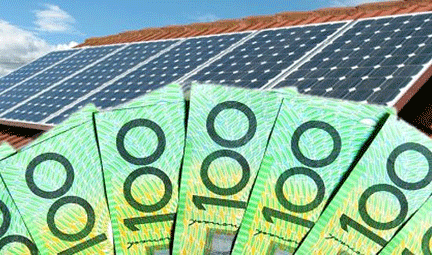
ANALYSIS from the Australian Conservation Foundation has found for just one-fifth of the Coalition’s nuclear price tag, the government could install rooftop solar on every house in the country that doesn’t already have it.*
And for less than half (42%) of the $331 billion, the government could also install a battery system on every Australian house that doesn’t already have one.
“For just a fraction of what the Coalition says its nuclear ideas will cost, the government could pay for the installation of rooftop solar on every house in Australia, saving households $1,300 a year and generating clean, sustainable energy to power our homes far sooner,” ACF CEO Kelly O’Shanassy said.
“The CSIRO’s GenCost work and multiple independent analyses consistently rank nuclear as Australia’s most expensive energy option.
“The Coalition’s assumptions defy lived experience of the nuclear industry overseas, where nuclear projects routinely run over time and over budget, leaving taxpayers to pick up the tab.
“In the unlikely event the Coalition’s nuclear ideas ever go ahead, we would be waiting at least 20 years for the reactors. That is far too slow to be an effective response to the climate crisis, which is affecting Australians right here, right now. We don’t have two decades to waste.
“Instead of nuclear, Australia’s energy sector is investing heavily in renewable technologies, which already supply 40 per cent of Australia’s electricity.
“The Coalition’s plan is full of holes. It lacks fundamental detail on reactor types, the proportion of nuclear slated for the national grid, as well as site preparation, assessment, licencing and regulatory costs.
“Today’s announcement conveniently ignores the massive costs and risks that come with storing this highly toxic material for thousands of years. The renewables transition is already powering ahead. We don’t need this nuclear distraction. Australia’s energy future is renewable, not radioactive.”
* ACF’s analysis shows the cost of installing solar PV systems on the 6.9 million Australian dwellings that don’t already have solar would be around $63 billion. Calculations based on the average installation cost for a 10kw solar system, at $9,120 in NSW and average battery installation costs at $13,000 (AGL). Does not include inverter costs.
Power, control and symbolic masculinity: How Freud might diagnose the pro nuclear lobby
ReNewEconomy, Giles Parkinson, Dec 19, 2024
When faced with arguments for nuclear power in Australia, many in the energy industry scratch their heads and wonder where they are coming from – the fossil fuel lobby, political ideology and other vested interests are often cited as the reasons, along with a hatred of renewables.
On close inspection, nuclear – at least in Australia – makes no sense on an economic, climate or even grid engineering and management perspective.
But maybe the problem runs deeper than that. John Poljak, a founder at Keynumbers and something of a data nerd (it appears) pondered the question and decided to ask ChatGPT for an answer.
“Australia’s nuclear debate is as polarising as it gets, with two starkly opposed camps,” Poljak writes on LinkedIn. “Let’s be honest – facts alone aren’t likely to sway minds here. So why not take a different approach and explore the deeper psychological forces at play?
So he asked ChatGPT why people might prefer nuclear over renewables.
“For a balanced perspective, I’ve also asked ChatGPT to explore the reverse scenario: Why might the ‘patient’ prefer renewables over nuclear? The answer might surprise you!”
Or, may be – if you have met some nuclear boosters – the answer won’t surprise you at all. We decided we couldn’t do any better than simply reprint the answers, as published on LinkedIn by Poljak.
See what you think. Despite the positive prognosis, we’re not convinced the pro-nuclear lobby is going to sign up for the recommended treatment.
Oh, and if you are interested in pursuing the issue further, here is another musical perspective on the Coalition nuclear proposal, from a group that call themselves the NEMChat Singers, Stake it on the Atom.
The subject group demonstrates a pronounced preference for nuclear energy over cheaper renewable alternatives. From a Freudian psychoanalytic perspective, this preference may be interpreted as stemming from underlying unconscious drives, particularly those related to power, control, and symbolic masculinity.
- The Symbolism of Nuclear Power: Nuclear energy serves as a potent phallic symbol – a technological manifestation of potency, authority, and industrial mastery. The size, complexity, and centralization of nuclear facilities mirror the patriarchal ideals of dominance, precision, and order. For individuals navigating the existential anxieties of middle age – such as waning virility, diminishing career dominance, and an encroaching sense of societal irrelevance – nuclear power provides an unconscious projection of strength and continuity.
Fear of Fragmentation (Dispersed Renewables): Renewable energy, particularly solar and wind, is decentralized, diffuse, and perceived as inherently “feminine” in its relationship to nature, fluidity, and “soft power.” To the Freudian psyche, this challenges the hierarchical, centralized models of energy production that resonate with a paternal superego. Renewables may unconsciously symbolize a loss of control and traditional authority, evoking latent anxieties about societal shifts away from rigid masculinity.
- Latency of Childhood Influences: Many members of this cohort were raised during the Cold War era when nuclear technology was framed as an apex of human achievement. Early life exposure to narratives of nuclear power as an emblem of progress and invincibility may resurface as repressed nostalgic idealization, leading to its advocacy in adulthood.
Treatment Recommendation
- Confrontation of Symbolic Associations: A structured exploration of the symbolic meanings attributed to nuclear versus renewable energy may help subjects recognize their emotional attachments. Psychoeducation regarding the symbolic neutrality of energy sources could loosen the phallic projections onto nuclear power.
Embrace of Decentralized Power Structures: Group therapy focused on reimagining control and security within decentralized systems (e.g., community-owned solar power) could facilitate emotional acclimatization to renewables. Subjects may benefit from recognizing renewable energy as a cooperative expression of resilience rather than a threat to hierarchical order.
- Midlife Reorientation Therapy: Addressing unconscious fears surrounding aging and obsolescence through therapy targeting generativity (Erikson’s stage of psychosocial development) can channel these drives into productive societal advocacy. Renewable energy can be framed as a forward-looking, legacy-building effort rather than a diminishment of traditional ideals.
Prognosis
With appropriate intervention, prognosis is favorable. By fostering awareness of the unconscious biases at play, subjects can transition from rigidly defending nuclear power as a symbolic “bulwark” to embracing renewables as an adaptive, generative solution for the future. Such a shift may alleviate underlying anxieties, promoting psychological reconciliation between their self-image and societal change…………………………………………………………………………………………………………………………….. more https://reneweconomy.com.au/power-control-and-symbolic-masculinity-how-freud-might-diagnose-the-pro-nuclear-lobby/
Dutton’s nuclear plan a “con job” and a recipe for blackouts, says Bowen

Giles Parkinson, Dec 19, 2024, https://reneweconomy.com.au/duttons-nuclear-plan-a-con-job-and-a-recipe-for-blackouts-says-bowen/
Federal energy and climate minister Chris Bowen has lambasted the federal Coalition’s nuclear power plans, describing them as a recipe for blackouts and a “con job”, and has expressed astonishment at Peter Dutton’s assumption of a grid that will use 40 per cent less power than forecast.
Dutton’s nuclear costings – revealed last Friday – and some of its major assumptions have been widely dismissed, even mocked, by the energy industry, although the proposal has garnered support from some with strong connections to the fossil fuel industry.
The reason for that is the Coalition’s focus on extending the life of the country’s ageing coal fired power generators, increasing the dependence on gas, and the implications for renewables, which will largely be stopped in their tracks, and climate targets, which will be ripped up and ignored.
The Coalition says it can get the first nuclear power plant running by the mid 2030s – a target most in the industry find laughable. But its own modelling confirms that most of the planned 14 GW will not be delivered until the mid 2040s, which means it must run ageing coal generators for another two decades.
“This is a recipe for blackouts and unreliability,” Bowen says in the latest episode of Renew Economy’s weekly Energy Insiders podcast. “Sweating the coal assets for longer, I mean, these coal fired power stations are not getting younger. None of us are.
“Just this week, we’ve had 3.4 gigawatts of coal out in the NEM (National Electricity Market, the main grid) and three gigawatts of that was unplanned, ie breakdowns, unexpected breakdowns, three gigawatts out this week.
“Now, the grid’s coped okay, even though it’s been very hot, but you’d still rather not have three gigawatts out, and that’s only going to get worse the longer you rely on coal.”
Indeed, the Australian Energy Market Operator has made it abundantly clear, and even the coal plant owners agree, that the biggest threat to reliability on the grid is the unplanned and sudden losses of big fossil fuel generators, particularly coal.
Over the last two weeks, AEMO has managed the heatwaves and the multiple outages and has turned to more demand and supply flexibility to help manage the situation, including putting several big batteries on standby – a protocol it is now using when the grid faces demand highs, and demand lows.
It is this focus on flexibility that is undermining the case for existing, let alone new even larger “always on” baseload power stations.
Many analysts say there is simply not enough room in the grid. In a submission released this week, Tesla said there was room for barely 1 GW of “baseload” without severe curtailment of household solar.
The Coalition, however, says it is determined to power on, but its costings have also come under heavy criticism – both on the assumed price and timeline of building new nuclear from a standing start, but also its assumption that electricity demand would fall more than 40 per cent below forecasts.
In the energy world, it is generally assumed that less primary energy will be used in an electrified world. But that’s because inefficient fossil fuel engines and generators (in cars, homes and on the grid) are replaced by more efficient inverter based technologies – wind, solar and battery storage.
That means less energy is needed overall (because around two thirds of energy from fossil fuels is lost as waste heat), but more electricity will produced on the world’s grids. The Coalition modelling shuts its eyes to that evolution, and assumes that electrification does not happen and fossil fuels are still burned in huge quantities.
“I spent a fair bit of time thinking about how they (the Coalition) might try and make nuclear look cheaper, and I’ve got a confession to make,” Bowen tells Energy Insiders.
“Not in my wildest dreams did I suspect that they would just assume we need less electricity. So they’ve said we’re going to need 40% less electricity than AEMO’s Step Change scenario.
“And guess what? Who knew if you make 40% less electricity, it’s roughly 40% cheaper. I mean, who would have figured? I mean, what a con job. We all know that nuclear is the most expensive. They had to find a way of pretending it isn’t.”
On Labor’s own policies, Bowen says that the Capacity Investment Scheme, which released the winners of the first major generation tender last week, is working better than expected, with 6.4 GW of capacity awarded rather than the planned 6 GW, and all representing new projects that have not begun construction.
“It’s working better than I thought it would,” Bowen says.
“And that’s a very encouraging thing. The value and the quality of the projects we’re having coming forward means that we can award more than we were intending.
“No, I won’t be giving tenderers an opportunity to know what our reserve price is. That’s not how an auction works, but (the result) meant that I could also announce for the next round that we’re going to target, in effect, 10 gigawatts, four gigawatts of dispatchable and six gigawatts of generation for tenders three and four.
“That’s huge, and that really means that those projects will get into the planning system faster and the emos connection process faster and help us get to our target.
“The only disappointing thing about this round, from my point of view, was the lack of projects that we could award in Tasmania.
“I want to see more Tasmanian projects come forward, and … we have provided feedback to Tasmanian bidders about that …. we’ve got to ensure that we might get more Tasmanian projects into the future.”
However, Bowen says there is more to do, and he is hopeful – should Labor be re-elected and he remains in the portfolio – to make more reforms.
“We’ve made good progress in the first three years, but not yet good enough, in my view, and you really need a good long stretch in a job like this to, you know, bed down the reforms and make them work properly, and keep the momentum growing going and and learn as you go,” he says.
“Obviously, you know, you just get, you just get more proficient on things like the CIS, etc, as you build the experience collectively in the department.
“I would say the next term … should we get one, as I hope and expect we will, is that it’s a combination of consolidation, so a whole bunch of things that are well underway just need to be bedded down and consolidated, including the CIS, including the new vehicle efficiency standards that … have been in the too hard basket for so long, but don’t actually come in until the first of January.
“So they haven’t had any impact yet, to be honest, but they will. Same with the safeguards reforms, again, big and huge and difficult to do, but it has got to be bedded down and continued with and so there’s so much at stake.
“And then there’s the what’s next? And of course, we’ll go through the process of the 2035 target, the climate change authority advice to sector plans. All that process is underway, but I really see it now as a bit of a continuum.
“Having made good progress in the first two and a half to three years, got to build on it, bed it down, continue it. And it’s just unthinkable to me that we would, you know, having made this good progress, then stop, rip some of it up and go backwards, as the alternative would suggest.”
To hear more from Bowen on those plans and more, you can listen to the full episode here once its published later today.
1 This month
15 April – Zoom –Nuclear Power is Not the Solution
Apr 15, 2026 01:00 AM in Canberra, Melbourne, Sydney

Join the International Physicians for the Prevention of Nuclear War (IPPNW) on Tuesday, April 14th for a timely webinar exploring the risks associated with nuclear power and challenging the myth that it offers a simple, safe, carbon-free solution to the climate crisis

of the week – Australians for War Powers Reform (AWPR)
To see nuclear-related stories in greater depth and intensity
 Antinuclear