AI goes nuclear
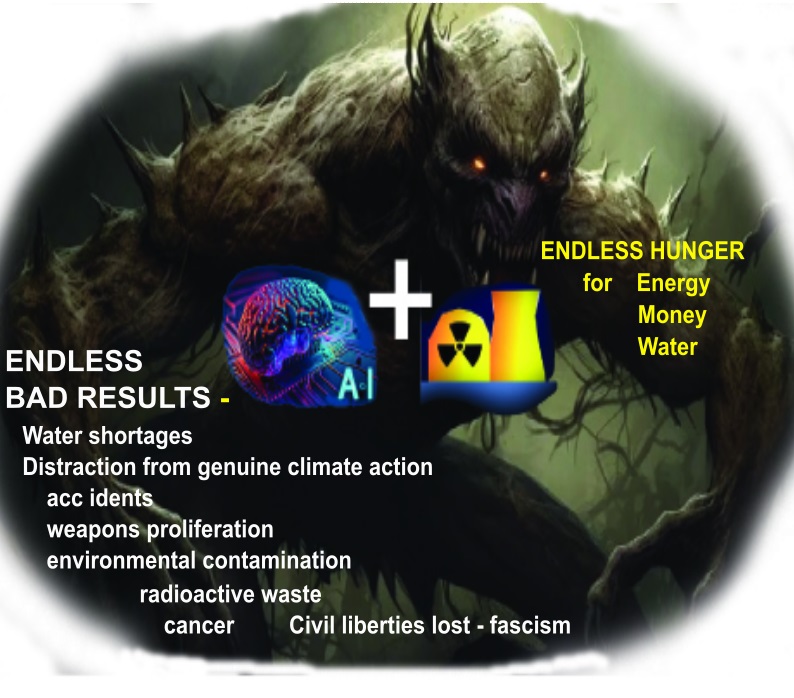
Big tech is turning to old reactors (and planning new ones) to power the energy-hungry data centers that artificial intelligence systems need. The downsides of nuclear power—including the potential for nuclear weapons proliferation—have been minimized or simply ignored.
Bulletin, By Dawn Stover, December 19, 2024
When Microsoft bought a 407-acre pumpkin farm in Mount Pleasant, Wisconsin, it wasn’t to grow Halloween jack-o’-lanterns. Microsoft is growing data centers—networked computer servers that store, retrieve, and process information. And those data centers have a growing appetite for electricity.
Microsoft paid a whopping $76 million for the pumpkin farm, which was assessed at a value of about $600,000. The company, which has since bought other nearby properties to expand its footprint to two square miles, says it will spend $3.3 billion to build its 2-million-square-foot Wisconsin data center and equip it with the specialized computer processors used for artificial intelligence (AI).
Microsoft and OpenAI, maker of the ChatGPT bot, have talked about building a linked network of five data centers—the Wisconsin facility plus four others in California, Texas, Virginia, and Brazil. Together they would constitute a massive supercomputer, dubbed Stargate, that could ultimately cost more than $100 billion and require five gigawatts of electricity, or the equivalent of the output of five average-size nuclear power plants.
Microsoft, Amazon, Apple, Google, Meta, and other major tech companies are investing heavily in data centers, particularly “hyperscale” data centers that are not only massive in size but also in their processing capabilities for data-intensive tasks such as generating AI responses. A single hyperscale data center can consume as much electricity as tens or hundreds of thousands of homes, and there are already hundreds of these centers in the United States, plus thousands of smaller data centers.
In just the past year, US electric utilities have nearly doubled their estimates of how much electricity they’ll need in another five years. Electric vehicles, cryptocurrency, and a resurgence of American manufacturing are sucking up a lot of electrons, but AI is growing faster and is driving the rapid expansion of data centers. A recent report by the global investment bank Goldman Sachs forecasts that data centers will consume about 8 percent of all US electricity in 2030, up from about 3 percent today
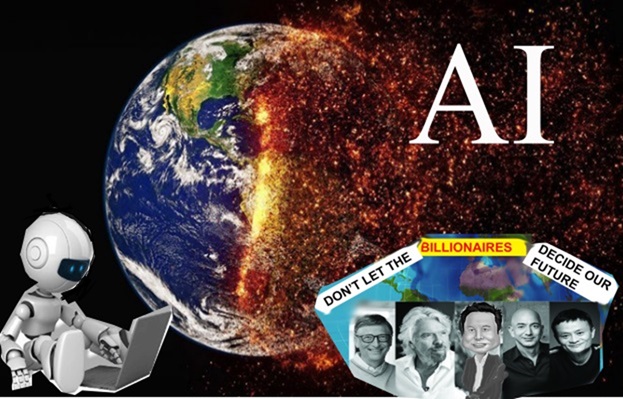
Bill Gates, Jeff Bezos, Elon Musk, Mark Zuckerberg, Larry Ellison, and other so-called “tech bros” who also happen to be among the world’s richest men have thought about how the energy industry can—or must, in their view—keep pace with AI’s rapid growth while also enabling Big Tech to meet its climate commitments. They have all come to the same conclusion: Nuclear energy, whatever it costs, is the only viable solution.
In a rash of recent announcements, Big Tech companies have declared that they will either be reviving existing nuclear power plants, developing next-generation nuclear reactors, or both. Dollars are also flowing to nuclear fusion projects—even though many physicists think commercial fusion power plants that generate electricity are at least decades in the future, if they ever can be built. The federal government is not only supporting this nuclear-powered vision but also subsidizing it in the name of “clean energy.” However, both the government and the tech industry are largely ignoring the known and significant downsides of nuclear power—including high costs, long construction times, accidents, nuclear weapons proliferation risks, and environmental contamination from uranium mining and radioactive waste disposal.
Betting on nuclear. Again.

In Pennsylvania, Microsoft has plans to revive Three Mile Island. For people old enough to remember that name, it’s synonymous with the demise of nuclear power in the United States. Forty-five years ago, a partial reactor meltdown at the Three Mile Island nuclear power plant 10 miles south of Harrisburg, Pennsylvania, gripped the nation and exposed nearly two million people to radiation. It was the worst accident in the history of the US commercial nuclear power industry.
The failed reactor never operated again, but a similar reactor built on the same island in the Susquehanna River was restarted six years after the accident and later received a license extension until 2034. That reactor was shut down in 2019 after its owner, Constellation Energy, was unable to secure subsidies from the state of Pennsylvania and deemed the reactor a financial albatross. Now, however, Constellation plans to reopen the reactor and sell 100 percent of the electricity that will be generated by it—enough to power 800,000 homes—to Microsoft………………………………………………………………………………………………..
The sudden interest in nuclear energy is largely due to AI, which is rapidly transforming the tech industry. Electric utilities are forecasting the nation will need the equivalent of 34 new, full-size nuclear power plants over the next five years to meet power requirements that are rising sharply after several decades of falling or flat demand.
Microsoft, Amazon, and other tech giants are not interested only in reviving existing nuclear plants. They are also funding the development of next-generation nuclear reactors. ……………………………………………………………….
Counting “compute”
Globally, electricity demand is also soaring and is now expected to be 6 percent higher in 2035 than the International Energy Agency forecast just a year ago. Electricity consumption by data centers, of which there are already 11,000 worldwide, could reach more than 1 million gigawatt-hours in 2027—about as much total electricity as Japan now uses annually, according to a recent analysis by the agency……………………………………………………………………………………………………………..
An analysis done by OpenAI in 2018 found that the amount of “compute” required to train the largest AI models was doubling every three to four months. An analysis of more recent models reports that the training requirements multiplied by four to five times annually during the past four years………………………………………………………………..
Based solely on current trends, power consumption at US data centers is projected to grow by about 10 percent annually between now and 2030. By one estimate, the exponential growth of AI could consume nearly all the world’s energy production by 2050……………………………………………
In the meantime, data centers are being built faster than energy capacity is expanding. The rapid growth of this sector has not been adequately figured into climate models and is rarely mentioned as a safety concern about AI. In the March 2023 “pause” letter that called on AI labs to stop training the most powerful AI systems for at least six months, tech experts expressed concern about losing jobs—or even control of civilization—but not about climate impacts.
The AI boom is heavily dependent on power-hungry graphics processing units,…………………………………………………………………………………………………………………………………………………………………..
A dirty secret
Whether it’s chip manufacturing or bot training and chatting, where will the energy for AI activity come from? Big tech companies have been prominent in efforts to move toward a carbon-free economy. But with the rise of AI, tech-related emissions are going up.
…………………………………………………… the AI boom has pushed climate goals aside. Microsoft’s emissions, for example, are up by 30 percent since 2020. Google’s emissions have risen by almost 50 percent over the past five years. “As we further integrate AI into our products, reducing emissions may be challenging due to increasing energy demands from the greater intensity of AI compute, and the emissions associated with the expected increases in our technical infrastructure investment,” Google acknowledged in its 2024 environmental report.
………………………………………………………………………………………………………… there is no solid evidence that AI can deliver a quick fix for the climate crisis. In fact, AI is also helping the oil and gas industry increase production of fossil fuels. In Guyana, for example, ExxonMobil is using AI “to determine the ideal parameters for drilling” in deep water. For now, at least, AI’s massive environmental footprint is more of a climate problem than a solution.
Is this the “nuclear renaissance”?
As AI’s energy demands grow more intense, and it becomes increasingly clear that the expansion of wind and solar power cannot keep pace, tech leaders have set their sights on nuclear energy.
So nuclear hype has flowed like champagne at a wedding reception.

Proponents of nuclear power have been predicting a “nuclear renaissance” for nearly a quarter-century. But nuclear has never been cost-competitive with other energy sources, and that is unlikely to change anytime soon. The US Energy Information Administration’s Annual Energy Outlook 2023 projected that renewable power would continue to outcompete nuclear, even in scenarios that predict aggressive cost declines for nuclear.
The Biden administration embraced subsidies to keep existing nuclear power plants online and reopen closed ones—for example, a $1.52 billion loan guarantee from the Energy Department is what made it possible for the owner of the shuttered Palisades nuclear plant to announce plans for a reopening. “In 2022, utilities were shutting down nuclear reactors; in 2024, they are extending reactor operations to 80 years, planning to uprate capacity, and restarting formerly closed reactors,” the Energy Department approvingly noted in a report released at the end of Climate Week NYC in late September.
The White House also recently offered $900 million in new funding for small reactors. In its initiative for AI, the Energy Department waves vaguely at plans to “unlock new clean energy sources, optimize energy production, and improve grid resilience.”

“We’re looking at a chance to build new nuclear at a scale not seen since the ‘70s and ‘80s,” Secretary of Energy Jennifer Granholm said at the opening plenary of the American Nuclear Society annual conference in June.
The Energy Department sees potential for a “commercial liftoff” that could triple US nuclear capacity by 2050 and puts a positive spin on AI’s role in boosting nuclear: “AI and data center load growth is aligning the fundamentals for new nuclear with requirements for 24/7 power, valuing decarbonization, and investment in new generation assets.”
Despite this federal support, the nuclear renaissance so far lacks an order book for new nuclear plants that are actually being constructed. What it does have, as noted in the White House’s “liftoff” report, is “a set of customers who are willing and able to support investment in new nuclear generation assets.” Namely, big tech companies that can afford to pay big electricity bills…………………..
Although tech titans currently have ample funds to invest in energy, the cost curve for AI is going up. The expense of powering chatbots is already climbing so fast that companies are holding back their newest versions from the public.
Existing nuclear power can’t satisfy the demand for energy that is not only more abundant but also cheaper. “We still don’t appreciate the energy needs of this [AI] technology,” lamented OpenAI CEO Sam Altman at the World Economic Forum in Davos in January. “There’s no way to get there without a breakthrough.” Altman, who has warned that AI’s “compute costs are eye-watering,” called for increased investment in nuclear fusion as well as fission.
The fission (and fusion) frenzy
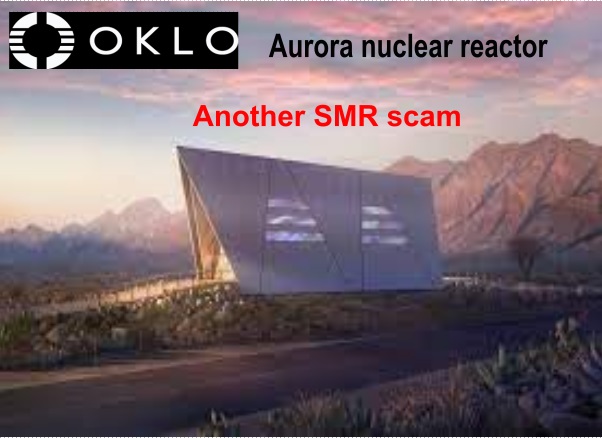
In addition to OpenAI, Altman also chairs Oklo, a nuclear power startup that went public last year when it merged with a special purpose acquisitions company that Altman also chairs. Oklo plans to build its first liquid metal-cooled sodium fast reactor at Idaho National Laboratory in 2027. However, the company’s initial application for a license was denied—for lack of information—by the Nuclear Regulatory Commission in January 2022 and has not yet been re-submitted.
In August 2023, the Pentagon announced an “intent to award” a contract to Oklo for a small modular reactor at an Air Force base in Alaska. However, the deal was quietly revoked a month later.
Despite setbacks like these, Altman sees the future of nuclear energy and AI as inextricably linked. “I don’t see a way for us to get there without nuclear,” he told CNBC last year.
Retired Microsoft co-founder Bill Gates is not as worried about AI’s energy demands as Altman is, but he too is bullish on nuclear energy. Among his multiple investments in nuclear startups is a company called TerraPower, which has received funding from the Energy Department and Los Alamos National Laboratory to develop a sodium-cooled fast reactor similar to Oklo’s.
Gates has invested more than $1 billion in a TerraPower plant that broke ground in Kemmerer, Wyoming, in June. TerraPower says the reactor will be operational by 2030. But construction of the plant’s Natrium reactor has not yet begun, nor has it been approved by the Nuclear Regulatory Commission (NRC), which is still conducting safety and environmental reviews.
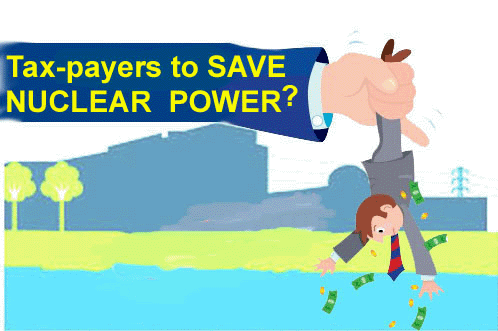
Gates issued a celebratory announcement calling the science behind the reactor “super cool.” Not mentioned in the announcement is the estimated price for the 345-megawatt reactor: $4 billion, of which the federal government is contributing half. Even if the project comes in on budget (which would make it exceptional among US nuclear reactors of the past several decades), it will be more expensive than comparable gas or renewable projects.
Microsoft and Google are also placing bets on nuclear. Earlier this year, Microsoft hired a director of nuclear technologies and a director of nuclear development acceleration to lead the company’s strategy for powering AI advances with small, onsite nuclear reactors—as well as buying energy from larger conventional reactors such as Three Mile Island. Microsoft, which has invested $13 billion in OpenAI and owns almost half of its equity, plans to use AI to expedite the process of getting nuclear plants approved and has been training an AI model on regulatory and licensing documents.
Google last month signed an agreement to buy a total of 500 megawatts of generating capacity—about half the output of a conventional nuclear reactor—from six to seven Hermes small modular reactors designed by Kairos Power. Google aims to deploy the reactors next to Google data centers by 2030. This past summer, Kairos broke ground on an NRC-permitted demonstration reactor in Oak Ridge, Tennessee. It was the first non-water-cooled US reactor approved for construction in more than 50 years.
Michael Terrell, senior director for energy and climate at Google, said the agreement with Kairos could help the company support AI technologies and “reliably meet electricity demands with carbon-free energy every hour of every day.”

Wealthy tech companies and individuals are investing in nuclear fusion as well as fission. Peter Thiel, who co-founded PayPal and was the first outside investor in Facebook, joined Altman in backing a fusion startup called Helion, which claims it will begin producing electricity from its first commercial reactor by 2028 and will sell it to Microsoft.
Breakthrough Energy Ventures, a venture capital firm founded by Bill Gates, has invested in Helion and three other fusion startups. One of those ventures, an MIT spinoff company called Commonwealth Fusion Systems, is also backed by Amazon CEO Jeff Bezos and has received $1.8 billion in second-round venture capital. Commonwealth announced earlier this week that it has leased land to build a commercial-scale fusion power plant in Virginia, but the company has not yet secured any permits or customers.
Critics such as Daniel Jassby, the former principal research physicist at the Princeton Plasma Physics Lab, have called the excitement surrounding these fusion projects “over-the-top and unjustified.”………………………………………………………………………………………
The downsides of nuclear
Despite massive infusions of money from corporations, billionaires, and governments, nuclear is not a sure bet. Around the world, large reactors have repeatedly come in over budget and behind schedule, and although they require lower initial capital investment, smaller reactors are likely to be even less economic than the larger ones that now exist, in terms of the cost of the electricity they produce.
“Very few of the proposed SMRs have been demonstrated, and none are commercially available, let alone licensed by a nuclear regulator,” wrote Allison Macfarlane, who chaired the NRC a decade ago and now directs the School of Public Policy and Global Affairs at the University of British Columbia, in an essay published last year by IAI News.The only SMR reactor design certified by the NRC is the NuScale Power reactor, which received more than $200 million in federal support and was slated to be built at the Idaho National Laboratory. But the projected cost of building the reactor ballooned between 2020 and 2023; its only committed utility customer dropped out, and the project was canceled a year ago.
The only new nuclear reactors that have been built in the United States in the past 30 years are Vogtle Units 3 and 4 in Georgia. These Westinghouse AP1000 pressurized water reactors were the nation’s first “advanced” reactors, but they ended up costing $35 billion (more than twice as much as originally projected) and were completed seven years behind schedule.
There are more than 50 designs for new reactors, and the tech giants investing in nuclear do not seem to be working toward a standardized design—something that many nuclear experts recommend as the best way to get plants approved and built quickly and affordably.
Cost and time are not the only obstacles that must be overcome if nuclear is to meet the AI-energy problem. The work force needed to build a host of nuclear projects has dwindled as plants have closed and not been replaced. Also, none of the proposed new projects has included any new ideas for what to do about the radioactive waste generated not only by reactors by also by uranium mining. There is still no permanent repository for long-lived radioactive waste in the United States.
Radioactive waste isn’t just a disposal problem, either. “Bill Gates should be worried about reprocessing and proliferation,” said Alex Glaser, a nuclear security expert at Princeton University and a member of the Bulletin’s Science and Security Board.
Concepts like the Oklo fast reactor would produce fissile material that bad actors could use to make nuclear weapons. Oklo and other nuclear startups propose to reprocess their waste to keep costs down. But that reprocessing produces plutonium that could be diverted for use in nuclear weapons. The United States rejected reprocessing in the 1970s after determining that the potential for proliferation made it too risky for commercial use.
n all the hype about AI and nuclear, there is scant mention of nuclear weapons proliferation to more countries or the risk that fissile material could be acquired by (or provided to) terrorists. Nor is there much attention to the vast amounts of raw materials and water required for the growth of both AI and nuclear energy, or the electronic waste generated by chip manufacturing and data centers.
A conversation of a few dozen questions with an AI chatbot may require a half-liter of water. A large data center consumes more than a million gallons of water daily, and some data centers are being built in places where water is already scarce.
Developers are loathe to reveal how much water they use, but after a legal battle with an Oregon newspaper, Google finally agreed to reveal that its data centers in The Dalles consume 29 percent of the town’s water supplies. Google plans to build two more data centers there.
No roadmap for “responsible” AI
AI has been compared to electricity—a utility that people soon won’t be able to live without. But there is currently no framework for regulating this new utility, and AI’s energy demands have been given short shrift in the many discussions of AI’s safety risks……………………………………………………………………………………….
Both incoming vice president JD Vance and Elon Musk, who have the president-elect’s ear at the moment, are strongly pro-nuclear. “Broligarchs” Musk and Peter Thiel played significant roles in the recent presidential campaign. Thiel reportedly had a hand in pushing for JD Vance, who had previously worked for him, as Trump’s vice presidential pick…………………….
The tech bros now have a clear path to the unfettered growth of AI and are already pressing Trump to review federal AI policy and weed out laws and regulations that “may be unnecessarily impeding AI adoption.”
Silicon Valley’s AI gold rush aligns almost perfectly with aspirations at Mar-a-Lago, where AI is seen as a must-win race with China. But a second race is also afoot, one in which skyrocketing US electricity demand may outpace supplies, perhaps leading to power outages and utility rate increases of up to 70 percent by 2029.
History suggests nuclear will be a slow starter in that race. https://thebulletin.org/2024/12/ai-goes-nuclear/#:~:text=Big%20tech%20is%20turning%20to,that%20artificial%20intelligence%20systems%20need.
No comments yet.
1 This month
7 April – WEBINAR – Australia and the Doomsday Clock – Preventing nuclear war through NoFirstUse and other policies
Online | Tuesday April 7, 4:00-5:30pm, Australian Eastern Time / 8:00-9:30am Central Europe Time
– Access the registration link
15 April – Zoom –Nuclear Power is Not the Solution
Apr 15, 2026 01:00 AM in Canberra, Melbourne, Sydney

Join the International Physicians for the Prevention of Nuclear War (IPPNW) on Tuesday, April 14th for a timely webinar exploring the risks associated with nuclear power and challenging the myth that it offers a simple, safe, carbon-free solution to the climate crisis

of the week – Australians for War Powers Reform (AWPR)
To see nuclear-related stories in greater depth and intensity
 Antinuclear
Leave a comment